anthropology · children · community · creativity · culture · design · environment · music

In New Documentary “Landfill Harmonic” Music Students Scrape Together their Instruments from Trash

The kids show off their instruments

Making music is a pretty powerful thing. Especially if you’re making it out of recycled objects and keeping things out of landfills.

“Landfill Harmonic,” an upcoming documentary scheduled for release in 2014, tells the story of an orchestra whose musicians play instruments made from trash. The film is set in the town of Cateura, Paraguay, which is built on a landfill. Many of the town’s residents collect trash to recycle and sell for money, and many of the town’s children are susceptible to getting involved with gangs or drugs. A music program was set up to help keep the kids out of trouble, but because so many of them were interested, there was soon a shortage of instruments.

more via In New Documentary, ‘Recycled Orchestra’ Makes Instruments from Trash | Earth911.com.

Music, like play, has been shown to have so many cognitive benefits, and emotional as well (plus even the act of music is called “playing”). There is something very deeply rooted in humanity about playing music, it is wonderful that through ingenuity and creativity these kids can channel their energy into the incredible power of making music. Plus the fact that they’re keeping things out of landfills is just a double bonus!

More information: https://www.facebook.com/landfillharmonicmovie?fref=ts

Kickstarter project: http://www.kickstarter.com/projects/405192963/landfill-harmonic-inspiring-dreams-one-note-at-a-t

anthropology · behavior · community · happiness · health

Americans’ happiness score – latimes.com

Life is good.
Americans are in the top 10 for happy nations. (Photo credit: Wikipedia)

We’re a lot happier as a nation than I was otherwise led to believe. Um, go us?

We’re No. 6! That’s according to new data from the Organization of Economic Cooperation and Development , which on Tuesday released results of a survey measuring quality of life in 36 industrialized nations.

For the last three years, the Paris-based outfit has weighed 11 criteria, including housing, income, jobs, environment, safety and work-life balance. For the third year in a row, Australia was the big winner, thanks in large part to an economy that managed to avoid the global recession of the last decade.

The U.S. hobbled across the finish line in sixth place, behind Sweden, Canada, Norway and Switzerland, which ranked second through fifth, respectively.

more via Daum: Americans’ happiness score – latimes.com.

But seriously (ha ha), I feel like happiness scoring, as subjective as it is, is a good way of measuring our overall health and well being. It also indicates we’re doing okay and getting time in our lives for all the important stuff like family and time to recreate. I like Bhutan’s use of grass national happiness as a major marker for the nation’s well-being (lovely country, BTW, just be prepared for an exciting landing).

architecture · children · community · creativity · design · health

Energy drink maker Red Bull proposes skate-able art investment for Myrtle Edwards Park


The Seattle City Government Parks & Recreation site recently hosted a public meeting to gather input on a proposed public art piece in Myrtle Edwards Park that will be used for skateboarding.

Energy drink maker Red Bull has approached Seattle Parks and Recreation about making a community investment that would include commissioning an artist to design and fabricate a unique piece of skate-able art. At the meeting, Seattle Parks presented the history of the proposed project, followed by an opportunity for the public to weigh in on the idea.

Myrtle Edwards Park is located at 3130 Alaskan Way on the shoreline of Elliott Bay, north of the Olympic Sculpture Park.

The Citywide Skatepark Plan, developed in 2006 and 2007 with extensive public process, designated Myrtle Edwards as a recommended site for a skatedot [editor: which is apparently smaller than a skatepark]. Since 2007, Seattle Parks and Recreation has constructed eight new skate parks and skatedots. Two more are in construction and design.

4Culture is administering the Call for Artists associated with this project. The artist will coordinate the design with Seattle Parks and Recreation.

A second follow-up meeting is planned in June.

I love the idea of creating public art that is actually usable, whether it’s by skaters, kids, or even animals. I understand that some art is best appreciated by not messing with it, but especially in a public space sometimes it’s hard to not want to interact with sculptures or murals. I also appreciate Red Bull’s focus on supporting play in all its forms, although private sponsorship of public spaces is always a touchy, tricky gray area.

Is there a public art piece, or artistic skatedot, fountain, whatever, that you really enjoy sitting on, playing on, or just watching others play? Let me know about it in the comments below.

architecture · behavior · community · environment · health · play · Social

Competition: Create Your City’s Next Great PLAYscape

Yes! Seattle had a similar competition a couple of years ago, more focused on art but in a similar vein. Unfortunately not much came of the competition, so I would LOVE to see the results of this competition. Hooray for Playscapes!

Unknown's avatar

Yes! Seattle had a similar competition a couple of years ago, more focused on art but in a similar vein. Unfortunately not much came of the competition, so I would LOVE to see the results of this competition. Hooray for Playscapes!

View original post

community · creativity · environment · play · Social

99 Tiny Games Project in London Brings Play to the Streeets

Sometimes we just need a little spark to get us to play.

In 2012, Hide&Seek installed 99 tiny games around London:

http://hideandseek.net/projects/99-tiny-games/

Tiny Games began life at the Southbank Centre in 2011 and are a collection of very small, very quick-to-understand games. They sit in the real world, inviting participation from any interested passer-by. Their rules can be summarised in just a couple of sentences.

In the spirit of the “big” games in London this summer, Hide & Seek created 99 wee-tiny games and stuck them all over the city, transforming buildings, sidewalks, tube stations and more into impromptu game sites. The rules are all quick and simple and each game takes almost no time to play – anyone can play, anytime they want. Players will be tested on everything from wits to creativity to cooperation to determination, all within immediate reach of their home, workplace, or favorite pub.

It’s great to watch the Olympians do what they do best and admire their near-superhuman abilities, but it’s also important to bring this spirit of competition and fun to non-superhumans like us. We bet that if everyone stopped to play even for just a few minutes everyday the world would undoubtedly be a better place. 99 Tiny Games serves as a reminder to everyone to always be playful, no matter where you are.

In the past year, the team has since created a Kickstarter to try and get an app built so you can find fun games wherever you go. Hooray for using technology to create playful spaces wherever you are! Unfortunately it only looks like it’s available in the UK market, but it’s great inspiration to look for play wherever you go.

community · creativity · environment · music

Want to support music? Support green space and parks!

OK, maybe that’s overstating it a bit, but that’s the headline/thesis that Grist Editor Jess Zimmerman proposes in his short article about Seattle rapper Macklemore, and I gotta admit I like his thinking…

In this video for the Nature Conservancy, rapper Macklemore explains how municipal green space in his home city of Seattle influenced his career: He and his friends didn’t want to kick it at their parents’ houses, so they went and freestyled in parks. (Side note: Do people really still say “kick it,” or is Macklemore even older than I am?) We knew, of course, that Macklemore was into creative reuse, but who knew he had so many ideas about urban infrastructure?

The moral here is clear: Want more rappers? Make more parks. It’s just science.

I also love the fact that a hip hop artist is “kicking it” with the Nature Conservancy.

Do you know of any other artists who got their start playing in parks, beaches, or other urban green spaces? Leave your thoughts in the comments below.

community · culture · environment · happiness · health

Parks, bikeways, other natural playful landscapes are good for the economy

English: Ritner Creek Covered Bridge near Pede...
Ritner Creek Covered Bridge near Pedee, Oregon, used as a rest stop during the Watermelon Rides organized by the Salem Bicycle Club (Photo credit: Wikipedia)

Happy Friday. I hope you get a chance to go outside this weekend. Not just because it’s good for you, but because it also helps the economy. No really, at least according to one study, and anecdotally, Oregon is seeing  ahuge economic benefit by encouraging outdoor recreation, specifically bikeways and bike tourism:

During a special hearing on bicycle tourism at the House Transportation and Economic Development Committee in Salem, OR, on May 9th, representatives from Travel Oregon released a major new report on the economic impact of bicycle-related travel. The Travel Oregon study, The Economic Significance of Bicycle-Related Travel in Oregon Detailed State and Travel Region Estimates, 2012 (PDF), looked at bike tourism’s impact throughout the state during 2012. The big number — which garnered a headline in The Oregonian and has been adjusted up since our story in March — is $400 million. That’s how much people “involved in bicycle-related activities” spent in Oregon last year.

One key reason for the ascension of bike tourism in Oregon are initiatives like the nation’s first State Scenic Bikeway program.

The Oregon Parks and Recreation Department named two new Scenic Bikeways that same day. They’ve got the right idea about increasing revenue by making their state fun to hang out in!

You can read more about the economic impacts, but it’s so far a pretty effective strategy to promote tourism.

architecture · community · culture · happiness · work

Does Not Having an Office Make You a Happier Worker?

Office Space
Office Space (Photo credit: steve-and-diane)

I read an article yesterday about “the next big thing” in office space. According to Uday Dandavate, the CEO of SonicRim, the next “megatrend” is going to be no office space:

Large working complexes will be pyramids for dead people. I’m not making a judgment. I am just observing. They are fading symbols of an era that is soon going to be a bygone era.The ideal environment is where people don’t have to go to a workplace. The workplace is distributed in the community.
Companies won’t be building offices; they will be building communities and nice places to work in those communities. It’s a fallacy that people want to stay at home to work. In a given moment they want to work where they would be most productive, or relaxed, in the kind of mindset they need to be in. We need to get away from constructing buildings that have flexibility to creating work environments that can evolve.

There needs to be a complex assessment of different moments at work. Recently we finished a global study on auto interiors for Johnson Controls. When you sit inside your car there are different moments that have different states of mind, going to work or coming home. Sometimes people want to feel their car is their home. At times people want the car to feel like a workplace. Take the same concept and apply it to architecture and work places. For any productive activity, not just working but cooking, reading, writing a letter, there is always a most conducive environment.

More at: The Registry SF

While Dandavate believes that the workers will be dispersed throughout the community, I’m not sure I entirely buy the idea that the central office space or main corporate headquarters is going to disappear. The emphasis on having everyone in one space my diminish, but there are a lot of reasons why having a central space sanctioned as “for work” is important.
To name a few:

  • Working parents who need a space away from family distractions, like screaming children and biting puppies. Or heck, noisy roommates for that matter.
  • People for whom going to the local library or coffee shop every day. This isn’t an option for a lot of people, even those living in big cities.
  • People who work very collaboratively and need real-time input, and face time in order to accomplish their work.
  • People who need more space to work than the kitchen table or their tiny apartment walls can provide.
  • Those who just need the peer pressure of others working around them to push through a hard deadline.
  • Extraverts!

Dandavate mentions a sense of identity for workers with the company that doesn’t require a tangible, geographical locale. I agree with his assessment that people don’t need a geographic place to congregate at to form a bond with coworkers or identify with a company, but they sure want one. Microsoft has a huge annual gathering of its employees in or near their homebase in Redmond, that most employees working from afar get really excited about. Traceurs (people who train parkour) will make pilgrimages to a small park outside of Paris simply because one of the sport’s founders filmed a video there. Elvis fans have Graceland.

Workers are also becoming more vocal about work vs. home life, and for many it is unappealing to have your work at home or not be able to leave it somewhere else (even places like Office Nomads you have to bring most of your stuff home with you).

Maybe I’m totally off-base, but while I think the workplace will become more flexible, we will always have the “homebase/headquarters” office buildings.
Disagree? Leave your thoughts in the comments below.

anthropology · architecture · behavior · community

Parkour and Preserving Playful Spaces

People who practice parkour, called traceurs or tracers, often get a bad rap by city officials, saying they are disturbing or damaging public property. But in fact, often traceurs are some of the most vocal activists for preserving and protecting their environments. Take this story from The Atlantic, for example:

On warm days, when office-tower émigrés can enjoy their lunches next to its calming water features, Calgary’s Century Gardens Park serves as a popular daytime downtown retreat.

But at 38 years-old, the Brutalist public space is starting to show its age. The color of its odd concrete features has faded to a dreary ash, the foliage is overgrown, and the water pumps are failing. Angular slabs create both barriers to pedestrian access and places for miscreants to hide—city park staff complain of finding evidence of overnight drinking and drug use.

The city is itching to overhaul Century Gardens, though how much of the park might survive the process remains to be seen. Early proposals range from sprucing up the existing park and keeping it mostly intact to completely razing it and building a new park from scratch. The park’s age and need for refurbishment has given the city the opportunity to address its magnetism for social disorder, as well as apply a more contemporary approach to urban design.In the meantime Calgary’s parkour community—for whom the park’s structures are perfectly suited—have allied themselves with a local heritage group to try to save it.”Century Gardens is one of the coolest locations around for parkour. Not just in Calgary, but Canada-wide, and internationally,” says Steve Nagy, editor of the Calgary-based parkour magazine Breathe and co-owner of a local parkour gym. The Netherlands-based MunkiMotion parkour group also included it in their YouTube series, “Best Parkour Spots in the World”

more via The Calgary Park Thats United Historic Preservationists and Parkour Athletes – Brandon Beasley – The Atlantic Cities.

This group of traceurs is banding together with a preservationist group in Calgary to save the park. It’s a great example of two seemingly incompatible groups joining forces to preserve an urban space.

I think this kind of collaboration can and should be done more often.

In many peoples’ eyes these older parks, structures, or abandoned lots are just seen as wasted space, or maybe even dangerous, and certainly many old playgrounds don’t meet current safety codes. But for traceurs, or any adults that likes to climb or jump around, these spaces offer endless playful opportunities. I believe traceurs are some of the best urban playground spotters, and they know a good playground or playful space when they see it. Preserving or adjusting these spaces, rather than tearing them down and starting from scratch, is a viable alternative that can appease all parties involved.

I am glad The Atlantic is looking at this challenge over balancing use of space by different groups in urban environments.

Juliet Vong, President of HBB Landscape Architecture, Tyson Cecka, Executive Director of Parkour Visions, and I proposed a session about this topic for the annual meeting for the American Society of Landscape Architects. Sadly, it was turned down, I believe primarily because we didn’t explain what parkour was well enough to the panel. Hopefully next year we’ll be accepted, because I STILL think this is an important topic that needs to be explored more, and we are happy to come chat about it with your school, company, or conference. Just ping me. 🙂

anthropology · behavior · community · creativity · culture · mental health · play

Offices move towards more playful space design, but what kind of play is best for workspace environments?

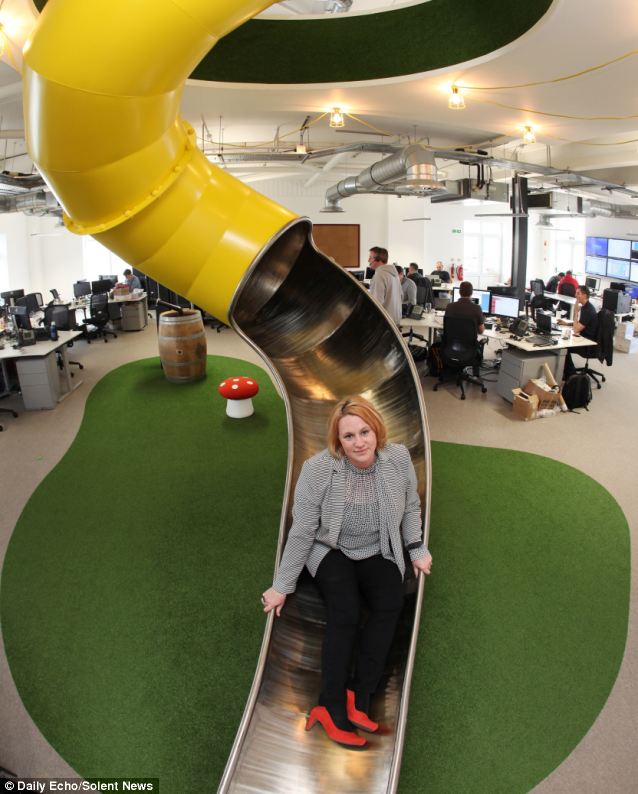
More and more office spaces are trying to become more playful, offering employees a way to destress and/or get more creative. Usually that takes the form of having ping pong tables or video game consoles set up for breaks, but more and more offices are adding slides, swing sets, picnic tables, or other more active and engaging apparatus. They are also bringing in more greenery for workers.

This office may be the most fun in Britain as it comes kitted out with a giant helter skelter slide, a tree house and even a pub.

The unique workplace also boasts a pool table, a putting green, a giant swing and a cinema.

Office designers Space & Solutions were tasked with turning a former pub in Southampton into the home for IT company, Peer 1 Hosting.

‘If you don’t feel comfortable sitting at a desk you can sit on a picnic bench. The reality is that you can do your work from anywhere.’

Read more: UK Daily Mail

The article points out that some people may find all this fun a little distracting to actually work around. Some kinds of play are probably great at cutting stress but may be more of a time suck than creativity inducer. I’m curious what readers think. Are you one of those people who does their best work sitting on a couch, or heck, a swing? Do you prefer quiet and focus without any noise? Do you have a toy or plant on your desk you fiddle with when you’re trying to think or just need to destress?

Another question; do you actually use the toys and playful apparatus in the office? The office I currently work in has a ping pong and air hockey table, but only two people ever use the ping pong table, and I have only seen the air hockey table turned on once for a promo video.

Leave your thoughts in the comments below.