behavior · children · learning · school

When the future becomes detrimentally more important than the present

I read this article in the New York Times a couple of days ago, and it really bothered me:

Since second grade, Nathaly has taken advantage of a voluntary integration program here, leaving her home in one of the city’s poorer sections before 6:30 a.m. and riding a bus over an hour to Newton, a well-to-do suburb with top-quality schools. Some nights, she has so many activities that she does not get home until 10 p.m.; often she’s up past midnight studying.

“Nathaly gets so mad if she doesn’t make the honor roll,” says Stephanie Serrata, a classmate.

Last Wednesday, Nathaly did it again, with 5 A’s and 2 B’s for the first marking period.

via Let’s Get Ready Offers Help for College Admissions – NYTimes.com.

At first I couldn’t figure out why; it was a story essentially about all the great programs that our K-12 education system has for getting help and getting ahead in school and prepping to apply for prestigious colleges. Then, when I looked closer at the lead picture of the article it hit me:

Nathaly Lopera in her Passport class, one of several programs she attends to help her get into college. Article by MICHAEL WINERIP, New York Times, Nov 20th, 2011

This 17 year old girl is yawning in her class, and it’s not from boredom or because she stayed up too late the night before chatting with her friends online. It’s because she is working so hard to get into college she isn’t getting enough sleep. Her health is suffering for a future prospect of getting into a “good” secondary education facility.

I find this idea horrible. Yes, it’s great that all these programs exist for kids to get help in applying to college and help in school. I was a tutor in high school, and I took SAT-prep courses which helped me immensely. I applaud this girl’s dedication to her education and her future. I absolutely appreciate the idea of staying up late to study for finals every once in awhile. However, constant sleep deprivation is REALLY dangerous, both in the immediate present (poorer performance, slowed reaction times) and in the future (delayed physical and mental growth). Being sleepy is just as dangerous and being drunk behind the wheel of a car.

I truly believe that this push to get kids into a “good” school, focusing on the future, is a really bad idea.

There was the uproar earlier this year about the self-described “Tiger Mom” and her pride in how hard she pushed her kids. Again, while I appreciate how much she is dedicated to her daughters’ success, there have been numerous studies that show kids do just as well without the focused drilling by their parents. An extra push every now and then, and support driving them to piano lessons or football games? Absolutely! But a parent does not need to be a drill sergeant, nor does the kid need to be literally killing themselves to get into a decent college. A documentary came out in April discussing the phenomenon, called The Race To Nowhere, which does a really nice job of capturing how a lot of this college-prep focus is about as useful as a chicken running around with their head cut off.

I understand this kind of drive starts as early as preschool in many communities, but that doesn’t mean you have to buy into it! Yes, of course I want my future children to get a good college education. Yes, I want them to receive quality primary education. But focusing so much on the future is absolutely detrimental to the health of the child and to the parent.

I would love to hear back from people who have either dropped out of this school rat race to focus more on developing and spending time with their child now, or from people who feel this kind of dedication is essential and worth the health risks.

behavior · children · education · mental health

Reading, Writing, Empathy: The Rise of ‘Social Emotional Learning’ | GOOD

Creative Curriculum: CDCs provide tools to con...
Learning how to empathize improves the entire learning process. Image by familymwr via Flickr

How does empathy and social learning improve the learning experience at schools? A lot, apparently! And some research is finding that actively teaching empathy and social understanding can be taught in a public school setting, with great benefits for the entire learning process:

At a time of contentious debate over how to reform schools to make teachers more effective and students more successful, “social emotional learning” may be a key part of the solution. An outgrowth of the emotional intelligence framework, popularized by Daniel Goleman, SEL teaches children how to identify and manage emotions and interactions. One of the central considerations of an evolved EQ—as proponents call an “emotional quotient”—is promoting empathy, a critical and often neglected quality in our increasingly interconnected, multicultural world.

Brackett quickly learned that developing empathy in kids requires working on their teachers first. Ten years ago, he and his colleagues introduced a curriculum about emotions in schools, asking teachers to implement it in their own classrooms. When he observed the lessons, he was struck by the discomfort many of the instructors showed in talking about emotion. “There was one teacher who took the list of feelings we had provided and crossed out all of what she perceived of as ‘negative’ emotions before asking the students to identify what they were feeling,” Brackett says. “We realized that if the teachers didn’t get it, the kids never would.”

So in 2005, Brackett and his team at the Health, Emotion, and Behavior Lab at Yale developed a training program—now called RULER—that instructs teachers in the skills, knowledge, and attitudes necessary for emotional health, then helps them shift the focus to children. The program focuses on five key skills: recognizing emotions in oneself and others, understanding the causes and consequences of emotions, labeling the full range of emotions, expressing emotions appropriately in different contexts, and regulating emotions effectively to foster relationships and achieve goals. Classrooms adopt “emotional literacy charters”—agreements that the whole community agrees to concerning interpersonal interactions—and kids use “mood meters” to identify the nature and intensity of their feelings and “blueprints” to chart out past experiences they might learn from.

Read more at Reading, Writing, Empathy: The Rise of ‘Social Emotional Learning’ at GOOD Magazine.

children · education · environment · learning

Middle school as enrichment

Middle School Field Hockey
What were your experiences in middle school? Image by North Shore Country Day School via Flickr

Recently, GOOD Magazine asked on Facebook and Twitter: What’s one thing you could learn from your middle school self?

This brought up several reactions for me. For one thing, I hated middle school. I was teased for being a smarty pants with the wrong clothes, scolded by my teachers for being too bossy, and became convinced I wasn’t good at Math. Later on, as I grew up and eventually made it out into the “real world,” I realized that I had a “classic” fashion sense, my “bossiness” came in handy when working with contractors and employees, and I was good at Math if I didn’t let my phobia get the best of me. Rather than learning a great deal about the world, I feel like I forgot a lot of important lessons during middle school. If anything, I wish there were things I could go back and tell my middle school me not to worry about, or worry more about them.
That is not the case for everyone, though. Some people had great experiences in middle school, and felt like they grew as individuals and started to become truly who they were meant to be. Middle school was enriching for them, a good experience.
And to be fair, middle school wasn’t all bad. Middle school is the place of first crushes, first dances, joining sports teams, finding your passion, breaking free from your parents a little bit, meeting new people, starting to be taken seriously adults, but still getting to be a kid and have time to play.
What are some of your lessons from middle school? Were they good, bad? How did those experiences enrich your life, or how did they make them worse? What is one thing or rule you learned in middle school that you wish you still followed, or what is one rule you wish you could forget?
architecture · children · creativity · design · play

Playground designs curated on Flickr

One job that has always sounded super fun is playground designer. Playgrounds can be fun, exciting, inspiring places, full of color, creative design, and above all inspire play.  Some of the different playground designs from around Sweden got the spotlight recently on Flickr.

[Last week], @megrosker shared a link to Swedish Aesthetic, a gallery featuring colorful and very creative Swedish playground designs and play structures… be sure to visit the gallery for all photos curated by PlayGroundology.

view the gallery via Swedish playground design « Flickr Blog. PlayGroundology’s photostream includes photos from Canada and other adventures around the world.

Flickr has quite a few different playground designs scattered throughout the Flickrverse:


I even got so inspired I started my own Playground gallery on Flickr. Check it out, and if you have any photos you’d like to contribute, let me know.

behavior · brain · children · environment · family · learning · psychology

How To Help Your Child’s Brain Grow Up Strong : NPR

A lot of parents freak out about how to provide enriching environments for their children and help them grow, from music lessons to early reading to math flash cards.

In one of those “well duh” books, two neuroscientists, Sandra Aamodt and Sam Wang remind us it doesn’t take all that much…

Babies may look helpless, but as soon as they come into the world, they’re able to do a number of important things. They can recognize faces and moving objects. They’re attracted to language. And from very early on, they can differentiate their mother from other humans.

“They really come equipped to learn about the world in a way that wasn’t appreciated until recently,” says neuroscientist Sandra Aamodt. “It took scientists a long time to realize that their brains are doing some very complicated things.”

Aamodt and fellow neuroscientist Sam Wang explain how the human brain develops from infancy to adolescence in their new book, Welcome to Your Child’s Brain. The two researchers also offer tips for parents to help their children eat their spinach, learn their ABCs and navigate elementary school.

more via How To Help Your Child’s Brain Grow Up Strong : NPR, on Fresh Air.

They talk with Terry Gross about complicated concepts like self control, abstract thought, and things that are even hard for some grown-ups, and how to create an environment that makes kids want to practice these things.

children · community · design

Kids paint South Seattle mural for safety | Seattle Times

Hajiyeva Aysha, a volunteer from Harborview Medical Center, foreground, and Keith Harrison help paint a whale mural near Graham Hill Elementary School on Sunday. The mural is meant to improve walking conditions for child pedestrians in the Graham Hill Community. Photo credit Ellen Banner. Seattle Times.

Flashing lights or a “Slow Children” sign are common sights around schools, but now a local school has put in a “a huge, round, sea-themed mural right smack in the middle of South Graham Street in South Seattle,” to alert drivers to pint-sized pedestrians:

Some of the kids who had helped earlier talked about what the painting was supposed to accomplish.”It’s there so people will notice it and think they should really, really slow down so they don’t get into accidents,” said Maya Garcia, 8, one of the students the mural is meant to protect at nearby Graham Elementary School.Her friend Lilly King, 9, had another concern. “I hope they don’t crash into each other when they’re slowing down.”

The mural, part of the Safe Kids Seattle project installed this weekend in the 5100 block, is thought to be the fourth in the city and the first south of Interstate 90, according to Graham Elementary Principal Christina Morningstar. Each year, according to officials, more than 244 children under the age of 14 are killed in pedestrian accidents in the nation. All the Safe Kids projects are designed to alert drivers to the presence of children in school zones.

In addition to the mural, which features a whale and several fish, organizers installed speed bumps and school-warning signs using $35,000 in grant money from FedEx and the Seattle Department of Transportation.

via Local News | Kids paint South Seattle mural for safety | Seattle Times Newspaper.

I read this story in the office lounge while I was waiting for my leftovers to warm up in the microwave, and immediately thought this was a good idea not just for schools, but for any place that pedestrians frequent. Often cities will put in colored bricks or tiles at busy crosswalks, but for areas with less options and/or funds to renovate, this is a great solution!


autism · behavior · children · cognition · creativity · mental health · psychology · technology

Using Play and Technology for Therapy

Griffin Wajda and Juan Pablo Hourcade in Iowa City, IA, play a collaborative-storytelling app.

I truly think technology (and play) are underutilized when it comes to all kinds of therapy, partially because it’s expensive, and partially because people don’t know how to implement it. This article in the Wall Street Journal offers a great example of how people are integrating play AND technology into therapy.

Multitouch technology—which turned smartphones, iPads and other tablet computers into consumer sensations—has a new function: therapy for cerebral palsy and autism spectrum disorders, as well as a range of developmental disabilities. Researchers from at least three North American universities, including Iowa, are developing therapeutic applications for multitouch devices. Games developed by the Scientists’ Discovery Room Lab at Harvard University, and by University of Alberta researcher Michelle Annett, encourage children with cerebral palsy and stroke victims to stretch their range of upper arm and wrist motion.

“It’s a very motivating tool for the patients. It’s visual, the feedback is instant and it’s fun,” said Isabel Henderson, vice president of Glenrose Rehabilitation Hospital in Edmonton, Canada, where games on a touch-screen table are part of stroke victims’ physical rehabilitation.

The new apps offer patients engaging ways to address their medical conditions over the long term, said Quentin Ranson, an occupational therapist at the Alberta hospital. They also could help reduce the time patients need to spend in expensive traditional therapy, Mr. Ranson said.

Children with cerebral palsy—a group of disorders caused by brain damage before or shortly after birth—work to improve their motor skills and coordination through repetitive exercises like wiping a cloth across a table, stringing beads on a pipe cleaner or throwing a ball back and forth. Patients recovering from stroke do much of the same, stacking cones and flipping cards to help them lift their arms against gravity.

more via the Wall Street Journal.

This is just one example of how using play and the right tools can encourage development and healing.

behavior · children · community · creativity · health · play

6 Ways To Get Kids Outside And Moving This Summer, suggested by Kaboom

KaBOOM! CEO Darell Hammond
Kaboom CEO Darrel Hammond (told ya' it wasn't the SNL guy!) Image via Wikipedia

It doesn’t really feel like summer here in the Pacific Northwest yet, but we’re already scheduling picnics and camping trips and weddings and all kinds of outdoor activities in hopes of the weather getting nice. But there are more ideas for getting outside than (hopefully not) tedious nuptials or a forced march uphill. Darrel Hammond, CEO of Kaboom (not the SNL guy), has some ideas specifically for families:

Summer should be a time for roaming, discovering and running outside — but unfortunately, for all too many kids, more free time means more screen time and more structured activities.

It’s up to you to ensure that your kids get a healthy daily dose of unstructured outdoor play. Here are six ways to get your children moving, nurture their creativity and provide them with all the rich learning opportunities that outdoor play presents. In the process, you’ll meet new neighbors and contribute to a nationwide movement to save play.

Suggestion #4: Close a street for play. I’ve actually seen several neighborhoods around town grab a permit for the afternoon to close down their street and have a block party. Some cities are probably easier to work with than others, but the idea of a block play party sounds fabulous!

We all need a little push to get out the door (especially when it’s too hot, too cold, too windy, not windy enough, etc.), so having a planned event or project like this can be very useful.

more suggestions by Darell Hammond: 6 Ways To Get Kids Outside And Moving This Summer.

Kaboom! is a play-focused non-profit that is working to ensure that every child has a great place to play within walking distance of their school or home. They certified a playground here on Mercer Island, WA, and are working to install or certify others all over the U.S. Another idea to get your kids out and active: help build a playground!

behavior · children · creativity · design · play

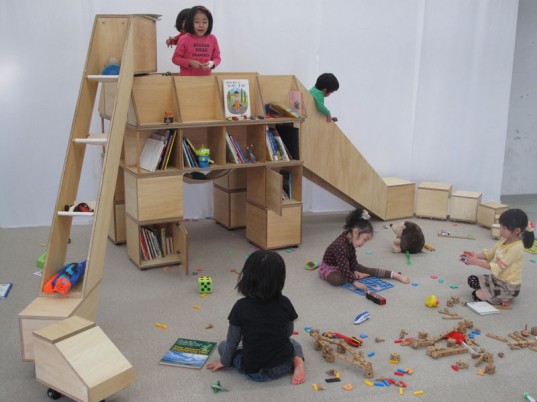
Bookshelf/Playground combo makes putting your toys away fun

Casasaurus

My mom always told me not to climb up my bookshelves when I was a kid; now I wish I was little again and could beg her to get me one of these. This is actually a great tool for learning, because it allows kids to think three dimensionally, in a playful way. Trying to decide which cubbies hold what items, and climbing, sliding, and thinking of an object as two things at once (a bookshelf AND a dinosaur) are great exercises for the brain at any age.

Casaurus, the senior thesis project of student designer Koichiro Hoshino from Tokyo University of the Arts. The designer’s dinosaur-shaped bookshelf includes plenty of space for a bookworm’s library, a tail-like slide for kids to whiz down, shelves made for climbing and small boxes that add length to the dino’s tail. Kids can also find a reading nook underneath the dino’s belly.

more via Koichiro Hoshino’s Casaurus is a Bookshelf and a Playground | Inhabitots.

behavior · children · community · environment · family · learning · Nature

7 Creative Ways to Experience your Local Farm this Spring | Inhabitots

A pastoral farm scene near Traverse City, Mich...
Image via Wikipedia

Where I grew up and where I live now, though focusing on very different kinds of agriculture, were both very farm-focused communities, and I always encourage people to  go out and see what a working farm is all about. It is a great way to learn about where your food comes from, different jobs, and all about nature.

Beyond simply stopping by to view the animals at your local farm, there are many other hands-on and creative activities you can do with your family — and the spring is a great time to go. Visiting your local farm during the spring comes complete with baby animals, plus the weather is warming up and it’s the perfect opportunity for outdoor learning time with your children. To get the most out of your springtime visit to the farm, you’ll want to explore it with a different lens and look at your local farm as more than just a place that keeps animals and agriculture. Read on to learn seven creative ways to experience your local farm this spring with your family.

more via 7 Creative Ways to Experience your Local Farm this Spring | Inhabitots.