Happy Friday! I hope you get a chance to go out and play this weekend. Speaking of play, here is another great find from Milan’s Design week (remember the edible mini furniture from earlier this week?). This exhibit of design focused specifically on children’s spaces, with a focus that was very playful, creative, and also a great idea for grown-ups to incorporate into their own environments.
Students from the HDK master program Child Culture Design created an exhibit to explore new ways of bringing play into everyday objects to help foster imagination and creativity. Dubbed “Play In Progress“, the exhibit was one of our favorites at the Salone Mobile.
Johanna Larsson‘s cool table features transparent color plates that can be arranged and rearranged to create different tabletop scenes that push imaginative thinking.
At first look of Hide||show appears to be nothing special, but just put a kid in front of one of these and you’ll realize that there is definitely something more to this cabinet. The cabinet features two pairs of handles — one ordinary set for adults and a pint-sized set of hole-like handles for children. The variation indicates different accesses to function, and give children the feeling of exclusivity in their own world.
Inspired by the game of “hide and seek”, Behind the Curtain blocks out part of a white curtain with color to create a secret space for a child to be alone in his/her world.Griet Boucique has designed an ‘Alternative Playground’ – a landscape of soft seats – that questions what is a ‘good’ play environment for a child? The design considers material usage, its impact on the environment, and how different textiles can the way a child engages in play.
Check out more great designs at Inhabitat (I love the block table, for example!)
I love the fact that playgrounds are incorporating the stuff that kids love to play with the most – dirt, rocks, and sticks!
Children won’t find new monkey bars and bright plastic play structures at the upgraded Donnan Park.
Instead, the aging playground at 9105 80th Ave. will become Edmonton’s first “natural playground,” part of a growing trend in playground design.
Children in the redesigned Donnan Park will entertain themselves with such timehonoured playthings as rocks, sticks, sand and dirt. The overhauled space will feature a slide built into a hill, a sideways-growing tree, a boulder spiral, a hand pump to pour water into a small stream and plenty of plants, trees and greenery.
It will be “a beautiful garden that everyone plays in,” says Kory Baker-Henderson, co-chair of the neighbourhood committee that worked on the preliminary playground design with expertise from Ontario-based Bienenstock Natural Playgrounds.
“Around us there are already some typical playground structures, so we wanted to have something different that blends in with the (Mill Creek) ravine,” Baker-Henderson says.
“Studies have shown imaginative play is much more stimulated (in natural settings) and children actually will play longer and become much more involved than on a typical red, plastic slide structure. Their games will just get much more imaginative. There’s that connection with nature. We have plans for a community garden, so it’s a learning and teaching tool, too.”
The playground at Donnan Park currently has swings and a slide that will remain for now, but won’t be replaced, she says.
Will this robot someday be a child's best friend? (Photo credit: glemak)
An article from LiveScience talks about recent studies that find kids can get along pretty well with robots as playmates:
As technology continues to improve, human-like robots will likely play an ever-increasing role in our lives: They may become tutors for children, caretakers for the elderly, office receptionists or even housemaids. Children will come of age with these androids, which naturally raises the question: What kind of relationships will kids build with personified robots?
Children will view humanoid robots as intelligent social and moral beings, allowing them to develop substantial and meaningful relationships with the machines, new research suggests.
Researchers analyzed the interactions between nearly 100 children and Robovie, a 3-foot-tall (0.9 meters) robot developed by the Advanced Telecommunications Research Institute in Japan. In the study, two technicians controlled Robovie remotely from another room, leading the children to believe that the robot was autonomous. The researchers imparted humanlike behavior to the robot, such as having Robovie claim unfair treatment when he was told to go into the closet at the end of the interaction sessions.
After reading the LiveScience question is, is this a good idea? I know positive results have been found for kids with Autism, who are able to transfer skills practiced with robots on to other humans, but for healthy kids is this really as beneficial? The scientists don’t seem too concerned:
…the researchers think that the results have important implications for the design of future robots. If engineers design robots to simply obey orders, the master-servant relationship that children experience may trickle into their interactions with other humans. Is it then better to design robots with the ability to “push back” as Robovie did when he was instructed to go into the closet?
Shen said there is no easy answer to which design scheme is better.
“I don’t think children will treat robots as nonsocial beings, they will treat them as social actors and interact with them in social ways,” she said. “But we need more data and evidence to see how adults, as well as children, will develop relationships with these robots.”
What do you think? Is this a good idea? The elderly in Japan do seem to benefit from having robot pets. Could the same be true for kids?
A nice story about a redesign of a park in Seattle so children could actually, you know, play in it:
Located on the northeast corner of Seventh Avenue and South Lane streets in the Chinatown-International District, the park is small – about one-fifth of an acre — but in a key spot.
Vegetation had grown up around the periphery of the 30-year-old park, obscuring views and raising concerns about safety. There were few amenities for adults who bring kids to the park, and no accommodations for people with disabilities. A rock mound posed a hazard, and during the winter, the grass was often soggy.
Cultural and language differences were also part of the landscape, making decisions about the park complicated.
But renewal made sense because the neighborhood has seen increasing residential and commercial development, leading to more active community places such as the Wing Luke Asian Museum and a branch of the Seattle Public Library.
To involve stakeholders young and old, Hou’s group, along with the city and several neighborhood groups, held an intergenerational design workshop in 2007.
“I think the most difficult challenge was to incorporate as much of the feedback we got from the community while still allowing the park to have a clear and concise design,” said student Patrick Keegan.
Engaging multiple generations of users was the most interesting part of the redesign, said Joyce Pisnanont, manager of IDEA Space, which promotes and develops the Chinatown-International District. Desires were consistent across age groups, she said, and the adults “really wanted to ensure that the park was fun for kids to play in.”
The final design by landscape architect Karen Kiest includes an expanded children’s area with a play structure big enough for a dozen kids, a dragon sculpture restored by artist Gerard Tsutakawa, a stainless steel pagoda with seats for grown-ups and a three-level rockery that serves as both gathering space and a climbing area.
Public art by Stuart Nakamira includes a brushed stainless steel top the size of a typical 4-year-old.
In a Lane Street corner, pink viburnum are budding, surrounded by circles of black mondo grass.
In recent years, child development experts, parents, and scientists have been sounding an increasingly urgent alarm about the decreasing amount of time that children – and adults, for that matter – spend playing. A combination of social forces, from a No Child Left Behind focus on test scores to the push for children to get ahead with programmed extracurricular activities, leaves less time for the roughhousing, fantasizing, and pretend worlds advocates say are crucial for development.
Meanwhile, technology and a wide-scale change in toys have shifted what happens when children do engage in leisure activity, in a way many experts say undermines long-term emotional and intellectual abilities. An 8-year-old today, for instance, is more likely to be playing with a toy that has a computer chip, or attending a tightly supervised soccer practice, than making up an imaginary game with friends in the backyard or street.
But play is making a comeback. Bolstered by a growing body of scientific research detailing the cognitive benefits of different types of play, parents such as Taylor are pressuring school administrations to bring back recess and are fighting against a trend to move standardized testing and increased academic instruction to kindergarten.
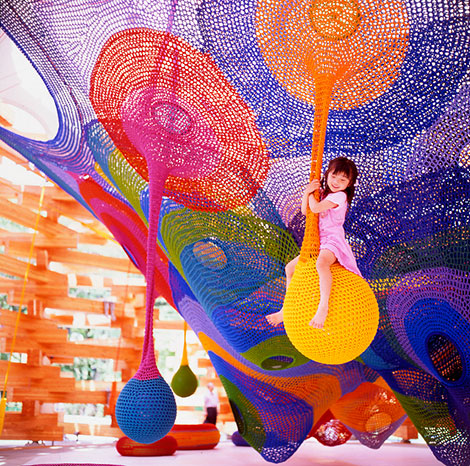
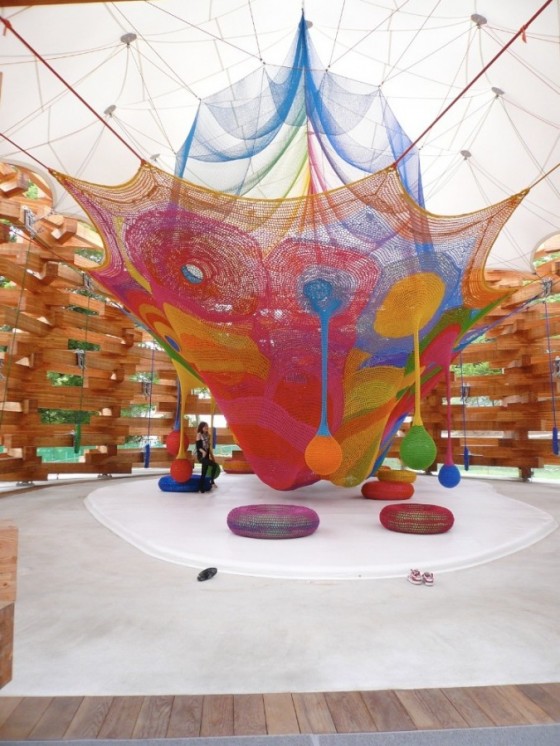
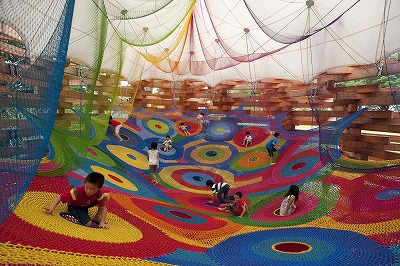
I love the story of how she came to be engaged with children’s play: “It all happened quite by accident. Two children had entered the gallery where she was exhibiting ‘Multiple Hammock No. 1’ and, blissfully unaware of the usual polite protocols that govern the display of fine art, asked to use it. She watched nervously as they climbed into the structure, but then was thrilled to find that the work suddenly came alive in ways she had never really anticipated. She noticed that the fabric took on new life – swinging and stretching with the weight of the small bodies, forming pouches and other unexpected transformations, and above all there were the sounds of the undisguised delight of children exploring a new play space.”
From that point, her work shifted out of the gallery and a subdued, monochromatic pallet into a riotous rainbowof colors for children’s playscapes.
Rainbow Net was produced in close collaboration with structural engineers TIS & Partners and landscape architects Takano Landscape Planning and opened in July of 2000 after three years of planning, testing, and building.
Note that the project began with a brief not for a playground, but simply for ‘public art‘. Wouldn’t it be great if when we heard ‘public art’ we automatically thought ‘play’?
But innovative playscapes require an enormous commitment: “…endless cycles of discussion and approval, with meticulous attention to detail…[including] an actual scale wooden replica of the space in Horiuchi’s studio and accurately scaled crocheted nets using fine cotton thread. Even then, it was difficult to assess many things. What difference, for instance, would the weight of the real yarn make when everything increased in scale? All of these factors had to be calculated in order to arrive at a scientific methodology that could eradicate any risk of unacceptable danger.”During final assembly, Toshiko crocheted ten hours a day, often on her knees, until the installation was complete.”
With the current revival of the textile arts and yarn bombings everywhere, I’d love to see more crochet on the playground!
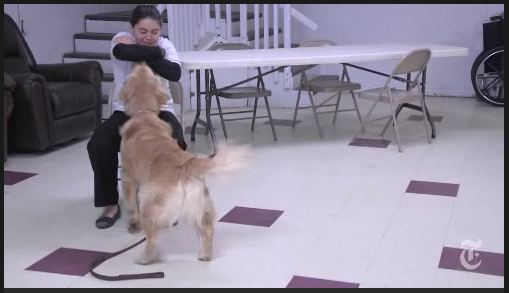
Your feel good story of the day, brought to you by the New York Times: a nonprofit organization trains dogs to help kids with all kinds of disorders, from autism to muscular dystrophy to seizures.
In October 1998, Shirk assembled a board and founded 4 Paws for Ability, a nonprofit corporation. She rescued Butler, a German shepherd mix, from a shelter; hired a trainer to prepare him for mobility work with the 12-year-old; and became a pioneer among service-dog agencies. “People started calling from all over to ask, Am I too young? Am I too old? Am I too disabled? Am I disabled enough?” she says. “I said, ‘If your life can be improved by a dog, and if you and your family can take good care of a dog, we’re going to give you a dog.’…” “We place dogs with kids in wheelchairs, kids on ventilators, kids with autism, kids with dwarfism, kids with seizure disorder and cognitive impairments; but if your dog does tricks, other kids want to meet you. Kids will ignore your disability if you’ve got a cool dog.”
A trainer works with a dog on behavior modification techniques. Click the image to see the video.
It is also an amazing relationship dynamic to see occur between the children and their dogs, how the children with cognitive disabilities in particular are helped to see the world, in a way, through their dog’s eyes:
Alan M. Beck, the director of the Center for the Human-Animal Bond at Purdue University’s College of Veterinary Medicine, is among those intrigued by it. “There is a real bond between children and animals,” he told me. “The younger the child, the greater the suspension of disbelief about what an animal understands or doesn’t understand.” According to Beck, more than 70 percent of children confide in their dogs, and 48 percent of adults do. “The absolutely nonjudgmental responses from animals are especially important to children,” he says. “If your child with F.A.S.D. starts to misbehave, your face may show disapproval, but the dog doesn’t show disapproval. The performance anxiety this child may feel all the time is absent when he’s with his dog. Suddenly he’s relaxed, he’s with a peer who doesn’t criticize him.”
Toys are not only great for thinking outside the box with, they’re also great for thinking outside of our world! Two Canadian students recently sent a Lego man out to the edge of space:
Matthew Ho and Asad Muhammad used a weather balloon to carry a camera and a toy lego man high above the clouds.
Great article from The Atlantic about how squeezing recess and playtime out of education is a really bad idea:
Play is important for the emotional, social, cognitive, and physical development of children. In addition to being critical for general health and a preventative against overweight, play develops life skills for children and communication skills among peers and family members.
Children living in poverty experience these barriers and more, according to a recent clinical report from the American Academy of Pediatrics. Underprivileged children often have less access to recess and school-based creative arts, music, and physical education programs. Additionally, the socioeconomic stressors on poor families often conspire against parents having the time, energy, or skills to engage in play with their children.
Poor children’s access to outdoor play spaces may be compromised by the safety of their neighborhoods and the decrease in parks and open spaces in urban areas. Children who are unable to play outside tend to spend more time on screen-based activities such as watching TV or playing video games. Excessive screen time takes a huge toll on mental and physical health and academic achievement
Many urban schools have replaced recess and purely recreational after-school activities with academic enrichment activities to help close the academic achievement gaps between lower-income children and their more privileged peers. While improved academics is an important goal, the report emphasizes that the developmental role of play should not be forgotten and the benefits of play should not be traded off in favor of academics.
According to the report, play’s benefits extend to psychological well-being. Play provides an opportunity for a student to shine in areas that are not strictly academic and thus contributes to the child’s personal sense of pride and belonging in her school environment. This has the potential to discourage truancy and encourage children to remain in school to complete their education
Twenty-eight percent of schools with children in the highest poverty levels have no recess at all. This impacts a population of children who already have limited opportunities for creative experiences and social play, especially since research that has shown that physical education periods and recess enhance a child’s readiness for academic pursuits during the school day. They suggest that the elimination of these pace-changing opportunities may in fact be counterproductive for academic success.
What makes a career seem achievable, especially in STEM fields? Image via Wikipedia
Interesting article about making science appealing to youngsters, particularly girls:
Addressing the country’s shortfall of students in the STEM disciplines (science, engineering, technology and mathematics) begins with persuading students that scientists are people, too.
A series produced by the science program NOVA, available online, is a good place to start. The Secret Life of Scientists and Engineers (tag line: “Where the lab coats come off”) features footage of scientists working in their labs and sitting down for interviews. The researchers come off as curious, playful, even goofy — people you might want to befriend, or become. The same process of humanization can work with written materials. Susan Nolen, a professor of psychology at the University of Washington, gave two different statistics texts to groups of female students. One selection was written in the remote, impersonal style of most textbooks. The other struck a more accessible tone, sharing the writer’s views and opinions on the information. The text with a “visible author,” as Nolen describes it, prompted the students to engage in mental interactions with the author as they read, a process that promoted their understanding and retention of the material.
Do you agree or disagree with Paul’s assessment? Are scientists scary, unapproachable beings that nobody wants to be when they grow up?
From my personal experience I know that making that kind of job and expertise seem attainable was important to me as a high school and college student. I had a journalism professor in college that I greatly admired, Conn Hallinan. He was so GOOD at what he did; he seemed to know the history of every issue. In his provost house (not even his “real” house) he had an entire room full of file cabinets filled with clippings of stories, and somehow kept track of all of it. It was somewhat intimidating as a budding journalist. I remember thinking a couple of times “I will NEVER be this organized/dedicated/whatever. How will I ever become a journalist?” Thankfully he was very supportive of my budding talents, and I ended up writing for a scientific magazine for several years.
That being said, I think it helps to have the mask removed and being able to see the real people behind some of these professions. At the same time, probably the most helpful course I took in college was a two-credit seminar on writing professions. Each week they brought in guest speakers who talked about how they made money writing, and what they did as side-jobs if/when the writing didn’t pay enough. One journalist who’s name I can’t remember told us that she was a terrible introvert, but loved being a journalist because it gave her an excuse and a reason to talk to people. As a fellow introvert, that helped me a lot.
So, I do think it’s important to humanize jobs if we want kids to pursue them. I was going to say this is especially true for girls, but I think it’s true for both genders.
What are your thoughts? Was there a person that inspired you to get into your current career? What were they like; were they very approachable, or more legendary/iconic? Leave your story in the comments.







 Mental Flowers