Dear readers,You may have noticed the site got a little quiet last week. That is because my daughter was born, so we have been suddenly thrown into parent mode, not leaving room for much else. Once the dust settles I will continue to update this blog, especially now that I have one of the best authorities on play living under my roof!
Get outside and play for me while the weather is still nice.
Playground doesn’t need to be fancy to be effective (Photo credit: Wikipedia)
As we head back into the academic school year, a lot of people are focused on education and making sure students get the best possible opportunity to learn and thrive. Here’s one easy way to support that: give them space and time for play!
Numerous academic studies [sources stored in a weird place, will update soon] on school-aged kids have demonstrated that recess time is valuable for learning and aids in the overall learning process. But I think it can be more powerful to hear how valuable it is from someone who actually lives with the results of life with more or less recess; the teachers.
Apart from being a fun activity, it is widely recognised that play is one of the most important ways in which brain development occurs in children.
Sadly, in some schools valuable recess and lunch time has been reduced in favour of more rigorous academic pursuit within the classroom. In other schools, running or ball games have been banned due to a perceived high injury risk factor.
As many families now choose structured and adult-directed play activities after school or on weekends, the school playground becomes one of a few outlets where children can engage in free outdoor play with their peers. More than 28 hours a week, often spent solitarily, are devoted to computers, mobile phones, television and other electronic devices. Considering that as much as 25 per cent of time spent at school is playground time, we need to rethink the benefits of play at school.
Conversely, a lack of play can result in challenging behaviour and negative performances in the classroom, according to an American educational psychologist, Anthony Pellegrini.
Also, playgrounds that lack play stimuli become spaces where children often wander around aimlessly, become frustrated and bully other children. Not many schools can afford expensive playground equipment, but the good news is that this is not needed anyway.
Professor Anita Bundy, from the Faculty of Health Sciences at Sydney University, has launched a large-scale study involving 12 primary schools in NSW, introducing simple, recycled play resources during recess, with outstanding results. This included crates, car tyres, foam pool noodles, plastic barrels, tarpaulins, foam cubes and other open-ended materials that lend themselves to creative, imaginary play.
Not only do children become physically more active, they also hone important social skills, build resilience and are encouraged to think creatively.
The entire Op-Ed is very strongly written and makes a great case for play, and it’s great to hear it from the teacher’s standpoint, so please read it and share. And be sure to support play time in school, whether it’s by voting, volunteering, donating red rubber balls, or whatever you can do.
Friday’s Google doodle honoring Maria Montessori’s 142nd birthday.
Have you noticed Google’s doodle for today yet? It is in honor of Maria Montessori, founder of the Montessori style of learning, which focuses on open-ended, free-form learning, which involves a lot of play. From PC Magazine:
Google on Friday honored Italian physician and educator Maria Montessori with a homepage doodle celebrating her 142nd birth anniversary.
The drawing features some of the tools that form the basis of Montessori’s educational methods, which emphasize hands-on, individualized learning within mixed age groups in a child-friendly setting.
After working in insane asylums with mentally handicapped children, in 1904 she began re-engineering the field of children’s education. She believed that all children have an inner drive to learn, and that children learn best when in a safe, hands-on learning environment.
Montessori also found that children help teach each other when put into groups with other kids of their own age range. She believed that teachers should pay close attention to students, not the other way around.
Her early efforts were so successful that she amassed a large following of parents and teachers who wanted to learn her methods. She later gained support from Thomas Edison, Helen Keller, and Alexander Graham Bell, who founded the Montessori Educational Association, headquartered in Washington D.C.
Thanks Google for showcasing a great woman who was a pioneer in creating more playful and therefore better learning environments for kids.
Hope everyone has a great looong weekend before school starts up for a lot of people (appropriate timing to honor Montessori, eh?), filled with lots of learning, exploration, and playful environments.
Kids don’t need a mountain of toys to stay entertained; in fact fewer turns out to be better (Photo credit: red5standingby)
I came across an interesting commentary from the Telegraph in the UK anecdotally supporting a new study that claims it only costs 6 pounds (about $10) to keep kids entertained.
A study by child development experts has concluded that the average family forks out £10,000 on toys and gadgets before their offspring turns 18. That’s a potential £20,000 on my two girls – cue a Munchian scream of Lebensangst.
Psychologists say that despite this casual largesse, youngsters are better off with colouring pencils and embroidery threads than computer consoles. While it might be hard to convince a surly 13 year-old that modelling clay and beads are more fun than a Wii, I couldn’t agree more. Are beads as thrilling as shooting baddies or crashing aeroplanes? Hardly, but it’s all about the social interaction, stupid.
It’s a rare and lovely feeling to be vindicated as a parent, so forgive me if I bask. You see, I am usually regarded (especially by my husband) as a bit of a skinflint who is too tight to buy the big one a Nintendo DS and the wee one, well, pretty much anything.
If my youngest asks for an ice lolly, we make them with apple juice. If they’re bored, I give them each a tray and send them outdoors to make a garden.
To the casual observer, this makes me a sickeningly virtuous hands-on mother. But it is merely the happy by-product of the fact that I am mean-fisted when it comes to frivolous expenditure. It goes against my grain to throw money at the children just to keep them amused and out of my hair. It feels wrong, and, worse, it feels lazy.
The truth that all parents know, deep down, is that what kids really crave is attention, not stuff. Stuff is a pretty good, if pricey opiate, but it never quite satiates, hence the ongoing clamour for more of it, except faster and louder to excite pleasure centres inured by computer-generated over-stimulation.
Lots of parents have the old joke that at Christmas their kids spend more time playing with the box a toy came in than the toy itself. Now research is finding this to be more true than we realized.
It’s nice to hear that even in an age when children of younger generations appear to use advanced devices and technology as if it were second nature, nothing beats some old fashioned string and beads, or sticks and mud, for a good time. It can take a little bit more creativity on the parent’s end, but that can be a good thing, AND it also encourages more creativity and problem-solving in the child.
My personal favorites were pieces of wood and nails, and just hammering them together into odd art shapes, or just nailing them onto a tree. What were your favorite tools and environments for play when you were a kid? Let me know in the comments below.
Why aren’t American kids allowed to play outside anymore; Children in Khorixas, Namibia (Photo credit: Wikipedia)
While summer may just be getting into full swing in my neck of the woods, it’s almost over for most everyone else (*sob!*). It seems everyone is trying to take advantage of a few last weekends of summer before school starts back up. But for some kids, that is a lot harder than it sounds. Free Range Kids recently posted about separate instances of a mom and a dad getting in trouble for letting their kids play outside unattended.
Today the police visited my home after one of my neighbors called in about my children being outside alone…in our yard with a home on two sides and six foot fence on the other two sides. The officer said, “Don’t have me called back out.” So now, do I have to go outside with my children every time they go out? I have a chronic illness and sitting outside all day sucks for me. They love being outside. They come in for bathroom breaks, they come in to tattle, they come in to say “I Love You”… they are in and out every 5-10 minutes. I check on them anytime I pass the door, and I lay or sit next to an open window. If I call for them, they come to the door/window and answer as a “check in.” They will literally stay outside from wake up to 9 pm, when I force them to come in, with breaks for the above and for food. They were perfectly safe. I don’t know what to do.
Dear Lenore: A neighbor of mine called the Texas CPS (Child Protective Services) and the Police on my wife and I because we allow our children, ages 6 and 8, to play in the courtyard directly in front of our apartment. CPS has been investigating my family since April 4th 2012, it is now August 12 2012, and all they have come up with is the one report to Police about my 6-year-old being outside in front of his home. Now we are dealing with the courts in a “Negligent Supervision” case, which makes absolutely no sense because my child wasn’t hurt or asking anyone for help. I was outside with my son when the Police arrived, but the CPS caseworker insists that I take drug tests and parenting classes. People are not neighbors anymore, they are just @$$holes. – A Texas Dad
Unfortunately the Free Range Kids blog has waaaay too many examples of this kind of reaction from authorities.
I find this really concerning, since we’re basically telling children they can’t be responsible for themselves when parents are trying to teach their children independence and responsibility, we’re not allowing them unstructured play time which is crucial for learning and brain development, that it is a way more dangerous world out there than it really is, AND it discourages them from exploring and getting exposure to nature and natural sunlight, both things that are crucial for growing bodies.
Why are children no longer allowed to play in their own front yards? I’m sorry if this comes off as a rant, but I feel not letting children play outside and learn on their own is a serious problem if we are simultaneously so concerned about “winning” the education race against other nations.
Aside from yelling at CPS and the police, what can we do as concerned citizens, either with children or without, to encourage and enable children to play outside and allow parents to let their children roam a little bit freer and get the unstructured, unsupervised play time they need in order to develop normally? Ideas welcome in the comments below.
I loved playing with Legos and building blocks as a kid (and actually still do); all the possibilities of what to build, and the ability to tear it all down and start over. Well here are two different ideas from Inhabitat about using that same concept of moveable, removable, and piece-meal design (in a good way):
A green initiative called Softwalks has come up with a way to use existing scaffolding as support stations for fun and lively modular public spaces using their awesome little DIY kits that contain easy-to-build pieces such as a chair, a counter, and a green trellis. The components latch onto the metal beams to create simple impromptu hang-outs and rest stops for busy city dwellers, making the possibilities for sidewalk beautification endless.
The project’s greatest aspect is that anyone can get involved. The kit pieces are modular and lightweight, making them easy to install, take down, and reuse in new areas. The kits also create a public art activity, involving the community to brighten up their construction-heavy areas.
Walrus Toys’s Chimeras is a new line of plush toys that allows your little creative genius to build his [or her] own wacky stuffed animal critters with different interchangeable snap-in ears, arms, legs and wings each day as the mood strikes.
What if a bat really wants to have giant elephant ears to match its wings? You’ll end up with a Batephant! What if a bunny wanted to swing on tree branches, but needed the monkey’s long arms? You’ll have a Bunkey.
These are really adorable, and definitely a step up from Mr. Potato Head. I love how kids’ toys are moving away from the electronic “can only do one thing and LOUDLY” mentality and moving back to more creative play. Robotics toys and robotic dance competitions seemed to be a huge thing a couple of years ago, which is also very modular.
What other creative, modular ideas have you seen pop up lately, either as urban architecture, toys, or other arenas? Leave a note about it in the comments below. If we’re lucky, we’ll be able to make this a new series in the blog!
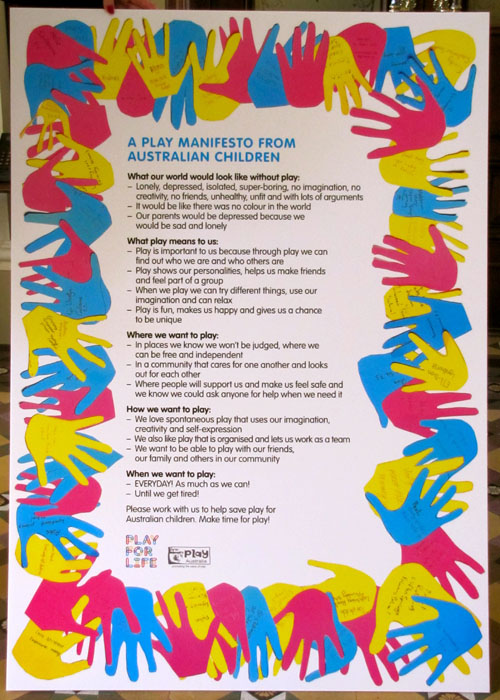
Play Based Learning in Australia is sharing a poster that captures the play manifesto of its children; how awesome!
After the overwhelming reaction to the success of the Australian Children’s Play Summit held in Melbourne on May 17th and 18th 2012 Play for Life Australia is kindly making available a copy of the Play Manifesto created BY Australian children FOR Australian children as a download. Play for Life believes that if we put the future of PLAY back into the hands of Australia’s children, then PLAY will be in very good hands!
From the blog Art Farm, a play/art therapist who offers some advice on creating spaces that encourage kids to explore, learn and play:
I really learned the importance of organizing and preparing spaces while working with youth in school settings in several public housing developments in Chicago. So often these youth would come to me (for either individual or group art therapy sessions) filled with anxieties which either manifested as acting out or withdrawn behaviors. The arrangement and presentation of the private space we used was a powerful, non-verbal message to them stating that all things are respected here – including you; everything has a place here – including you; and everything you will need to have a successful experience is here – starting with you.
[Mariah] Bruehl offers some questions to ask when designing a space for your own child:
Can your child access the materials in the play space independently? Are they organized in baskets or bins that are clearly labeled so your child knows how and where to put things away when finished with them?
Are the materials presented in an attractive manner that invites your child to use them?
Do the materials, toys, and games represent a balance between your child’s and your own preferences? Do they represent what you value and thus encourage your child to engage in activities that you feel good about?
What is your child currently interested in? If your child no longer plays with dinosaurs, but has been talking a lot about birds, make sure that the play space reflects this current passion. Rotating toys is a great way to keep your child interested in play space activities and ultimately prolongs the life of your child’s playthings. It never ceases to amaze me how excited my girls get about a toy that comes back into rotation. The nostalgia they feel toward a toy they have not seen in a while is almost more than their delight over a brand-new toy.
Is the play space a calming environment that allows one to focus on the task at hand without distracting colors, decorations, or objects?
Are you seeing things from you child’s perspective? Put yourself in your child’s shoes to determine the right height for displaying and storing materials and hanging art.
Is this a space that makes you want to make art, explore science, write stories, and more? If so, would you have everything you need to do what you want to do? What else would you add to enrich and deepen your child’s learning experience in the play space?
What other playful space researchers are out there? Any recommendations? I know about the organization Art With Heart, which focuses on creating therapeutic resources for sick kids. But I’d love to hear more about what’s out there. Let me know in the comments below.
What a great series from Co.Exist and Fast Company: play grounds, and other structures, that harness the energy of people’s movement. This may be the first time employees are actively encouraged to move around all day. 🙂
Kids have boundless energy. What if that energy could be put to some use besides just running around and having a good time. These new jungle gyms convert play to power.
When IBM came up with a list in 2011 of the five technologies it thinks will change the world in five years, kinetic energy–power from people–topped the list. Advancements could come, they say, from developments in devices that might harvest power from your shoes, your exercise, and even the soccer ball you kick. Green gyms are also cropping up. And now the idea has come to playgrounds, where kids’ movement can be harnessed and funneled into powering schools and toys.
Natural Energy Park
This playground–designed by Hyundai engineering and construction–is part jungle gym and part renewable energy science experiment. After climbing a ladder into a laboratory, kids can spin a wheel that will illuminate “Benjamin Franklin’s kite.” An optical illusion will spin at varying speeds as children adjust a solar panel to different angles. Pedaling a bicycle powers a pinwheel and illuminates lights around the structure. Hyundai calls this the “Natural Energy Park” and it looks like a lot of fun.
Empower Playground
Mixing fun and helping people, Empower Playgrounds is a non-profit organization that provides electricity-generating
playground equipment to villages in Ghana that are too remote to be on their nation’s electricity grid. The school children gain a playground as well as safe, rechargeable LED lanterns to light their homes so they can do their homework. Additionally, the play equipment doubles as part of a hands-on science lab that brings science concepts into their daily lives
Babies are born social scientists. (Photo credit: Wikipedia)
Happy Friday! I read this article in the New York Times about Dr. Liz Spelke, at Harvard University, who studies the neuroscience of babies.
Dr. Spelke is a pioneer in the use of the infant gaze as a key to the infant mind — that is, identifying the inherent expectations of babies as young as a week or two by measuring how long they stare at a scene in which those presumptions are upended or unmet.
While the article primarily focused on what we can glean from babies about human cognition and knowledge, I couldn’t help but pick up on the author’s observations that the main thing the baby test subjects want to do, and the main thing that is enriching to them, is engage with the people around them (and how enriching it is for the grown-ups involved too):
The 15-pound research subject … tracked conversations, stared at newcomers and burned off adult corneas with the brilliance of her smile. Dr. Spelke, who first came to prominence by delineating how infants learn about objects, numbers, the lay of the land, shook her head in self-mocking astonishment.
“Why did it take me 30 years to start studying this?” she said. “All this time I’ve been giving infants objects to hold, or spinning them around in a room to see how they navigate, when what they really wanted to do was engage with other people!”
Babies are born with a desire to learn and engage in their world. They are pretty helpless, and so the only thing they have to defend themselves, as well as learn, is to engage with others and beg for help. As soon as they figure out who’s safe, they look for more people like that:
Katherine D. Kinzler, now of the University of Chicago, and Kristin Shutts, now at the University of Wisconsin, have found that infants just a few weeks old show a clear liking for people who use speech patterns the babies have already been exposed to, and that includes the regional accents, twangs, and R’s or lack thereof. And in guiding early social leanings, accent trumps race.
But, babies are also fascinated with the unknown, and will stare at new concepts and objects for much longer than the known items and individuals.
To me the really interesting thing is that what most interests the baby subjects is getting to know the researchers. As grown-ups we don’t have to lose that sense of wonder. Many people grow up to be researchers (like Dr. Spelke). We can continue to be fascinated by our surroundings and new people and always seek knowledge about what’s around us.
P.S.: Also, just if you’re curious, according to the Spelke lab here are some of the things that babies know, generally before the age of 1:
They know what an object is. They know that objects can’t go through solid boundaries or occupy the same position as other objects, and that objects generally travel through space in a continuous trajectory.
Babies can estimate quantities and distinguish between more and less. They also can perform a kind of addition and subtraction, anticipating the relative abundance of groups of dots that are being pushed together or pulled apart.
Infants and toddlers use geometric clues to orient themselves in three-dimensional space, navigate through rooms and locate hidden treasures.





 Mental Flowers