I tweeted about this short film yesterday, but I really feel like this is worth giving some space on the blog for.
The value of play is important for teaching life skills like conflict resolution and collaboration, health lessons, healing from trauma, building community and just overall survival as a child and human being, the work this organization does seems simple but is hugely important.
This short video highlights some of the incredible impact that play can have on a child, or group of children.
You can also visit the organization’s website at Right to Play.
These findings make sense to me and yet also don’t.
Image credit: Carnegie Mellon University
Few environments feature such a cacophony of decor as the elementary school classroom. Colorful bulletin boards, scientific posters, state maps, and student artwork tend to cover nearly every inch of wall space. Yet a new study on classroom design from researchers at Carnegie Mellon University suggests that all that educational flair may not be all that great for getting kids to learn.
The study, carried out over two weeks, examined 24 kindergarten students who were taught six lessons on topics they had not yet learned in school. Half the lessons were taught in a highly decorated classroom environment, with posters and art all over the walls, and the other half were taught in a classroom with no decoration.
CMU’s researchers found the kids spent more time off-task and were more distracted when the room was brightly decorated, and they tested better on subjects they learned in the sparser classroom compared to the ones they learned in the more visually stimulating environment.
Elementary school children typically stay in one room all day, so classroom decorations don’t necessarily match the subject matter they’re learning at any given time. If they’re sitting in front of a U.S. map, they’ll be looking at that all day whether the current lesson is on geography or math. This study, though very small, adds to previous research from the same psychologists showing that visual stimulation that’s irrelevant to on-going instruction can distract kids.
The study doesn’t go on to offer any ways to necessarily improve the classroom design, although the article does give other links discussing it.
Nature can be fairly visually cacophonous, so what is it about classroom designs that are so distracting? I also wonder how much of their distraction is from an unnatural learning style, and then other more engaging things to look at. That is not an attack on the teacher, I’m just skeptical whether any human is capable of sitting in one room for 6-8 hours, with a couple of lunch breaks, and concentrate the entire time, for an extended period of time. Even grown-ups have a hard time doing that, and suffer when they try to sustain that for too long.
What are your thoughts? Leave them in the comments below.
This is a nice study that looks at the value for kids, but unstructured creative and/or play time is important for adults AND kids.
German psychologists find people who were allowed to play freely as children have greater social success as adults.
There has been plenty of hand-wringing in recent years about the “overscheduled child.” With after-school hours increasingly dominated by piano lessons, soccer practice, and countless other planned activities, many of us have a nagging sense that kids are missing out on something important if they have no time for unstructured play.New research from Germany suggests these fears are justified. It finds people who recall having plenty of free time during childhood enjoy high levels of social success as adults.
A team of three psychologists from the University of Hildesheim, led by Werner Greve, conducted a survey of 134 people. Participants were presented with a list of seven statements and reported the degree to which they conformed with their own childhood experiences that is, ages three to 10.
Nice to see toys being introduced that work with already existing toys (sticks!), and encourages kids to go find their own sticks and go play in nature.
As an inductee to the National Toy Hall of Fame, the stick doesn’t need much improving as a classic toy. For as long as there have been children and sticks, sticks have served as a versatile toy in outdoor play. But connecting sticks takes a bit of ingenuity.
Enter Christina Kazakia, a design student with a mission. As she explains, “I designed these flexible silicone connectors as part of my graduate thesis in Industrial Design at the Rhode Island School of Design. My goal was to create prompts to engage children with their surrounding natural environment.” Called Stick-lets™, these connectors help small children build big structures like forts, teepees, lean-tos, or other creations.
Staying playful and creative sometimes requires going back to your roots, or at least your crayons. Drawing, scribbling, doodling, and coloring have all been found to help with destressing, thinking out ideas and problems, and keep brains active into old age.
Drawing is also a great learning activity with lots of fine motor skill and development, problem solving, language development and social learning opportunities… (Editor’s note: all of which tie into the above-mentioned benefits, and these skills are all useful for both grownups and kids to practice and refresh on a regular basis).
Drawing is a way for children everyone to process their world, to represent and share their ideas and to explore new skills and information.
Drawing with Geometry ToolsGraph Paper DrawingCollaborative Doodle Drawings
If you think this is just “kid’s stuff” I dare you to try some of these, especially the collaborative drawing exercise. It’ll (potentially) expose some growth areas of yourself and/or others very quickly. 😛
We’re too late to join Elisabeth Stone on her group session she had back in February, but I still loved this idea of making a 21 day challenge to get outside!
21 Days in the Woods is a connection project to get you and your family out in the woods once a day for 21 days. It is well-structured and adaptable to any age range. When you purchase your immediate download of the workbook, you can choose to work through it now or later
April has just started, and it’s starting to feel more and more like Spring, so take a look and see about how you can challenge yourself to get out into the woods.
An older article, but too charming and innovative not to share on the blog:
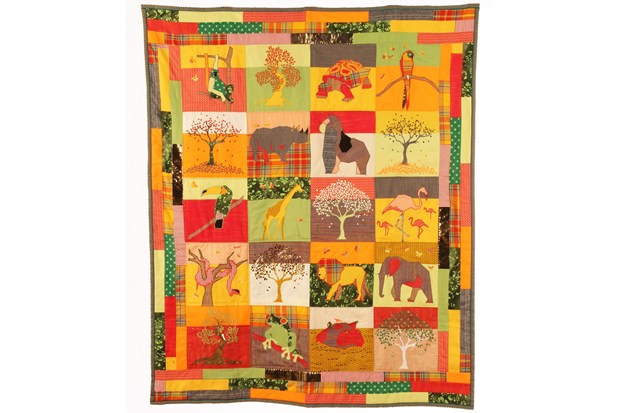
A patchwork quilt aims to combat separation issues and distress in hospitalised children by allowing them to helping them to communicate with their families using augmented reality.
Each of the quilt’s 20 squares is decorated with a unique multi-coloured animal or plant design and can be linked to an individual friend or family member. Loved ones can then leave messages for children to access with Aurasma, an app which uses the camera on a phone or tablet to recognise the unique image and overlay content — a picture, photo or video — so that it pops up on the screen.
The quilt is designed to serve as both a comforting, tactile object and a method of communication
Having fun, exciting spaces to play is important for both kids and grown-ups, so it’s nice to see what’s out there for kids, and hopefully grown-ups will follow suit.
When you’re a kid, visiting an amazing playground is the greatest experience ever. And these fantasy-themed playgrounds around the world have us wishing that we were kids again so we could run around in them like small, crazy people.
All of these are in more urban settings, and it would be cool to see some more natural playscapes, but the ideas behind some of these parks are fantastic!
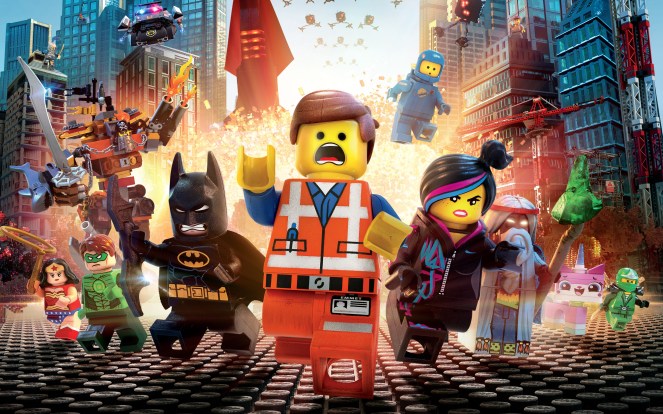
I am a huge fan of Legos, and so the little kid in me was super excited to see this movie trailer. But the more I read about it, the more the grown-up in me gets excited to. The whole premise of the movie is about fighting a bad guy who wants to keep people from getting creative with Legos and playing with them just the way they want. The goal of the heroes is to keep free play, well, free.
Photo from the Forbes review
“The Lego Movie” explores what may be the essential question of Lego building as it applies to life: Must you dutifully follow the instructions, or can you combine pieces creatively to make anything you dream up? In the animated children’s comedy, a repressive overlord voiced by Will Ferrell is so maniacal about controlling the residents of Bricksburg that he has a weapon designed to glue all the pieces of their world together, putting an end to freestyle play. Only a band of wisecracking rebels including Chris Pratt, Elizabeth Banks, Will Arnett and Morgan Freeman can stop him. The film is computer-animated but made to look as if all the scenery is built out of real Lego pieces. Everything moves in a way that simulates the stop-motion films that thousands of Lego customers have created with their pieces and posted online.
I am so excited to see a big budget movie with a lot of big budget actors devoted to promoting free-thinking free play, and some of the clips do in fact look really creative and are all about messing with your perceptions of the Lego reality!
The blogger of Illustrated with Crappy Pictures posted a couple of years ago about the differences between her childhood and her kids’ childhood, and how we are much more focused on safety, for better or for worse.
There are things I did that my kids will never do.
This type of comparison would be way more interesting coming from my grandparents who walked 50 miles barefoot uphill both ways in the snow and all that.
Still. Times have changed.
My aunt (who is only six years older than me) used to pull me in my Radio Flyer® wagon by tying a rope to her bike. On country roads. Down hills. No helmets.
But the wagon would go too fast.
And she’d yell “put the brakes on!” which actually meant “PANIC!” because there weren’t any brakes. We stopped ourselves by turning into the ditch and wiping out. It was fun.
My kids? They wear helmets at the dinner table. You know, just in case they fall off their chairs.
There are definitely some good things to avoid with her own kids, but even the author questions whether she is being too safe.
Are parents as a whole more protective these days? And where is the line drawn between good protection (seat belts and not letting your kids drink bleach) and being over-protective to where it is stifling for them. I think about this sometimes. FreeRangeKids is an excellent read if you are interested in this sort of discussion.
What are your thoughts about letting kids go out and explore on their own? Obviously some of it is determined by your local environment, like if you live in the city or a country road. But letting kids explore on their own is also crucial to good development. Tough topic.






 Mental Flowers