
behavior · emotion · psychology

The ‘Mood Graph’: How Our Emotions Are Taking Over the Web | Wired Opinion

Happy face high res
Do emoticons box you in or set you free?


More analysis and research looking into how we interact with and effect the digital space, and how that space in turn effects us, emotionally and mentally.

[Facebook, Bitly, Google+]… all these interfaces are now focusing on the emotional aspects of our information diets. To put this development in a broader context: the mood graph has arrived, taking its place alongside the social graph (most commonly associated with Facebook), citation-link graph and knowledge graph (associated with Google), work graph (LinkedIn and others), taste graph and interest graph (Pinterest and others).

Like all these other graphs, the mood graph will enable relevance, customization, targeting; search, discovery, structuring; advertising, purchasing behaviors, and more. It also signals an important shift in computer-mediated communication.

But placing a digital mood ring on users also has the power to change us — how we express ourselves. Especially when one considers that the data populating mood graphs comes from our encounters with behavior-altering interfaces packaged as fun little emojis and innocuous, “handy-dandy buttons”…

…drop-down expression makes us one-dimensional, living caricatures of G-mail’s canned responses — a style of speech better suited to emotionless computers than flesh-and-blood humans. As Marshall McLuhan observed, just as we shape our tools, they shape us too. It’s a two-way street.

more via The ‘Mood Graph’: How Our Emotions Are Taking Over the Web | Wired Opinion | Wired.com.

The author of the opinion, Evan Selinger, is a Fellow at the Institute for Ethics and Emerging Technology who focuses on the collisions between technology, ethics, and law.

He seems hell bent against putting a happy face next to his Facebook post, and I hear what he’s saying about the dangers of trying to sum up a concept with a parenthesis or semicolon. And I agree that companies are offering these emoticon options often just so they can collect more data on their users, rather than be focused on helping their customers express themselves more fully.

But, as Selinger also points out, spoken language itself can be nuanced and tricky, in the digital or non-digital world, and it can be nice to have more tools to express yourself in the digital space. People also post songs or pictures in order to share their mood or sentiment with others.

I feel that these are enhancements for people to share more ideas, not have them boxed in. Sometimes creativity is aided with a few rules. All language has restrictions, whether you’re coding or signing or chatting. Yes these restrictions should be recognized, but not

Do you feel that a smiley face or frowny face limits your ability to communicate and express yourself with others online? Leave your thoughts in the comments below.

behavior · emotion · happiness

Get in the Habit of Being Happy

Brain chemistry is a powerful thing, and as much as environments can shape our happiness, more research is finding we can consciously influence happiness.

Martin Seligman, the father of positive psychology, theorizes that while 60 percent of happiness is determined by our genetics and environment, the remaining 40 percent is up to us.

In his 2004 Ted Talk, Seligman describes three different kinds of happy lives: The pleasant life, in which you fill your life with as many pleasures as you can, the life of engagement, where you find a life in your work, parenting, love and leisure and the meaningful life, which “consists of knowing what your highest strengths are, and using them to belong to and in the service of something larger than you are.”

After exploring what accounts for ultimate satisfaction, Seligman says he was surprised. The pursuit of pleasure, research determined, has hardly any contribution to a lasting fulfillment. Instead, pleasure is “the whipped cream and the cherry” that adds a certain sweetness to satisfactory lives founded by the simultaneous pursuit of meaning and engagement.

And while it might sound like a big feat to to tackle great concepts like meaning and engagement (pleasure sounded much more doable), happy people have habits you can introduce into your everyday life that may add to the bigger picture of bliss. Joyful folk have certain inclinations that add to their pursuit of meaning — and motivate them along the way.

Some of my favorites:

  • They unplug
  • They make exercise a priority.
  • They go outside.

Continue reading at  Huffington Post for the full list.

This is certainly something I strive for rather than achieve as much as I’d like, but the idea of cultivating your own happiness is an important one. Even giving the agency back to ourselves to be happy, rather than waiting for the right environment, job, or person to come along to make us happy, has been found to make us happier.

So go get happy. 🙂

behavior · children · creativity · family · play

Goodbye screen time, hello awesome kid | Offbeat Families

A great example of how letting your kid have free play, and encouraging it over screen time, can have wiiiiide reaching positive consequences.

Four months ago, I told my husband that we needed to cut out all screen time during the week. While he understood the merits of the proposal, he balked at the logistics, telling me that there was no way that he could handle morning routine alone without television (to accommodate preschool hours we stagger our work schedules, with one parent leaving an hour or two before the other). I disagreed, and, being the bull-headed lady that I am, waited him out until he agreed to a screen-free weekday existence on a trial basis.

To prepare for the transition, I devised a series of “Mystery Boxes” for each day of the week. These boxes were stacked on the table each morning, and Uli got to choose one for each morning. Inside, I placed a project or special toy that would keep him occupied while Dad showered and fixed breakfast. One morning it was a Spider-Man puzzle, the next colored pencils and pictures I’d drawn for him to color. All of the toys or projects were sourced from forgotten objects in his toy box or from our craft and art supplies. His favorite Mystery Box item, though, was an old digital camera that he used to snap the most unflattering photos that have ever existed of myself and his father.

We only used the Mystery Boxes for about two weeks, and after that Uli was able to play in a more self-directed and creative manner than he ever was able to when he had weekday screen time. We were actually shocked by how quickly he adjusted to the no-tv-during-the-week proclamation. His teachers at school also noticed a difference, telling us that Uli was more engaged than he had been previously — a side benefit we hadn’t expected.

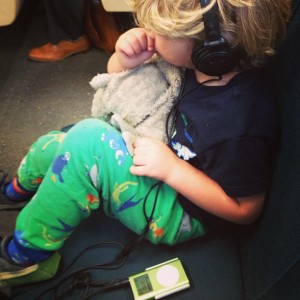
And in August, Uli and I took our first long plane trip without the iPad — including one fourteen-hour travel day. His dad had loaded a nine-year-old iPod with Uli’s favorite songs, which amused him for most of the plane trip, and in the airport, he did relay races in the terminal. It was a really successful experiment, and we have no plans to use the iPad again for travel.

read more about Uli’s transition via Goodbye screen time, hello awesome kid | Offbeat Families.

What have you done to encourage free play for your kids or yourself? Share in the comments below.

anthropology · behavior · brain · community · emotion · happiness · mental health · Social

Social Media Isolates But Also Binds

Flickr friends
How many of your virtual friends would you actually invite over for lunch? (Photo credit: Meer)

Does social media make us feel more or less connected? How does connecting and communicating in a digital space impact us differently than connecting and communicating in a physical space?

There are mixed results from various studies, but recently more studies have come out finding that we actually feel less connected to each other the more we use social media like Facebook:

Kross found that the more people used Facebook, the less happy they felt—and the more their overall satisfaction declined from the beginning of the study until its end. The data, he argues, shows that Facebook was making them unhappy.Research into the alienating nature of the Internet—and Facebook in particular—supports Kross’s conclusion. In 1998, Robert Kraut, a researcher at Carnegie Mellon University, found that the more people used the Web, the lonelier and more depressed they felt. After people went online for the first time, their sense of happiness and social connectedness dropped, over one to two years, as a function of how often they used the Internet.Lonelier people weren’t inherently more likely to go online, either; a recent review of some seventy-five studies concluded that “users of Facebook do not differ in most personality traits from nonusers of Facebook.”

But, as with most findings on Facebook, the opposite argument is equally prominent. In 2009, Sebastián Valenzuela and his colleagues came to the opposite conclusion of Kross: that using Facebook makes us happier. They also found that it increases social trust and engagement—and even encourages political participation. Valenzuela’s findings fit neatly with what social psychologists have long known about sociality: as Matthew Lieberman argues in his book “Social: Why Our Brains are Wired to Connect,” social networks are a way to share, and the experience of successful sharing comes with a psychological and physiological rush that is often self-reinforcing. The prevalence of social media has, as a result, fundamentally changed the way we read and watch: we think about how we’ll share something, and whom we’ll share it with, as we consume it. The mere thought of successful sharing activates our reward-processing centers, even before we’ve actually shared a single thing.

Virtual social connection can even provide a buffer against stress and pain: in a 2009 study, Lieberman and his colleagues demonstrated that a painful stimulus hurt less when a woman either held her boyfriend’s hand or looked at his picture; the pain-dulling effects of the picture were, in fact, twice as powerful as physical contact.

more via How Facebook Makes Us Unhappy : The New Yorker.

So what does this all mean? That we are complicated. And so is how we use social media.

“What makes it complicated is that Facebook is for lots of different things—and different people use it for different subsets of those things. Not only that, but they are also changing things, because of people themselves changing,” said Gosling. A 2010 study from Carnegie Mellon found that, when people engaged in direct interaction with others—that is, posting on walls, messaging, or “liking” something—their feelings of bonding and general social capital increased, while their sense of loneliness decreased. But when participants simply consumed a lot of content passively, Facebook had the opposite effect, lowering their feelings of connection and increasing their sense of loneliness.

I have seen forums used to create physical communities (I don’t want to say “real world” because virtual is real, it’s really happening) and create friendships that crossed continents, but I have also heard of and seen virtual bullying that in some very sad cases led to a person’s death. We can be cruel to others by hiding behind that veil of anonymity, or even just by creating a lack of physical presence which also creates a mental separation which makes it easier for us to feel isolated or intentionally isolate others. But we also want to share and connect with others, even if we can’t be physically near them, and share very intimate details with people we may not otherwise have given the time of day, which can be a good or bad thing depending on the context and situation.

How do you use social media? Does it make you feel more connected to your tribe, or do you feel left out or perhaps even more isolated? Do you bridge the gap between your virtual world and physical world, or does the slogan “What happens in Vegas stays in Vegas” also apply to your social media and physical lives? Leave your thoughts in the comments below.

behavior · children · environment · happiness · Nature

Make-A-Wish, Woodland Park Zoo grant a child’s wish to play with animals.

When 2 1/2-year-old Rylee, a Make-A-Wish Alaska and Washington kid, said she loved animals, we wanted to give her an unforgettable day at Woodland Park Zoo. Two weeks ago, Rylee arrived in a stretch limo, fed elephants Chai and Watoto, pet and fed the goats, pigs and bunnies, enjoyed a picnic and rode the carousel—and had a wonderful time sharing it all with her family. We’re so sorry to learn that Rylee has since passed. But we know that while we gave Rylee and her family the gift of nature, they gave us the gift of sharing one of Rylee’s last days with her. Go outside and play today—nature and time are gifts we should all treasure together. (Photo: Jessica Johnny Photography)

Photo: When 2 1/2-year-old Rylee, a Make-A-Wish Alaska and Washington kid, said she loved animals, we wanted to give her an unforgettable day at Woodland Park Zoo. Two weeks ago, Rylee arrived in a stretch limo, fed elephants Chai and Watoto, pet and fed the goats, pigs and bunnies, enjoyed a picnic and rode the carousel—and had a wonderful time sharing it all with her family. We’re so sorry to learn that Rylee has since passed. But we know that while we gave Rylee and her family the gift of nature, they gave us the gift of sharing one of Rylee’s last days with her. Go outside and play today—nature and time are gifts we should all treasure together. (Photo: Jessica Johnny Photography)

Biophilia is amazingly strong for all kids, and it’s simultaneously wonderful and heartbreaking that this was a little girl’s last wish.

behavior · children · creativity · emotion · health · play · psychology

Tiny superheroes combat big challenges with capes made by Seattle mom | Local News | The Seattle Times

Robyn Rosenberger makes capes for only the fiercest of fighters.

Have you ever had days where you felt you had super powers, or felt you needed them? One woman in Seattle is making that a reality for over 1,700 kids with illnesses and disabilities in 50 states and 14 countries, with a new workshop opening to help out more kids:


Gabby has epilepsy and is completely dependent: She cannot talk, walk or eat on her own. But she is a tiny superhero — her superpowers include perseverance, courage and strength — and she has the cape to prove it. A purple number, with a blue letter “G” hand-sewn on by Robyn Rosenberger.

Rosenberger is the powerhouse behind TinySuperheroes, which makes capes as a form of empowerment. “Our mission is to empower these kids to feel as extraordinary as we see they are,” Rosenberger explained.


via Tiny superheroes combat big challenges with capes made by Seattle mom | Local News | The Seattle Times.


On the surface this may seem a little fluffy, but it exemplifies the power of play, particularly imaginary play and pretending.  First, it gives the kids a chance to take a break from their illness and maybe laugh a little, which is good for everyone.  Second, the crazy thing is researchers are finding that by pretending to be big, strong, dominant, and super-hero-esque, it can train your body to actually be more strong, dominant, and super-hero-esque. Even healthy kids can feel pretty powerless, so by imagining what it feels like to be strong and healthy it can help their minds and bodies map out what that might look and feel like and maybe even help along the road the recovery.


So by giving these kids superhero capes, these volunteers are in fact giving these kids some pretty strong medicine.


Now I want a cape, or at least a magic wand.

If you are interested in helping out, visit the Tiny Superheroes site.


behavior · children · disease · environment · happiness · health

Why adult hospitals should be more like children’s hospitals – FierceHealthcare

My hospital has a goat 120/365
One hospital has a goat on their property that patients can see. One way to keep things engaging and fun and not feel like “a hospital.” (Photo credit: Jen R)

It’s not as silly as it sounds; in fact it’s genius!

Hospitals could improve patients’ quality of life, satisfaction and even health outcomes if they simply model adult hospitals after the ones designed for children, according to an opinion piece written by a fourth-year medical student in this week’s Journal of the American Medical Association.

Mark A. Attiah, who attends Perelman School of Medicine at the University of Pennsylvania in Philadelphia, writes in the piece, “Treat Me Like a Child,” that adult hospitals should take a page from pediatric facilities by creating surroundings that distract and reduce stress and making clinical practices more patient- and family-oriented rather than more convenient for caretakers.

Attiah was inspired to write the opinion piece after encounters with two pediatric patients during a rotation and another who transitioned into an adult hospital, according to an announcement about the editorial. The children’s hospital was bright, had longer visiting hours and allowed families to stay at the child’s bedside throughout the night. In addition, pediatric patients enjoyed the distractions of group activities, arts and crafts, and concerts. “If I ever get sick, I’d want to be taken here,” he writes.

more via Why adult hospitals should be more like children’s hospitals – FierceHealthcare.

Kid’s hospitals keep stuff light, upbeat, and optimistic. which is exactly what we need to get healthier, and want to go back to a particular hospital for our next ailment, since most hospitals care about that sort of thing.

behavior · brain · creativity · disease · happiness · mental health · Nature · play · psychology

10 Simple Things You Can Do Today That Will Make You Happier, Backed By Science – The Buffer Blog

I think I’ve talked about ALL of these tips individually on the blog before, so I’m thrilled that somebody combined them into a “Top 10 With Science!” post:


Happiness is so interesting, because we all have different ideas about what it is and how to get it. It’s also no surprise that it’s the Nr.1 value for Buffer’s culture, if you see our slidedeck about it. So naturally we are obsessed with it.

I would love to be happier, as I’m sure most people would, so I thought it would be interesting to find some ways to become a happier person that are actually backed up by science. Here are ten of the best ones I found.

1. Exercise More (7 minutes might be enough)

2. Sleep More

read all 10 Simple Things You Can Do Today That Will Make You Happier, Backed By Science – The Buffer Blog.

I particularly like suggestion #5.

behavior · community · creativity · work

Organize an Office Recess and Create Your Own Game | Play on GOOD

Yes! I’m in!

When you think of our everyday endeavors and going through life as adults, we’re not really encouraged to be playful. But when we play games, we relax and become more receptive and less judgmental. Games trigger our creative juices—through solving problems, navigating complex systems and managing resources. They present us with hard problems; like solving a puzzle or defeating a boss. As players we need to be creative and come up with good ideas to solve those problems. They make us more playful in our way of being and experiencing life. Best of all, games bring us together. Go ahead, organize an office recess and create your own game—and use the toolkit at the link to help get you started.

sign up and find out more at Organize an Office Recess and Create Your Own Game | Play on GOOD.

behavior · community · happiness · Nature

The tent is too damn high: Camping comes to the city

Using some creativity, playfulness, and friends to bring “nature” and community to the city? Yes, please!