behavior · children · environment · health · play

The Value of Unstructured Play Time for Kids – Pacific Standard: The Science of Society

This is a nice study that looks at the value for kids, but unstructured creative and/or play time is important for adults AND kids.

German psychologists find people who were allowed to play freely as children have greater social success as adults.

There has been plenty of hand-wringing in recent years about the “overscheduled child.” With after-school hours increasingly dominated by piano lessons, soccer practice, and countless other planned activities, many of us have a nagging sense that kids are missing out on something important if they have no time for unstructured play.New research from Germany suggests these fears are justified. It finds people who recall having plenty of free time during childhood enjoy high levels of social success as adults.

A team of three psychologists from the University of Hildesheim, led by Werner Greve, conducted a survey of 134 people. Participants were presented with a list of seven statements and reported the degree to which they conformed with their own childhood experiences that is, ages three to 10.

read the rest of the article via The Value of Unstructured Play Time for Kids – Pacific Standard: The Science of Society.

behavior · brain · cognition · creativity · environment · happiness · health · Nature · work

Why You Should Take Your Work Outdoors

Happy Friday. I got to start off my work day sitting on my back patio drinking coffee. Here’s why more people should do the same.

Do you feel stifled by the four walls of your office or cubicle?

There’s a reason for that.

Trapping ourselves indoors has created what health experts call a “nature deficit disorder” — depression or anxiety resulting from too little time spend outside. Getting outdoors can do great things for your health. Reducing stress, lowering blood pressure and improving immune function are among nature’s health benefits. What’s more, incorporating elements of nature into your workday can also give your brain a boost, resulting in increased productivity, focus and creativity.

Harvard physician Eva M. Selhub, co-author of Your Brain on Nature, says a drop of nature is like a drop of morphine to the brain, since it “stimulates reward neurons in your brain. It turns off the stress response which means you have lower cortisol levels, lower heart rate and blood pressure and improved immune response.”

Turning off the sensors that are involved in the stress response allows the higher brain centers to be accessed, resulting in increased concentration, improved memory, greater creativity and productivity and reduced mental fatigue. While Selhub says spending 20 minutes a day outdoors is recommended, studies have shown even looking at photographs of nature can deliver some of the same cognitive benefits as physically being outdoors. A 2008 study at the University of Michigan showed students who looked at photos of nature performed better on tests of attention and working memory than those who looked at photographs of urban scenes.

More reasons, and tips how, via Entrepreneur Magazine

behavior · environment · happiness · health · mental health · Nature · play

Philadelphia Zoo lets tigers stretch legs on trail – The Washington Post

THIS. IS. SO. COOL!

Not just for visitors, but for the animals!

tiger shot

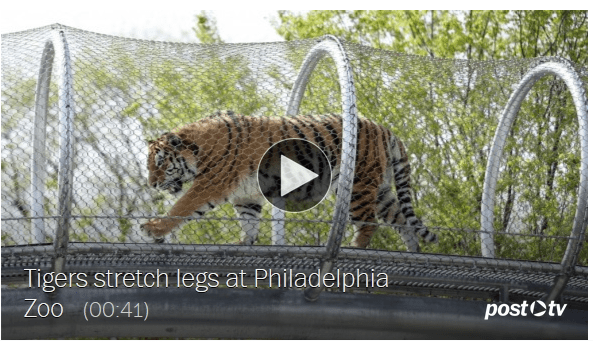
Visitors to the Philadelphia Zoo might want to beware of stray cats: A new enclosed passageway allows lions and tigers to roam outside their exhibits.

Humans, though, can safely gawk at the predators traveling along Big Cat Crossing. The protected, open-air path snakes above the felines’ habitat to an archway over the zoo’s main promenade and ends at a viewing spot along a lake.

The concept for the catwalk unveiled Wednesday stems from the increasingly common practice of animal rotation, which lets animals take in new stimuli while visitors encounter them in unexpected places.

more via Philadelphia Zoo lets tigers stretch legs on trail – The Washington Post.

Big carnivores are roamers, and prefer to have lots of space to patrol. Being able to get a cat’s eye view of their zoo is so much healthier for them, and gives them the enrichment and psychological and physical space they need to stay healthy.

I had heard about the plans to create this space, so it’s really nice to see it implemented and in action.

anthropology · architecture · behavior · community · creativity · culture · environment

The Playful City – Azure Magazine

A great article about how building playful spaces leads to more, and better, play.

Can playgrounds make kids smarter? Yes, say the experts, and landscape architects everywhere are responding. Welcome to outdoor play’s new reality.

All work and no play makes jack a dull boy. Granted, Jack does not lack for innovative toys and gadgets. But what Jack really needs is better playgrounds. These days, reality is exchanged for a simulation of reality, and the sandbox is abandoned in pursuit of the virtual. Cognitive scientists, however, are finding that the unstructured activity children engage in at the playground fosters the social and intellectual abilities they need to succeed in life. Monkey bars and swing sets present opportunities to develop new skills, encourage autonomous thinking and promote flexible problem solving – but they also shape the brain. This is good news. With technology taking over so much of our lives, increased pressure on children to compete academically at a much younger age, and helicopter parenting restricting play for fear of potential danger, many experts – such as David Elkind, psychologist and author of The Hurried Child – are drawing attention to the “reinvention of childhood.” It is time we also reinvent the playground.

more via The Playful City – Azure Magazine.

behavior · brain · children · cognition · creativity · culture · happiness · health · mental health · psychology · Social

20+ Drawing Ideas and Activities | picklebums.com

Staying playful and creative sometimes requires going back to your roots, or at least your crayons. Drawing, scribbling, doodling, and coloring have all been found to help with destressing, thinking out ideas and problems, and keep brains active into old age.

Drawing is also a great learning activity with lots of fine motor skill and development, problem solving, language development and social learning opportunities… (Editor’s note: all of which tie into the above-mentioned benefits, and these skills are all useful for both grownups and kids to practice and refresh on a regular basis).

Drawing is a way for children everyone to process their world, to represent and share their ideas and to explore new skills and information.

Drawing with Geometry Tools
Graph Paper Drawing
Graph Paper Drawing
Collaborative Doodle Drawings

see all 20+ Drawing Ideas and Activities at picklebums.com.

If you think this is just “kid’s stuff” I dare you to try some of these, especially the collaborative drawing exercise. It’ll (potentially) expose some growth areas of yourself and/or others very quickly. 😛

behavior · children · community · environment · family · Nature · play

Grab a copy of 21 Days in the Woods and start a group session | Elisabeth M. Stone

We’re too late to join Elisabeth Stone on her group session she had back in February, but I still loved this idea of making a 21 day challenge to get outside!

21 Days in the Woods Poster

21 Days in the Woods is a connection project to get you and your family out in the woods once a day for 21 days. It is well-structured and adaptable to any age range. When you purchase your immediate download of the workbook, you can choose to work through it now or later

more via Grab a copy of 21 Days in the Woods and join us for a group session on February 1st. | Elisabeth M. Stone.

April has just started, and it’s starting to feel more and more like Spring, so take a look and see about how you can challenge yourself to get out into the woods.

behavior · children · community · creativity · health

Anti-loneliness augmented quilt comforts children in hospital (Wired UK)

An older article, but too charming and innovative not to share on the blog:

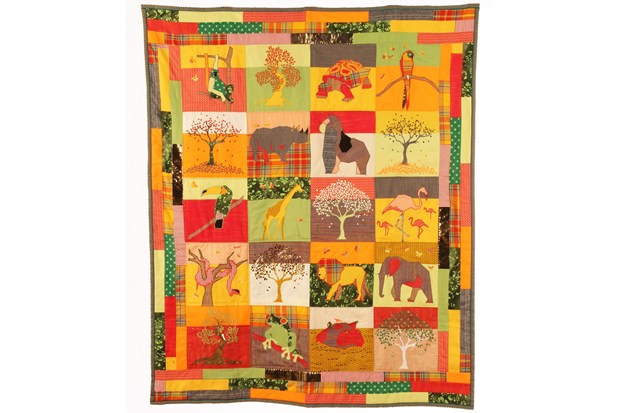
A patchwork quilt aims to combat separation issues and distress in hospitalised children by allowing them to helping them to communicate with their families using augmented reality.

Each of the quilt’s 20 squares is decorated with a unique multi-coloured animal or plant design and can be linked to an individual friend or family member. Loved ones can then leave messages for children to access with Aurasma, an app which uses the camera on a phone or tablet to recognise the unique image and overlay content — a picture, photo or video — so that it pops up on the screen.

The quilt is designed to serve as both a comforting, tactile object and a method of communication

more via Anti-loneliness augmented quilt comforts children in hospital (Wired UK).

behavior · community · creativity · culture · environment · happiness · play

An Artist’s Quest: To Force Strangers In Cities To Talk To One Another | Co.Exist

Sometimes all it takes is one person to start a neighborhood to start talking and engaging with one another. Someone moves in and throws an open house. Or even a garage sale. So how can art, or an artist, inject “love and play” into a community, particularly when the younger generations trust each other less than ever before?

San Francisco-based artist Hunter Franks is on a three-week mission across several different cities to explore just that, and hopefully get some “creative intervention” going in these urban areas.

An Artist's Quest: To Force Strangers In Cities To Talk To One Another | Co.Exist | ideas + impact

One Franks’s planned activities is something called “Vacant Love,” which aims to transform abandoned or neglected buildings with messages of affection. Another, called the “Free Portrait Project” asks residents to sit for a Polaroid photo taken by Franks, and during the 120 seconds it takes for the picture to develop, entertain a brief interview about their lives. Other interventions include two-way advice booths, for citizens to both give and take advice from one another, as well as an activity that asks people to write sticky notes about their loves and fears on a public wall. Franks will also be expanding his SF Postcard Project, in which he gathered postcards written from low-income San Francisco neighborhoods and mailed them to homes in ritzier ZIP codes.

more via An Artist’s Quest: To Force Strangers In Cities To Talk To One Another | Co.Exist | ideas + impact.

What activities have you seen, or even been engaged in, that got a neighborhood members involved and communicating? For some, even a Little Free Library can get the ball rolling. Tell us your experiences in the comments below.

anthropology · behavior · cognition · work

Inspire Creativity at Work With All 5 of Your Senses | Mashable

Work IS  a fully engrossing experience, so why not enhance all of those experiences?

You’ve probably heard of the debate about whether open offices or the oh-so-dreaded traditional cubicles are better in the workplace. All these discussions revolve around layout and arrangement, but did you know that ambience is equally (if not more) important for inspiring workplace creativity?

If only the interior designer had known that people working in white offices are more likely to complain of nausea and headaches, or that dim lighting jump starts creative freedom, your office might be a much happier place. In fact, the best offices engage all five senses — everything from colors and music to smells and tastes — to maximize your productivity and creativity.

Read the infographic below to decode why your office might be holding you back, and discover small things you can do to unleash your team’s creative powers in no time.

more via Inspire Creativity at Work With All 5 of Your Senses.

behavior · happiness · play

The Secret Lives Of Cows: Jumping For Joy : The Salt : NPR

People often interpret animal behaviors as one thing when in fact it’s something different. But in this case, frolicking is indeed frolicking.

It turns out “cows love a change of scenery. And a switch from the concrete floors of the indoors to a soft green pasture would surely help break a bovine’s winter blues.

In fact, cows are suckers for novelty, adds de Passille’s colleague, . They get an extra spring or leap in their step “whenever something new or unexpected happens,” he says – say, changing their bedding or letting them out or back in. “We think it’s a sign that things are well with them.”

more via The Secret Lives Of Cows: Jumping For Joy : The Salt : NPR.