behavior · brain · cognition · creativity · learning · play

Why we need play and relaxation to think

Recreated :File:Neuron-no labels2.png in Inksc...
These little guys need a break just like your muscles. Image via Wikipedia

The brain is an amazing thing. It allows us to problem solve, combine ideas, and create out of seemingly thin air. But only if we let it.

As a play advocate, I run into a lot of people grumbling that play takes away from learning; but the fact of the matter is, play is ESSENTIAL to the learning process. More and more science is showing that the brain needs that down time to process what it’s learned, digest it a little bit, in order for us to use it for any useful purpose.

People who study creativity and innovation are aware of this all too well:

Current neuroscience research confirms what creatives intuitively know about being innovative: that it usually happens in the shower. After focusing intently on a project or problem, the brain needs to fully disengage and relax in order for a “Eureka!” moment to arise. It’s often the mundane activities like taking a shower, driving, or taking a walk that lure great ideas to the surface. Composer Steve Reich, for instance, would ride the subway around New York when he was stuck.Science journalist Jonah Lehrer, referencing a landmark neuroscience study on brain activity during innovation, writes:

“The relaxation phase is crucial. That’s why so many insights happen during warm showers. … One of the surprising lessons of this research is that trying to force an insight can actually prevent the insight.”

keep reading the Developing Your Creative Practice: Tips from Brian Eno :: Tips :: The 99 Percent to hear Brian Eno’s take on creativity and how he puts his brain to work.

It’s nice to see that science is finally taking relaxation and play seriously. I just wish the rest of the world, or at least our education system, would too. I know my work would benefit greatly if I took time to just relax and contemplate things more, to relax and let my brain explore a little bit. Hmmm, another exercise to try…

behavior · brain · happiness · health · Me · mental health

June is “Me” month

Cardio Boxing Group Fitness Class
This month, kick your self-maintenance into high gear! Image via Wikipedia

Interested in joining me for a little “me” time? How about a whole month of it?

My mother and I have decided that for June, 2011, we are going to be totally self-centered. That’s right, we are going to focus entirely on ourselves; our health, our mental wellness, our physical fitness, taking time for ourselves, and figuring out what we want out of life. Neither one of us is very good at this kind of self-focused behavior, so it will be an interesting experiment to see if we can both pull it off.

So far I have done pretty good: I woke up early and did a productive, challenging workout, I have eaten quite healthy meals (oatmeal with raisins and a tuna salad, thank you very much!), did not spend an exhorbitant amount of time at work, tidied up some stuff online I’ve been meaning to do, finally asked my boss about a couple of nagging issues, and am planning to spend time doing fun stuff with my husband before going to bed at a reasonable hour. I actually started a day early yesterday and bought new clothes (some new, some new-to-me) that made me look and feel good, and had a decent dinner. Pretty good track record for only a day and a half.

I invite everyone to join me for “Me” month. If you can’t do a whole month, maybe choose a week. Or even one day a week. This isn’t about indulging in your every whim or being hedonistic or a narcissist. It’s about taking care of yourself for an extended period of time. Getting enough sleep. Eating healthy food, and not too much. Moving around, getting exercise. Figuring out who and what you want to spend more time on and DOING it!

We all have things we could be better at for self-maintenance, and often we take a lopsided approach. Some people focus entirely on what they put in their bodies, some only focus on how their body or mind performs, paying no attention to the other side. But we are all one big giant package of tissue and firing neurons, and all of it needs to be taken care of, not just the muscles OR the brain OR some other feature (your hair?).

Recently I asked what your deathbed regrets would be, so think of this as the next step: what can you do today to take better care of yourself, to make sure you don’t have those regrets, or at least delay that deathbed a bit more? I know some very healthy, well-rounded people, so I’m curious to see what they secretly think they need to work on.

Take some time to think about what your body and mind really need, unless you already know, and leave it in the comments below.

behavior · children · community · creativity · health · play

6 Ways To Get Kids Outside And Moving This Summer, suggested by Kaboom

KaBOOM! CEO Darell Hammond
Kaboom CEO Darrel Hammond (told ya' it wasn't the SNL guy!) Image via Wikipedia

It doesn’t really feel like summer here in the Pacific Northwest yet, but we’re already scheduling picnics and camping trips and weddings and all kinds of outdoor activities in hopes of the weather getting nice. But there are more ideas for getting outside than (hopefully not) tedious nuptials or a forced march uphill. Darrel Hammond, CEO of Kaboom (not the SNL guy), has some ideas specifically for families:

Summer should be a time for roaming, discovering and running outside — but unfortunately, for all too many kids, more free time means more screen time and more structured activities.

It’s up to you to ensure that your kids get a healthy daily dose of unstructured outdoor play. Here are six ways to get your children moving, nurture their creativity and provide them with all the rich learning opportunities that outdoor play presents. In the process, you’ll meet new neighbors and contribute to a nationwide movement to save play.

Suggestion #4: Close a street for play. I’ve actually seen several neighborhoods around town grab a permit for the afternoon to close down their street and have a block party. Some cities are probably easier to work with than others, but the idea of a block play party sounds fabulous!

We all need a little push to get out the door (especially when it’s too hot, too cold, too windy, not windy enough, etc.), so having a planned event or project like this can be very useful.

more suggestions by Darell Hammond: 6 Ways To Get Kids Outside And Moving This Summer.

Kaboom! is a play-focused non-profit that is working to ensure that every child has a great place to play within walking distance of their school or home. They certified a playground here on Mercer Island, WA, and are working to install or certify others all over the U.S. Another idea to get your kids out and active: help build a playground!

behavior · happiness · Me

The top 5 regrets people make on their deathbeds – inspired by Lifehacks

WLA moma Henri Rousseau The Dream 3
People's #1 deathbed regret: not being true to themselves. Image via Wikipedia

They say hindsight is 20/20, and I find it very informative to find out what people wish they had done or are very happy they did, either at the end of a school year or sitting in a rocking chair on a porch in retirement. So this bit of anecdotal evidence is interesting, and while none of the regrets are surprising it’s good affirmation of what people’s priorities in life should be.

…the following regrets were first posted in The Observer in 2010, and we’ve recopied them for you here below. But instead of just the grandmotherly bits of advice about dreams having gone unfulfilled, we’ve supplemented each regret with some rockstar advice on how to not have these regrets in the digital age.

1. I wish I’d had the courage to live a life true to myself, not the life others expected of me.

This was the most common regret of all. When people realise that their life is almost over and look back clearly on it, it is easy to see how many dreams have gone unfulfilled. Most people have had not honoured even a half of their dreams and had to die knowing that it was due to choices they had made, or not made.

It is very important to try and honour at least some of your dreams along the way. From the moment that you lose your health, it is too late. Health brings a freedom very few realise, until they no longer have it.

TNW Advice: We interview so many entrepreneurs here at The Next Web, some of whom will succeed, most of whom will fail. But it’s about going out and creating a reality out of what was once just an idea in your head.

read all 5 regrets, plus the added bits of TNW advice at The top 5 regrets people make on their deathbeds – Lifehacks.

What the five regrets basically constitute are making time for themselves, their friends and family, taking risks rather than playing it safe, and just giving space in their lives for happiness.

This is a really good exercise to do at any time, to see if you’re really living the life you want and what you can do to change it.

If you were told you were going to die tomorrow, this evening, whatever, what would your regrets be?

Mine would be:

1. Not taking that hiking vacation through Europe.

2. Not taking a sabbatical, more time for me.

3. Not finishing my thesis.

4. Not spending more time with my sister the last couple of years before she died, which translates into generally just spending more time with others I love before they kick the bucket.

5. Not starting a family.

anthropology · behavior · culture · disease · health

Workplace Cited as a New Source of Rise in Obesity – NYTimes.com

Gli stand - FORUM PA 2011
The amount of physical activity in a typical work day has changed dramatically in the past 50 years. Image by Forum PA via Flickr

To be perfectly honest, I have gained a significant amount of weight since starting my new job in November. I avoid the free sodas but can’t resist the occasional free chocolate, and combined with being chained to my computer for typically 10 hours at a time (or more) BOY is it adding up. And apparently I am not alone:

A sweeping review of shifts in the labor force since 1960 suggests that a sizable portion of the national weight gain can be explained by declining physical activity during the workday. Jobs requiring moderate physical activity, which accounted for 50 percent of the labor market in 1960, have plummeted to just 20 percent.

The remaining 80 percent of jobs, the researchers report, are sedentary or require only light activity. The shift translates to an average decline of 120 to 140 calories a day in physical activity, closely matching the nation’s steady weight gain over the past five decades, according to the report, published Wednesday in the journal PLoS One.

Today, an estimated one in three Americans are obese. Researchers caution that workplace physical activity most likely accounts for only one piece of the obesity puzzle, and that diet, lifestyle and genetics all play important roles.

more via Workplace Cited as a New Source of Rise in Obesity – NYTimes.com.

Thankfully there are things I can do at work, like adjust my desk so that I can stand instead. I often take breaks to wiggle or stretch, and I get a discount at several local gyms. But this is not enough, and if we want to not have to pay for workers’ lifestyle-induced health problems, from obesity to carpal tunnel syndrome, we need to encourage businesses to improve health in the workplace!

For starters, no free candy and less hours expected of your workers! You’ll get more productive workers, really really!

architecture · behavior · brain · community · design · disease · environment · health

A Better Way to Fight Obesity: New, Smarter Supermarkets | The Atlantic

"The New Fred Meyer on Interstate on Lomb...
Image via Wikipedia

I heard an interview on the radio today with Rupal Sanghvi, the founder of HealthxDesign (“Healthy By Design”), an initiative she launched in 2010 after a decade of work with the International Planned Parenthood Federation.

During her years in the field, Sanghvi observed numerous instances in which people developing public health solutions overlooked contextual factors that were contributing to the problem. In clinics, for example, she saw how redesigning ventilation systems, retrofitting inefficient lighting, or choosing different building materials could improve
treatment conditions and accessibility, but these things were rarely addressed. Likewise, in supermarkets, features like store layout and air temperature can influence purchasing decisions, but food access initiatives often stop short of such nuances of structural design.

“Standard supermarkets are designed to promote consumption of foods that are high in sugar and preservatives,” explains Sanghvi, “because those are the high-margin items that maximize profit.” According to current guidelines, in an average 10,000-square-foot supermarket, only 500 square feet must be utilized for fresh produce. If the U.S. spends millions to build supermarkets according to the conventional mold, she argues, we may see some improvement in public health simply as a result of increased access to food, but we stand to achieve far better outcomes if we first reconsider supermarket design itself.

more via A Better Way to Fight Obesity: New, Smarter Supermarkets – Sarah Rich – Life – The Atlantic.

This is a great point being made about how our environment has a huge impact on our behavior, as well as corporate responsibility for health and wellness, and not just profits. This seems especially important for food stores, and I’m glad to see somebody taking up the cause.

Related:

Supermarket “Video Game” Designed to Help Shoppers Buy Healthier Food

architecture · behavior · culture · design · environment · happiness · Nature

Seattle has too many bleak public spaces | Crosscut.com

Seattle Skyline view from Queen Anne Hill.
View of Seattle's city skyline. In such a gorgeous part of the U.S., Seattle itself is lacking in pretty public spaces. Image via Wikipedia

In case y’all hadn’t noticed yet, I’m a huge proponent of utilizing public space for community use and creating an overall aesthetically pleasing environment for people. Cities have one of the greatest opportunities to provide that for their citizens. So I was thrilled when I read this article in Crosscut Magazine arguing the same thing, specifically for my hometown of Seattle.

Our landscape-oriented mindset should have been good preparation for what we need in the densifying city now, which is more design intelligence given to the open spaces between buildings — plazas, parklets, and awkward leftovers like the places under freeway overpasses. The more the air space around us becomes stuffed with architecture, the more acutely we need the relief of thoughtfully landscaped open spaces on the ground. Arguably, these spaces are more important in the built environment than most buildings because they’re public — people use them.

Or if they’re emotionally cold, dreary, or austere, people don’t use them, which is the case with a number of Seattle’s precious open spaces. On one of our desperately rare sunny spring days this month, I visited about a dozen open spaces in the dense city and found — no surprise — the bleak ones practically unused and the beautiful ones full of life. What is surprising is that we’re not demanding more graceful, humane, imaginative design — and raising hell over trends such as Seattle Parks and Rec’s inexplicable new fascination with concrete and gravel.

The article goes on to provide examples and suggest different fixes for a couple of spaces. More via Why does Seattle have so many bleak public spaces? | Crosscut.com.

behavior · community · culture · environment · happiness · Social

“The Economics of Happiness” documentary argues buying local will save the planet, ourselves

Helena Norberg-Hodge
Helena Norberg-Hodge, director of "The Economics of Happiness" and founder of ISEC. Image via Wikipedia

I am a huge fan of buying local (although I could be a lot better at it). This film makes an interesting argument that buying local is not only good for the environment and the local economy, but also connects us back to our spiritual sense of community.

Economic globalization has led to a massive expansion in the scale and power of big business and banking. It has also worsened nearly every problem we face: fundamentalism and ethnic conflict; climate chaos and species extinction; financial instability and unemployment. There are personal costs too. For the majority of people on the planet, life is becoming increasingly stressful. We have less time for friends and family and we face mounting pressures at work.

The Economics of Happiness describes a world moving simultaneously in two opposing directions. On the one hand, an unholy alliance of governments and big business continues to promote globalization and the consolidation of corporate power. At the same time, people all over the world are resisting those policies, demanding a re-regulation of trade and finance—and, far from the old institutions of power, they’re starting to forge a very different future. Communities are coming together to re-build more human scale, ecological economies based on a new paradigm – an economics of localization.

more via The Economics of Happiness | Full Synopsis.

I have seen this same community/spirituality argument proposed as well with farmers in Hawaii trying to preserve traditional knowledge of taro planting, as well as other indigenous groups in South and Central America, and all over the world, so it is interesting to see this documentary maker make the argument on a larger scale, saying it can benefit all of us. I tend to agree.

I also like the idea of “grandmother universities,” which fit in well with the current trend of DIYers.

Has anybody seen this film, or know more about it? It’s sponsored by the International Society for Ecology & Culture, and directed by Helena Norberg-Hodge.

behavior · children · creativity · design · play

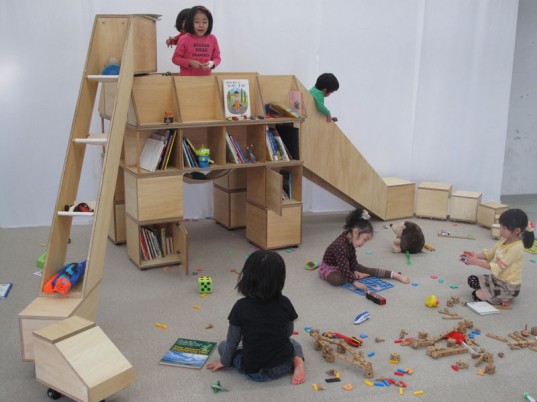
Bookshelf/Playground combo makes putting your toys away fun

Casasaurus

My mom always told me not to climb up my bookshelves when I was a kid; now I wish I was little again and could beg her to get me one of these. This is actually a great tool for learning, because it allows kids to think three dimensionally, in a playful way. Trying to decide which cubbies hold what items, and climbing, sliding, and thinking of an object as two things at once (a bookshelf AND a dinosaur) are great exercises for the brain at any age.

Casaurus, the senior thesis project of student designer Koichiro Hoshino from Tokyo University of the Arts. The designer’s dinosaur-shaped bookshelf includes plenty of space for a bookworm’s library, a tail-like slide for kids to whiz down, shelves made for climbing and small boxes that add length to the dino’s tail. Kids can also find a reading nook underneath the dino’s belly.

more via Koichiro Hoshino’s Casaurus is a Bookshelf and a Playground | Inhabitots.

behavior · children · community · environment · family · learning · Nature

7 Creative Ways to Experience your Local Farm this Spring | Inhabitots

A pastoral farm scene near Traverse City, Mich...
Image via Wikipedia

Where I grew up and where I live now, though focusing on very different kinds of agriculture, were both very farm-focused communities, and I always encourage people to  go out and see what a working farm is all about. It is a great way to learn about where your food comes from, different jobs, and all about nature.

Beyond simply stopping by to view the animals at your local farm, there are many other hands-on and creative activities you can do with your family — and the spring is a great time to go. Visiting your local farm during the spring comes complete with baby animals, plus the weather is warming up and it’s the perfect opportunity for outdoor learning time with your children. To get the most out of your springtime visit to the farm, you’ll want to explore it with a different lens and look at your local farm as more than just a place that keeps animals and agriculture. Read on to learn seven creative ways to experience your local farm this spring with your family.

more via 7 Creative Ways to Experience your Local Farm this Spring | Inhabitots.