Happy Monday. Most of us are probably back at work now after the holidays. But for many of us, our work space has changed fairly dramatically in the past few years, in large part due to advances in technology. What used to be office-bound work can now be done at home in one’s slippers while simultaneously playing with your child (not that I’ve ever done that!). What does the future of work spaces look like? This article tackles that very question. The subject isn’t specifically related to playful environments, but creating spaces that are more conducive to creativity and productivity are incredibly intertwined with playful environment:
The company Teknion has been doing a serious amount of research into where the office is going, and what they should be designing and building to furnish it, and have published Phonebooths and Mailboxes to look at the future of the office.
Phonebooths and Mailboxes is a discussion about new technologies. Consider how quickly the cell phone replaced the pager, how quickly the fax machine was replaced by email. Mobile technology now signals one of the biggest transformations within the modern office.
As awesome as flexibility with one’s work space is, there is also value with face-to-face, tangible collaboration. Plus spaces for creative work and data analysis work, or whatever kind of work, may need very different spaces.
What are your thoughts about how technology is changing what our offices look like?
The endangered Southern Resident Killer Whales visited Vashon and Maury Islands on December 3, 2012, searching for salmon. As they passed Point Robinson, they burst into playful antics that have to be seen to be believed: cartwheels, breaches, tail slaps, spyhops, and beautiful synchronized swimming in their tightly knit family groups.
Community gardens create ownership, a sense of place, and shared goals
Community gardens provide green space, community ownership, local landmarks and create a communal space for people to share, and beauty as well as food!
backyard community garden, by Rick Harrison on Flickr
Urban farming and agriculture has exploded in popularity in the United States, and . community gardens are now present in all 50 states. These communal green spaces can be as small as a parking space or as large as a few acres. They can be used to produce food, act as filtering systems for urban runoff such as rain gardens, or simply grow flowers.
Research is finding that these gardens are beneficial to communities for numerous reasons. First, these gardens provide green space and support the local environment, from migrating birds and bees to potentially filtering urban runoff. Second, they can often supplement vegetables for communities who live in densely urban areas where it can be hard to access fresh fruits and veggies through a grocery store. Third, these gardens create a sense of ownership not only for those working actively in the garden, but anyone who lives in the neighborhood. Creating this sense of ownership for a small space makes it more likely that communities will work together to protect and save larger green spaces, such as beaches or parks, that the community can share and enjoy in.
Community gardens are easy to set up and maintain, with minimal initial investment other than some seeds and a shovel. The key to success would be the need to designate a leader at first to spearhead the building and maintaining of the garden, to teach others and look over things until the garden was established and other knowledgeable gardeners began to work the space, or new gardeners who learned from experience in the community garden. The garden leader would need to be able to lead but not “own” the garden, but rather make it accessible for all community members.
OpenIDEO asks how do we promote wellness in the workplace. (Photo credit: Wikipedia)
Wow, OpenIDEO is on a role lately with their challenges that get my creative juices rolling and my passions up, in a good way! This latest challenge is about wellness in the workplace:
Together with Bupa and the International Diabetes Federation, we’re asking our global community to help us explore how people can best be supported in the workplace to make positive changes to their health and wellness – and what skills and tools are needed to pass these positive changes onto their networks of co-workers, family and friends.
As the Chair of the Wellness Committee at my job for just under a year, we tried out a lot of different wellness incentives, some with better results than others. I feel very passionately about offices promoting and encouraging wellness; we spend the majority of our waking lives there, it’s cheaper in the long run for companies to have healthy and happy workers, and it promotes productivity and dedication from employees.
What are your ideas? Add them to the inspiration. I’ll have to share some of my ideas for this challenge on the blog, as well as my ideas from the previous OpenIDEO challenge I mentioned, which is currently in the concepting phase.
I have been on vacation in California this week, playing with deer, ground squirrels, sea otters, sea lions, harbor seals, pelicans, sparrows, sheep, dogs, cats, persimmons, pomegranates, oak trees, poplars, and other assorted flora and fauna. It also means I haven’t been feeding and tending to this blog as much as I would like. So, to hold you over until I am back into my usual swing of things, I am providing a link to a collection of 10 TED talks on Creativity.
Why TED?
I like to think of TED talks as little mental snacks, so this smattering of talks about creativity, both as a blessing and a curse, when it flows and when it doesn’t, and what you can do about it if anything, are a great collection of videos for you to snack on.
Why creativity?
Because I see creativity as merely a facet of play, so any research or discussion of creativity is also beneficial for talking about play. People need creativity in order to play. Creativity is also a key element to a playful space. Writers and artists often need specific environments to create (or at least think they do). And, for some reason, I find it’s easier for academics and business types to talk about creativity than play, when in many regards they are talking about the same thing. You say tom-A-to, I say tom-au-to…
What does it take to reduce on-the-job depression and create an overall happier work environment? (Photo credit: Modern_Language_Center)
A recent study of health factors and their associated costs at seven companies, published in the journal Health Affairs, found that “depression is the most costly among 10 common risk factors linked to higher health spending on employees.”
The analysis, found that these factors — which also included obesity, high blood sugar and high blood pressure — were associated with nearly a quarter of the money spent on the health care of more than 92,000 workers.
First the employees were assessed for health risks, then researchers tracked their medical spending from 2005 through 2009.
The average medical spending for each employee was $3,961 a year. In total, $82 million, or 22 percent, of the $366 million annually spent on health care for the workers was attributed to the 10 risk factors, the study found.
The relationship between higher spending and depression was the strongest, with 48 percent more spending for workers with a propensity for that widespread problem.
Now, to be fair, this is a fairly small study of just seven companies, and the article didn’t say how many employees worked at these companies. However, this is definitely a trend that has been spotted at least anecdotally by many HR managers, so it’s nice to see that there is some “official” analysis being done on the issue.
So what can employers do about this? My fear is that employers would discriminate, unintentionally or intentionally, against people who suffer from depression. But these days many people will be diagnosed with depression due to a temporary life situation such as a death in the family, or their jobs, so being fired for temporary sadness is probably not a good idea for companies.
Instead, my hope is that companies would invest more on making people’s job satisfaction higher. As of two years ago, Americans reported the lowest job satisfaction ever recorded. That means employers can be doing A LOT more to improve their employees’ lives at work. And a lot of that has to do with feeling supported by their managers, and feel like they are heard and respected and overall a part of the team. A lot of that comes from having fun at work.
This philosophy has been spouted in several different books and magazines, and has been shown to work well in classrooms as well, referred to as the “Responsive Classroom” approach.
The Responsive Classroom approach centers on several ostensibly mundane classroom practices. Each morning students form a circle, greet one another, share bits of news, engage in a brief, fun activity and review the day’s agenda. The idea is to build trust, ensure a little fun (which adolescents crave) and confront small problems before they become big. Students might welcome one another with salutations from a foreign language. An activity might involve tossing several balls around a circle in rapid succession. Students share weekend plans or explore topics like bullying before lessons begin. (New York Times)
This approach could very easily be applied to a business setting, in fact it sounds like a team kick-off meeting one might see in a corporate environment. Taking time to connect with other coworkers and laugh a little before diving in to the day’s work has been shown to work wonders for productivity and boost morality in both school and work settings.
There is definitely a drive and expectation in many industries to work longer, faster, harder hours, and be available and working at all hours. But that drive is unsustainable, demonstrated by the low job satisfaction and high burnout rates in many industries, from high-tech to physicians. Taking time to play a little bit at work, or just connect with coworkers, is being shown as an effective way to reduce depression related to work and job burnout, increase productivity, and create a more cohesive company with more loyalty overall to the company’s mission.
So long story short: remember to bring the koosh ball to your next meeting.
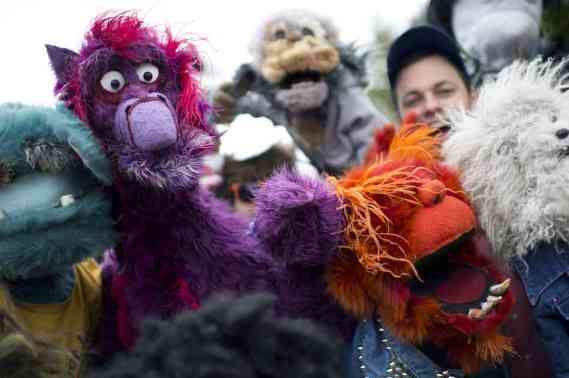
Puppets at the Million Muppet March protest this past weekend.
When presidential hopeful Mitt Romney threatened a childhood icon with funding cuts during a debate last month, people took to the streets and protested…with puppets. In what was deemed the Million Muppet March, people used puppets, marionettes, and other toys to show their unhappiness with the idea of funding for public broadcasting being cut:
Organizers say at least 600 people signed up to attend the march in person, with a few thousand more participating virtually on Facebook, Twitter and their own marches around the country. So far, the pictures on the group’s Facebook page show the marchers bundled in puppet-like hats with animal ears, carrying coffee, placards with statements like “Grouches of the World, Unite!” and, yes, more than a few puppets.
This protest is not only about supporting Public Broadcasting, but is also about play on several different levels. First, Big bird and other Sesame Street characters are a big part of many Americans’ childhoods. While imaginary, to many people these Muppets were very real and very important play characters during the formative years of their lives.
Second, the use of puppets and toys to protest politics is an age-old tradition. People in countries ranging from the England to Venezuela to Thailand have used puppets and epitaphs during protests to get a laugh out of people as well as get their attention. Even the court jester in days of old could get away with some nasty political commentary because it was said “in jest.”
Full disclosure, I am a huge Muppet fan, and am happy to see that others agree with me that Big Bird and PBS are worth funding, and I’m especially happy that people showed their support using puppets.
Kids in Halloween Costumes (Photo credit: epSos.de)
Ah, Halloween, originally considered the betwixt and between time of year when ghosts and souls past could pass over into our world and scare the crud out of their relatives.
But these days, Halloween is really a celebration of play. No, really! When else is it perfectly acceptable to dress up in funny costumes, stay up late on a week night running around banging on peoples doors, play tricks on people, and create food that looks spooky or gross but is really just lots of sugar?
The tradition of dressing up and playing for Halloween is alive and well in the tradition of Dia de los Muertos, for example. To deal with and make light of mortality, grown-ups and kids will put on make-up and costumes that represent death and the dead. They’ll make and eat sugary confections, parade down the street, play music, sing songs, and overall try to make a party out of a normally scary and sad phenomenon. Yes, there is some sadness involved, such as visiting relatives’ graves and setting up alters to reflect their passing, but for some even the act of creating the alter, i.e. being creative, is cathartic and helps with the loss of a loved one.
In the play deprived United States, Halloween has become one big kid’s night out for adults as well as kids. Children and grown-ups alike look forward to dressing up, pretending to be a character, and be silly with friends. Often the costume is a parody or commentary on something political, but that’s just as playful as covering yourself as marshmallows, although potentially socially sticky instead of just physically sticky.
That’s why it makes me sad that so many K – 12 schools have banned Halloween for fear of these socially sticky situations or fear of kids bringing weapons to school as part of their costumes, plus some religious groups find Halloween offensive. While I understand and respect all of these concerns, I disagree with the idea that we should just get rid of it outright. How are we going to learn to get along and get over differences if we just avoid them? Play and school are both supposed to be about learning, so why not turn Halloween into a learning opportunity?
As a proponent of play, I feel like Halloween is an important holiday, not because of what it originally stood for, but for what it stands for now. Being socially allowed to play and pretend, even for one day, is important for humans’ mental health. It also creates bonds between people who share in the activity, not just from sharing the experience but learning more about each other through their costumes.
I will definitely be buying candy and supporting Halloween this year, not for the sweet tooth but for the costumes. Play on!
You temperature impacts your perceptions and job performance (Photo credit: Wikipedia)
The rain, wind, and falling leaves make it feel like fall is officially upon us in most of the United States (although some regions are still experiencing an Indian Summer). This makes many of us think of warm beverages and sweaters, unless you work in an office that turns the heat up WAY too high all winter long. In fact, working in a space that is either too hot or too cold can effect productivity:
One of the painful ironies of office life is that we can never quite get the temperature right. We spend our summers shivering in meat lockers and our winters sweating in saunas.
Central air hasn’t made us comfortable, so much as made us uncomfortable in a different way.
The experience isn’t simply unpleasant. It comes with a real financial cost… [according to one study], when temperatures were low 68 degrees, employees committed 44% more errors and were less than half as productive as when temperatures were warm a cozy 77 degrees.
Cold employees weren’t just uncomfortable, they were distracted. The drop in performance was costing employers 10% more per hour, per employee. Which makes sense. When our body’s temperature drops, we expend energy keeping ourselves warm, making less energy available for concentration, inspiration, and insight.
This importance of creating comfortable work environments is interesting to me. I know a lot of freelance workers that have a favorite coffee shop to camp out in, often one of the criteria being it’s warm and cozy in the fall and winter.
I also vaguely recall a couple of studies that found play did not occur for animals outside of certain temperature ranges. (If anyone can find one of the studies please let me know).
As humans, we are adaptable to almost all climates from the Arctic to the Serengeti. So I think it is surprising to people to discover just how fragile we are.
Speaking of fragile, the article also mentions the connection between feeling cold and feeling lonely:
In a fascinating study reported in the prestigious journal Science, psychologists uncovered a link between physical and interpersonal warmth. When people feel cold physically, they’re also more likely to perceive others as less generous and caring.
When we’re warm, on the other hand, we let our guard down and view ourselves as more similar to those around us. A forthcoming paper from researchers at UCLA even shows that brief exposure to warmer temperatures leads people to report higher job satisfaction.
The unconscious desire for physical warmth is thought to be the reason lonely people bathe longer, more frequently, and use higher temperatures.
We often describe people as “cold” or “warm,” so it makes sense our perceptions would match our physical sensations. I wonder if this has anything to do with the reported “Seattle Freeze” phenomenon and in contrast the southern United States’ reputation for being open and hospitable.
While the article in Fast Company focused on job productivity, I think this is an interesting observation into overall well-being and improving environments in general.
Do you find you perform better at certain temperatures? Is one temp better for working over playing? For example, I like it to be warm but not hot while doing non-creative work, but if I’m doing an art or construction project or something creative I actually like it a little bit warmer. Leave your complaints or comments below.

 © TEKNION




 Mental Flowers