anthropology · behavior · community · happiness · health

Americans’ happiness score – latimes.com

Life is good.
Americans are in the top 10 for happy nations. (Photo credit: Wikipedia)

We’re a lot happier as a nation than I was otherwise led to believe. Um, go us?

We’re No. 6! That’s according to new data from the Organization of Economic Cooperation and Development , which on Tuesday released results of a survey measuring quality of life in 36 industrialized nations.

For the last three years, the Paris-based outfit has weighed 11 criteria, including housing, income, jobs, environment, safety and work-life balance. For the third year in a row, Australia was the big winner, thanks in large part to an economy that managed to avoid the global recession of the last decade.

The U.S. hobbled across the finish line in sixth place, behind Sweden, Canada, Norway and Switzerland, which ranked second through fifth, respectively.

more via Daum: Americans’ happiness score – latimes.com.

But seriously (ha ha), I feel like happiness scoring, as subjective as it is, is a good way of measuring our overall health and well being. It also indicates we’re doing okay and getting time in our lives for all the important stuff like family and time to recreate. I like Bhutan’s use of grass national happiness as a major marker for the nation’s well-being (lovely country, BTW, just be prepared for an exciting landing).

architecture · behavior · community · environment · health · play · Social

Competition: Create Your City’s Next Great PLAYscape

Yes! Seattle had a similar competition a couple of years ago, more focused on art but in a similar vein. Unfortunately not much came of the competition, so I would LOVE to see the results of this competition. Hooray for Playscapes!

Unknown's avatar

Yes! Seattle had a similar competition a couple of years ago, more focused on art but in a similar vein. Unfortunately not much came of the competition, so I would LOVE to see the results of this competition. Hooray for Playscapes!

View original post

behavior · brain · creativity · environment

How Acting Like a Scientist Can Help You Play

playing in the woods and acting like a scientist look pretty similar
I heard this story on NPR recently, and I think it’s the best advice I’ve heard in awhile on how to get out in the woods and explore, relax, and as they say in the article, take time to smell the roses! The answer: make an exploratory game out of it. “Pretend” to be a naturalist. Yes!

In this permanent state of hyperventilation, the issue for us all is not stopping to smell roses. It’s not even noticing that there are roses right there in front of us. Joseph Campbell, the great scholar of religion, hit the core of our problem when he wrote, “People say that what we’re all seeking is a meaning for life. I don’t think that’s what we’re really seeking. I think that what we’re seeking is an experience of being alive.”

But how can we experience “being alive” in the midst of the crushing urgencies that make up modern life?

Well, it might seem strange, but one answer to that question is “science,” at least science with a lowercase “s.” Science, you see, is all about noticing. This is where it begins, with simple act of catching seeing the smallest detail as an opening to a wider world of wonder and awe. And here is the good news. You don’t need a particle accelerator or well-equipped genetics lab in your basement to practice noticing (that would be science with a capital “S”).

You already are a scientist. You have been since you were a kid playing with water in the tub, or screwing around in the backyard with dirt and sticks and stuff.

If you want to rebuild your inner-scientist-noticing-skills, the best place to begin is with a walk in the woods.

There are lots of reasons to take a walk in the woods. To get away from it all, clear your head, smell the fresh air. The problem, of course, is that even if we get ourselves into a park or a forest, we might still be so lost in our heads that we miss what’s right in front of us. Practicing noticing, like a scientist, can change that by binding us to experience in ways that are thrilling, even in their ordinariness.

Noticing can take many forms. One trick is to count things. Scientists love to count stuff. How many trees are there on the sides of a steep hill compared with its crest? How many leaves are there on the stalks of the blue flowers compared to the yellow ones? How many different kinds of birdsong do you hear when you stop and listen, (by the way, this requires really stopping and really listening, which is awesome). Counting things forces you to pay attention to subtleties in the landscape, the plants, the critters.

Other things scientists love: shapes, colors, patterns. Do the rocks at the stream’s edge look different from the ones near the trail? Do the big cattails have the same color as the small ones? Get your naturalist on and bring a notebook. Pretend you are or John Muir. Jot down your findings, make little drawings and always, always ask your yourself those basic questions: why, how, when?

Read the full article.

It may seem counter-intuitive, but scientists are all about creativity and exploration, and noticing things outside of the ordinary, so acting like a scientist is great way to see the world in a whole new way by playing with things, seeing what happens when you mess with something. Kids are natural players/explorers/scientists, so you can even bring one along as it might be helpful to get you in the explorer mode.

I would also argue that it doesn’t have to be “the woods” necessarily to get the same playful/exploratory benefits, it can also be short walks around the block, whatever works to get your observational juices flowing.

anthropology · architecture · behavior · community

Parkour and Preserving Playful Spaces

People who practice parkour, called traceurs or tracers, often get a bad rap by city officials, saying they are disturbing or damaging public property. But in fact, often traceurs are some of the most vocal activists for preserving and protecting their environments. Take this story from The Atlantic, for example:

On warm days, when office-tower émigrés can enjoy their lunches next to its calming water features, Calgary’s Century Gardens Park serves as a popular daytime downtown retreat.

But at 38 years-old, the Brutalist public space is starting to show its age. The color of its odd concrete features has faded to a dreary ash, the foliage is overgrown, and the water pumps are failing. Angular slabs create both barriers to pedestrian access and places for miscreants to hide—city park staff complain of finding evidence of overnight drinking and drug use.

The city is itching to overhaul Century Gardens, though how much of the park might survive the process remains to be seen. Early proposals range from sprucing up the existing park and keeping it mostly intact to completely razing it and building a new park from scratch. The park’s age and need for refurbishment has given the city the opportunity to address its magnetism for social disorder, as well as apply a more contemporary approach to urban design.In the meantime Calgary’s parkour community—for whom the park’s structures are perfectly suited—have allied themselves with a local heritage group to try to save it.”Century Gardens is one of the coolest locations around for parkour. Not just in Calgary, but Canada-wide, and internationally,” says Steve Nagy, editor of the Calgary-based parkour magazine Breathe and co-owner of a local parkour gym. The Netherlands-based MunkiMotion parkour group also included it in their YouTube series, “Best Parkour Spots in the World”

more via The Calgary Park Thats United Historic Preservationists and Parkour Athletes – Brandon Beasley – The Atlantic Cities.

This group of traceurs is banding together with a preservationist group in Calgary to save the park. It’s a great example of two seemingly incompatible groups joining forces to preserve an urban space.

I think this kind of collaboration can and should be done more often.

In many peoples’ eyes these older parks, structures, or abandoned lots are just seen as wasted space, or maybe even dangerous, and certainly many old playgrounds don’t meet current safety codes. But for traceurs, or any adults that likes to climb or jump around, these spaces offer endless playful opportunities. I believe traceurs are some of the best urban playground spotters, and they know a good playground or playful space when they see it. Preserving or adjusting these spaces, rather than tearing them down and starting from scratch, is a viable alternative that can appease all parties involved.

I am glad The Atlantic is looking at this challenge over balancing use of space by different groups in urban environments.

Juliet Vong, President of HBB Landscape Architecture, Tyson Cecka, Executive Director of Parkour Visions, and I proposed a session about this topic for the annual meeting for the American Society of Landscape Architects. Sadly, it was turned down, I believe primarily because we didn’t explain what parkour was well enough to the panel. Hopefully next year we’ll be accepted, because I STILL think this is an important topic that needs to be explored more, and we are happy to come chat about it with your school, company, or conference. Just ping me. 🙂

behavior · creativity · play · psychology · work

How Play Makes You A Better Adult

I Watch them watch them play the game Then I w...
Adults at play. (Photo credit: Wikipedia)

Happy Friday. The weather is turning beautiful in many places around the U.S., with lots of sun. In fact one school in Washington gave kids the day off so they could go out and play. Some places get snow days, the principal figured, so why not a sun day? Perfect reasoning to me.

Unfortunately a lot of adults don’t take these opportunities to go out and play, thinking it’s a “waste” of their time. But, as I constantly argue on this blog, play is vital for healthy grown-ups too.

Erika Andersen explores the intersection between work and play for grown-ups, and how play makes us better grown-ups.

Sadly, by the time most of us reach our teens, play has been replaced as our primary learning mode by competition, memorization, practice and recitation – otherwise known as “sports” and “school.”  And we come to think of play as something we do when there’s nothing more urgent to be done – as time stolen from more critical things. However, the elements that make play such a great way to learn when we’re kids still work for us when we’re adults.  The happiest and most creative adults I know regularly bring play into their lives as a way to stretch, evolve, innovate and – this is important – enjoy.  Here’s a great example – two guys named Jay Silver and Eric Rosenbaum have created a kit called MaKey MaKey, that allows you to control any electronic device using household objects.

…When you play, you’re making up the world.  You’re saying, “Let’s imagine that…”  or “Why don’t we…?”  or “What if….?” And that’s where freshness, learning and innovation live.

Full article at: How Play Can Make You a Better Grown-up | Forbes

Andersen offers up some ideas on how to be more playful as a grown-up, although as she points out the whole point of being playful is to think outside the box, so just think of these as starting places:

Be the littlest kid.  You know how when kids play, the littler kids usually follow the older kids’ lead?  When you play with actual kids, let them call the shots, rather than you, adult-like, defining the play.  You’ll get drawn into wonderful worlds you would never have considered.

Declare a no win-zone.  Occasionally, when trying someone new, agree with yourself that the goal isn’t to ‘get good at it’ or ‘be better at this than so-and-so’ – but rather ‘to look like a fool’ or ‘have as much fun as possible.’ Remember what Bettelheim says about play including “the absence of any goals outside the activity itself.”

Lose the watch.  Little kids have no sense of time.  When they’re engrossed in something, hours could pass and they’d never know it. Try moving all your time-based commitments out of a day (or at least part of a day), and give yourself permission to do whatever you want for as long as you want.  Get fascinated about your choices.

Bring play to work.  Sometime during the next week, approach a work problem through the rules of play, that is “characterized by freedom from all but personally imposed rules (which are changed at will).”  Start thinking about it by asking “What if we didn’t have any constraints – how would we think about this?”  If you really get into that “play” mindset, you just might come up with a crazy notion that contains the germ of greatness.

anthropology · behavior · community · creativity · culture · mental health · play

Offices move towards more playful space design, but what kind of play is best for workspace environments?

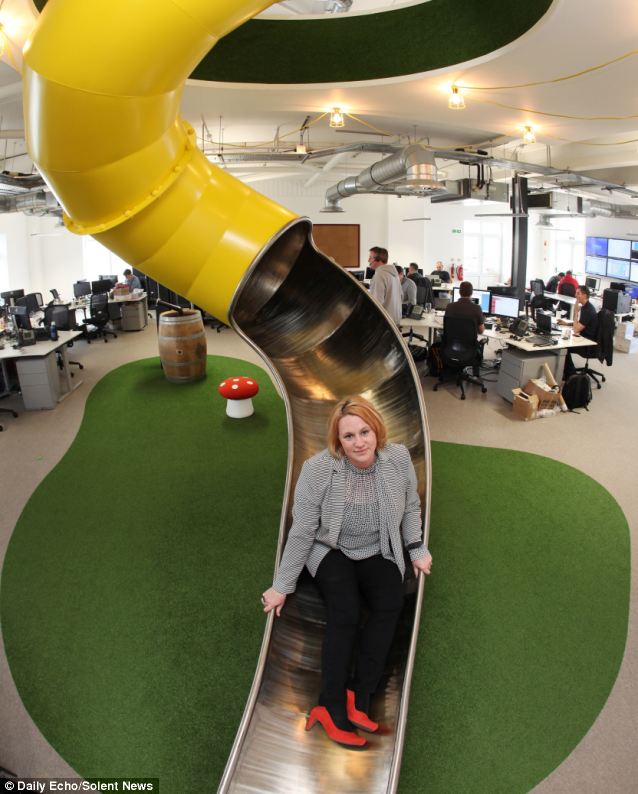
More and more office spaces are trying to become more playful, offering employees a way to destress and/or get more creative. Usually that takes the form of having ping pong tables or video game consoles set up for breaks, but more and more offices are adding slides, swing sets, picnic tables, or other more active and engaging apparatus. They are also bringing in more greenery for workers.

This office may be the most fun in Britain as it comes kitted out with a giant helter skelter slide, a tree house and even a pub.

The unique workplace also boasts a pool table, a putting green, a giant swing and a cinema.

Office designers Space & Solutions were tasked with turning a former pub in Southampton into the home for IT company, Peer 1 Hosting.

‘If you don’t feel comfortable sitting at a desk you can sit on a picnic bench. The reality is that you can do your work from anywhere.’

Read more: UK Daily Mail

The article points out that some people may find all this fun a little distracting to actually work around. Some kinds of play are probably great at cutting stress but may be more of a time suck than creativity inducer. I’m curious what readers think. Are you one of those people who does their best work sitting on a couch, or heck, a swing? Do you prefer quiet and focus without any noise? Do you have a toy or plant on your desk you fiddle with when you’re trying to think or just need to destress?

Another question; do you actually use the toys and playful apparatus in the office? The office I currently work in has a ping pong and air hockey table, but only two people ever use the ping pong table, and I have only seen the air hockey table turned on once for a promo video.

Leave your thoughts in the comments below.

behavior · community · happiness · Social

Seattle City Hall is at least thinking about happiness, even if haphazardly

Seattle: Christmas Cookie Edition
What about Seattle as a cookie? Cookies make people happy.

I read this article in Seattle’s The Stranger: Can City Government Make Us Happy?

The authror of the article was pretty snarky about the whole process, and I admit it’s not the best thought-out initiative, but my first thought was, “at least they’re interested and trying.”

I actually thought the task force (let’s call it that since the town hall meeting was fairly limited in public representation) had some pretty interesting insights:

“The last four days, we were out on the streets asking, ‘What makes people happy?'” explained Laura Musikanski of Seattle’s Happiness Initiative, which was tasked with surveying Seattle’s happiness levels in 2011 (spoiler: Poor people are less happy). Behind the panelists sat a wall of sticky notes with the answers to that question, including sex, fish, power, free parking, corn, and sun.
“A lot of people said water—they love the rain,” added Mario Chamorro of Make It Happy. “People in Seattle are waterproof!”

I don’t know if people meant rain when they said water – Seattle is also surrounded on multiple sides by lake or sound – but maybe they did mean rain. Who knows, we might just be that crazy. But rather than critique their methodology, I would like to applaud the city of Seattle, a city that is shrouded in damp, dark, and gray for most of the year, for at least starting to tackle this question.

I’m curious if anything will come of this, or if they’ve burned all their happy budget on the Make It Happy team from New York. If this is in fact ongoing, I might suggest having your next Happy Team meeting in the sun. It was one of the things on your list that makes people happy, after all. And maybe offer some fish and corn. 🙂

behavior

Play anywhere, with anything

A boy slides down a metal beam in Manila, Philippines, on April 23.
According to new census data, the Philippines has failed to make headway in cutting rampant poverty, with more than one in four citizens deemed poor despite the country’s economic growth. However, seeing children play is a good sign for the country’s overall well being of its citizens, since play tends not to occur unless all essential needs have been met (food, shelter, safety).

behavior · community · creativity · happiness · play · youtube

Take a Seat – Make a Friend? – YouTube

SoulPancake hits the streets to see what happens when two strangers sit in a ball pit… and talk about lifes big questions.

via Take a Seat – Make a Friend? – YouTube.

behavior · children

Playborhoods: Why Children Playing Street Games Is the Best Measure of a Healthy Neighborhood | Education on GOOD

English: Children playing in snow
Children playing outside in the snow (Photo credit: Wikipedia)

This weekend, take a look around to see if you see any kids running or biking around in your neighborhood. Children playing, or not playing, can be seen as a litmus test for overall neighborhood health. Yes physical health, but also the cultural and economic health.

Neighborhoods are suffering these days largely because children are absent. Instead of playing in their neighborhoods, they’re either staring at screens eight hours a day, according to a Kaiser Family Foundation study!, doing lots of homework, or attending numerous adult-led activities outside their neighborhoods.How are the children faring with these differently structured lives?They’re suffering, too, perhaps even worse. Pretty much every pediatrician and child psychologist will tell you that children need to play outside, every day. Without frequent outdoor play, children have been getting fatter, sadder, and less socially adept, and all that homework isn’t making them any smarter.

Children’s immediate neighborhoods—right on their block, outside their front door—are the ideal places for them to play outside. These are the safest, most comfortable places for children outside their homes because they can stay within earshot of their parents, and they can also get to know dozens of neighbors.

via Playborhoods: Why Children Playing Street Games Is the Best Measure of a Healthy Neighborhood | Education on GOOD.