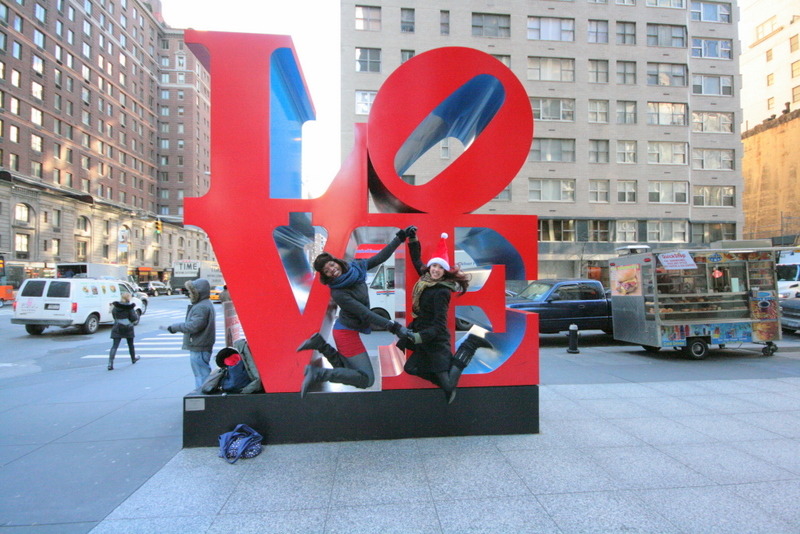
Yes, yes, yes! Accessibility for all! Allow everyone to be able to use their environments and stay in their communities! Different generations living together in a community is better for everyone!
Category: architecture

Energy drink maker Red Bull proposes skate-able art investment for Myrtle Edwards Park

The Seattle City Government Parks & Recreation site recently hosted a public meeting to gather input on a proposed public art piece in Myrtle Edwards Park that will be used for skateboarding.
Energy drink maker Red Bull has approached Seattle Parks and Recreation about making a community investment that would include commissioning an artist to design and fabricate a unique piece of skate-able art. At the meeting, Seattle Parks presented the history of the proposed project, followed by an opportunity for the public to weigh in on the idea.
Myrtle Edwards Park is located at 3130 Alaskan Way on the shoreline of Elliott Bay, north of the Olympic Sculpture Park.
The Citywide Skatepark Plan, developed in 2006 and 2007 with extensive public process, designated Myrtle Edwards as a recommended site for a skatedot [editor: which is apparently smaller than a skatepark]. Since 2007, Seattle Parks and Recreation has constructed eight new skate parks and skatedots. Two more are in construction and design.
4Culture is administering the Call for Artists associated with this project. The artist will coordinate the design with Seattle Parks and Recreation.
A second follow-up meeting is planned in June.
I love the idea of creating public art that is actually usable, whether it’s by skaters, kids, or even animals. I understand that some art is best appreciated by not messing with it, but especially in a public space sometimes it’s hard to not want to interact with sculptures or murals. I also appreciate Red Bull’s focus on supporting play in all its forms, although private sponsorship of public spaces is always a touchy, tricky gray area.
Is there a public art piece, or artistic skatedot, fountain, whatever, that you really enjoy sitting on, playing on, or just watching others play? Let me know about it in the comments below.
Related articles
- Public Art: Red Bull Skateable Artwork and More/ Calls for Artists (artistmarketingresources.com)
Competition: Create Your City’s Next Great PLAYscape
Yes! Seattle had a similar competition a couple of years ago, more focused on art but in a similar vein. Unfortunately not much came of the competition, so I would LOVE to see the results of this competition. Hooray for Playscapes!
15 Amazing Creatively Themed Office Spaces
Hopefully it gets them in the right mindset and right kind of play (i.e. working rather than "goofing off")
If you’re part of a business that prizes creativity and innovation, inspiring surroundings might not go amiss. Luckily, some companies are moving away from the sterile-looking cubicles, bland layout and generally humdrum designs that can still be seen in many workplaces. The following 15 workspaces take a non-traditional approach to office design, and we love the results, whether they feature orchards or cupcakes. Check out some of these incredible places that people get to work in – although you might get a little green with envy.
See them all here.

Fish-shaped Building Inaugurated in Hyderabad, India
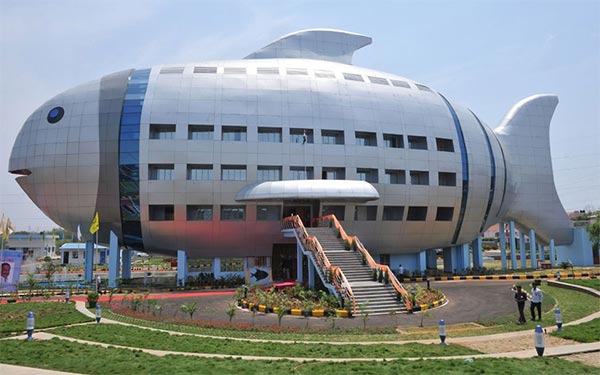
The newly opened National Fisheries Development Board building in Hyderabad, India, designed to resemble a fish.
via Fish-shaped Building Inaugurated in Hyderabad, India.
I like the playfulness of the Fisheries team, at least. And it’s actually clever advertising to boot. Hopefully they won’t want to move for a few years, since I’m not sure who else might need a fish-shaped building. But it sure is a fun thing to see as you walk into work everyday.
Does Not Having an Office Make You a Happier Worker?

I read an article yesterday about “the next big thing” in office space. According to Uday Dandavate, the CEO of SonicRim, the next “megatrend” is going to be no office space:
Large working complexes will be pyramids for dead people. I’m not making a judgment. I am just observing. They are fading symbols of an era that is soon going to be a bygone era.The ideal environment is where people don’t have to go to a workplace. The workplace is distributed in the community.
Companies won’t be building offices; they will be building communities and nice places to work in those communities. It’s a fallacy that people want to stay at home to work. In a given moment they want to work where they would be most productive, or relaxed, in the kind of mindset they need to be in. We need to get away from constructing buildings that have flexibility to creating work environments that can evolve.There needs to be a complex assessment of different moments at work. Recently we finished a global study on auto interiors for Johnson Controls. When you sit inside your car there are different moments that have different states of mind, going to work or coming home. Sometimes people want to feel their car is their home. At times people want the car to feel like a workplace. Take the same concept and apply it to architecture and work places. For any productive activity, not just working but cooking, reading, writing a letter, there is always a most conducive environment.
More at: The Registry SF
While Dandavate believes that the workers will be dispersed throughout the community, I’m not sure I entirely buy the idea that the central office space or main corporate headquarters is going to disappear. The emphasis on having everyone in one space my diminish, but there are a lot of reasons why having a central space sanctioned as “for work” is important.
To name a few:
- Working parents who need a space away from family distractions, like screaming children and biting puppies. Or heck, noisy roommates for that matter.
- People for whom going to the local library or coffee shop every day. This isn’t an option for a lot of people, even those living in big cities.
- People who work very collaboratively and need real-time input, and face time in order to accomplish their work.
- People who need more space to work than the kitchen table or their tiny apartment walls can provide.
- Those who just need the peer pressure of others working around them to push through a hard deadline.
- Extraverts!
Dandavate mentions a sense of identity for workers with the company that doesn’t require a tangible, geographical locale. I agree with his assessment that people don’t need a geographic place to congregate at to form a bond with coworkers or identify with a company, but they sure want one. Microsoft has a huge annual gathering of its employees in or near their homebase in Redmond, that most employees working from afar get really excited about. Traceurs (people who train parkour) will make pilgrimages to a small park outside of Paris simply because one of the sport’s founders filmed a video there. Elvis fans have Graceland.
Workers are also becoming more vocal about work vs. home life, and for many it is unappealing to have your work at home or not be able to leave it somewhere else (even places like Office Nomads you have to bring most of your stuff home with you).
Maybe I’m totally off-base, but while I think the workplace will become more flexible, we will always have the “homebase/headquarters” office buildings.
Disagree? Leave your thoughts in the comments below.
Related articles
- Some Important Tips for Office Space Design (officespacedesigners.wordpress.com)
- How to Find Co-Working Spaces Around the World (projecteve.com)
- Who Is Happiest At Work? Probably Not Who You Think (business.time.com)
Parkour and Preserving Playful Spaces
People who practice parkour, called traceurs or tracers, often get a bad rap by city officials, saying they are disturbing or damaging public property. But in fact, often traceurs are some of the most vocal activists for preserving and protecting their environments. Take this story from The Atlantic, for example:

On warm days, when office-tower émigrés can enjoy their lunches next to its calming water features, Calgary’s Century Gardens Park serves as a popular daytime downtown retreat.
But at 38 years-old, the Brutalist public space is starting to show its age. The color of its odd concrete features has faded to a dreary ash, the foliage is overgrown, and the water pumps are failing. Angular slabs create both barriers to pedestrian access and places for miscreants to hide—city park staff complain of finding evidence of overnight drinking and drug use.
The city is itching to overhaul Century Gardens, though how much of the park might survive the process remains to be seen. Early proposals range from sprucing up the existing park and keeping it mostly intact to completely razing it and building a new park from scratch. The park’s age and need for refurbishment has given the city the opportunity to address its magnetism for social disorder, as well as apply a more contemporary approach to urban design.In the meantime Calgary’s parkour community—for whom the park’s structures are perfectly suited—have allied themselves with a local heritage group to try to save it.”Century Gardens is one of the coolest locations around for parkour. Not just in Calgary, but Canada-wide, and internationally,” says Steve Nagy, editor of the Calgary-based parkour magazine Breathe and co-owner of a local parkour gym. The Netherlands-based MunkiMotion parkour group also included it in their YouTube series, “Best Parkour Spots in the World”
This group of traceurs is banding together with a preservationist group in Calgary to save the park. It’s a great example of two seemingly incompatible groups joining forces to preserve an urban space.
I think this kind of collaboration can and should be done more often.
In many peoples’ eyes these older parks, structures, or abandoned lots are just seen as wasted space, or maybe even dangerous, and certainly many old playgrounds don’t meet current safety codes. But for traceurs, or any adults that likes to climb or jump around, these spaces offer endless playful opportunities. I believe traceurs are some of the best urban playground spotters, and they know a good playground or playful space when they see it. Preserving or adjusting these spaces, rather than tearing them down and starting from scratch, is a viable alternative that can appease all parties involved.
I am glad The Atlantic is looking at this challenge over balancing use of space by different groups in urban environments.
Juliet Vong, President of HBB Landscape Architecture, Tyson Cecka, Executive Director of Parkour Visions, and I proposed a session about this topic for the annual meeting for the American Society of Landscape Architects. Sadly, it was turned down, I believe primarily because we didn’t explain what parkour was well enough to the panel. Hopefully next year we’ll be accepted, because I STILL think this is an important topic that needs to be explored more, and we are happy to come chat about it with your school, company, or conference. Just ping me. 🙂
Related articles
- The Calgary Park That’s United Historic Preservationists and Parkour Athletes (theatlanticcities.com)
- Why Toowoomba needs a Park for Parkour (sykose.com)
Adding art to Belltown, Seattle
This is an ongoing project in Seattle of sprucing up vacant office or retail space with art. It’s a plus for the artists, the building managers since it brings attention to their space, and the passersby who are charging to and from work or tourists who stop and linger a little bit longer to view. Always love seeing updates on new projects by this group.

Storefronts Seattle is proud to announce the first two of three projects in the Belltown neighborhood!
Ingrid Lahti
One Pacific Tower, 2006 First Avenue, Belltown
Through June 2013

Ingrid Lahti traditionally works in neon, but has branched out into illuminated lighting gels in her new installation at First and Virginia. Inspired by the saturated color in Matisse paintings and Chinese artwork, Ingrid views the illuminated window pieces as a study on the emotional effects of color and light, fitting seamlessly into the vibrant neighborhood in Belltown.
These installations glow brightly at night, adding to the street-level nightlife of Belltown and kicking off a summer in Seattle with a burst of color.
Chris Papa
2505 Second Avenue
Through June 2013

Chris Papa, a local printmaker and sculptor, has installed 5 sculptures at Second and Wall, featuring playful sewn wood sculptures conflating art, craft, and architecture. Interested in the…
View original post 86 more words
In Gritty Sao Paulo, Artists Take To The Streets : NPR
A great example of actively adding art in urban settings in order to create enrichment for its inhabitants:
Urban landscapes have always inspired art, and Brazil is no exception. A new crop of artists like Matos not only is taking inspiration from Sao Paulo‘s streets but also is trying to give something back.
Matos covers trees and street poles with woolen sleeves and small, colorful pompoms. Her works look like whimsical webs of rainbow yarn; the effect is surprising and oddly comforting.
“I want people to have something familiar in the city. Here in Brazil we teach knitting from mother to daughter,” Matos says. “When they see my art, they suddenly feel comfortable walking these cold streets. And you can feel better.”
The newest and the biggest urban art project here is called , and it has an impressive list of corporate sponsors. The idea is to connect graffiti artists with individuals or business owners who have a wall they want covered with original art.
Artist Guilherme Matsumoto says he saw the website and signed up to say he was available to paint a space. Walter Orsati, owner of the Purple House Hostel, responded.
It was that easy, they say.

via In Gritty Sao Paulo, Artists Take To The Streets : NPR.
Related articles
- In Gritty Sao Paulo, Artists Take To The Streets (wnyc.org)
- Brazilians play Pac-Man in Sao Paulo (euronews.com)
These Insane Houses Have Indoor Slides | i09
Sometimes it’s nice to add a little play into a normally quiet, serene space like the home.
Whether you’re a superhero or still reliving your childhood, an indoor slide is obviously the best way to get from one floor to the other in your home. Here are some houses that turn slides into amazing works of art — and stairway replacements.


more via These Insane Houses Have Indoor Slides.
Related articles
- A DIY Stairway Slide – The Contemplative Creative (apartmenttherapy.com)
 Mental Flowers