A million times yes! This article focuses on one of my biggest pet peeves and challenges as a play advocate; play not being taken seriously.
The author, Hilary O’Shaughnessy, and also the producer of the Playable City Award, discusses her play competition and the usual rub of people asking whether this is really all “worth it.” I’m quoting over half of her article, but she very eloquently covers an entire blog post I was planning on writing (I will still write it, I promise):
Amongst the usual squeals of anticipation [around the competition], there are questions about the value of these ideas to the “real” world. Fun is all well and good – but surely fun is the stuff we get to when the grown up work of building hospitals and roads is done with? When we’ve fixed the economy, let’s play. Cities are full of problems, why are we not fixing them first?
Herein lies the real issue. When we see play simply as fun, a whimsy for those of us lucky enough to have the time to engage in it, we underestimate the transformative power of play and it’s role in our lives.
Fixing problems, making our living and working spaces more livable and resilient, designing better cities, starts at every level with the people that Iive in those cities. Increasingly we are realising that our cities are designed for exclusivity, so it makes sense that we don’t feel part of shaping the future. This is revealed in the language we use to describe our relationships to the services and organisations that our cites are made of. We want them to fix it, they don’t want us to have a say, they give money to them to exclude us: the language is divisive and separating, and that’s the problem. Even the descriptions of the projects fail to deliver what they promise, because a playable city is experienced, not described.
The idea of what our cities should mean, how public money is spent, what we imagine as good for us and who is involved in designing them, is only ever addressed when we have a complaint or we feel excluded. We talk to the city council when the road is road is torn up or the lights won’t come on. We complain that our voices are unheard, but we never seize opportunities to speak, fearing that if we do we will be ignored or shouted down by the loudest ones.
This feeling of separation cannot be undone overnight. We need new approaches, new tools, and new ways to talk to one another about how to live together in cities.
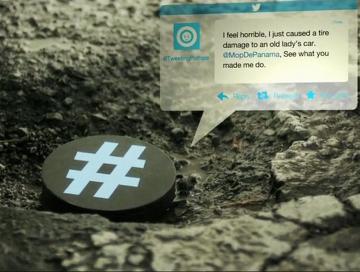
From a different article, but an example of using play as political protest: a device placed in large potholes that tweets whiny complaints when it is run over in order to publicly shame govt. into action.
Conversations about the future, about how we want to live, have to begin from a level playing field, and crucially that level playing field may not be where we expect. Play is a leveler: when we play, we play as humans, first. Traditional status markers like wealth, celebrity, or qualifications are not really much use when invited to dance with your shadow or conduct lights like a demi-god.
Addressing problems and finding solutions that work for us all begin with inviting everyone into conversation. Play as unexpected interventions in familiar places act as invitations to connect, an offer to begin to talk about those parts of our cities that we feel excluded from. To new eyes and ears, some projects can seem esoteric – but that is because we have become numbed to dull public announcements, badly designed flyers and clunky websites which act as information dumps that no-one reads, let alone takes as an invitation to work together. Yet, this is important stuff: we need to talk about the kind of future we want or it be will be decided for us while we look the other way.
As our climate becomes more unpredictable, finding better ways to manage stormwater is crucial to mitigating flood damage. However, traditional stormwater management strategies can be unforgettable at best and unsightly at worst. In the new book, Artful Rainwater Design: Creative Ways to Manage Stormwater, authors and Pennsylvania State University professors, Stuart Echols, ASLA, and Eliza Pennypacker, ASLA, prove that this doesn’t always have to be the case — it is possible to effectively manage runoff without sacrificing aesthetics.
In this well-organized how-to guide for designers, Echols and Pennypacker highlight the benefits of Artful Rainwater Design (ARD), a term coined by Echols in 2005 to describe rainwater collection systems that are not only functional, but also attractive and engaging. These systems are usually designed to handle small rain events and the initial — and dirtiest — events, rather than major flooding from large storms…
Great article about the evolution of the playground, as well as the next generation of playgrounds emerging in cities:
After World War II, European architects turned out custom playgrounds that challenged kids both physically and intellectually. Inspired by their work, a few American architects, including Philadelphia’s Louis Kahn, tried their hands at the form. But the movement didn’t get very far. Playgrounds were a casualty of the breakdown of American cities in the ’60s and ’70s. As maintenance was deferred, they fell into ruin. By the time cities began to recover in the ’90s, Solomon says, all that local officials wanted was equipment that was indestructible and vetted for safety.
Moore, a professor at North Carolina State University who has been studying children’s play for 50 years, sees a connection between those designs and the increase in such childhood ailments as obesity, anxiety, and attention-deficit disorder. In the simple act of scrambling up the branches of a tree, a kid learns to monitor risk and deal with fear. But on most playgrounds, the climbing frames are lower than ever.
The concern about such controlled environments has sparked any number of popular books advocating less programming: Free Range Kids, 50 Dangerous Things (you should let your children do), Last Child in the Woods. All see our culture’s fear of risk as worse than the occasional scraped knee or broken bone.
So what’s the alternative to standard-issue playgrounds? Solomon envisions multipurpose, multigenerational urban parks that incorporate spaces where kids can take charge of their own play. Instead of a fixed bridge in a plastic fort, they would have to use their imagination to decide which objects could be converted to play equipment. Such a challenging play space also would include nooks where kids could temporarily escape the nervous gaze of their caregivers. There would be no fences, plenty of trees and bushes, and good seating.
My favorite playground growing up was made of mostly huge sewer pipe pieces, a monkey cage, and random cement shapes. What was your favorite playground as a kid? Or now? Describe it in the comments below.
Dying is tough stuff. No question. So it is wonderful to see how facilities are making it easier on the dying and their families to feel comfortable via the design, look, and layout of a space, with everything from the hues on the wall to the view from their window. Amy Marquez shared her observations about her mother’s hospice space a couple of years ago on Offbeat Families (now retired, but visit the sistersites for Pete’s Sake before they meet a similar fate!), and it is a wonderful ode to both her mom and people who cared for her and her family during her last days, but also the importance of creating a great, peaceful, and sometimes playful space.
At first I was impressed with how sensitive and involved the staff was. They made sure she was comfortable, asked us how we were doing and offered to help us if we needed anything. And although my mother had lost the ability to communicate verbally by the third day that she was there, they spoke to her as though she was able to answer and talked her through everything they were doing to assist her.
I spent enough days there to really start looking around. This facility was, at first glance, a very nice, tranquil place that was inviting and welcoming to family and friends of loved ones in residence there. Then I really started looking and I was amazed at the amount of thought that had to go in to building this hospice.
Good Magazine Asked 10 of Their Favorite Artists to Create Love Letters to Their Cities. Here’s What They Came Up With… (click either the link below or the picture to see them all.)
“Rigamajig is not about a finished product. It’s the playful process. The collaborating. The tinkering. The soft and hard skills that are learned while kids are engaged in play. This is what learning can look like!” – Cas HolmanInstead of coming with an instruction booklet that outlines how to build specific contraptions, the guide booklet for teachers, parents, and educators gives tips on how to best utilize Rigamajig for their situation, as well as offering “Play Prompts” to spur children’s imagination.
The Future Workspaces study has been conducted by SB Seating in collaboration with the Norwegian Design Council, under the Design Pilot programme. Together with ethnologist Truls Erik Johnsen and Designit, we have researched and conducted an analysis of a wide range of social trends that would affect the workplace 10 years from now. The purpose of the project has been to create scenarios for future workspaces through user involvement.Users from selected workplaces in Norway & Netherlands were interviewed, and observations of corporate cultures have been made. The developed scenarios provide conceptual directions for the future workspace and serve as useful input for long-term product development and brand strategy.
I recently had a short stay at a hospital (just some minor surgery), and as I lay in my hospital bed I recall looking out my window at a green canopy of trees planted two stories below. I remember how peaceful and pleasant it was to be able to look out and watch the trees. I also noticed my anxiety went down, I was distracted from my pain, and just overall felt better.
More and more research is coming out that is finding the benefits of incorporating nature and natural environments into the healing process, for everything from surgery to PTSD to dementia, and a variety of other ailments. So it’s great to see hospitals incorporating this knowledge into new building designs as well as therapies.
The University Medical Center of Princeton realized several years ago that it had outgrown its old home and needed a new one. So the management decided to design a mock patient room.Medical staff members and patients were surveyed. Nurses and doctors spent months moving Post-it notes around a model room set up in the old hospital. It was for just one patient, with a big foldout sofa for guests, a view outdoors, a novel drug dispensary and a bathroom positioned just so.
Equipment was installed, possible situations rehearsed. Then real patients were moved in from the surgical unit — hip and knee replacements, mostly — to compare old and new rooms. After months of testing, patients in the model room rated food and nursing care higher than patients in the old rooms did, although the meals and care were the same.
But the real eye-opener was this: Patients also asked for 30 percent less pain medication.
Reduced pain has a cascade effect, hastening recovery and rehabilitation, leading to shorter stays and diminishing not just costs but also the chances for accidents and infections. When the new $523 million, 636,000-square-foot hospital, on a leafy campus, opened here in 2012, the model room became real.
City planners are finally starting to grok that in order to keep residents, they will need to offer the whole package, including playful spaces for everyone, kids and grown-ups alike.
About a decade ago, the so-called creative class of 20somethings fueled the revival of urban centers by settling in downtown areas mixing condos and coffee shops. Now, as millennials and other urbanites have children, their needs are changing. Cities want to hold on to them by becoming more “playable,” for both children and adults.
For decades, cities “relegated kids to the playground and said, ‘We’ve done something for you,’ ” says Darell Hammond, chief executive of Washington, D.C. nonprofit KaBOOM!, which consults with city officials on promoting and preserving play. “The whole city should be a playground, and play should happen everywhere.”
That means not only building more parks and bike paths but also incorporating the ideas of “fun” and “play” throughout a city, whether it is musical swings downtown Montreal, a hopscotch crosswalk in an arts district Baltimore or camp sites on a city lake front Chicago.
I hope that this attitude shift from city planners and designers makes it more acceptable for grown-ups to go out and play, and I mean actually physically play, not just go to bars and concerts that were traditionally classified as the only acceptable adult “play.” Seattle and Portland, and are definitely accepting and encouraging of grown-ups playing bike polo in city parks or just going for a run. Creating an environment that welcomes play also helps change the attitude of others
I am often focused on efficiency walking from place to place. But cyclists, runners, and other athletes talk about taking the more scenic route on their commutes or exercise routes, and maybe we should all follow suite.
We’ve all [probably] taken a detour because the path is pleasant and scenic, even if it takes longer. But Google Maps and the like aren’t set up for that. They’re solely about speed and efficiency.Recent research led by Yahoo Labs shows how a planner-for-happiness might work. Using crowdsourced impressions of streets, Flickr data, and survey responses, it looks for a balance between “people’s emotional perceptions of urban spaces” and getting them to a destination in a reasonable amount of time.




 Mental Flowers