anthropology · architecture · community · design · environment

Does adding art to slums improve poor’s quality of life?

I saw this article last week on Recycle Art, about a design company in Brazil that does outreach to poor communities by creating more aesthetically pleasing surroundings:

Brazilian design studio Rosenbaum and TV show Caldeirao do Huck help poor families to redecorate their homes and improve their surroundings, in the hope that they feel more comfortable and happier at home.

++ Do the green thing

See more at Plastic bottles garden | Recycle Art

I’m pleasantly surprised by this philosophy. And apparently this idea is starting to pick up steam.  The New York Times just published an article (also below) about a design show being presented at the United Nations right now focusing on design for third-world countries, trying to create effective, efficient, and hopefully beautiful tools, boats, and buildings.

I’m curious, however, if designing a new space or adding beauty to an already existing slum really works. Does having a more beautiful environment make you want to protect it and invest in it? Even the curators of the exhibit in the New York Times article state that building something new and getting people to adopt it are two entirely different challenges.

I know having a greener work space is correlated with better worker productivity, and many communities in the U.S. have installed public gardens or parks with some success regarding improved community involvement and improved outlook of the neighborhood. The groups featured in the exhibit claim successes all over the world. However, somewhat similar experiments have been tried out with movie stars and athletes installing movie theaters or centers in poor neighborhoods with mixed success with mixed results, as I remember.

I would be interested in seeing more studies that looked at parks or even residential gardens and patios correlated with crime rate, income, and so on.

Anecdotally, have you seen or know of anyone who has seen a correlation between greening or beautifying a space and better sociological stats?

architecture · creativity · design

Bob Cassilly Remembered: Part Sculptor, Part Kid : NPR

City Museum
Image of Cassilly's City Museum. Image by Northfielder via Flickr

A great remembrance of Bob Cassilly, who died last week, and who was well known for being a forever kid and player. It’s always great to hear stories of people who never lost their love of play and used it to inspire others; too often this kind of playful exploration and love of sharing it with others is not truly appreciated until after they die or are near death (Jim Henson and Randy Pausch come to mind).

“If you can’t climb on it and you can’t slide on it, what good is it?” asks J. Watson Scott, summing up the approach of the man responsible for the spectacle. Scott knew and worked with Bob Cassilly for decades, and says the artist never lost his inner kid. Today, with many in St. Louis, he’s mourning Cassilly, who died last month in an accident while working on his latest creation.

Cassilly’s City Museum, which opened in 1997, is a fantastical place that features caves, a jungle gym and lots of slides. As the Ferris wheel squeaks in the background, Scott says the artist loved to reuse discarded items to create unique spaces that children and adults could climb over, under and through.

more via Bob Cassilly Remembered: Part Sculptor, Part Kid : NPR.

anthropology · architecture · brain · disease · environment · psychology

Thinking by Design: Scientific American

Illustration for Design Portal.
What makes some objects more appealing than others? Image via Wikipedia

One of the biggest pieces to having an enriching, relaxing, invigorating, or overall non-stressful space is what you put into it. There has been lots of research into creating better work spaces, medical spaces and homes, but it can be hard to quantify some of this research; after all, it’s hard to quantify “feeling better.” So it’s nice to read about one team in Vienna that is doing just that, by trying to figure out which objects people like more than others:

Each person’s aesthetic taste seems distinct, and yet that perception belies a large body of shared preferences. Our team at the University of Vienna, among others, has sought to unravel the patterns and principles behind people’s emotional reactions to objects. Although trends drive certain design decisions, scientists have identified fundamental properties of the mind that consistently dictate which products people tend to like and dislike. Psychologists are now better equipped than ever to explain how you came to choose your belongings in the first place. They can also begin to decipher why you continue to love certain purchases long after they have lost their initial shine, whereas others land in the trash.

more via Thinking by Design: Scientific American.

According to their work so far, we like big, round things, but also like things to be symmetrical. It’s pretty well established that we like symmetrical faces, so it makes sense that our tastes in other areas would follow. We also like things that are familiar but not exactly the same, old with a kick maybe.

While none of this is ground-breaking insight per say, it confirms what psychologists, architects and designers have known for years but didn’t necessarily have a good scientific reason when asked why.

I’m curious what other insights other groups have found when looking at design and aesthetics form a neurobiological standpoint. Know of any good ones? Post them in the comments below!

architecture · community

Developer seeks to create inviting structures | Seattle Times Newspaper

I read an article recently about a very cool developer in the Seattle area. His company focuses on creating buildings and projects that are good for the environment and for the community:

Rogers’… 4-year-old company, Point 32, is developing one of the region’s highest-profile projects: the Bullitt Center, billed as the greenest office building on the planet.

The Capitol Hill project, which broke ground last month, has been designed to produce its own water, treat its own waste, and each year generate as much power as it uses.

“It really could change the nature of green building, nationally and locally,” Rogers says.

He acknowledges his career path hasn’t been a conventional one. But his background in conservation and the arts prepared him well for what he’s doing now, he says.

Rogers and his business partners, Chris Faul and Matt Kellogg, have been working with the owner, the environment-focused Bullitt Foundation, almost from the start. They helped find the site, design the six-story building, obtain permits and arrange construction financing.

Point 32 also recently completed the first project in which it has an ownership stake: a high-end, boutique live-work loft complex in South Lake Union called Art Stable, targeted at artists and art collectors.

The award-winning building’s most distinctive feature: a crane on the roof and enormous, hinged windows through which oversized art pieces can be lowered.

So what’s the thread that ties together Rogers’ eclectic career?

“I think it’s an interest in place-making,” he says.

Creating something that’s aesthetically appealing is part of that, he says, but there’s more:

“We’re interested in helping create places where people can come together naturally of their own accord, places that improve the physical and social fabric of the city, places that provide a greater benefit than just the physical structures.”

He’s already played a major role in creating one highly acclaimed place: the Seattle Art Museum‘s Olympic Sculpture Park. As SAM’s project manager, Rogers oversaw all facets of the $85 million park’s development — permits, financing, design, construction.

more via Business & Technology | In Person: Developer seeks to create inviting structures | Seattle Times Newspaper.

architecture · children · creativity · design · play

Playground designs curated on Flickr

One job that has always sounded super fun is playground designer. Playgrounds can be fun, exciting, inspiring places, full of color, creative design, and above all inspire play.  Some of the different playground designs from around Sweden got the spotlight recently on Flickr.

[Last week], @megrosker shared a link to Swedish Aesthetic, a gallery featuring colorful and very creative Swedish playground designs and play structures… be sure to visit the gallery for all photos curated by PlayGroundology.

view the gallery via Swedish playground design « Flickr Blog. PlayGroundology’s photostream includes photos from Canada and other adventures around the world.

Flickr has quite a few different playground designs scattered throughout the Flickrverse:


I even got so inspired I started my own Playground gallery on Flickr. Check it out, and if you have any photos you’d like to contribute, let me know.

architecture · community · environment · happiness · health

Seattle Neighbors Fight Stormwater Pollution by Building Rain Gardens · Oregon Public Broadcasting

This post is a total plug on my part of an activity meant to encourage people to go out and get their hands dirty, improve their environment, and help nature at the same time: Rain gardens!

Gardening season is coming to an end for most of us, but it’s not too late to plant a rain garden for this winter’s torrents.

Rain gardens are becoming more popular, especially in places like Seattle with significant rain and run-off, and I suspect also because they’re very low maintenance; you simply plant, water them until they’re established, and let nature to the rest. They also make the neighborhood look nicer than just having a strip of grass between your car and the sidewalk.

The West Seattle neighborhood is actively encouraging residents to plant rain gardens:

The gardens are part of a campaign by Washington State University and the non-profit Stewardship Partners. Their goal is to install 12,000 rain gardens in Puget Sound communities by 2016. So far, more than 700 gardens have been installed (see a map of them) and more are being added every week.

“Twelve thousand gardens will absorb approximately 160 million gallons of stormwater each year,” said Stacey Gianas, who is with Stewardship Partners.

That much water would fill 250 Olympic swimming pools. And its stormwater, which washes over roofs and streets, picking up all kinds of pollution. Usually that contaminant-filled water runs into storm drains that empty into waterways and rivers.

more via Neighbors Fight Stormwater Pollution by Building Rain Gardens · Oregon Public Broadcasting · EarthFix.

Rain gardens can be as small as a couple of feet, or take up the entire yard. They also promote wildlife (the good kind!) to stop and visit.

architecture · behavior · community · creativity · environment · happiness · play

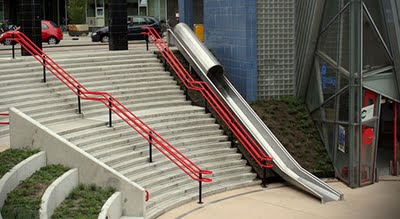
Slide into work with the subway slide in Holland

Thanks to the blog Cup of Jo for finding this:

Leave it to the Dutch to install a slide in a subway station. Commuters are encouraged to use it if they’re running late, and the official name is a “transfer accelerator.” At night they play Bach. How rad is that?!

more via A CUP OF JO: Dutch subway slide.

I love the idea of putting a little fun in your commute, in the community, and just keeping your environment fun in general.

Where else have you seen a little fun put into everyday surroundings? I’ve posted about the musical stairs before, but what else is out there? Some silly graffiti? Colorful cars? Share in the comments below.

architecture · community · creativity · design

6 Awesome Parks Made From Rehabilitated Urban Structures | Inhabitat

It’s starting to be State Fair time around the U.S., so what better time to talk about interesting parks, particularly those made from rehabbed structures?

Over the past few years we’ve seen some very creative minds transform urban ruins into spectacular parks for us to enjoy. If you can brave an abandoned nuclear plant turned into an amusement park, head to Germany – or see how old train tracks can be transformed into beautiful and fun parks in New York City and Lima.

see all of the 6 Awesome Parks Made From Rehabilitated Urban Structures | Inhabitat – Green Design Will Save the World.

architecture · community · design · technology

Prague’s Passive Solar Social Housing Project Makes the Most of Inexpensive Materials | Inhabitat

Just a great reminder that solar power doesn’t have to include high tech!

Prague-based DaM Architects recently completed a tenement housing project in the center of their city that takes advantage of passive solar design, glazing, ventilation and green materials to give it a high degree of energy efficiency. The firm organized the social housing project by stacking a series of brick-shaped apartments modules in a way that maximizes space, light, natural ventilation, and circulation. They also focused on keeping the project’s overall cost down through the use of inexpensive materials, however they still managed to maintain a high level of quality through precise workmanship.

more via Prague’s Passive Solar Social Housing Project Makes the Most of Inexpensive Materials | Inhabitat – Green Design Will Save the World.

architecture · community · culture · environment · Social

Bathrooms, Internet part of revitalization plan for Pioneer Square

101 S Jackson St in the Pioneer Square neighbo...
Example of architecture in Pioneer Square Neighborhood. Image via Wikipedia

Revitalizing a neighborhood, i.e. growing a community or keeping it from leaving, can be difficult, even if everybody’s in agreement on what needs to get done. I’m seen a couple of revitalization plans for neighborhoods *cough* *Alameda* *cough* *cough* go nowhere fast. Seattle’s plan for one of its oldest neighborhoods, Pioneer Square, involves free Internet and better parking.

Comcast has been chosen to provide high-speed Internet service to businesses in Pioneer Square, Mayor Mike McGinn said Wednesday, one of several efforts aimed at reanimating a neighborhood perceived to be in trouble.

McGinn also announced that Onehub, a business-file sharing company from Bellevue, was moving into the city’s oldest community next month. Charles Mount, Onehub CEO, said juiced-up Internet was a key factor in the decision to bring his 10-person business across Lake Washington…

The Comcast and Onehub announcements were part of the unveiling of a new plan (PDF) to revitalize Pioneer Square, the product of a panel of more than two dozen business, neighborhood and city leaders. Among the ideas are to increase residential density, streamline permits, improved lighting, better manage parking increase public safety.

“We by no means think we have the problems licked in Pioneer Square, we know it’s going to take a lot more work,” McGinn said.

more via Bathrooms, good Internet: Can they save Pioneer Sq.? – seattlepi.com.

Last summer they also had a “Pioneer Square” craft festival with food trucks and all sorts of crafty items. I have no idea if they’re doing it again this year (I guess not?), but if they are going to try and keep it as a tourist attraction for the people who jump off the ferries, then bathrooms and better lighting are a good start.

What else would you do to improve the feel of Pioneer Square? Cleaner streets? Different kinds of shops? Leave your ideas in the comments below.