anthropology · architecture · community · creativity · culture · design · environment · happiness · Social

How legalizing street art made Rio de Janeiro a prettier, happier place

A recent article in the Huffington Post explored Rio de Janeiro’s acceptance of street art and how it has enriched the various neighborhoods:

Brazilian graffiti art is considered among the most significant strand[s] of a global urban art movement, and its diversity defies the increasing homogeneity of world graffiti.” – Design Week

In March 2009, the Brazilian government passed law 706/07 making street art and graffiti legal if done with the consent of building owners. As progressive of a policy as this may sound, the legislation is actually a reflection of the evolving landscape in Brazilian street art, an emerging and divergent movement in the global street art landscape.

Rio de Janeiro has been particularly progressive in its policy towards street art, with its 1999 “Não pixe, grafite” (Don’t Tag, Graffiti) project that brought together 35 graffiti artists to showcase diversity in local styles. But more unique is the evolution of a permission hierarchy, blurring the line between formal and informal. The new street art law merely reinforced these unique patterns of street art and legitimized an already flourishing form of artistic expression.

Retaining walls on the steep terrain provide canvases for artists.

In Rio de Janeiro, street art is ubiquitous. It exists in all corners of the city, from the favelasto upper class neighborhoods, from residential to institutional. It is bold in scale and aesthetics and is anything but graffiti. The urban fabric of Rio de Janeiro also figures prominently in the evolving street art scene. The high walls, whether for security or to contain the topography, provide ample surfaces for painting. But rather than location dictating art, the relationship between owner and artist has a direct impact on where street art occurs.

Owners of buildings, both residential and commercial, sometimes invite artists for commissions, which is done to protect from tagging, as an aesthetic choice or as an economic choice — painting a façade with art may be cheaper than another mode of beautification. In another case, street artists ask permission from the owner.

Tudo de cor para você, Santa Marta, Rio de Janeiro (photo source: favelapainting.com)

Thanks to the city’s openness to various forms of artwork, and specifically “street” art, Rio de Janeiro is now known for its colorfulness and art. In informal studies the art has also been found to make citizens more invested in their communities and overall happier.

Hooray for public art.

anthropology · behavior · community · environment · happiness · Nature · psychology · technology

Mappiness: Mapping Happiness

A shot of the app.

From the blog How Do you Landscape; a group from the UK has created an app that can be used to measure our happiness based on our surroundings, and using maps to look at the data:

“People feel better outside than inside”. “People feel better in the park/woods/nature than in the city”. These are some of the conclusions from a project with the telling title ‘Mappiness’ Good news for landscape and Landscape Architecture on first sight. But are these only one-liners or firmly based scientific statements? Well, that depends on the quality of the empirical evidence of course. Most experience sample methods (ESM) have a hard time getting a representative group (in the end almost only colleagues) that has to struggle trough tedious interview forms (“it will take only twenty minutes”) to step-by-step end up with modest results. How about a sample group of 47.331 people (and growing by the day) who willingly support their data three times a day to the researchers that by now collected over three million forms in a few months? I stumbled upon these remarkable Experience research feats in a TedxBrighton 2011. In this “Twenty minutes lectureGeorge MacKerron explains why and how he and Susana Mourato (both from the Department of Geography & Environment at the London School of Economics and Political Science) created ‘mappiness’. They want to better understand how people’s feelings are affected by features of their current environment. Things like air pollution, noise, and green spaces influence your well being is their hypothesis.

This is how it works. They developed an app that can be downloaded for free. It must be one of the most irritating apps around on the web because it rings you (with your approval, you can influence the settings) three times a day to ask you three simple questions.

When put through a big regression model they can gauge the happiness as the function of habitat type, activity, companionship, weather conditions (there is of course a link between meteorological data and the GPS data), daylight conditions, location type (in, out, home, work, etc), ambient noise level, time of the day, response speed, and individual ‘fixed-effects’ (that come out of your personal Mappiness-history). Factors can be plotted out against each other.

How awesome is that? What a neat piece of technology to measure our surroundings and how they influence us!

anthropology · behavior · brain · community · happiness · health · mental health · psychology

Life Lessons Passed On

English: Elderly Muslim during the Republic of...

I was really inspired by that blog post I shared a couple of months ago about cancer survivors and what they’d learned about life. I also posted a survey done with older folks last year giving advice on what NOT to do.

Well, thankfully all of that hard-earned knowledge is coming out in book form. Many of the interviews can also be at legacyproject.human.cornell.edu. From the NYTimes:

Eventually, most of us learn valuable lessons about how to conduct a successful and satisfying life. But for far too many people, the learning comes too late to help them avoid painful mistakes and decades of wasted time and effort…

Enter an invaluable source of help, if anyone is willing to listen while there is still time to take corrective action. It is a new book called “30 Lessons for Living” (Hudson Street Press) that offers practical advice from more than 1,000 older Americans from different economic, educational and occupational strata who were interviewed as part of the ongoing Cornell Legacy Project.

Its author, Karl Pillemer, a professor of human development at the College of Human Ecology at Cornell and a gerontologist at the Weill Cornell Medical College, calls his subjects “the experts,” and their advice is based on what they did right and wrong in their long lives.

You can also read a summary of their advice in the article: Advice From Life’s Graying Edge on Finishing With No Regrets

What are your life lessons?

anthropology · creativity · culture · learning

Slow school movement

lutin waldorfThe holidays are a time to reflect on our lives, our jobs, and what we want for the new year. It might also be a good time to think about ways to cut back on our obligations and “must dos”. Especially for our children at school.
I appreciated this op-ed piece questioning the value of play versus academic work in kindergarten, pre-k, and the lower grades. The piece is US-oriented but it does refer to data from elsewhere, and to the ‘ethnographic record’ :0)

While the U.S. pushes their kids to excel earlier and earlier, science is finding it might not be the most efficient way to learn:

Students from countries where reading is not taught until age six actually do better on standardized reading tests than those from countries that begin at five or earlier, as in the USA. Children who start even later catch up quickly: Suggate collected extensive data from about 400 students in New Zealand – some in public schools and some in private “Waldorf” schools, where reading teaching doesn’t even begin until age seven. Difference in reading achievement between the two groups disappeared by age 10.

Research comparing Waldorf school students’ academic skills to those of public school students shows even more encouraging results. In a report exploring the value of the Waldorf approach for public school reform, Ida Oberman found that second-graders from four Waldorf-style schools underperformed in comparison to 10 “peer-alike sites.” Yet by eighth grade, these students could match and even outperform comparison sites on state school achievement tests.

If nothing is lost from academic achievement when training starts later, and some competencies even may be gained, why then the rush to begin it? Why buy toddler flash-cards, fund pre-K academies, and start kindergartners on reading and math when children could be otherwise engaged, developing other kinds of skills and dispositions, such as empathy and creativity?

more at: What can slow schools teach us?

There is also great research coming out of Denmark vs. the U.S. that find kids that aren’t taught to read until 6 or 7 (Denmark) vs. 4 or 5 (U.S.) do better overall, similar to the study in New Zealand.

Interesting to see how taking it easy can sometimes be better for learning.

anthropology · architecture · community · creativity · design · environment

Coloring inside the lanes: Art that creates community | Grist

The Fremont Turtle - Grist

I found another great article from Grist magazine about how something as simple as a bucket of paint, or several different colored, buckets of paint, can have a huge positive impact on a neighborhood:

Sunnyside Piazza, it is called, which may seem a bit much for a splash of color on asphalt, but in person, it seemed fitting. This whimsical design, interrupting the functional but monotonous gray of Portland’s street grid, felt like a somewhere. It seemed like a place deserving a name. It even felt like a “piazza.”

That was in 2002. I later learned that the Sunnyside Piazza was the second painted public square in Portland, facilitated by the nonprofit City Repair Project. Now, dozens of painted plazas, dubbed Intersection Repairs, pepper the map not just of Portland but also of Los AngelesNew YorkSt. Paul, and Seattle.

It all started in the mid-1990s with Share-It-Square, in Portland’s Sellwood neighborhood, where architect and City Repair co-founder Mark Lakeman lives. After visiting villages in Central America where residents gather around common spaces, Lakeman decided to bring similar spaces to Portland. “Putting the public space back where it’s supposed to be may not sound like a huge change,” Lakeman says, “but it has a profound effect on the social culture … We know that Americans are more lonely and isolated than ever before, but we don’t realize that the absence of cohesion in American communities is totally related to the absence of places where people can actually build that.”

more via Coloring inside the lanes: Art that creates community | Grist.

The article goes on to discuss how creating a group mural creates a sense of community:

“It’s not about the paint,” says professor Jan Semenza, a professor of public health at Portland State University who lives near the Sunnyside Piazza and has researched intersection repairs. “It’s about neighbors creating something bigger than themselves.” As an everyday intersection becomes someplace special, residents begin to experience the value of community. Neighbors paint themselves out of a corner — of the intersection, of their individual homes — and into the middle of the street. By turning an intersection from a dividing line between neighbors into a gathering place, residents begin to solve the problems that plague neighborhoods and cities. Where isolation existed, they find community. Where cars dominated, they create a people place. With a little paint, neighbors are solving big problems.

I have seeen some great community spaces also created out of roundabouts, water fountains at outdoor shopping centers, and often at landmarks like stairs or trees. Sometimes, if a natural landmark or meeting space isn’t in place, all it takes is some paint, chalk, or even ribbon to make a place significant and identify it as a community gathering space.


anthropology · behavior · community · happiness · hugs · psychology · Social

For those days you really need a hug

Ever have a day when you just really need a hug, like, right now? Well now you’re in luck:

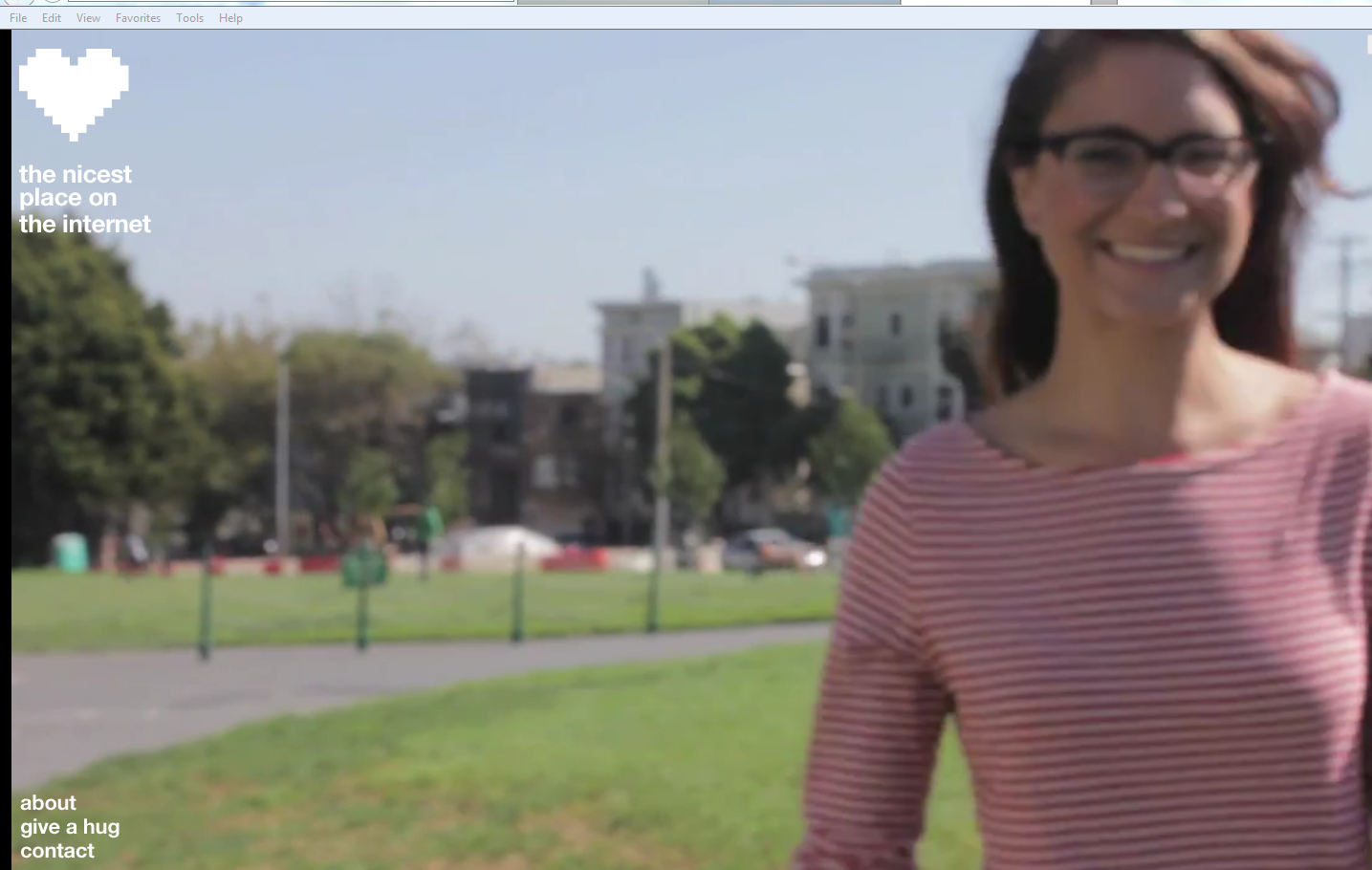
"Jeff Lam and Lauren Perlow created The Nicest Place on the Internet, a place where you can feel warm and fuzzy with virtual hugs, because they were having an off day. It’s perfect for those chilly winter days."

Check out Creativity Online.

You can also go directly to the site: The Nicest Place on the Internet

You can also contribute your own hug.

I love this idea of virtual kindness; it’s a weird concept in a way, of people donating hugs (so to speak) to complete strangers. But, it’s great because it’s using the World Wide Web to create community and connections with people all over the world. Somehow, by being open to receiving a hug, even a virtual one, we are able to create connections and feel like part of a larger tribe or cohesion.

So often online communities can turn harsh or downright mean; it’s great to see online crowdsourcing being used for positive psychological benefits!

anthropology · behavior · community · Uncategorized

Getting the locals on board is key to conservation

An ethnic Adivasi woman from the Kutia Kondh t...
You're looking at the face of sustainable conservation. Image via Wikipedia

Great post from the Human Directions of Natural Resource Management:

Indigenous peoples are key to preserving the world’s forests, and conservation reserves that exclude them suffer as a result, according to a new study from the World Bank.

Its analysis shows how deforestation plummets to its lowest levels when indigenous peoples continue living in protected areas, and are not forced out.

Across the world millions of tribal people are conservation refugees, but the World Bank says its evidence shows ‘forest conservation need not be at the expense of local livelihoods.’

Using satellite data from forest fires to help indicate deforestation levels, the study showed rates were lower by about 16% in indigenous areas between 2000-2008.

Read more at It’s Official – The Key To Conservation Lies With Indigenous Peoples

This is something Woodland Park Zoo, Izilwane, and many other non-profit organizations have been working on for years, so it’s nice to see the World Bank back them up.

So, the next question is what can be done to support local, indigenous groups to protect and care for their natural surroundings? Most groups want to preserve their environments and keep them handy for the next generation, but it is simply economically not viable, at least not how they see it.

anthropology · behavior · community · psychology · Social · technology

Crowdsourcing the locals for travel recommendations

Uptake helps you ask locals what to do in different locations

On a recent roadtrip, my husband and I stopped in a medium-sized town out in the middle of nowhere, tired, dirty, and famished. Neither one of us are McDonalds or Subway types, but we definitely needed meat, and fast. What to do? My husband spent 10 minutes on my smartphone trying to read Yelp for a decently reviewed restaurant, which turned out to be a real dive but had somewhat tolerable pizza. Long story short, I bet this app would have helped us out a lot:


Uptake
is set up to have a web community of people passionate about their local bars, hotels, and restaurants, but the key is that they let you ask questions of your Facebook friends who are local in the city you’re interested in.

When you ask questions in an open community, you’re not guaranteed to get an answer. If you’re looking at reviews on Yelp, you don’t really know who are behind them [Editor’s note: Yeah, tell me about it!]. Your friends are usually the people you trust the most with picking a great bar or pub to eat at, so Uptake takes the extra step of drilling down to the friends who are relevant to your question.

A lot of apps and services like Nomad for iPad and Trazzler let you ask for travel recommendations, but Uptake helps you ask the people who probably know best.

Local destinations still need technology, as sites like Yelp have become a stomping ground for trolls sounding off about bad experiences. Social is the key to a good recommendation, but not many services have nailed the experience yet. When I see a recommendation from a name or avatar that I recognize, it instantly has more value to me.

Uptake is in beta right now and promises a few features that aren’t available yet.

Read more at: Uptake helps you ask locals all of your travel questions (The Next Web)

One interesting trend of crowd-sourcing apps is an attempt to reach out to pre-established tribes and communities (see yesterday’s post about creating tribes through community) and trying to tap into that local’s knowledge. As the author of the article mentioned, people trust other people they know, and getting “local” knowledge is very important to us humans. We want to feel like we’re an insider, included, and not some dumb tourist who gets taken advantage of or just looks silly.

We also trust other tribe members and their knowledge more than anything else. It’s been shown we trust word of mouth and let it influence us more than advertising, and our peers are hugely influential on what we buy, use, and spend time doing. As we travel, we will also trust our peers over guidebooks on what to do, what to see, and where to eat.

I’ll be interested to see how these social peer-sourcing apps continue to evolve over time. Visit Uptake‘s website to find out more about the app.

anthropology · community · education · happiness · school

Creating tribe through education

Students at Washington High School at class, t...
Working on a project together with a group can create a sense of "tribe." Image by The Library of Congress via Flickr

Having a community or “tribe” is one of the essential things all humans need in order to be happy, healthy, and really survive. In the predominantly urban, mobile environment most of us live in now, it can be hard to develop and maintain a tribe.

The UW Professional & Continuing Education Program recently published a blog post addressing the idea of tribe, and how we create that in modern, usually urban settings through education. One of the most common ways we create tribe is through what we spend time learning; taking Yoga, getting certified in Fiber Arts, sharing this knowledge, love, and in a way a rite of passage with others definitely creates a sense of community and tribe.

History defines tribes as groups united by shared ideas, values and goals. Godin and others put a 21st century spin on the term to empower ordinary people to lead big changes, including the pursuit of a new career.

For Tammie Schacher, the big change was to transition out of the architecture profession and into the nonprofit sector, where her goal was to align her values and passions with a new career. To get started, Schacher enrolled in the UW Certificate in Nonprofit Management where she joined a cohort of fellow students who would go through the program together.

“At the beginning the instructor told us that these groups become very tight knit and that we’d start relying on each other,” she says. “We didn’t necessarily believe that, but by the second quarter we realized we had not only started to rely on each other but that we’d become a family.”

The blog post goes on to discuss how to get the most out of putting yourself in this new, tribal situation:

Both Matthews and Schacher believe that getting the most out of being part of a tribe that starts in a continuing education classroom is fairly simple. First, say both, be open. “Have a little courage and put yourself out there,” says Matthews. “The structure of a classroom is a great place to try something out.”

Read more at: Find Your Tribe, Foster Your Future

There are lots of opportunities to create a tribe based on shared knowledge, and to create new ones based on group learning. We can also create tribes online through forums and blogs, as well as allegiances to sports teams or other athletics. Anything from military service to attending a concert can create a sense of tribe.

What are some of the surprising places you have found and/or created a tribe of like-minded people?

anthropology · behavior · community · creativity · environment · health

Making money off the land

A swaledale ewe on the rolling fells of the La...
You may be looking at a model of your next lawnmower. Image via Wikipedia

After the last post about dumpster diving, I thought we could focus on something a little more fresh, like growing your own food. Or your own sheep.

From renting out goats and sheep in order to naturally trim lawns and hillsides, to teaching other people how to raise chickens and bees, “urban homesteading” is becoming a way of life that is not only natural and makes people feel good, it’s also profitable.

As an uncertain economy and a stagnant hiring climate continue to freeze people out of the traditional job market, a number of entrepreneurs like Mr. Miller, many of them in their 20s and 30s, are heading back to the land, starting small agricultural businesses. And in the process, they are discovering that modern homesteading offers more rewarding work, and possibly more security, than entering the white-collar fray.

Mr. Miller, who supplements his income by working on a local farm, has resisted raising his prices because he wants his services to be available to all. And while Heritage Lawn Mowing is not yet in the black, he says he has found a better way of life.

“It’s a gateway to that whole rural dream,” he said. “And with the type of recession we’re having, there’s stability in it.”

Other yeoman start-ups are charting a more traditional path to profits.

Carrie Ferrence, 33, and Jacqueline Gjurgevich, 32, were in business school at Bainbridge Graduate Institute in Washington State when they noticed that many local neighborhoods were “food deserts,” without easy access to fresh local produce and other grocery staples.

Their answer was StockBox Grocers, a company that repurposes old shipping containers as small grocery stores. The company won $12,500 in a local business plan competition and raised more than $20,000 online in a Kickstarter campaign to finance its first store, which opened in the Delridge neighborhood of Seattle in September.

“It’s a tough job market, and you have really few instances in your life to do something that you really love,” Ms. Ferrence said. “It’s not that this is the alternative. It’s the new plan A.”

Read more: Sheep Lawn Mowers, and Other Go-Getters (New York Times)

What is it that is so appealing to this (my) generation about growing gardens, knitting, and owning a sheep-rental mowing company? Why are we so drawn to this idea of keeping bees, growing our own vegetables, and sewing our own clothes? I have some ideas, but I’d be curious to hear yours in the comments below.