
As humans go more urban, what that means for how we live together…
Category: anthropology

As you digest your turkey and reflect on a hopefully happy Thanksgiving, I am offering this summary of a recent conference session that talked about how to integrate biophilia into urban spaces and cities. As the human population increases, more people move away from the country and into the city, yet as humans we still crave nature and natural environments. Three researchers suggest how to go about addressing that.
OpenIDEO – How might we create healthy communities within and beyond the workplace?

Wow, OpenIDEO is on a role lately with their challenges that get my creative juices rolling and my passions up, in a good way! This latest challenge is about wellness in the workplace:
Together with Bupa and the International Diabetes Federation, we’re asking our global community to help us explore how people can best be supported in the workplace to make positive changes to their health and wellness – and what skills and tools are needed to pass these positive changes onto their networks of co-workers, family and friends.
via OpenIDEO – How might we create healthy communities within and beyond the workplace?.
As the Chair of the Wellness Committee at my job for just under a year, we tried out a lot of different wellness incentives, some with better results than others. I feel very passionately about offices promoting and encouraging wellness; we spend the majority of our waking lives there, it’s cheaper in the long run for companies to have healthy and happy workers, and it promotes productivity and dedication from employees.
What are your ideas? Add them to the inspiration. I’ll have to share some of my ideas for this challenge on the blog, as well as my ideas from the previous OpenIDEO challenge I mentioned, which is currently in the concepting phase.
Related articles
- IDEO asks how to inspire communities to care about their environments (mentalflowers.wordpress.com)
Unhappy Employees Cost More (and how to reduce that cost)

A recent study of health factors and their associated costs at seven companies, published in the journal Health Affairs, found that “depression is the most costly among 10 common risk factors linked to higher health spending on employees.”
The analysis, found that these factors — which also included obesity, high blood sugar and high blood pressure — were associated with nearly a quarter of the money spent on the health care of more than 92,000 workers.
First the employees were assessed for health risks, then researchers tracked their medical spending from 2005 through 2009.
The average medical spending for each employee was $3,961 a year. In total, $82 million, or 22 percent, of the $366 million annually spent on health care for the workers was attributed to the 10 risk factors, the study found.
The relationship between higher spending and depression was the strongest, with 48 percent more spending for workers with a propensity for that widespread problem.
via VPR News: Depression And Health Spending Go Together.
Now, to be fair, this is a fairly small study of just seven companies, and the article didn’t say how many employees worked at these companies. However, this is definitely a trend that has been spotted at least anecdotally by many HR managers, so it’s nice to see that there is some “official” analysis being done on the issue.
So what can employers do about this? My fear is that employers would discriminate, unintentionally or intentionally, against people who suffer from depression. But these days many people will be diagnosed with depression due to a temporary life situation such as a death in the family, or their jobs, so being fired for temporary sadness is probably not a good idea for companies.
Instead, my hope is that companies would invest more on making people’s job satisfaction higher. As of two years ago, Americans reported the lowest job satisfaction ever recorded. That means employers can be doing A LOT more to improve their employees’ lives at work. And a lot of that has to do with feeling supported by their managers, and feel like they are heard and respected and overall a part of the team. A lot of that comes from having fun at work.
This philosophy has been spouted in several different books and magazines, and has been shown to work well in classrooms as well, referred to as the “Responsive Classroom” approach.
The Responsive Classroom approach centers on several ostensibly mundane classroom practices. Each morning students form a circle, greet one another, share bits of news, engage in a brief, fun activity and review the day’s agenda. The idea is to build trust, ensure a little fun (which adolescents crave) and confront small problems before they become big. Students might welcome one another with salutations from a foreign language. An activity might involve tossing several balls around a circle in rapid succession. Students share weekend plans or explore topics like bullying before lessons begin. (New York Times)
This approach could very easily be applied to a business setting, in fact it sounds like a team kick-off meeting one might see in a corporate environment. Taking time to connect with other coworkers and laugh a little before diving in to the day’s work has been shown to work wonders for productivity and boost morality in both school and work settings.
There is definitely a drive and expectation in many industries to work longer, faster, harder hours, and be available and working at all hours. But that drive is unsustainable, demonstrated by the low job satisfaction and high burnout rates in many industries, from high-tech to physicians. Taking time to play a little bit at work, or just connect with coworkers, is being shown as an effective way to reduce depression related to work and job burnout, increase productivity, and create a more cohesive company with more loyalty overall to the company’s mission.
So long story short: remember to bring the koosh ball to your next meeting.
Related articles
- Burnout hitting more workers, study says (sfgate.com)
- The relationships of empowerment, job satisfaction, and organizational commitment among Filipino and American registered nurses working in the U.S.A. (udini.proquest.com)
- The relationship between leadership style and job satisfaction (udini.proquest.com)
- Study: Burnout on the rise among workers (rep-am.com)
- New research reveals job satisfaction is determined by our work colleagues (prweb.com)
- Burnout up among employees (usatoday.com)
When Play Gets Political: Puppets Protest At The U.S. Capitol
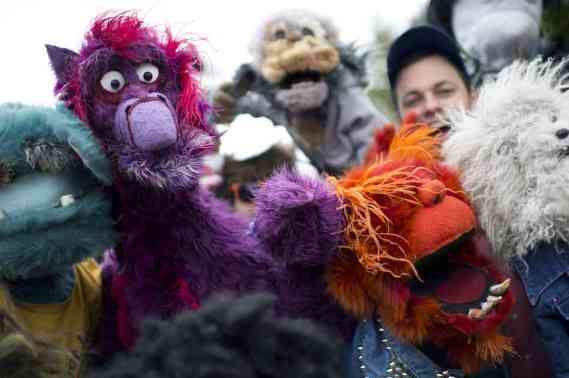
When presidential hopeful Mitt Romney threatened a childhood icon with funding cuts during a debate last month, people took to the streets and protested…with puppets. In what was deemed the Million Muppet March, people used puppets, marionettes, and other toys to show their unhappiness with the idea of funding for public broadcasting being cut:
Organizers say at least 600 people signed up to attend the march in person, with a few thousand more participating virtually on Facebook, Twitter and their own marches around the country. So far, the pictures on the group’s Facebook page show the marchers bundled in puppet-like hats with animal ears, carrying coffee, placards with statements like “Grouches of the World, Unite!” and, yes, more than a few puppets.
via They’re Furry And Furious: Puppets Protest At The U.S. Capitol : The Two-Way : NPR.
This protest is not only about supporting Public Broadcasting, but is also about play on several different levels. First, Big bird and other Sesame Street characters are a big part of many Americans’ childhoods. While imaginary, to many people these Muppets were very real and very important play characters during the formative years of their lives.
Second, the use of puppets and toys to protest politics is an age-old tradition. People in countries ranging from the England to Venezuela to Thailand have used puppets and epitaphs during protests to get a laugh out of people as well as get their attention. Even the court jester in days of old could get away with some nasty political commentary because it was said “in jest.”
Full disclosure, I am a huge Muppet fan, and am happy to see that others agree with me that Big Bird and PBS are worth funding, and I’m especially happy that people showed their support using puppets.
Related articles
- ‘Puppet March’ To Defend PBS Funding At U.S. Capitol (baltimore.cbslocal.com)
- ‘Puppet March’ to defend PBS funding at U.S. Capitol (politico.com)
- They’re Furry And Furious: Puppets Protest At The U.S. Capitol (wnyc.org)
- Protesters (and their puppets) march to support public broadcasting (cnn.com)
- Million Puppet March to support public broadcasting in America (boingboing.net)
- Puppets Not Controlled by Lobbyists Protest Romney’s Threat to Public Broadcasting (themoderatevoice.com)
IDEO asks how to inspire communities to care about their environments

I love these OpenIDEO public challenges, so I was thrilled when I saw this challenge alert pop up in my inbox (and then unfortunately let it get buried for a week, oops!) about ideas on how to make communities more involved and engaged in their environments.
Public agencies such as Singapore’s National Environment Agency would like to envision how to rejuvenate our local environments to inspire and enable communities to make our living environments better – and are eager to collaborate with the global community to explore solutions which resonate in Singapore and across the world.
In this challenge we are looking to try and explore the following questions, both for Singapore and for communities everywhere that face similar challenges.How might we better collectively solve problems facing our neighbourhoods?How might communities look out for each other more?How might we provide a safe space for positive and constructive action?How might we help passive citizens become active contributors?How might the role of the government evolve in the future, with regards to local neighbourhoods?In short, what does community ownership look like in 2012 and beyond? The National Environment Agency invites you to join us in designing better answers, together.Let’s collect examples of existing initiatives and explore the challenge topic to inform our ideas for the upcoming Concepting phase.
It’s a question that I bring up a lot on the blog, and share different examples of how communities around the world are doing just that, from adding public art to bee and butterfly gardens to building playgrounds. I am bubbling with excitement over this challenge, and have lots of different ideas, but there are only 14 more days to submit ideas and I want to make sure mine are really good, eek!
What have you seen that worked in growing communities to keep the residents and developers motivated to preserve the surrounding environments, rather than bulldoze them over for a quick couple hundred bucks? What are some of your ideas? Have you seen any story of community building on this blog that screams “Yes, this is the answer!”? Submit your ideas at the OpenIDEO website.
Related articles
- LinkLog: Open IDEO Challenge (dorai.me)
- Opinion: Dignifying Design (nytimes.com)
- 15 Minutes With – Design Thinking – Ideo (designingdesignthinkingdrivenoperations.wordpress.com)
Halloween, the most playful time of year

Ah, Halloween, originally considered the betwixt and between time of year when ghosts and souls past could pass over into our world and scare the crud out of their relatives.
But these days, Halloween is really a celebration of play. No, really! When else is it perfectly acceptable to dress up in funny costumes, stay up late on a week night running around banging on peoples doors, play tricks on people, and create food that looks spooky or gross but is really just lots of sugar?
The tradition of dressing up and playing for Halloween is alive and well in the tradition of Dia de los Muertos, for example. To deal with and make light of mortality, grown-ups and kids will put on make-up and costumes that represent death and the dead. They’ll make and eat sugary confections, parade down the street, play music, sing songs, and overall try to make a party out of a normally scary and sad phenomenon. Yes, there is some sadness involved, such as visiting relatives’ graves and setting up alters to reflect their passing, but for some even the act of creating the alter, i.e. being creative, is cathartic and helps with the loss of a loved one.
In the play deprived United States, Halloween has become one big kid’s night out for adults as well as kids. Children and grown-ups alike look forward to dressing up, pretending to be a character, and be silly with friends. Often the costume is a parody or commentary on something political, but that’s just as playful as covering yourself as marshmallows, although potentially socially sticky instead of just physically sticky.
That’s why it makes me sad that so many K – 12 schools have banned Halloween for fear of these socially sticky situations or fear of kids bringing weapons to school as part of their costumes, plus some religious groups find Halloween offensive. While I understand and respect all of these concerns, I disagree with the idea that we should just get rid of it outright. How are we going to learn to get along and get over differences if we just avoid them? Play and school are both supposed to be about learning, so why not turn Halloween into a learning opportunity?
As a proponent of play, I feel like Halloween is an important holiday, not because of what it originally stood for, but for what it stands for now. Being socially allowed to play and pretend, even for one day, is important for humans’ mental health. It also creates bonds between people who share in the activity, not just from sharing the experience but learning more about each other through their costumes.
I will definitely be buying candy and supporting Halloween this year, not for the sweet tooth but for the costumes. Play on!
Related articles
- Halloween, A Time to Be Anything You Want…. (catseyesk.wordpress.com)
- Will You Be Dressing Up for Halloween? (neutrakris.com)
- Halloween Special: How to survive Halloween THE NIGHT. (makinguseofmydegree.wordpress.com)
- Halloween and Dia de los Muertos (davidleesummers.wordpress.com)
Attention Disorder or Not, Children Prescribed Pills to Help in School – NYTimes.com

I find this article in today’s New York Times extremely disturbing:
When Dr. Michael Anderson hears about his low-income patients struggling in elementary school, he usually gives them a taste of some powerful medicine: Adderall.
The pills boost focus and impulse control in children with attention deficit hyperactivity disorder. Although A.D.H.D is the diagnosis Dr. Anderson makes, he calls the disorder “made up” and “an excuse” to prescribe the pills to treat what he considers the children’s true ill — poor academic performance in inadequate schools.
“I don’t have a whole lot of choice,” said Dr. Anderson, a pediatrician for many poor families in Cherokee County, north of Atlanta. “We’ve decided as a society that it’s too expensive to modify the kid’s environment. So we have to modify the kid.”
via Attention Disorder or Not, Children Prescribed Pills to Help in School – NYTimes.com.
Sadly the doctor is correct that many schools refuse to change a child’s environment to improve academic success, namely that they are cutting out activities like recess and P.E. in order to make more time for studying.
However, P.E., recess, and just getting outside for a quick breath of fresh air have all shown to also be extremely effective ways to improve attention and academic success. Yet because these activities are getting cut out of the school day, doctor’s feel like they must prescribe these incredibly strong, brain-chemistry changing medications to growing brains, many of these drugs with strong side effects .
I have no problem with using these drugs for what they were originally intended for, but prescribing them basically as “performance-enhancing” drugs just seems unethical to me. We frown upon athletes and grown-ups in the business world from taking speed and other kinds of drugs that are supposed to improve performance (other than coffee of course, that seems pretty much like a must-have for adults), but it’s okay for students so they can do well in elementary and middle school? To put in mildly, yuck!
I hope other people will be as outraged as I am and stand up for a child’s right to recess and P.E., and actually NOT studying from time to time, rather than encouraging giving them strong medications in order to perform well on standardized tests.
Related articles
- NYT Hits The Problem With ADHD Drugs: They Work (forbes.com)
- Raising the Ritalin Generation – NYTimes.com (mbcalyn.com)
Letting the seasons influence work hours

In this blog I often talk about play and creating space for play in our busy lives. A recent article in Good magazine discussed the idea of changing our work habits to match the seasons, making more room for play (or at least less work time) in the summer:
Jason Fried, CEO of 37Signals, recently wrote for the New York Times that his company’s work schedules change with the seasons.
“For example, from May through October, we switch to a four-day workweek. And not 40 hours crammed into four days, but 32 hours comfortably fit into four days. We don’t work the same amount of time, we work less.”
We work less, he says. I can imagine it’s pretty easy to get buy-in for that idea around the office.
“When there’s less time to work, you waste less time. When you have a compressed workweek, you tend to focus on what’s important. Constraining time encourages quality time.”
This is a pretty rare set-up, but I have worked at places where they did offer 4 10-hour days in the summer, or 4 9-hour days and a half day on Friday, or some other kind of flexibility so people could take advantage of the nice weather. Europeans will often take a month off in later summer for vacation.
First, I think this is a great idea, and I think Fried makes a good argument that with less work time, people will prioritize work and really get the essential stuff done. From an anthropologist’s perspective, however, this dichotomy of summer equaling less time in the office, and theoretically less work, I find somewhat interesting, since as humans we traditionally tend to be MORE active and alert when we have more sunlight. In winter there was traditionally less food and worse weather conditions, so we would stay inside, hunkering down with our tribe or family, and maybe catch up on repairing clothing or tools. Late spring (when it stays light the longest) and late summer/early fall (just after the hottest temperatures) was a time of planting, hunting, gathering, harvesting, and getting stores up for the long winter months.
Today, we still hunker down inside during the colder months, but I find it interesting that this has translated into a tendency to stay inside busy over paperwork or computer work while summer, our traditionally busier work time, has become a time associated with leisure and play, or at least that’s what many of us would like it to be.
What are your thoughts? Do you like the idea of having work schedules that adjust with the seasons? Do you find yourself more or less productive in summer or winter, ignoring factors like kids home from school, etc.? Leave your thoughts in the comments below.
Related articles
- Opinion: Be More Productive. Shorten the Workweek. (nytimes.com)
- 37signals Works 4 Days a Week in the Summer. Should Other Tech Firms Do the Same? (bostinno.com)
- How to Convince Your Boss to Let You Try a Four Day Work Week [Jobs] (lifehacker.com)
- Be More Productive. Shorten the Workweek. (andsp.com)
Animals get their own trail systems at Philadelphia Zoo

I am so excited about this I’m practically jumping out my seat to tell people. I first read about it in USA Today; animals are getting to wander outside of their exhibits, share spaces with other animals, and over all just chill around the zoo. Yup, that’s right:
The Philadelphia Zoo on Thursday opens the first leg of an ambitious enclosed trail system designed to allow large animals such as great apes, bears and big cats to roam throughout the zoo. It will give them access to one another’s habitats in a kind of time-share arrangement and offer visitors a closer look at wild animals behaving like wild animals.
Other U.S. zoos have created paths between exhibits, mixed habitats, elevated paths or rope swings for apes.
“This is an emerging trend” among zoos accredited by the Association of Zoos & Aquariums, says the group’s senior vice president for external affairs, Steve Feldman. “Great animal care means providing for animals’ physical and psychological welfare. These pathways and rotations really allow them that kind of stimulation.”
The Philadelphia Zoo’s program is the first to encompass the entire zoo. “This campus-wide effort to build this trail system is unique,” Feldman says. “It’s innovative and is really taking that trend to the next level.”
Because it’s the first effort of its kind, “we don’t have a road map to see how others have done it,” says Vik Dewan, the Philadelphia Zoo’s chief executive officer. The system “puts animal well-being first and foremost,” he says, and gives visitors “an experience here, that when combined with other experiences, paints the bigger picture of how they could be more effective stewards of the world.”
The critters will have to “timeshare” so the orangutans won’t be hanging out with the brown bears. In fact the bears might not get a chance to use the pathways until winter when it’s too cold for the primates. But that said, it’s sure to be a boon for the animals, as well as for the people. The zookeepers already report seeing a positive result from a similar vine system in their primate exhibit.
The article mentions other zoos starting to move in this direction. But which ones, and what exactly are they up to? I’m curious to learn more. Any hints? Leave them in the comments below.
animals given access to the new trail are expected to be more active and
to benefit from the stimulation of being able to see visitors and other
animals from a new perspective.
 Mental Flowers