Beth Kelley is an applied & digital anthropologist with an overall interest in how people engage with and are impacted by their environments and vice versa. This has manifested itself in many ways, by looking at creativity, playful spaces, built environments, and environmental enrichment, sustainability, design research, and integrative and collaborative models of learning such as through play and hands-on learning.
I have heard of this kind of therapy before, how autistic kids tend to respond better to robots teaching them emotions and proper social responses; the robot acts as a sort of bridge, or neutral third party for the kid:
STEVENAGE, England (AP) – Eden Sawczenko used to recoil when other little girls held her hand and turned stiff when they hugged her. This year, the 4-year-old autistic girl began playing with a robot that teaches about emotions and physical contact – and now she hugs everyone.
“She’s a lot more affectionate with her friends now and will even initiate the embrace,” said Claire Sawczenko, Eden’s mother.
The girl attends a pre-school for autistic children in Stevenage, north of London, where researchers bring in a human-looking, child-sized robot once a week for a supervised session. The children, whose autism ranges from mild to severe, play with the robot for up to 10 minutes alongside a scientist who controls the robot with a remote control.
The robot, named Kaspar, is programmed to do things like smile, frown, laugh, blink and wave his arms. He has shaggy black hair, a baseball cap, a few wires protruding from his neck, and striped red socks. He was built by scientists at the University of Hertfordshire at a cost of about 1,300 pounds (US$2,118).
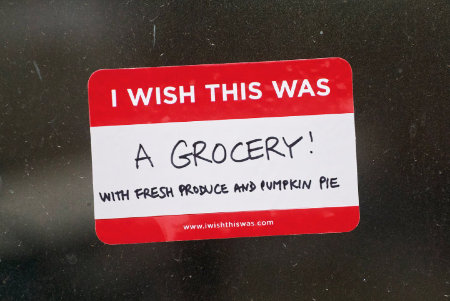
Candy Chang is a public installation artist, designer, and urban planner who likes to make cities more comfortable for people. She’s also a 2011 TED Fellow and will be at the mythic conference this week to talk about I Wish This Was, her endearingly low-tech community engagement project.
Chang believes that public space can better serve the people who live, work, and play in them. Cities like New Orleans, where she lives, are filled with abandoned buildings, empty storefronts, vacant lots, and people who need things, but are devoid of the most basic necessities like grocery stores. So Chang came up with the project, ideal for its super low barrier of entry, to allow her fellow citizens to offer their ideas. The responses, which run the gamut from Disneyland to a bike rack, heaven to an art supply store, reflect, says Chang,"the hopes, dreams, and colorful imaginations of different neighborhoods."
Do you know of a city or neighborhood that could use this kind of survey or community brainstorming? Post it in the comments below, or look for her forthcoming site Neighborland, which will, she explains, "help residents and community leaders self-organize over shared goals, whether that be the desire for a local grocery store, bike lanes, more trees, less blight, a cafe with WiFi, a taco stand, a recreation center, and beyond."
This is an example of a personally enriching environment. The question is how do I get there (figuratively), without running away and becoming beach bum (literally)?
This blog explores the integration of environment and wellness, both emotional and physical. So far I’ve looked at positive psychology, museums, education, urban farming, neurology, environmental sciences, architecture, play, exercise, and almost everything in between. The whole point of starting this blog was to explore the science behind what it takes to make us happy, healthy, wholly-functioning humans. What does it take to be happy? How does one’s home, job, family, dog, car, bicycle, clothing, toys, i.e. their environment, their world, fit into that? I was, and AM, curious about what it takes to be holistically happy?
But with all the quick posts, longer posts, and cool news snippets, one subject on this blog that has only hinted at: me. What does it take in my environment to make me happy? What do I need surrounding for mental wellness?
To be perfectly honest, I haven’t been doing a good job of exploring that. In the past nine months I’ve changed residences twice, changed jobs numerous times, lost sleep, gained an injury, lost mobility, changed exercise plans so many times I’ve lost count, gained weight, lost friends, gained a gray hair or two (I’m 28!), lost family, gained furniture, lost some dreams, had my dreams change, lost hope, changed my commute mode, and gained even more patience. But I haven’t really looked at what it would take to make me happy. What I need to do to put myself in a healthy, fulfilling, sustainable environment.
At first I thought discussing myself and my quest for happiness, wellness, and all around goodness would take away from this blog, and my focus on research, ideas, and theoretical rather than the actual doing. But the truth is I am in this blog already, whether actively or not. So why not be in all the way? It’s supposed to make you happier if you can fully commit to something, anyway.
So, just as a heads up to my few readers; you will be seeing a bit more of me, the actual me, around this place. As of today, March 3rd, 2011, I am making it my overarching goal to become happier, healthier, and a better version of me. I am going to make my environment an enriching place; that includes what I put in, on, and around my body, and what I use to feed my mind. And I plan to hold myself accountable by writing about it here. My accomplishments, slip-ups, and epiphanies.
All the studies and research and cool enriching stuff I find will not go away, not by any stretch. It’s just that now you get ME as an added bonus. Lucky y’all!
This is a very dangerous place for me, BTW, out in the open (The irony is I was called M.E. as a child (those are my initials), but I chose another name when I was six because I didn’t like being called “me.” Maybe I should have stuck with it). I’m definitely not in my most comfortable surroundings exposing myself in this way to the entire blogosphere. But it’s a much-needed shake out of my comfort zone in order to be ready to take on new challenges.
Are you also exploring your wellness, what you find enriching? I’d be interested in hearing your story or you sharing your blog with me; strength in numbers and all that.
Do you treat yourself as well as you treat your friends and family?
That simple question is the basis for a burgeoning new area of psychological research called self-compassion — how kindly people view themselves. People who find it easy to be supportive and understanding to others, it turns out, often score surprisingly low on self-compassion tests, berating themselves for perceived failures like being overweight or not exercising.
The research suggests that giving ourselves a break and accepting our imperfections may be the first step toward better health. People who score high on tests of self-compassion have less depression and anxiety, and tend to be happier and more optimistic. Preliminary data suggest that self-compassion can even influence how much we eat and may help some people lose weight.
This idea does seem at odds with the advice dispensed by many doctors and self-help books, which suggest that willpower and self-discipline are the keys to better health…
“This past weekend a small slice of the Alaskan Way Viaduct was bashed to the ground…The absence of the hulking, dirty superstructure with its squat legs immediately makes apparent new possibilities.
One can easily imagine a green promenade extending from the imposing facade of Qwest Field diagonally northwesterly, eventually touching down on an expansive waterfront park, perhaps outfitted with beaches and habitat for marine life. The promenade could be a splendid setting for food carts and festivals, art, and interpretive signs that explain the colorful history of the area previously known as the mud flats. The diminutive and delicate-looking triangle building would be a modest but distinctive landmark — now freed from lying in the shadow of the viaduct.
But still, as one looks along that alignment stretching towards Elliott Bay, the forest of dark gray columns is a dismal reminder of how much there is to be done before we reclaim the waterfront as attractive and accommodating public space.”
Kids learn the best by what they see and experience, not just what they are told. What better way to teach about environmental and sustainable practices then by demonstrating that at school?! Two projects in the Pacific Northwest are combining creative alternative designs and technologies to create an ideal environment for learning and minimizing impact on the environment.
I always wanted to live in a tree house or a hobbit hole. But going to school in a “living building” would be a pretty close second. From KUOW:
LEED–certified buildings are meant to be environmentally friendly and highly energy efficient. But now, there is a new standard that goes well beyond that. It’s called the “living building” and there are only three of them in the world. In Seattle, one elementary school is building what could be the first living building in the state.
The kids got to offer ideas for the school, and with its grand opening last friday, will hopefully make a splash (it does have it’s own little stream, after all).
In a related project, a school in Poulsbo is putting in Washington State’s fifth largest solar array:
“Next month, Lander, 56, will flip the switch on his first full-size community solar project atop Poulsbo Middle School, the largest of its kind in Washington and the fifth-largest solar system in the state.”
I also love the fact that both of these projects are community-based, in that the kids got to provide input on the school, and the solar panels are also community-driven.
I often post events on behalf of Science Gallery, and I’ve never even been, but soooo want to go, especially to this event:
17:02:11 18:00 – 20:00
COMMUNICATING COMMUNICATIONS: An illustrated lecture inspired by Ray & Charles Eames’ film A Communications Primer (1953)
CTVR and Hugh Campbell, Professor of Architecture UCD, invite you to a lively discussion about contemporary understanding of communication and design, particularly questioning how we communicate complexity, and how we design for communication. Inspired by the work of Charles & Ray Eames, CTVR presents a cinema-style screening of the 23 min film A Communications Primer (1953), introduced by Linda Doyle and Jessica Foley, followed by an illustrated lecture presented by Hugh Campbell, which will explore Eames’ design thinking using A Communications Primer as a starting point.
Just in time to get into the Valentine’s Day mood: enriching signs that spread joy and cheer to everyone, not just your favorite sweety!
Colorful “Signs of Affection” from graphic designer Paul Price. Wandering by one of these on a cold afternoon sure would be a cheerful surprise. I’m hoping Paul’s work somehow makes it over to the gray Brooklyn streets in my area, so I can stumble upon “Your Hair Looks Dashing.” That would totally make any bad day feel like it was taking a turn for the better. Click below to check out more of Paul’s work online.
On the shoreline of the East River and with a sweeping view of the Manhattan skyline, Eagle Street Rooftop Farm is a 6,000 square foot green roof organic vegetable farm located atop a warehouse rooftop in Greenpoint, Brooklyn.During New York City’s growing season, the farmers at Eagle Street Rooftop Farm supply a community supported agriculture (CSA) program, an onsite farm market, and bicycle fresh produce to area restaurants.
Eagle Street Rooftop Farm offers educational programming in partnership with Growing Chefs: Food Education from Field to Fork.
They also offer talks, events (today was their annual pie eating contest!), and other ways to engage with urban farming. If you live anywhere near there, go check it out; it is amazing to see a true working farm in action, and to see it done in an urban environment is really exciting. Although, you might want to wait until the weather isn’t, you know, freezing!, to go visit:
The Farm is a bit windy & chilly this time of year, so we’re waiting ’til spring for visits. To register for a workshop, contact us Education@RooftopFarms.org.
What a great way to learn about where your food comes from, and it’s healthier and fresher since it doesn’t have to travel as far or receive so many pesticides or preservatives for transport. And apparently these urban farms are now popping up all over the United States; check out some of the links below to read about other city’s urban farms. Eat up!