Thanks Inhabitat for featuring this great story about reclaiming unused public space and making it more playful:
Berlin’s Spreepark Planterwald amusement park, also called Kulturpark, has been abandoned since 2001, but this summer several curators took over the overgrown park and transformed it into a big, interactive art installation. The park reopened at the end of June, letting visitors tour the ruins and witness nature’s takeover of the Soviet-era amusement park. Inhabitat was on hand to check out the park and explore the art installations at the perimeter of the park.
For ambitious curators, Anthony Spinello, George Scheer, Stephanie Sherman and Agustina Woodgate (an Inhabitat favorite) were stationed at Kulturpark for the summer, organizing site-specific installations around the park, as well as artistic programming to engage the community once again with this abandoned place. With help from the curators, the fate of the park, which goes up for auction next year, may veer toward a place for public consumption, and hopefully create a place for the public to enjoy the grounds and non-profits to conduct cultural programming for the community.
I’m a very visual person, so I like to map stuff out as much as possible. It looks like some artists had the same sentiment and took it to the next level. I argue this is environmental enrichment because it takes human connections (or missed human connections) and marks them in the universe, in a fun way! From Wired:
You know Craigslist’s Missed Connections, right? The personals page where you log a brief interaction with a stranger who you hope to see again? The posts are a candid, wistful, often hilarious look at interactions — or the lack thereof — between people in the digital age, and beg the question, “Have we become so used to interacting online that we can’t say ‘hi’ in person?”
That question, among others, inspired artists Lisa Park and Adria Navarro to take these digital love notes and turn them back into physical markers. The pair made oversize stickers based on Missed Connections posts, then affixed them at the exact spot where the missed connection occurred. They document the entire project, called I Wish I Said Hello, online, completing the loop.
To me this is kind of like marking your initials in a tree without hurting a living organism. It’s fun, it tells a story, and it helps us make connections with people; even if we never meet them in real life, we learn a little bit about who they are, how they see the world, and a moment in their lives. That helps us in turn feel more connected to our communities and large, ever-expanding tribes.
Locations also hold special meaning to people; pilgrimages to the cafe where their favorite singer performed to Mecca and everything in between. These also create small landmarks that are probably insignificant in the long run, but help orient us in the world in some way.
Have a special place or spot? Why not mark it with a ribbon or rock, or just let us know about it in the comments below.
I’m on a role with these public art installations, although this one is technically a little older, but I’m still happy to share. I also like that it’s somewhat guerrilla artwork, and done in places that might not otherwise get noticed:
Paige Smith prefers to express her point of view through 3D paper sculptures instead of traditional paint. Her finished works represent mineral formations like crystals, quartz, and especially geodes. But instead of finding these gems in nature, she creates them in some of the oldest neighborhoods in L.A.
“Design is a means to an end,” Smith says. “An effective design creates a bridge between an idea and a recipient. The key term is effective. The creative challenge lies in finding a design solution that doesn’t just hang there but is an active conduit for communication.”
Nowadays people’s attention spans are short, and therein lies the point of her art. Like geodes and other mineral formations that may be found on a hike in the mountains, her paper sculptures are meant to be unexpected treasures. Smith says she understands that many people will not notice her art when they walk along the crowded streets of Echo Park, the Arts District or Abbot Kinney Boulevard. In fact, several of these paper geodes have already been dismantled or thrown away, and one fell victim to the rain. Their fate is not that different from the objects we see in nature as we walk along a hiking trail – but the memory and photographs live on. Smith maintains an online map for those who wish to hunt for the existing ones.
Know of any good yarn-bombings or other public art meant to improve or enhance public space? Share your findings with me via email or in the comments below.
Another great story about public artwork and interactive public space. This time courtesy of Design*Sponge:
Mike Perry (who was part of Design by the Book four years ago) is launching a new project via Kickstarter called Wondering Around Wandering. It’s a three-month FREE community exhibition and event space where Mike will teach workshops and host screenings, discussions and more. The space will welcome artists and art appreciators alike and, because of the time span, would be a great way for visiting artists and design enthusiasts to learn and experience on a more intimate level.
Holiday Zine, one example of what you’d get as part of your support via Kickstarter
A little more play for your Friday. Via Inhabitat and PSFK:
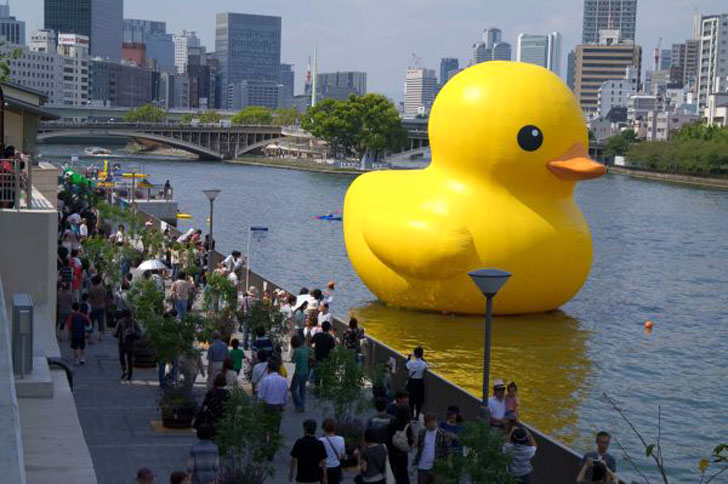
Artist Florentin Hofman’s giant yellow duckie puts a smile on the faces of passers-by as it floats from city to city along the Loire river in France. The hilarious and striking sight has already traveled the world before through cities such as Osaka and Sao Paulo.
The 25 meters tall and 25 meters wide friendly creature’s mission is to provide a joyful interruption to people’s daily routines. People from all over the world connect the rubber duck with their childhood memories and are brought up with positive sensations.
Famous for his humoristic pieces, the Dutch artist Florentin Hofman used rubber coated PVC to built the duck on a pontoon with a generator. Hofman believes that the soft giant can relieve global tensions through delighting people coming from different countries and backgrounds. Hofman has generated smiles many times before. In 2011, the Kobe Frog, an enormous frog wearing a party hat, was sitting on the edge of Hyogo Prefectural Museum of Art in Kobe, Japan.
The duck itself is a durable vessel, made from inflatable rubber-coated PVC, a pontoon boat, and generator to help propel it forward downstream.
Brazilian graffiti art is considered among the most significant strand[s] of a global urban art movement, and its diversity defies the increasing homogeneity of world graffiti.” – Design Week
In March 2009, the Brazilian government passed law 706/07 making street art and graffiti legal if done with the consent of building owners. As progressive of a policy as this may sound, the legislation is actually a reflection of the evolving landscape in Brazilian street art, an emerging and divergent movement in the global street art landscape.
Rio de Janeiro has been particularly progressive in its policy towards street art, with its 1999 “Não pixe, grafite” (Don’t Tag, Graffiti) project that brought together 35 graffiti artists to showcase diversity in local styles. But more unique is the evolution of a permission hierarchy, blurring the line between formal and informal. The new street art law merely reinforced these unique patterns of street art and legitimized an already flourishing form of artistic expression.
Retaining walls on the steep terrain provide canvases for artists.
In Rio de Janeiro, street art is ubiquitous. It exists in all corners of the city, from the favelasto upper class neighborhoods, from residential to institutional. It is bold in scale and aesthetics and is anything but graffiti. The urban fabric of Rio de Janeiro also figures prominently in the evolving street art scene. The high walls, whether for security or to contain the topography, provide ample surfaces for painting. But rather than location dictating art, the relationship between owner and artist has a direct impact on where street art occurs.
Owners of buildings, both residential and commercial, sometimes invite artists for commissions, which is done to protect from tagging, as an aesthetic choice or as an economic choice — painting a façade with art may be cheaper than another mode of beautification. In another case, street artists ask permission from the owner.
Tudo de cor para você, Santa Marta, Rio de Janeiro (photo source: favelapainting.com)
Thanks to the city’s openness to various forms of artwork, and specifically “street” art, Rio de Janeiro is now known for its colorfulness and art. In informal studies the art has also been found to make citizens more invested in their communities and overall happier.
Before and After example of Storefronts Seattle project.
With the down economy a lot of stores and businesses have gone out of business, leaving a lot of empty store fronts, at least in places around Seattle. But rather than let those places stay dark and dormant, one woman is spearheading an effort to get local Seattle artist’s work installed in these vacant storefronts:
Storefronts debuted in late 2010 as an experiment in activating vacant spaces with art, creative enterprise, and performance… We also revitalize neighborhoods. And we beautify blocks. And we make areas safer at night, and we market real estate, and we paint walls and mop floors and install lighting and turn desolate half-empty blocks into the hippest, happiest, and hottest real estate in town.
Storefronts Seattle leases storefront space from neighborhood property owners for the nominal rate of $1 per month. We can program up to 15 storefronts in any given neighborhood at any given time, and we fill these spaces with art installations, with creative businesses, and with artist’s studios. These projects are proposed by artists throughout the region, and are chosen by a panel that includes neighborhood representatives, local museum curators, arts professionals, and our programming staff.
At full integration into a neighborhood, Storefronts Seattle is programming up to 60 arts installations per year into your spaces. That’s enough to instantly turn any neighborhood into a walking destination, an arts and culture destination, and a shopping destination. It’s enough to generate regional press. It’s enough to get the city’s creative class and cultural leaders to pay attention.
This is a great project where everyone benefits: property managers get free positive attention for their site, artists get their work exposed, and normal people get to benefit from the art for free!
It also involves a lot of local Seattle neighborhood organizations, bringing attention and buy-in from various communities around Seattle. There are quite a few installations in place right now through May.
What a great opportunity to improve and enrich everyone’s environment. Know of other groups out there taking advantage of empty spaces like these in other cities? Share them in the comments below!
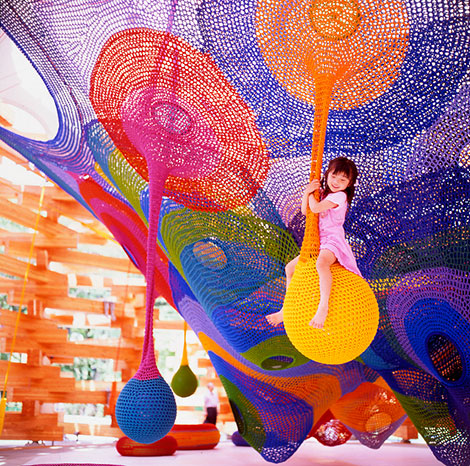
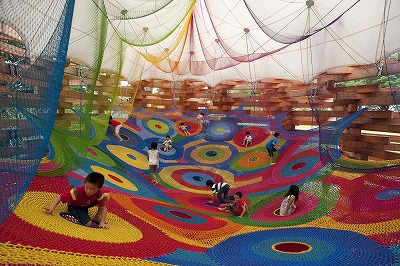
I love the story of how she came to be engaged with children’s play: “It all happened quite by accident. Two children had entered the gallery where she was exhibiting ‘Multiple Hammock No. 1’ and, blissfully unaware of the usual polite protocols that govern the display of fine art, asked to use it. She watched nervously as they climbed into the structure, but then was thrilled to find that the work suddenly came alive in ways she had never really anticipated. She noticed that the fabric took on new life – swinging and stretching with the weight of the small bodies, forming pouches and other unexpected transformations, and above all there were the sounds of the undisguised delight of children exploring a new play space.”
From that point, her work shifted out of the gallery and a subdued, monochromatic pallet into a riotous rainbowof colors for children’s playscapes.
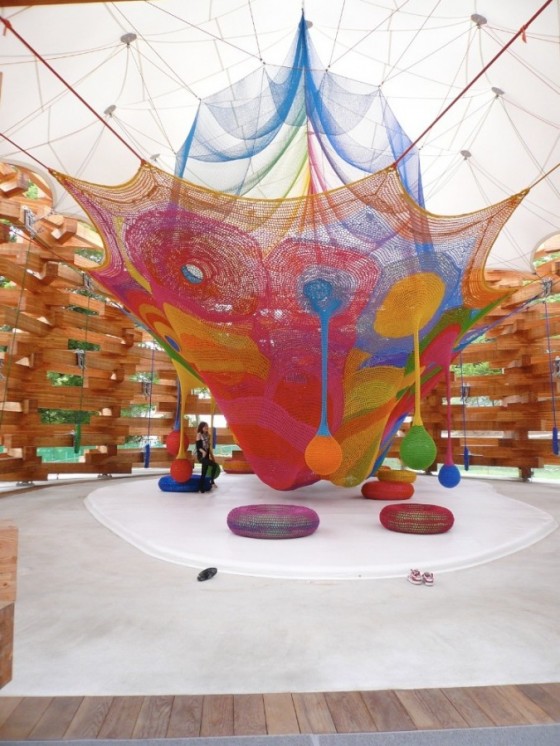
Rainbow Net was produced in close collaboration with structural engineers TIS & Partners and landscape architects Takano Landscape Planning and opened in July of 2000 after three years of planning, testing, and building.
Note that the project began with a brief not for a playground, but simply for ‘public art‘. Wouldn’t it be great if when we heard ‘public art’ we automatically thought ‘play’?
But innovative playscapes require an enormous commitment: “…endless cycles of discussion and approval, with meticulous attention to detail…[including] an actual scale wooden replica of the space in Horiuchi’s studio and accurately scaled crocheted nets using fine cotton thread. Even then, it was difficult to assess many things. What difference, for instance, would the weight of the real yarn make when everything increased in scale? All of these factors had to be calculated in order to arrive at a scientific methodology that could eradicate any risk of unacceptable danger.”During final assembly, Toshiko crocheted ten hours a day, often on her knees, until the installation was complete.”
With the current revival of the textile arts and yarn bombings everywhere, I’d love to see more crochet on the playground!
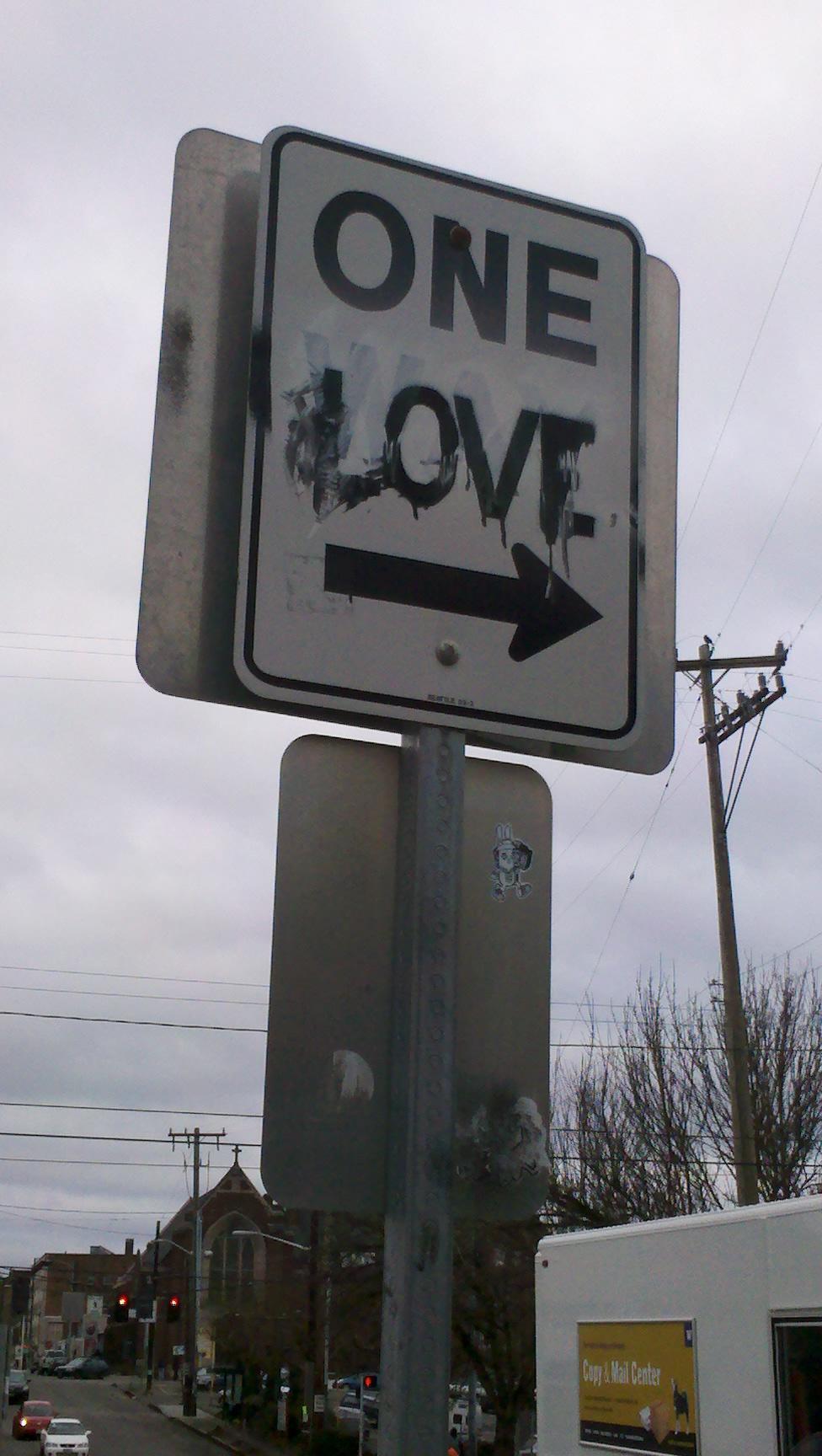
While I don’t condone defacing public street signs, I liked the sentiment. It made me think about how easy it is to make people smile and make a space more friendly with a word.
Happy Friday!
I found another great article from Grist magazine about how something as simple as a bucket of paint, or several different colored, buckets of paint, can have a huge positive impact on a neighborhood:
Sunnyside Piazza, it is called, which may seem a bit much for a splash of color on asphalt, but in person, it seemed fitting. This whimsical design, interrupting the functional but monotonous gray of Portland’s street grid, felt like a somewhere. It seemed like a place deserving a name. It even felt like a “piazza.”
That was in 2002. I later learned that the Sunnyside Piazza was the second painted public square in Portland, facilitated by the nonprofit City Repair Project. Now, dozens of painted plazas, dubbed Intersection Repairs, pepper the map not just of Portland but also of Los Angeles, New York, St. Paul, and Seattle.
It all started in the mid-1990s with Share-It-Square, in Portland’s Sellwood neighborhood, where architect and City Repair co-founder Mark Lakeman lives. After visiting villages in Central America where residents gather around common spaces, Lakeman decided to bring similar spaces to Portland. “Putting the public space back where it’s supposed to be may not sound like a huge change,” Lakeman says, “but it has a profound effect on the social culture … We know that Americans are more lonely and isolated than ever before, but we don’t realize that the absence of cohesion in American communities is totally related to the absence of places where people can actually build that.”
The article goes on to discuss how creating a group mural creates a sense of community:
“It’s not about the paint,” says professor Jan Semenza, a professor of public health at Portland State University who lives near the Sunnyside Piazza and has researched intersection repairs. “It’s about neighbors creating something bigger than themselves.” As an everyday intersection becomes someplace special, residents begin to experience the value of community. Neighbors paint themselves out of a corner — of the intersection, of their individual homes — and into the middle of the street. By turning an intersection from a dividing line between neighbors into a gathering place, residents begin to solve the problems that plague neighborhoods and cities. Where isolation existed, they find community. Where cars dominated, they create a people place. With a little paint, neighbors are solving big problems.
I have seeen some great community spaces also created out of roundabouts, water fountains at outdoor shopping centers, and often at landmarks like stairs or trees. Sometimes, if a natural landmark or meeting space isn’t in place, all it takes is some paint, chalk, or even ribbon to make a place significant and identify it as a community gathering space.





 Mental Flowers