
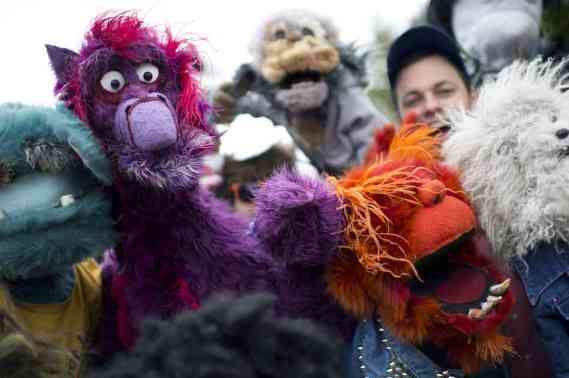
When presidential hopeful Mitt Romney threatened a childhood icon with funding cuts during a debate last month, people took to the streets and protested…with puppets. In what was deemed the Million Muppet March, people used puppets, marionettes, and other toys to show their unhappiness with the idea of funding for public broadcasting being cut:
Organizers say at least 600 people signed up to attend the march in person, with a few thousand more participating virtually on Facebook, Twitter and their own marches around the country. So far, the pictures on the group’s Facebook page show the marchers bundled in puppet-like hats with animal ears, carrying coffee, placards with statements like “Grouches of the World, Unite!” and, yes, more than a few puppets.
via They’re Furry And Furious: Puppets Protest At The U.S. Capitol : The Two-Way : NPR.
This protest is not only about supporting Public Broadcasting, but is also about play on several different levels. First, Big bird and other Sesame Street characters are a big part of many Americans’ childhoods. While imaginary, to many people these Muppets were very real and very important play characters during the formative years of their lives.
Second, the use of puppets and toys to protest politics is an age-old tradition. People in countries ranging from the England to Venezuela to Thailand have used puppets and epitaphs during protests to get a laugh out of people as well as get their attention. Even the court jester in days of old could get away with some nasty political commentary because it was said “in jest.”
Full disclosure, I am a huge Muppet fan, and am happy to see that others agree with me that Big Bird and PBS are worth funding, and I’m especially happy that people showed their support using puppets.
Related articles
- ‘Puppet March’ To Defend PBS Funding At U.S. Capitol (baltimore.cbslocal.com)
- ‘Puppet March’ to defend PBS funding at U.S. Capitol (politico.com)
- They’re Furry And Furious: Puppets Protest At The U.S. Capitol (wnyc.org)
- Protesters (and their puppets) march to support public broadcasting (cnn.com)
- Million Puppet March to support public broadcasting in America (boingboing.net)
- Puppets Not Controlled by Lobbyists Protest Romney’s Threat to Public Broadcasting (themoderatevoice.com)

 Mental Flowers