anthropology · brain · children · education · health · learning · mental health

Attention Disorder or Not, Children Prescribed Pills to Help in School – NYTimes.com

English: Adderall
Doctor’s are prescribing Aderall to kids without ADHD (Photo credit: Wikipedia)

I find this article in today’s New York Times extremely disturbing:

When Dr. Michael Anderson hears about his low-income patients struggling in elementary school, he usually gives them a taste of some powerful medicine: Adderall.

The pills boost focus and impulse control in children with attention deficit hyperactivity disorder. Although A.D.H.D is the diagnosis Dr. Anderson makes, he calls the disorder “made up” and “an excuse” to prescribe the pills to treat what he considers the children’s true ill — poor academic performance in inadequate schools.

“I don’t have a whole lot of choice,” said Dr. Anderson, a pediatrician for many poor families in Cherokee County, north of Atlanta. “We’ve decided as a society that it’s too expensive to modify the kid’s environment. So we have to modify the kid.”

via Attention Disorder or Not, Children Prescribed Pills to Help in School – NYTimes.com.

Sadly the doctor is correct that many schools refuse to change a child’s environment to improve academic success, namely that they are cutting out activities like recess and P.E. in order to make more time for studying.

However, P.E., recess, and just getting outside for a quick breath of fresh air have all shown to also be extremely effective ways to improve attention and academic success. Yet because these activities are getting cut out of the school day, doctor’s feel like they must prescribe these incredibly strong, brain-chemistry changing medications to growing brains, many of these drugs with strong side effects .

I have no problem with using these drugs for what they were originally intended for, but prescribing them basically as “performance-enhancing” drugs just seems unethical to me. We frown upon athletes and grown-ups in the business world from taking speed and other kinds of drugs that are supposed to improve performance (other than coffee of course, that seems pretty much like a must-have for adults), but it’s okay for students so they can do well in elementary and middle school? To put in mildly, yuck!

I hope other people will be as outraged as I am and stand up for a child’s right to recess and P.E., and actually NOT studying from time to time, rather than encouraging giving them strong medications in order to perform well on standardized tests.


behavior · children · cognition · education · happiness · health · play · school

Play time vital for learning

Combination playground equipment (plastic)
Playground doesn’t need to be fancy to be effective (Photo credit: Wikipedia)

As we head back into the academic school year, a lot of people are focused on education and making sure students get the best possible opportunity to learn and thrive. Here’s one easy way to support that: give them space and time for play!

Numerous academic studies [sources stored in a weird place, will update soon] on school-aged kids have demonstrated that recess time is valuable for learning and aids in the overall learning process. But I think it can be more powerful to hear how valuable it is from someone who actually lives with the results of life with more or less recess; the teachers.

From the Sydney Morning Herald, educator Susanne North writes about the values of recess from an education viewpoint:

Apart from being a fun activity, it is widely recognised that play is one of the most important ways in which brain development occurs in children.

Sadly, in some schools valuable recess and lunch time has been reduced in favour of more rigorous academic pursuit within the classroom. In other schools, running or ball games have been banned due to a perceived high injury risk factor.

As many families now choose structured and adult-directed play activities after school or on weekends, the school playground becomes one of a few outlets where children can engage in free outdoor play with their peers. More than 28 hours a week, often spent solitarily, are devoted to computers, mobile phones, television and other electronic devices. Considering that as much as 25 per cent of time spent at school is playground time, we need to rethink the benefits of play at school.

Conversely, a lack of play can result in challenging behaviour and negative performances in the classroom, according to an American educational psychologist, Anthony Pellegrini.

Also, playgrounds that lack play stimuli become spaces where children often wander around aimlessly, become frustrated and bully other children. Not many schools can afford expensive playground equipment, but the good news is that this is not needed anyway.

Professor Anita Bundy, from the Faculty of Health Sciences at Sydney University, has launched a large-scale study involving 12 primary schools in NSW, introducing simple, recycled play resources during recess, with outstanding results. This included crates, car tyres, foam pool noodles, plastic barrels, tarpaulins, foam cubes and other open-ended materials that lend themselves to creative, imaginary play.

Not only do children become physically more active, they also hone important social skills, build resilience and are encouraged to think creatively.

Read more: Play time vital for children | Sydney Morning Herald

The entire Op-Ed is very strongly written and makes a great case for play, and it’s great to hear it from the teacher’s standpoint, so please read it and share. And be sure to support play time in school, whether it’s by voting, volunteering, donating red rubber balls, or whatever you can do.
behavior · community · creativity · education · emotion · environment · mental health · play · psychology · Social

Outdoor Play Poster

From the nonprofit organization Voice of Play and their host organization, the IPEMA (International Play Equipment Manufacturing Assocation):

This poster is appropriate for any player, whether you are 2 or 92.

What other reasons can you think of to play outside? Leave them in the comments below.


behavior · children · cognition · education · learning · play · Social

Montessori Google Doodle

Friday’s Google doodle honoring Maria Montessori’s 142nd birthday.

Have you noticed Google’s doodle for today yet? It is in honor of Maria Montessori, founder of the Montessori style of learning, which focuses on open-ended, free-form learning, which involves a lot of play. From PC Magazine:

Google on Friday honored Italian physician and educator Maria Montessori with a homepage doodle celebrating her 142nd birth anniversary.

The drawing features some of the tools that form the basis of Montessori’s educational methods, which emphasize hands-on, individualized learning within mixed age groups in a child-friendly setting.

After working in insane asylums with mentally handicapped children, in 1904 she began re-engineering the field of children’s education. She believed that all children have an inner drive to learn, and that children learn best when in a safe, hands-on learning environment.

Montessori also found that children help teach each other when put into groups with other kids of their own age range. She believed that teachers should pay close attention to students, not the other way around.

Her early efforts were so successful that she amassed a large following of parents and teachers who wanted to learn her methods. She later gained support from Thomas Edison, Helen Keller, and Alexander Graham Bell, who founded the Montessori Educational Association, headquartered in Washington D.C.

Read the full article.

Thanks Google for showcasing a great woman who was a pioneer in creating more playful and therefore better learning environments for kids.

Hope everyone has a great looong weekend before school starts up for a lot of people (appropriate timing to honor Montessori, eh?), filled with lots of learning, exploration, and playful environments.


community · environment · play · Social

Fear, Traffic Largest Inhibitors of Outdoor Play in UK

This makes me sad to see that fear is stopping a lot of kids from playing outdoors in the U.K. From the national organization Play England:

Traffic and a fear of strangers are preventing children from playing outdoors, new research released for Playday 2012 has found. Almost half (49%) of parents report that fear of strangers stops their children from playing out, while 46% say traffic and almost a third (31%) highlight fear of accident and injury as barriers to outdoor play.

The findings of the survey have been released today as an estimated half-a-million children and families nationwide celebrate Playday- the national day for play in the UK, held this year on Wednesday 1st August. Around 500 community events are taking place across the UK to celebrate 25 years of the campaign, which raises awareness about children’s right to play and the importance of play for children’s health, wellbeing and happiness.

The Playday 2012 theme isGet out and play! The campaign, which is co-ordinated by Play England (part of the National Children’s Bureau), Play Wales, Play Scotland and PlayBoard Northern Ireland has gone from strength-to-strength since its conception in London in 1987, when the first events were held to raise awareness about the effects of cuts to local play services.

Cath Prisk, Director of Play England, said: “Simply playing outside should be a normal, everyday event for all children. If we want to foster the next generation of Olympians and sports stars, then we need children with confidence, who love being active and are confident in tackling challenges. If parents are too afraid to let their children play out – because of fear of strangers, traffic or their children having accidents – then we as a society need to address this fear. Whether that’s a community living in a cul-de-sac agreeing children will be playing out every day, a street applying to the council to close the road for play regularly, or residents volunteering to help local play projects reach more children, we can all do our bit to make sure every day is a Playday.”

Mike Greenaway, Director of Play Wales, said: ‘… As a society we have developed an irrational fear that our children are unsafe outside. Compound this with the domination of cars and their drivers, and the world outside the front door doesn’t look particularly attractive for anyone who wants to play there … and children regularly tell us that outside is where they want to play. Children value time, quality places and freedom to play in their own way; we need to support them, recognise that for their wellbeing, they need to play outside and that it’s safer than we think.’

Read the full release.

I am glad, however, that the U.K. seems to be taking play more seriously than the U.S.; just the fact that they have a Play Day (August 1), is pretty cool. And the Quote from Mike Greenaway is as accurate for the U.S. as it is for the U.K.: serious crime has actually been decreasing since the early 1990s.

Thankfully where I grew up was pretty rural, so as long as we were within whistle-shot (my mom would blow a whistle rather than yell), we could roam as far and wide as we wanted. What rules did your parents have about playing outside? What rules do you have for kids you are in charge of (kids, nieces and nephews, neighbor kids, grandkids, etc.)? Leave a note in the comment below.

behavior · community · creativity · happiness · play · Social

Why The Nose working to get a laugh out of the world

A clown nose

Happy Friday! Have you been waiting all week for some fun? Why the wait? Why not get a quick giggle in now? All it takes is a little red piece of foam, and the ability to not take yourself too seriously. I saw this shared on Facebook and had to spread the good cheer.

Why The Nose is a movement in clown accessories laughter and clowning around:

Whythenose.com is dedicated to the act of wearing a clown nose everyday, in order to make people smile.

It’s here for YOU…to encourage you with an act of Heroic Uninhibited Innocence :)

It’s really that simple. In a world filled with distractions and distrust, you’d be amazed at how many people (of all ages) have lost a sense of childlike wonder. Or maybe you wouldn’t…

Wearing a clown nose is fun, it’s easy, and it’s free (if you already have the nose).

We’re not trying to sell anything, we’re only showing you how joyful it is to change someone’s day.
Trust us, the nose breaks through barriers and opens doors every time you wear it…give it a try!

This phenomenon of adults wearing silly noses has been seen around both the 2011 and 2012 Burning Man Festival and other playful grown-up events courtesy of Tex Allen, who according to the website is a “responsible burner” but also wants to encourage people to enjoy themselves and enjoy their lives. I honestly hope this becomes a movement beyond just the Burning Man circuit, although I don’t think you’d need to wear the nose all day to get the effect he’s looking; maybe just for a quick trip to the grocery store. Visit the website for videos of some high quality goofing off. Or visit them on their Facebook page to see who else is getting their silly on.

Check out the video from Burning Man 2011 for more examples and maybe some inspiration.

creativity · environment · learning · Nature · play

Create your own science station

When I was a kid I loved to collect beach glass, shells, pretty rocks, leaves, feathers, or whatever cool stuff I found. I would take them home and want to display them somewhere to admire and study them further. My mom was gracious enough to give me vases to hold the feathers, and let me keep my rock collection on top of our wooden fence (the brace that goes along the top) for years. Eventually I had quite the collection of feathers or rocks or whatever grouping I had come up with. It was not only educational, it was just fun and inspired a lot of creativity, either by arranging the items in new ways or imagining where they came from.

I think most kids really like to do this kind of treasure hunting, and in fact I don’t think it goes away as grown-ups; we just find reasons to stop collecting. Some of them are legitimate, like the fact that it’s illegal to remove items from state parks and beaches, even teeny tiny shells. Some grown-ups I know also replace this urge of hunting for feathers by going to yard sales or reused building material stores like the ReStore (hey, I’m guilty as charged). BUT, for the places it IS legal, and for a free version of this activity, I would encourage people to not only continue collecting, but to also make a space in your home specifically dedicated to your recent finds. For one thing, it’s fun, but it is also a great way to learn more about your environment, even just your own backyard. You may notice new colors or shapes and be inspired to draw the feathers you find, or explore the geology of a strange rock.

Mary Mullikan at Tree Life Coaching has created a “Found” table, or officially known as a Home Science Station, for her child, but I think this is a great idea for people of all ages:

I made the very easy one-word banner from Handmade Home and within an hour had the whole bite-size Science Station assembled.  A few garage sale items re-purposed (like the little wooden board which is actually an old game piece), some family heirloom pottery, a few sprigs of lavender from our driveway and some mint from our herb garden, some of the rocks Orlis has been bringing indoors, a handful of sand and a postcard procured from our recent trip to the coast, and a flower in a jelly jar, Orlis’ collection basket, and a beloved piece of feedsack fabric to provide a backdrop.  All of it was in the house or just outside, and now it’s here, displayed, for further discovery.

Oh, I love this little table already, and I know, as time passes it will change and change a hundred times as the seasons do and so do our fascinations with the great big world.  I know we’ll easily find many things to pile and gather in the shelf below, and I know the living things will die and be replaced with other tangible items of interest.  For now, it’s simple and easy, this little science station — the perfect place for a toddler to bring in his outdoor treasures for more handling and organizing, and deeper relationship.

I am excited to see this idea get picked up by different people and in different ways, and to see how easy it can be. Whether you have some wall space, a shelf, or even a window sill, it can be very fun and insightful to create a “science station” of your own to inspire you.

Have a science/creativity station already set up in your home? Send me a picture of it, or tell me about it in the comments below.

creativity · design · learning · play · Social

Making stuff at Science Gallery

Makeshop
Picture from Science Gallery’s Makeshop. (Photo credit: David Ramalho)

I used to write about Science Gallery in Dublin, Ireland, a lot on my now defunct blog The Art of Science. They have now been open for a couple of years, and are huge proponents of hands-on science, art, and learning. This week they’re debuting their new MAKESHOP.

MAKESHOP is a new collaborative workshop space where you can learn everything from cross-stitching to DIY robotics, from origami to 3D printing. It’s for everyone from novices to advanced makers, the only thing you need to get involved is a curious mind and a yearning to make stuff.

We’ll be running these free, drop-in workshops over the weekend to celebrate the opening:

  • LED throwies – LED throwies were developed by the Grafitti Research lab at Eyebeam’s R&D OpenLab. LED throwies are a simple combination of a magnet, LEDs and some sticky tape and allow you to attach coloured lights to any (ferromagnetic) metal surface. They are called throwies because they can be thrown in clusters to attach to high up metal objects and structures for impressive colourful interventions in public space or simply to liven up your fridge door.
  • Paper Toys – The status of the paper toy lies somewhere between an art object, admired for it’s ultra cool design and a quirky DIY aesthetic. Choose from a range of templates in the form of flat 2D pattern that you can fold together and transform into awesome paper toys by some of the worlds best paper toy designers. Alternatively you can colour in your own blank template to give your paper toy a unique look.
  • Extract your DNA – Ever wonder what your made up of? In this simple extraction workshop you will be able to isolate your own DNA strands from your saliva and take home a sample to keep.
  • 8 bit Cross Stitch – Inspired by the simple grid layout of retro computer characters, 8 bit cross stitch combines old world craft with old school aesthetic. You’ll learn the basics of needle work and take home a starter kit that will get you well on your way to making a wonderful wearable.
  • Drawing Robots – Drawing Robots are autonomous drawing robots that people can make without any knowledge of electronics. Participants connect a battery pack to a weighted motor, some paper cups and magic markers and watch as the drawbots begin to draw incredible images by bouncing around on paper.
  • Read about more activities here.

What a great space to explore and play! The Science Gallery is one of the many reasons I’d love to visit Dublin someday. Science Gallery has lots of exhibits rotating in and out throughout the year, and a coffee shop to hang out at after your science-y/artistic adventures.

Have you ever been into the Science Gallery? What was it like? What about the one opening in London (see related articles below)? Share your experience in the comments below.

children · community · education · happiness · health · learning · Social

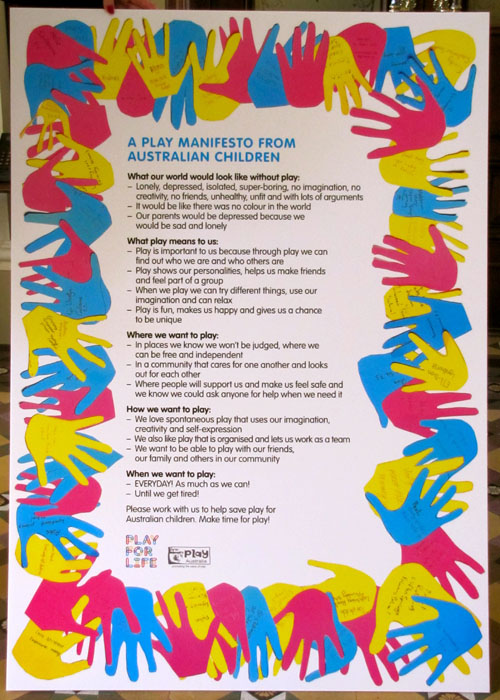
Australian Children’s Play Manifesto Poster

Play Based Learning in Australia is sharing a poster that captures the play manifesto of its children; how awesome!

After the overwhelming reaction to the success of the Australian Children’s Play Summit held in Melbourne on May 17th and 18th 2012 Play for Life Australia is kindly making available a copy of the Play Manifesto created BY Australian children FOR Australian children as a download. Play for Life believes that if we put the future of PLAY back into the hands of Australia’s children, then PLAY will be in very good hands!

Visit the original site for the full size poster.

behavior · environment · health · play

Create Time and Space in your Day to Play

Play Hooky
Play can involve just sitting in a quiet spot and thinking about the world (Photo credit: Pensiero)

I was introduced to Seattle-based, play-based Jungian therapist Mary Alice Long, PhD, who is the creator of Play=Peace . Her latest article focuses on the different ways that people create play in their lives (found via Seriously! The Future Depends on Play.):

There are as many ways to play as there are people. You might take a morning walk and make discoveries with new eyes. Be a traveler in your city and visit a museum, gallery, or park you have never been to before. Put a date on your calendar to attend a local parade or arts festival with friends. People watch at the farmers market. Once you get started the playful ideas are endless.

Read the full blog post here. (Full copyright Mary Alice Long.)

I like how Long is emphasizing the less physical ways to play, and instead focusing on interacting and being aware of one’s environment, which can often be very playful but not quite as active or aggressive as more

traditionally thought of kinds of play. So often people think that play is only about kicking a ball around the field, and while I don’t think Americans get nearly enough exercise, I do feel that these quieter, more introspective types of play can get overlooked.

What’s your favorite kind of “quiet” or more imagination-focused play? I love people-watching, making up stories about people, attending festivals, or just observing nature. Leave your favorite ways in the comments below.