
environment · health

Porous Roadways for Better Runoff

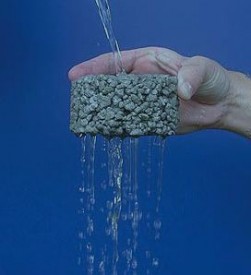
Water flowing through pervious concrete, courtesy of the National Ready Mixed Concrete Association.

This post is more focused on conservation and environmental preservation than usual, but I’m a sucker for a good “save the planet” technology story. Plus, I believe pretty much anything we can do to conserve the environment makes for an overall better, healthier, happier us.

When I first read the headline for this article, I thought it was going to be a complaint about the poor quality of several streets in major cities like Seattle and Portland that are supposedly “bike friendly,” where even a seemingly small series of potholes in a street can mean trouble for bikers like myself.

But no, this is better; a type of concrete that actually lets rain water and other liquid runoff through to the soil beneath, preventing flash floods, bad puddling and worse erosion:

Permeable pavement can make old-school road engineers and pavement builders anxious. To them, the idea of water seeping through roads like they’re made of Swiss cheese just doesn’t seem right. Water runs off roads, not through them. Or at least it used to.

In the Northwest, there’s a growing acceptance of the use of pervious concrete and porous asphalt for roads, sidewalks, parking lots, and driveways. The unconventional pavement does a great job reducing the amount of polluted stormwater runoff that damages homes, streams and lakes. Instead of gushing from the roads carrying a slug of toxic chemicals, the water seeps through small pores in the pavement, soaking into the gravel and dirt beneath the road. Some of the pollutants get trapped inside or beneath the pavement, or are consumed by organisms living in the ground below it.

Those who’ve used the pavement praise the technology. Advocates can be found around the region, including a 32-acre eco-friendly development near Salem called Pringle Creek, where all of the roads and alleys were built with porous asphalt.

Read more at: The Porous Road Less Traveled | Sightline

I’ve heard of this technology being used in driveways with great success, so it’s nice to hear it being used in larger applications.

behavior · brain · environment · health · mental health · neuroscience

Your brain on oceans, now part of a study

Fishing in the Maldives
The ocean has a significant, presumably positive, effect on the brain. Image via Wikipedia

Several researchers have looked at the effects of nature on the brain, but usually look at wooded environments. But how does the ocean effect us? Some argue a lot.

One researcher, Wallace J. Nichols, is looking at the effect that the ocean has on our brains.

If the ocean has a direct, neurological impact on our brains, an awareness of this connection will change the way we treat it—and the policy implications could be profound. That’s the hope, at least, that motivated “neuro-conservationist” and turtle specialist Wallace J. Nichols to invite a group of neuroscientists, marine scientists, journalists and artists to start a conversation about our emotional connection with the sea.

Nichols thinks that our grey matter is actually uniquely tuned into the Big Blue. “When we think of the ocean—or hear the ocean, or see the ocean, or get in the ocean, even taste and smell the ocean, or all of those things at once,” Nichols said in an OnEarth interview, “we feel something different than before that happened. For most people, it’s generally good. It often makes us more open or contemplative. For many people, it reduces stress.”

Nichols aims to tap into this emotional response to oceans—what he calls the Blue Mind—to help build support for responsible stewardship of the world’s marine ecosystems.

more via This Is Your Brain on Oceans

I like the term “neuro-conservationist,” but I’m not sure what it means exactly, even after reading this article. But anecdotally I agree the ocean has a definite effect on the brain.

What information or experiences are already out there that involve the ocean.

behavior · environment · Nature

Can’t Eliminate an Invasive Species? Try Eating It. – NYTimes.com

Pterois volitans, also known as red or common ...
Can you imagine this guy for dinner? Image via Wikipedia

NOAA recently issued a warning that ocean warming may push common fish staples into more northern climes, causing a shift for fisherman and an introduction of “invasive” species. There are also several species of fish that have invaded lakes and rivers that gobble up juvenile local breeds. It’s proven very hard to eliminate only one kind of fish from an environment. One solution may be “If you can’t beat ’em, eat ’em”?

An invasive species, the lionfish is devastating reef fish populations along the Florida coast and into the Caribbean. Now, an increasing number of environmentalists, consumer groups and scientists are seriously testing a novel solution to control it and other aquatic invasive species — one that would also takes pressure off depleted ocean fish stocks: they want Americans to step up to their plates and start eating invasive critters in large numbers.

“Humans are the most ubiquitous predators on earth,” said Philip Kramer, director of the Caribbean program for the Nature Conservancy. “Instead of eating something like shark fin soup, why not eat a species that is causing harm, and with your meal make a positive contribution?”

“We think there could be a real market,” said Wenonah Hauter, the executive director of Food and Water Watch, whose 2011 Smart Seafood Guide recommends for the first time that diners seek out invasive species as a “safer, more sustainable” alternative to their more dwindling relatives, to encourage fisherman and markets to provide them.

more via Can’t Eliminate an Invasive Species? Try Eating It. – NYTimes.com.

Unfortunately I’ve heard the lionfish doesn’t taste very good, but if they get the right marketing campaign on this, lionfish sushi may become all the rage!