behavior · brain · cognition · creativity · learning · play

Why we need play and relaxation to think

Recreated :File:Neuron-no labels2.png in Inksc...
These little guys need a break just like your muscles. Image via Wikipedia

The brain is an amazing thing. It allows us to problem solve, combine ideas, and create out of seemingly thin air. But only if we let it.

As a play advocate, I run into a lot of people grumbling that play takes away from learning; but the fact of the matter is, play is ESSENTIAL to the learning process. More and more science is showing that the brain needs that down time to process what it’s learned, digest it a little bit, in order for us to use it for any useful purpose.

People who study creativity and innovation are aware of this all too well:

Current neuroscience research confirms what creatives intuitively know about being innovative: that it usually happens in the shower. After focusing intently on a project or problem, the brain needs to fully disengage and relax in order for a “Eureka!” moment to arise. It’s often the mundane activities like taking a shower, driving, or taking a walk that lure great ideas to the surface. Composer Steve Reich, for instance, would ride the subway around New York when he was stuck.Science journalist Jonah Lehrer, referencing a landmark neuroscience study on brain activity during innovation, writes:

“The relaxation phase is crucial. That’s why so many insights happen during warm showers. … One of the surprising lessons of this research is that trying to force an insight can actually prevent the insight.”

keep reading the Developing Your Creative Practice: Tips from Brian Eno :: Tips :: The 99 Percent to hear Brian Eno’s take on creativity and how he puts his brain to work.

It’s nice to see that science is finally taking relaxation and play seriously. I just wish the rest of the world, or at least our education system, would too. I know my work would benefit greatly if I took time to just relax and contemplate things more, to relax and let my brain explore a little bit. Hmmm, another exercise to try…

behavior · children · creativity · design · play

Bookshelf/Playground combo makes putting your toys away fun

Casasaurus

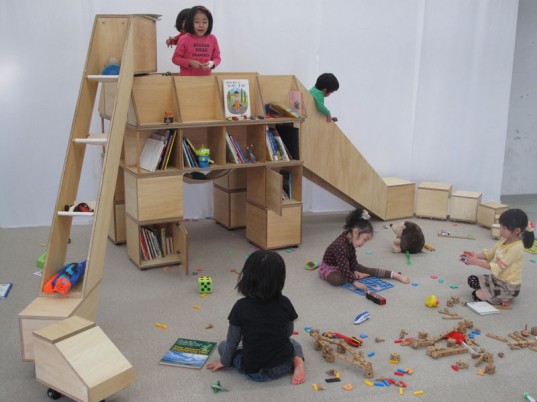
My mom always told me not to climb up my bookshelves when I was a kid; now I wish I was little again and could beg her to get me one of these. This is actually a great tool for learning, because it allows kids to think three dimensionally, in a playful way. Trying to decide which cubbies hold what items, and climbing, sliding, and thinking of an object as two things at once (a bookshelf AND a dinosaur) are great exercises for the brain at any age.

Casaurus, the senior thesis project of student designer Koichiro Hoshino from Tokyo University of the Arts. The designer’s dinosaur-shaped bookshelf includes plenty of space for a bookworm’s library, a tail-like slide for kids to whiz down, shelves made for climbing and small boxes that add length to the dino’s tail. Kids can also find a reading nook underneath the dino’s belly.

more via Koichiro Hoshino’s Casaurus is a Bookshelf and a Playground | Inhabitots.

behavior · creativity · design · psychology · writing

How The Mundane Can Produce Creativity

I subscribe to this business blog, The 99 Percent (Success is 1% inspiration, 99% determination), that typically offers business strategies and stuff, but this article I found really interesting; the idea that having a ritual around your day actually allows your brain to focus on being creative:

You follow the same routine, sipping your coffee, browsing your email, skimming through the same blogs, the same news pages, the same social networks. As your colleagues arrive, you exchange the same greetings, the same gripes and gossip. As you drain the cup, you get the same itch for the same music, take your headphones out and plug yourself in. You open the same blank document, give it the same hard stare. The music kicks in.

Now you can begin.

If that sounds anything like your morning routine, you’re in good company. Over the years, as a coach and trainer, I’ve heard a similar story from hundreds of creative professionals. Of course, the details will vary – if you’re like me, your trip to work will be the “30 second commute” known to freelancers the world over, and you’ll be making your own coffee. You may incorporate meditation, or other exercise into your morning routine. And you may use a camera, easel, guitar or whatever instead of a computer.

But the chances are you’re living proof of one of the great paradoxes of creativity: that the most extraordinary works of imagination are often created by people working to predictable daily routines. There’s even an entire blog (sadly now on hold) devoted entirely to accounts of the Daily Routines of writers, artists, and other interesting people.

more via How Mundane Routines Produce Creative Magic :: Tips :: The 99 Percent.

It says the 3 common threads of these rituals are:

  1. Uniqueness – it should be something (or a combination of things) you don’t associate with other activities, otherwise the effect will be diluted.
  2. Emotional intensity – the kind you experience when you’re really immersed in creative work.
  3. Repetition – the more times you experience the unique trigger in association with the emotions, the stronger the association becomes.

Athletes, actors, and even accountants have these rituals, so why not creative types? What about you, what behaviors or rituals do you have to help you concentrate on being creative?

anthropology · brain · creativity · Mental · neuroscience · psychology

The Evolving Minds Of Humans : NPR


Where do we get artistic ideas and inclinations? What is it about the brain that makes us like art? Neurologist Antonio Damasio writes about his ideas why in his new book, Self Comes to Mind.

In his new book, Self Comes To Mind, neurologist Antonio Damasio argues that consciousness gave humans an evolutionary advantage. Damasio describes the differences between self and mind, and traces the evolutionary path of the human brain.

Where do we get the ability to create works of art, to be moved by a piece of beautiful music or to feel bad when someone says something hurtful?

via The Evolving Minds Of Humans : NPR.

His main focus is on consciousness, but touches on the idea of creativity, new thinking, and artistic desires as part of our evolution as humans.

brain · creativity · design · music

10 Ways to Boost Creativity

This list was compiled by the very talented Lori McNee (@lorimcneeartist) for The Top 10 Blog.

Lori is an internationally recognized professional artist who specializes in still life and landscape oil paintings. She shares valuable fine art tips, art business tips and social media advice on her superb blog FineArtTips.com.

Lori writes: Artists, writers, musicians and even bloggers have a common need to create. But, sometimes we hit a mind block and often find ourselves stressed, overwhelmed and unable to produce original ideas. This happens to me from time to time, so I decided share my top ten ways to boost your creativity.

1. Set aside a time and place.
2. Give yourself a break from technology. (um, but continue reading this blog for more ideas before you take a break!)
3. Try something new.

Read all of her ten tips and why here: http://www.thetop10blog.com/top-10-ways-to-boost-your-creativity/

behavior · brain · children · community · creativity · education · environment · health · learning · mental health · technology

Let’s hear it for being a kid

I’ve been reading some very depressing stuff today – about one school that doesn’t allow anyone over the age of 6 to have recess, kids not feeling protected from their tormentors, and so on – so I needed a pep talk.

Adora Svitak’s TED talk did just the trick.


community · culture · education · family · learning · play · school · Social · technology

HASTAC, Superman, and the school fair

The Education system in the U.S. has reached a pretty low low right now. This is currently being displayed on the big screen in the documentary “Waiting For Superman.” Film-maker Davis Guggenheim “follows a handful of promising kids through a system that inhibits, rather than encourages, academic growth, and undertakes an exhaustive review of public education, surveying ‘drop-out factories’ and ‘academic sinkholes’.” (IMDB)

So, what do we do about it?

Lots of things.

One idea is HASTAC, or Humanities, Arts, Science, and Advanced Technology Collaboratory. Pronounced “haystack”, it is “a network of individuals and institutions inspired by the possibilities that new technologies offer us for shaping how we learn, teach, communicate, create, and organize our local and global communities.” They’re the group behind Reimagining Learning (DMLcompetition.net), and other scholarly workshops.

Cathy DavidsonDuke University Co-founder, HASTAC; Co-PI, HASTAC, writes:

Traditional education too often forgets its precious social condition of face-to-face interaction and takes its collective opportunity for granted. If your classroom can be replaced by a computer screen, maybe it should be.

We are using lessons from collaborative open web development and peer-to-peer learning and assessment to storm the academy at the first international Drumbeat Festival in Barcelona, Nov 3-5. Surrounded by pioneering open source web developers and experimenters in online peer-to-peer learning, we are using methods of the open web to look back and at shake up traditional learning institutions. Were looking at four key areas that need storming: collaboration, syllabus building, assessment, and publishing (including peer review). Our chief idea is that face-to-face learning should not be taken as a given in education but as an affordance, as an opportunity not a default. How does thinking about the unique opportunity to learn together change the components of traditional learning?

more via We’re Storming the Academy! A Provocation and a Promise | HASTAC.

Teachers are already spending their own money to provide supplies for a fuller education experience.

“Vicky Halm spends a $1,000 a year out of her own pocket to equip her Brooklyn classroom. She buys star stickers to help motivate her students, but she also spends a great deal on basic supplies — such as pencils and paper.
A whopping 97% of teachers frequently dip into their own pockets to purchase necessary classroom supplies, according to a national survey conducted by Kelton Research. Last year, teachers spent more than $350 on average from their own income on school supplies and instructional materials, according to the National School Supply and Equipment Association” (CNNMoney)

There are lots of opportunities for students to gain hands-on learning outside of the classroom too. Zoos and Universities often have family or kid-only programs to try out.

“Children and parents hummed through wax paper-covered combs while jazz singer Jeni Fleming sang the “Science Saturday” version of “Hound Dog,” everyone rocking out to their newly learned blues chord progression. And so — with tingling lips and a room full of smiles — the second season of Science Saturdays came to a close. Over 900 children from Bozeman, communities as far away as Helena, Stevensville and Glasgow; and the Crow Indian Reservation have participated in Science Saturdays since MSU started offering the program in the fall of 2008, said Suzi Taylor, outreach director for MSU’s Extended University. (MSU News)

Parents can also organize these events. A blogger on GeekDad describes his son’s school fair:

For our school fete we blacked out a classroom with curtains and asked for donations from people to enter the “Corner of Curiosity.” It was amazing what people came up with. There was a delightful Plasma Ball near the entrance which was a favorite of the younger children, and a beautifully faded yellow newspaper from 1938 headlining concerns about Hitler’s leadership in Germany. One parent produced a display of the “history of mobile” phones and others had insect collections.

One student produced what has to be the most curious of collections – a collection of animal scats. A local community member supplied a whale vertebrae (and a kangaroo vertebrae for comparison). But, the real value was being able to present a fund raising activity for the school that was also educational. (GeekDad)

Any small measure, from buying markers to throwing a curiosity fair, helps enrich kids’ learning and keeps them wanting more. Even just a little bit of time each week adds up quickly.

play · Social

Innovation, Education, and Making stuff

I am so excited to share! My friends Janine and Willow were quoted as part of a workshop this past week about the Maker culture that has been growing dramatically over the past ten years and is really starting to bloom. My friends are part of the Jigsaw Renaissance, based in Seattle. The article appeared on the O’Reilly Radar article (excerpt below, with my friend’s quote in bold):

From a social perspective, vibrant communities are organizing around projects, technologies, and physical places. For example, one community called DIYDrones has developed a $500 unmanned aerial vehicle using open source chip sets and gyroscopes. Hacker Spaces and Maker Spaces are springing up around the country — like Jigsaw Renaissance in Seattle, which seeks to encourage:

Ideas. Unfiltered, unencumbered, and unapologetically enthusiastic ideas. Ideas that lead to grease-smeared hands, lavender sorbet, things that go bang, clouds of steam, those goggle-marks you see on crazy chemistry geeks, and some guy (or girl) in the background juggling and swinging from a trapeze … Walk through our door with an open mind, and you are liable to be whisked off your feet and into a project you’d never have thought up. We encourage communal learning, asking questions, and pushing that red button. Go on. Do it. If you stick around long enough, you’ll end up being the one creating projects and doing the 3-2-1 countdown for some new toy. Which is exactly what we hope will happen.

Technologically — we are moving towards what MIT‘s Neil Gershenfeld has called personal fabrication. Consider how Moore’s Law has enabled the transition from the expensive and remote mainframe to the personal computer to the smartphone that fits in your pocket to the Internet of things. We are seeing the same phenomena with the dramatic reduction in the cost of the tools needed to design, make and test just about anything — including $1,200 3D printers, CAD tools, machine tools, sensors, and actuators. Remember the replicator from Star Trek? It’s rapidly moving from science fiction to science fact. What will happen as we continue to democratize the tools needed to make physical objects that are smart, aware, networked, customized, functional, and beautiful? I have absolutely no clue — but I am confident that it will be awesome. As one maker put it, “The renaissance is here, and it brought ice cream.”

Economically — we are seeing the early beginnings of a powerful Maker innovation ecosystem. New products and services will allow individuals to not only Design it Yourself, but Make it Yourself and Sell it Yourself. For example, Tech Shops are providing access to 21st century machine tools, in the same way that Kinkos gave millions of small and home-based business access to copying, printing, and shipping, and the combination of cloud computing and Software as a Service is enabling “lean startups” that can explore a new idea for the cost of ramen noodles.

Makers are also becoming successful entrepreneurs. Dale just wrote a compelling story about Andrew Archer — the 22-year-old founder of Detroit-based Robotics Redefined. As a teenager, Andrew started off entering robotics competitions and making printed circuit boards on the kitchen table. He is now building customized robots that transport inventory on the factory floors of auto companies. With more entrepreneurs like Andrew — we could see a bottom-up renaissance of American manufacturing.

The article even goes on to talk about why the Obama Administration is behind DIY-ers and Makers. Exciting stuff! Read the whole article on O’Reilly Radar.

Nature · Social

PARKing Day in Seattle

Speaking of public creativity, yesterday Seattle held its third annual PARK(ing) Day demonstration. Despite the drizzly weather, several groups such as the Trust for Public Land, Piper Creek Nursery, Hazard Factory, and others* came out to raise awareness about open space and promote public space and parks.

From the website:

PARK(ing) Day is an annual, worldwide event that inspires city dwellers everywhere to transform metered parking spots into temporary parks for the public good.

It’s happening already in Australia, Japan, Korea, and for the first time ever, in China! Rebar is up bright and early for the first major PARK(ing) Day installation in Paris. And hundreds of you are preparing to please the public with your own PARKs across Europe, America and beyond.

More at parkingday.org.

Seattle held their event outside the Seattle Art Museum (SAM) downtown. One of the representatives from the Public Land Trust told me how the rotten economy has led people to hold more events outside in public places, from business picnics to yoga classes, raising awareness of all the public space Seattle has to offer and why it’s important to maintain these and add more. Hopefully people won’t forget that once the weather turns bad, or the economy turns good.

Here are some of the pictures I took at the Seattle event:

Park(ing) Day, SAM, Seattle WA 2010
PARKing Day outside the SAM, Seattle WA
Parking Day Seattle 2010 line-up
an arts+crafts table and lounge area were set up for visitors to PARKing Day
Parking Day Seattle 2010 Mark a Park
The Trust for Public Land set up a map for people to mark parks that they liked, could use a little love, or places they wanted parks.
Parking Day Seattle 2010 Bear feet
Bear feet drawn by a little girl visiting the event
PARKing Day activity, Rusty Oliver, Seattle 2010
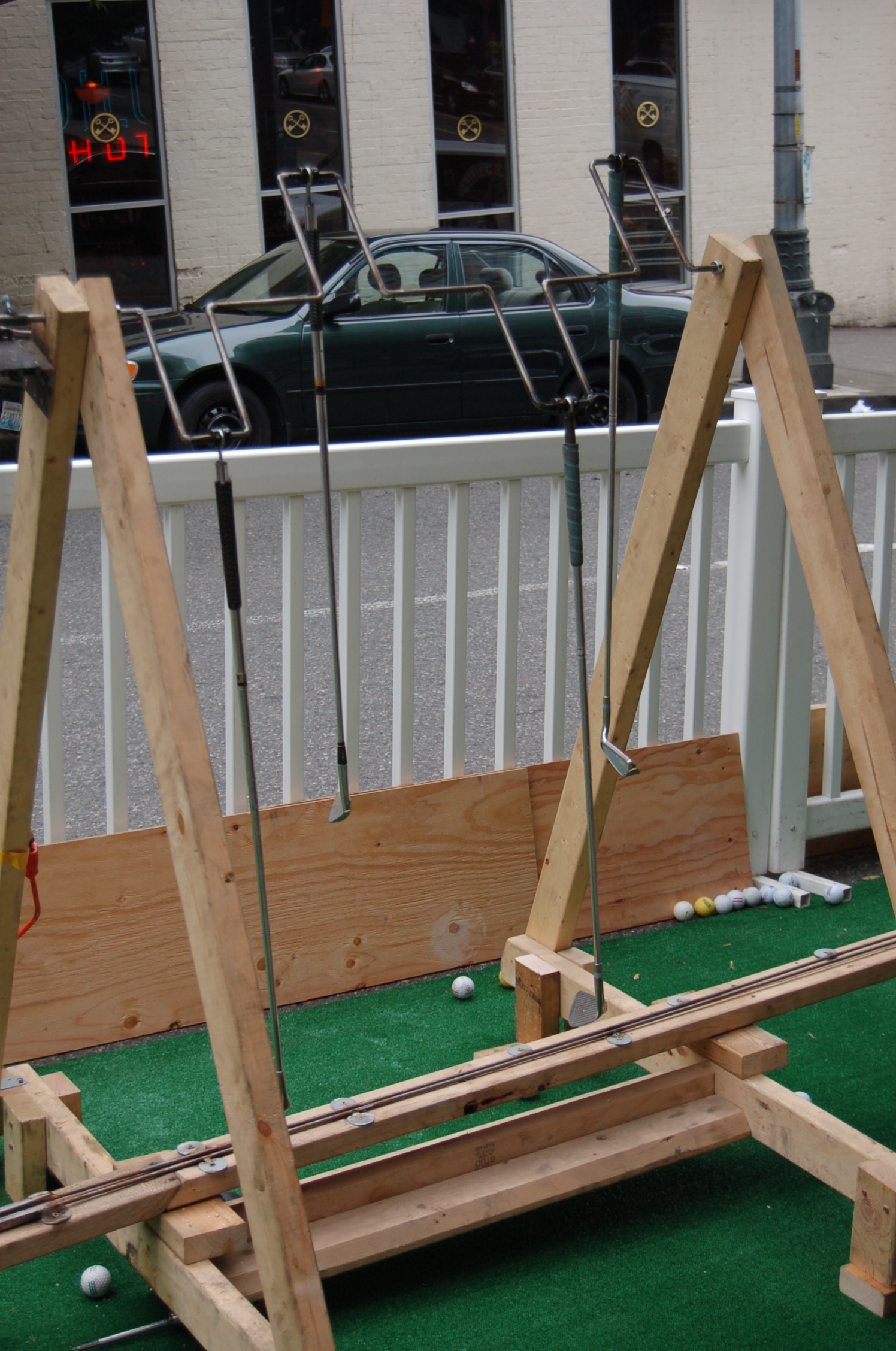
Rusty Oliver, artist behind the Hazard Factory, devoted his PARKing space to this portable mini-golf obstacle he built.

Hopefully the weather next year will be nicer and bring out more participants.

*If I missed any organizers, please leave their names in the comments and I’ll update this post. Thanks!

Social · writing

Crafternoons happening RIGHT NOW in NYC Public Library

If you live anywhere near the New York Public Library, go go go right now now now! And then tell me all about it. 🙂

After a talk with Julia, you and fellow attendees will work with the artists to create a collaborative craft project inspired by the book — a classic exquisite corpse, a hand-sewn double-bound book, a giant scroll, or even a crowdsourced short story. Supplies will be on hand (including some amazing images from the NYPL’s image collection) and all you have to do is show up because it’s FREE! So if you’re in town, stop by, get crafty, meet the artists and enter a raffle to win a free copy of the book! (Books will be available for sale, as well.)

Thanks for the tip at Design*Sponge » Blog Archive » crafternoons: the exquisite book + d*s event poll.