architecture · community · creativity · culture · design

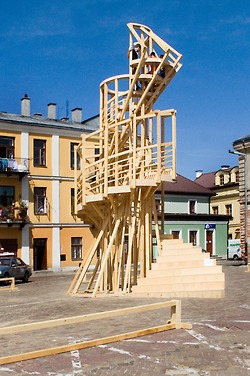
Teatro del Mare celebrates public space, community

A fun way to encourage public participation in space and creativity.

In order to celebrate its 10 years of activity, the artistic centre Lungomare in Bolzano Italy has recruited the ConstructLab/exyzt team composed by Alexander Römer, Gonzague Lacombe, Patrick Hubmann and Mattia Paco Rizzi. The result is the creation of Teatro del Mare, a wooden temporary structure, both a contemporary stage and street furniture, hosting a series of events, meetings and screenings until the end of June.

LIEU d’ÊTRE by the French Compagnie Acte is more than a performance. The project is an urban collective experience involving, both in the creation and the production of the event, professionals as well as inhabitants of a block of flats or of a whole neighbourhood. It uses the tool of dance to explore the pattern of the city.

more via In public space we trust.

behavior · community

Noted: Collaborative Consumption | The Etsy Blog

Helsinki city bikes
Helsinki's "city bikes." Image via Wikipedia

I used to live in a house with my husband, dog, and three or more roommates. While this lifestyle was a little too “collaborative” for us at times, I did appreciate the ability to borrow tools from one another, be able to cook a large meal and know that somebody would eat the leftovers, and have built-in dog sitters for a quick weekend getaway. I definitely see this idea catching on in people my age (the younger Gen-Xers and older Millenials), and while I don’t know if it’s because we’re younger and have no money, or if we’re all brain-washed commies, but I’m glad to see our ideas weren’t that unique.

Collaborative consumption, a movement recently highlighted by Morgan Clendaniel for Co.Design, encourages communities to monetize their unused goods through a system of borrowing. Zip Car and bike sharing programs are excellent examples of rethinking consumption, enabling people to borrow a method of transportation for the few hours it’s needed. “You might own some tools that you never use, or perhaps you have a backyard that you just don’t have the time to do anything interesting with,” explains Clendaniel. “Today, they can look like revenue streams, not wastes of money.”

via Noted: Collaborative Consumption | The Etsy Blog.

As a sort of antithesis to “Keeping Up with the Joneses,” we borrow books from friends, have slow food dinners that are really just giant potlucks, and practice other collaborative consumption.Other communities have city bikes and cars that anyone can use, as well as “free” stores where people can drop off stuff they no longer need and pick up anything they like.

But we live in a fairly hippy city; what is it like in other communities that might not be so collaborative? Leave your observations in the comments below.

anthropology · behavior · community · culture · environment · health · Nature

It’s Raining Rain Gardens | Sightline Daily

View of a bioretention cell, also called a rai...
Example of a rain garden. Image via Wikipedia

Oh, all right, but only because you asked soooo nicely; for Earth Day, an example of how communities in the Puget Sound are coming together to protect the Earth and improve their own personal environments as well.

Researchers have pointed the finger at stormwater runoff as the top source of pollution that’s getting into Puget Sound and other Northwest waterways. And because runoff comes from just about everywhere — roofs, roadways, parking lots, farms, and lawns — the solution has to be just as widespread.

Enter 12,000 Rain Gardens.

This week Washington State University and Stewardship Partners, a nonprofit working on land preservation, announced a campaign to promote the installing of 12,000 rain gardens around Puget Sound by 2016. The website even has a counter tracking the number of gardens and encourages folks to enter their rain garden into the database.

more via It’s Raining Rain Gardens — Sightline Daily – Northwest News that Matters.