
anthropology · architecture · community · creativity · design · environment

Coloring inside the lanes: Art that creates community | Grist

The Fremont Turtle - Grist

I found another great article from Grist magazine about how something as simple as a bucket of paint, or several different colored, buckets of paint, can have a huge positive impact on a neighborhood:

Sunnyside Piazza, it is called, which may seem a bit much for a splash of color on asphalt, but in person, it seemed fitting. This whimsical design, interrupting the functional but monotonous gray of Portland’s street grid, felt like a somewhere. It seemed like a place deserving a name. It even felt like a “piazza.”

That was in 2002. I later learned that the Sunnyside Piazza was the second painted public square in Portland, facilitated by the nonprofit City Repair Project. Now, dozens of painted plazas, dubbed Intersection Repairs, pepper the map not just of Portland but also of Los AngelesNew YorkSt. Paul, and Seattle.

It all started in the mid-1990s with Share-It-Square, in Portland’s Sellwood neighborhood, where architect and City Repair co-founder Mark Lakeman lives. After visiting villages in Central America where residents gather around common spaces, Lakeman decided to bring similar spaces to Portland. “Putting the public space back where it’s supposed to be may not sound like a huge change,” Lakeman says, “but it has a profound effect on the social culture … We know that Americans are more lonely and isolated than ever before, but we don’t realize that the absence of cohesion in American communities is totally related to the absence of places where people can actually build that.”

more via Coloring inside the lanes: Art that creates community | Grist.

The article goes on to discuss how creating a group mural creates a sense of community:

“It’s not about the paint,” says professor Jan Semenza, a professor of public health at Portland State University who lives near the Sunnyside Piazza and has researched intersection repairs. “It’s about neighbors creating something bigger than themselves.” As an everyday intersection becomes someplace special, residents begin to experience the value of community. Neighbors paint themselves out of a corner — of the intersection, of their individual homes — and into the middle of the street. By turning an intersection from a dividing line between neighbors into a gathering place, residents begin to solve the problems that plague neighborhoods and cities. Where isolation existed, they find community. Where cars dominated, they create a people place. With a little paint, neighbors are solving big problems.

I have seeen some great community spaces also created out of roundabouts, water fountains at outdoor shopping centers, and often at landmarks like stairs or trees. Sometimes, if a natural landmark or meeting space isn’t in place, all it takes is some paint, chalk, or even ribbon to make a place significant and identify it as a community gathering space.

 

architecture · community · creativity · design

6 Awesome Parks Made From Rehabilitated Urban Structures | Inhabitat

It’s starting to be State Fair time around the U.S., so what better time to talk about interesting parks, particularly those made from rehabbed structures?

Over the past few years we’ve seen some very creative minds transform urban ruins into spectacular parks for us to enjoy. If you can brave an abandoned nuclear plant turned into an amusement park, head to Germany – or see how old train tracks can be transformed into beautiful and fun parks in New York City and Lima.

see all of the 6 Awesome Parks Made From Rehabilitated Urban Structures | Inhabitat – Green Design Will Save the World.

community · creativity · play

Knitting the potholes together in Paris

In 2009, Juliana Santacruz Herrera began filling Paris’s potholes with elaborate knitted plugs; she called it “Projet Nid de Poule” (Project Pothole). What the yarn lacks in durability it makes up for in whimsy.

projet nid de poule (via Craft)

creativity · culture · design · play

Crochet Vandals Do Graffiti Like Your Grandma : NPR

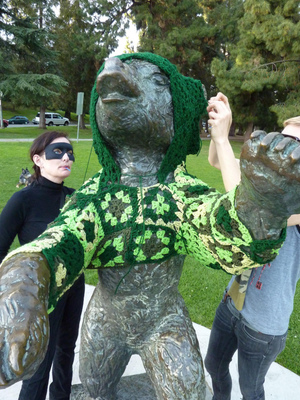
Captain Hook with bear shrug

I love this kind of public art! There was a tree in town that got a sweater a couple of years ago, and I’m so excited to see this is now becoming a “movement.”

“Captain Hook” is part of an international movement of so-called yarn bombers taking an old-school approach to street art. Unlike most street artists who travel with spray paint or markers, Captain Hook — as she asked NPR to call her — works with a crochet hook and yarn.

Her “walls” are public fixtures, like the bronze bear statue in L.A.’s Griffith Park that stands zombie-like with its paws out. “This is crochet on a statue,” she says, sitting in her Los Angeles apartment, a pile of granny squares in her lap. “This could be happening in 1725.”

more via Crochet Vandals Do Graffiti … Like Your Grandma : NPR.

anthropology · behavior · children · community · education · environment · Nature

MoMA engaging youth in art criticism (some harsh)

Happy Earth Day! I feel like I should have a blog post dedicated to the benefits of nature and why we need the Earth, but to be perfectly frank none of those environmental changes we talk about are going to happen unless we get everybody on board and engaged!

So, instead, here is one example of getting people, and particularly kids, involved and engaged, thinking critically about what they did or did not like about their experience, and giving it credibility and recognition by posting it to a public forum, and not just the online kind:

Flights of fancy, lively drawings, dreams of piloting the Bell helicopter, disdain for a museum with no dinosaurs… many of our absolute favorite “MoMA stories” were left by kids, from toddlers to teenagers. So for our second post about the “I went to MoMA and…” project, it wasn’t hard to pick a theme.

Some people think modern and contemporary art is too “hard” or “weird” for kids to understand and get excited about. Not the way our younger visitors tell it, though! It made us incredibly happy to hear from so many kids who thoroughly enjoyed their day at MoMA: admiring colors and shapes, learning new things, trying out Material Lab, picking a favorite artist, getting inspired to draw, and spending time with friends, parents, and grandparents. Take a look at some of the responses below, and a big thank you to all the kids who participated!

check it out at MoMA | “I went to MoMA and…”: The Kids Are All Right.

Kids read each other's feedback on MoMA

behavior · creativity · design · psychology · writing

How The Mundane Can Produce Creativity

I subscribe to this business blog, The 99 Percent (Success is 1% inspiration, 99% determination), that typically offers business strategies and stuff, but this article I found really interesting; the idea that having a ritual around your day actually allows your brain to focus on being creative:

You follow the same routine, sipping your coffee, browsing your email, skimming through the same blogs, the same news pages, the same social networks. As your colleagues arrive, you exchange the same greetings, the same gripes and gossip. As you drain the cup, you get the same itch for the same music, take your headphones out and plug yourself in. You open the same blank document, give it the same hard stare. The music kicks in.

Now you can begin.

If that sounds anything like your morning routine, you’re in good company. Over the years, as a coach and trainer, I’ve heard a similar story from hundreds of creative professionals. Of course, the details will vary – if you’re like me, your trip to work will be the “30 second commute” known to freelancers the world over, and you’ll be making your own coffee. You may incorporate meditation, or other exercise into your morning routine. And you may use a camera, easel, guitar or whatever instead of a computer.

But the chances are you’re living proof of one of the great paradoxes of creativity: that the most extraordinary works of imagination are often created by people working to predictable daily routines. There’s even an entire blog (sadly now on hold) devoted entirely to accounts of the Daily Routines of writers, artists, and other interesting people.

more via How Mundane Routines Produce Creative Magic :: Tips :: The 99 Percent.

It says the 3 common threads of these rituals are:

  1. Uniqueness – it should be something (or a combination of things) you don’t associate with other activities, otherwise the effect will be diluted.
  2. Emotional intensity – the kind you experience when you’re really immersed in creative work.
  3. Repetition – the more times you experience the unique trigger in association with the emotions, the stronger the association becomes.

Athletes, actors, and even accountants have these rituals, so why not creative types? What about you, what behaviors or rituals do you have to help you concentrate on being creative?

Social

The Art House Co-op Sketchbook Project: 2011 | We build art projects and communities

This project is all about community. Artists are invited to pick a theme, sketch about it, and send their book on a tour around the world!

Every artist who completes their sketchbook and returns it to us will have their book included in the tour. Your book will visit galleries and museums across the country, putting your art in front of thousands of people.

If I had any sketching skills I’d be aaalllll over this! It’s not too late to sign up!

Thousands of sketchbooks will be exhibited at galleries and museums as they make their way on tour across the country.

After the tour, all sketchbooks will enter into the permanent collection of The Brooklyn Art Library, where they will be barcoded and available for the public to view.

Anyone – from anywhere in the world – can be a part of the project.

To participate, visit the site: The Sketchbook Project: 2011 » Art House Co-op | We build art projects and communities.

architecture · Social · technology · writing

Booklust of the week

I am a little worried it was supposed to be released more than a year ago and I can’t find any updates, but…

Play All Day documents a collection of the most vibrant, stimulating and engaging design products and concepts for children. This book sets a new standard of design for children with fascinating examples of innovative and well-designed toys, playgrounds and play environments, room decorations, wall coverings, furniture and kindergarten architecture. In addition to these products, it also presents illustration and photography as well as new and original ideas offering playful solutions that talented designers and creative parents are designing for and with their kids. It is an inspiring reference for design-savvy parents and other professionals.

more at the Play All Day publisher’s website.