behavior · children · design · learning · play · Social · technology

Download an Exercise Apps for Healthy Kids

The winners are in, and now you can reap the benefits!

The Apps for Healthy Kids competition is a part of First Lady Michelle Obama’s Let’s Move! campaign to end childhood obesity within a generation. Apps for Healthy Kids challenges software developers, game designers, students, and other innovators to develop fun and engaging software tools and games that drive children, especially “tweens” (ages 9-12) – directly or through their parents – to eat better and be more physically active.

via Apps for Healthy Kids.

community · culture · education · family · learning · play · school · Social · technology

HASTAC, Superman, and the school fair

The Education system in the U.S. has reached a pretty low low right now. This is currently being displayed on the big screen in the documentary “Waiting For Superman.” Film-maker Davis Guggenheim “follows a handful of promising kids through a system that inhibits, rather than encourages, academic growth, and undertakes an exhaustive review of public education, surveying ‘drop-out factories’ and ‘academic sinkholes’.” (IMDB)

So, what do we do about it?

Lots of things.

One idea is HASTAC, or Humanities, Arts, Science, and Advanced Technology Collaboratory. Pronounced “haystack”, it is “a network of individuals and institutions inspired by the possibilities that new technologies offer us for shaping how we learn, teach, communicate, create, and organize our local and global communities.” They’re the group behind Reimagining Learning (DMLcompetition.net), and other scholarly workshops.

Cathy DavidsonDuke University Co-founder, HASTAC; Co-PI, HASTAC, writes:

Traditional education too often forgets its precious social condition of face-to-face interaction and takes its collective opportunity for granted. If your classroom can be replaced by a computer screen, maybe it should be.

We are using lessons from collaborative open web development and peer-to-peer learning and assessment to storm the academy at the first international Drumbeat Festival in Barcelona, Nov 3-5. Surrounded by pioneering open source web developers and experimenters in online peer-to-peer learning, we are using methods of the open web to look back and at shake up traditional learning institutions. Were looking at four key areas that need storming: collaboration, syllabus building, assessment, and publishing (including peer review). Our chief idea is that face-to-face learning should not be taken as a given in education but as an affordance, as an opportunity not a default. How does thinking about the unique opportunity to learn together change the components of traditional learning?

more via We’re Storming the Academy! A Provocation and a Promise | HASTAC.

Teachers are already spending their own money to provide supplies for a fuller education experience.

“Vicky Halm spends a $1,000 a year out of her own pocket to equip her Brooklyn classroom. She buys star stickers to help motivate her students, but she also spends a great deal on basic supplies — such as pencils and paper.
A whopping 97% of teachers frequently dip into their own pockets to purchase necessary classroom supplies, according to a national survey conducted by Kelton Research. Last year, teachers spent more than $350 on average from their own income on school supplies and instructional materials, according to the National School Supply and Equipment Association” (CNNMoney)

There are lots of opportunities for students to gain hands-on learning outside of the classroom too. Zoos and Universities often have family or kid-only programs to try out.

“Children and parents hummed through wax paper-covered combs while jazz singer Jeni Fleming sang the “Science Saturday” version of “Hound Dog,” everyone rocking out to their newly learned blues chord progression. And so — with tingling lips and a room full of smiles — the second season of Science Saturdays came to a close. Over 900 children from Bozeman, communities as far away as Helena, Stevensville and Glasgow; and the Crow Indian Reservation have participated in Science Saturdays since MSU started offering the program in the fall of 2008, said Suzi Taylor, outreach director for MSU’s Extended University. (MSU News)

Parents can also organize these events. A blogger on GeekDad describes his son’s school fair:

For our school fete we blacked out a classroom with curtains and asked for donations from people to enter the “Corner of Curiosity.” It was amazing what people came up with. There was a delightful Plasma Ball near the entrance which was a favorite of the younger children, and a beautifully faded yellow newspaper from 1938 headlining concerns about Hitler’s leadership in Germany. One parent produced a display of the “history of mobile” phones and others had insect collections.

One student produced what has to be the most curious of collections – a collection of animal scats. A local community member supplied a whale vertebrae (and a kangaroo vertebrae for comparison). But, the real value was being able to present a fund raising activity for the school that was also educational. (GeekDad)

Any small measure, from buying markers to throwing a curiosity fair, helps enrich kids’ learning and keeps them wanting more. Even just a little bit of time each week adds up quickly.

community · Social

Building communities through online tools

It used to be considered sketchy to combine our online and offline worlds. With programs like Meetup and Foursquare, however, those days are long gone.

Lisa Gansky an author, instigator & entrepreneur, wrote a book about it, The Mesh: Why the Future of Business is Sharing. She also wrote an article for Boing Boing about 100k Garages “a Mesh-web-enabled sharing-platform that pairs people who want to make things (Makers) with digital fabrication tools (Fabbers).

“Many projects are small businesses that sell unique items. But 100k Garages, a team-up of ShopBot Tools and Ponoko, uses grass roots enterprise and ingenuity to help get us back in action — to modernize our public infrastructure, develop energy-saving alternatives, or simply produce great new products for our homes and businesses. There are already thousands of ShopBot CNC tools in garages and small shops across the country, ready to locally fabricate the components needed to address our energy and environmental challenges and to locally produce items needed to enhance daily living, work, and business.”

There are other non-business examples too; the sport Parkour spread internationally thanks to YouTube and online forums. People donated to the Haiti Earthquake relief fund in record numbers because they could do it via text message. People have Meetups and Tweet ups all the time. Foursquare is based entirely on allowing people know virtually where you are physically. However, security and safety are still a major concern, and some people still feel odd sharing these kinds of details online where anyone can access them, not just the community members they intended.

How do online communities translate into interactions in the real world and vice versa? What has your experience been with the navigation of having specific communities that exist both online and in-person? Does one seem more real than the other? Comment below.

Social

The Art House Co-op Sketchbook Project: 2011 | We build art projects and communities

This project is all about community. Artists are invited to pick a theme, sketch about it, and send their book on a tour around the world!

Every artist who completes their sketchbook and returns it to us will have their book included in the tour. Your book will visit galleries and museums across the country, putting your art in front of thousands of people.

If I had any sketching skills I’d be aaalllll over this! It’s not too late to sign up!

Thousands of sketchbooks will be exhibited at galleries and museums as they make their way on tour across the country.

After the tour, all sketchbooks will enter into the permanent collection of The Brooklyn Art Library, where they will be barcoded and available for the public to view.

Anyone – from anywhere in the world – can be a part of the project.

To participate, visit the site: The Sketchbook Project: 2011 » Art House Co-op | We build art projects and communities.

play · Social

Innovation, Education, and Making stuff

I am so excited to share! My friends Janine and Willow were quoted as part of a workshop this past week about the Maker culture that has been growing dramatically over the past ten years and is really starting to bloom. My friends are part of the Jigsaw Renaissance, based in Seattle. The article appeared on the O’Reilly Radar article (excerpt below, with my friend’s quote in bold):

From a social perspective, vibrant communities are organizing around projects, technologies, and physical places. For example, one community called DIYDrones has developed a $500 unmanned aerial vehicle using open source chip sets and gyroscopes. Hacker Spaces and Maker Spaces are springing up around the country — like Jigsaw Renaissance in Seattle, which seeks to encourage:

Ideas. Unfiltered, unencumbered, and unapologetically enthusiastic ideas. Ideas that lead to grease-smeared hands, lavender sorbet, things that go bang, clouds of steam, those goggle-marks you see on crazy chemistry geeks, and some guy (or girl) in the background juggling and swinging from a trapeze … Walk through our door with an open mind, and you are liable to be whisked off your feet and into a project you’d never have thought up. We encourage communal learning, asking questions, and pushing that red button. Go on. Do it. If you stick around long enough, you’ll end up being the one creating projects and doing the 3-2-1 countdown for some new toy. Which is exactly what we hope will happen.

Technologically — we are moving towards what MIT‘s Neil Gershenfeld has called personal fabrication. Consider how Moore’s Law has enabled the transition from the expensive and remote mainframe to the personal computer to the smartphone that fits in your pocket to the Internet of things. We are seeing the same phenomena with the dramatic reduction in the cost of the tools needed to design, make and test just about anything — including $1,200 3D printers, CAD tools, machine tools, sensors, and actuators. Remember the replicator from Star Trek? It’s rapidly moving from science fiction to science fact. What will happen as we continue to democratize the tools needed to make physical objects that are smart, aware, networked, customized, functional, and beautiful? I have absolutely no clue — but I am confident that it will be awesome. As one maker put it, “The renaissance is here, and it brought ice cream.”

Economically — we are seeing the early beginnings of a powerful Maker innovation ecosystem. New products and services will allow individuals to not only Design it Yourself, but Make it Yourself and Sell it Yourself. For example, Tech Shops are providing access to 21st century machine tools, in the same way that Kinkos gave millions of small and home-based business access to copying, printing, and shipping, and the combination of cloud computing and Software as a Service is enabling “lean startups” that can explore a new idea for the cost of ramen noodles.

Makers are also becoming successful entrepreneurs. Dale just wrote a compelling story about Andrew Archer — the 22-year-old founder of Detroit-based Robotics Redefined. As a teenager, Andrew started off entering robotics competitions and making printed circuit boards on the kitchen table. He is now building customized robots that transport inventory on the factory floors of auto companies. With more entrepreneurs like Andrew — we could see a bottom-up renaissance of American manufacturing.

The article even goes on to talk about why the Obama Administration is behind DIY-ers and Makers. Exciting stuff! Read the whole article on O’Reilly Radar.

Uncategorized

Loud workplaces may increase heart problems

From Associated Press (October 5, 2010):

LONDON – What’s bad for your ears may also be bad for your heart. According to a new study, people who work in noisy places for at least a year and a half could have triple the risk of a serious heart problem compared to those who work in quiet environments.

Gan Wenqi of the University of British Columbia examined more than 6,000 people who were at least 20 years old and employed, in a U.S. health survey from 1999 to 2004.

Most of the study participants working in loud workplaces were men aged 40 and were more likely to have other heart risk factors like having a higher than normal Body Mass Index and smoking. After statistically adjusting for those variables, Gan still found people working in loud places had a higher chance of heart disease.

Participants were asked to rate how noisy their workplace was and how long they were exposed to it. A workplace was classified as noisy if people had to raise their voices to have a conversation.

Gan found people who worked in loud environments for at least one year and a half years were two to three times more likely to have problems including a heart attack and severe chest pain.

In the U.S., more than 22 million people work in environments with a hazardous noise level. Some previous studies have already identified noise as a possible warning signal for heart problems.

The study was published online Wednesday in Occupational and Environmental Medicine.

Read the full story.

Mental · psychology

Design*Sponge best of: Offices

Grace Bonney at Design*Sponge is creating a design book, but as a business owner also appreciates the need for your own creative/productive space. Hence, two blog posts (and hopefully book sections) dedicated to creating spaces that are good for productivity and innovation:

…there are over 20 amazing offices in this final group, ranging from simple, minimalist desks to colorful offices that will wake you up with bright paint and hot pink piping. Visit here for Part One.

[image above: i love the matisse print above d*s editors (and horne owners) ryan and alissa’s beautiful home office in philadelphia]

[image above: i love all the green (and the cute paris print!) in julie murphy’s home (founder of jack and lulu)]

more at DesignSponge » Blog Archive » sneak peek best of: offices part two.

architecture · creativity · Mental · psychology

Rx Art For Hospitals: Just What The Curator Ordered : NPR

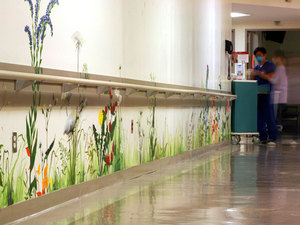
Being able to relax during medical treatments makes treatments more effective, as well as making better patients. Diane Brown is working to add a little art and light to a scary place: hospitals.

“While hospitals have become more physically welcoming in recent years, with new buildings designed by famous architects and lobbies filled with art, those changes rarely find their way to some of the hospital’s most difficult spaces — the rooms filled with machinery where treatment actually happens.

Diane Brown is trying to change that. She’s the founder of Rx Art, a nonprofit group dedicated to bringing art into the examination room and giving patients a way to escape their bodies’ sickness through their minds’ imagination.”

more via Rx Art For Hospitals: Just What The Curator Ordered : NPR.

Uncategorized

Lion lure line – Woodland Park Zoo

It’s like watching a giant cat play with a piece of string – with a chicken attached:
http://woodlandparkzblog.blogspot.com/2010/09/lion-lure-line.html

Lions sleep. A lot. But when not sleeping, their instinct is to stalk and hunt prey. To nurture those instincts and add some excitement to our lion exhibit—both for the lions and for visitors—our keepers recently experimented with the addition of an enrichment lure line. The lure line is basically a pully system stretching across the exhibit that allows the keepers to whiz a piece of meat or other tempting treat through the air, enticing the lions’ instincts and springing them into hunting action…

community · Uncategorized

Scent Map of Seattle’s Burke-Gilman Trail

"When you’re riding a bike and breathing deeply, something about the blood flowing fast and oxygen flooding your system heightens the senses — especially the sense of smell, it seems. Sometimes that’s a good thing. Not always. Here’s a map of sensational sniffs discovered along the western legs of the Burke-Gilman Trail during commutes between Shilshole and Fremont. –Brian Cantwell"

http://seattletimes.nwsource.com/html/outdoors/2013025700_nwwburkearomas30.html?cmpid=2628