community · design · technology

Summary of National Building Museum’s “Intelligent Cities” symposium: Change Observer: Design Observer

Red, yellow and green (unlit) LEDs used in a t...
LED traffic lights in Sweden. Image via Wikipedia

What does it take to make a city “smart”? Not intellectual, but make traffic lights respond to traffic, have buses alert people if they’re running a few minutes behind, and large corporate buildings comfortable for all its occupants. Journalist Phil Patton offers a nice review of the takeaways from National Building Museum‘s “Intelligent Cities” symposium which looked at these questions and more in order to design a better, smarter future city; among the many takeways:

What is critical in making cities “smart” is not just data, it seems, but clear, accessible data that is often used for purposes government may never have dreamed of. Early in the symposium, Judith Rodin, president of the Rockefeller Foundation, said that information to make cities smart was about “making it easier to do the right thing.”

Once-utopian ideas are now feasible, such as notions dreamed up at the MIT Smart Cities program, formerly headed by the late William Mitchell, author of City of Bits. “Smart parking places” that are RF-tagged could cut the energy wasted by circling vehicles. And systems that allow for hailing taxis and jitneys by mobile phone can provide “infill” transportation between private car and mass transit.

At the same time, there is concern about data that can make cities smart: fear of information used to justify policies imposed in a top-down way, and fear of loss of privacy.

more takeaways via Summary of National Building Museum’s “Intelligent Cities” symposium: Change Observer: Design Observer.

I’ve covered smart meters and “smart” monitoring of bridges and in cars before, so I’ve always thought of this kind of municipal monitoring exclusive to roadways or utilities.That last takeaway brought up a tough question for me: What data are you comfortable sharing with a municipality in order get a better experience navigating through and functioning in your community?

behavior · community

Noted: Collaborative Consumption | The Etsy Blog

Helsinki city bikes
Helsinki's "city bikes." Image via Wikipedia

I used to live in a house with my husband, dog, and three or more roommates. While this lifestyle was a little too “collaborative” for us at times, I did appreciate the ability to borrow tools from one another, be able to cook a large meal and know that somebody would eat the leftovers, and have built-in dog sitters for a quick weekend getaway. I definitely see this idea catching on in people my age (the younger Gen-Xers and older Millenials), and while I don’t know if it’s because we’re younger and have no money, or if we’re all brain-washed commies, but I’m glad to see our ideas weren’t that unique.

Collaborative consumption, a movement recently highlighted by Morgan Clendaniel for Co.Design, encourages communities to monetize their unused goods through a system of borrowing. Zip Car and bike sharing programs are excellent examples of rethinking consumption, enabling people to borrow a method of transportation for the few hours it’s needed. “You might own some tools that you never use, or perhaps you have a backyard that you just don’t have the time to do anything interesting with,” explains Clendaniel. “Today, they can look like revenue streams, not wastes of money.”

via Noted: Collaborative Consumption | The Etsy Blog.

As a sort of antithesis to “Keeping Up with the Joneses,” we borrow books from friends, have slow food dinners that are really just giant potlucks, and practice other collaborative consumption.Other communities have city bikes and cars that anyone can use, as well as “free” stores where people can drop off stuff they no longer need and pick up anything they like.

But we live in a fairly hippy city; what is it like in other communities that might not be so collaborative? Leave your observations in the comments below.

behavior · community · health

Obesity crisis: Does a lack of grocery stores make poor neighborhoods fatter? | OregonLive

Kaassouffle
Image via Wikipedia

Interesting follow-up article to a post I linked to earlier this week about people creating “food corridors” in Olympia, WA; according to this study, simply installing grocery stores “oases” doesn’t solve the problem:

There was never much hard science linking the obesity epidemic to so-called food deserts – inner city neighborhoods lacking stores selling fresh produce. One of the largest relevant studies, published July 11, found that having a nearby supermarket or grocery made no difference in the amount of fruits and vegetables people ate or the overall quality of their diets.

Being surrounded by fast food restaurants was linked to more frequent fast food dining – but only among low-income men. In that group, a 1 percent increase in the number of nearby fast food outlets appeared to increase the number of weekly fast food meals by 0.13 percent to 0.34 percent. That’s not a huge difference, but the researchers concluded that their findings “provide some evidence for zoning restrictions on fast food restaurants.”

Study author Penny Gordon-Larsen, of the University of North Carolina at Chapel Hill, told Reuters Health that researchers need to do more work to understand how people make decisions about what to eat, and that improving eating habits is likely to require broad efforts including community education.

“It’s not simply enough to introduce a grocery store,” she said…

In more bluntly stated commentary, the Economist asserts that the focus on food retailers may be misguided: “Open a full-service supermarket in a food desert and shoppers tend to buy the same artery-clogging junk food as before–they just pay less for it. The unpalatable truth seems to be that some Americans simply do not care to eat a balanced diet, while others, increasingly, cannot afford to.”

more via Obesity crisis: Does a lack of grocery stores make poor neighborhoods fatter? | OregonLive.com.

I think the Economist may have a point; if people are used to eating a certain way, and don’t understand the value of eating fresh fruits and veggies over cheaper-less-healthful foods, then they won’t stop buying soda and chips, mainly because they are usually cheaper and taste better stronger.

behavior · environment · Nature

Can’t Eliminate an Invasive Species? Try Eating It. – NYTimes.com

Pterois volitans, also known as red or common ...
Can you imagine this guy for dinner? Image via Wikipedia

NOAA recently issued a warning that ocean warming may push common fish staples into more northern climes, causing a shift for fisherman and an introduction of “invasive” species. There are also several species of fish that have invaded lakes and rivers that gobble up juvenile local breeds. It’s proven very hard to eliminate only one kind of fish from an environment. One solution may be “If you can’t beat ’em, eat ’em”?

An invasive species, the lionfish is devastating reef fish populations along the Florida coast and into the Caribbean. Now, an increasing number of environmentalists, consumer groups and scientists are seriously testing a novel solution to control it and other aquatic invasive species — one that would also takes pressure off depleted ocean fish stocks: they want Americans to step up to their plates and start eating invasive critters in large numbers.

“Humans are the most ubiquitous predators on earth,” said Philip Kramer, director of the Caribbean program for the Nature Conservancy. “Instead of eating something like shark fin soup, why not eat a species that is causing harm, and with your meal make a positive contribution?”

“We think there could be a real market,” said Wenonah Hauter, the executive director of Food and Water Watch, whose 2011 Smart Seafood Guide recommends for the first time that diners seek out invasive species as a “safer, more sustainable” alternative to their more dwindling relatives, to encourage fisherman and markets to provide them.

more via Can’t Eliminate an Invasive Species? Try Eating It. – NYTimes.com.

Unfortunately I’ve heard the lionfish doesn’t taste very good, but if they get the right marketing campaign on this, lionfish sushi may become all the rage!

architecture · community · design · technology

Prague’s Passive Solar Social Housing Project Makes the Most of Inexpensive Materials | Inhabitat

Just a great reminder that solar power doesn’t have to include high tech!

Prague-based DaM Architects recently completed a tenement housing project in the center of their city that takes advantage of passive solar design, glazing, ventilation and green materials to give it a high degree of energy efficiency. The firm organized the social housing project by stacking a series of brick-shaped apartments modules in a way that maximizes space, light, natural ventilation, and circulation. They also focused on keeping the project’s overall cost down through the use of inexpensive materials, however they still managed to maintain a high level of quality through precise workmanship.

more via Prague’s Passive Solar Social Housing Project Makes the Most of Inexpensive Materials | Inhabitat – Green Design Will Save the World.

community · culture · health · Social

‘Food corridor’ brings urban neighbors together – The Olympian

Hochbeet
Raised beds using concrete blocks. Image via Wikipedia

For the past couple of years people have been discussing the idea of “food deserts” in urban areas where there are no groceries or places for people to purchase fresh veggies and meat. This is an interesting concept of how to address that: a food corridor in Olympia, WA.

The commons is a collection of gardens, pathways, landscapes and building demonstration projects under the stewardship of the Fertile Ground Community Center and the South Sound Chapter of the Northwest EcoBuilding Guild. Together, they take up half a city block and include the guild headquarters known as EcoHouse, the Fertile Ground Community Center and the Fertile Ground Guesthouse, a bed-and-breakfast owned and operated by Karen Nelson and Gail O’Sullivan.

If chickens aren’t your thing, you’re welcome to pick a handful of fruits and berries — everything from Asian pears and Cascade cherries to golden raspberries and strawberries — growing along the sidewalk.

The community invitation extends into the garden where flowers, vegetables and herbs grow in raised beds built out of recycled wood and tree limbs.

more via ‘Food corridor’ brings urban neighbors together – Soundings – The Olympian – Olympia, Washington news, weather and sports.

I’m interested to see how this might manifest in other places, particularly those where it’s less common already to have chickens in backyards and use the front strip of grass in your yard as a raised bed. During World War II people had “Victory” gardens in containers on their front stoops, so it’s definitely doable to grow things even in the most compacted urban spaces, but it seems like the biggest hurdle is acceptance, so what could possibly be done to raise acceptance of backyard broccoli? Ideas?

community

Seattle gets OK to build Burke-Gilman Trail’s ‘missing link’ in Ballard | Seattle Times

Burke-Gilman trail in Seattle, WA
Burke-Gilman trail in Seattle, WA with the "missing link" shown.


I love cruising down the scenic, flat (which in a city of hills is wonderful), and also pedestrian friendly Burke-Gilman trail on my bike, passing parks, restaurants and coffee shops, trees, and amazing water views all the way from my home (kinda) near Lake Washington all the way to Golden Gardens beach. I have also experienced this “missing link” myself; a spot where the trail just disappears and you’re forced to share the road with giant trucks moving cargo in and out of ports. I always wondered why there was this gap, and I’m glad to see the city pushing to finish the trail.

After months of appeals, the Seattle Department of Transportation SDOT can finally begin construction on the “missing link” of the Ballard portion of the Burke-Gilman Trail, a Seattle hearing examiner ruled last week.

The hearing examiner ruled that the Shilshole Avenue Northwest portion of the “missing link” does not pose a significant environmental risk.

The ruling means the city will not have to conduct a full environmental-impact report for that section of the route, which runs along Shilshole Avenue Northwest between 17th Avenue Northwest and Northwest Vernon Place, and can move forward on its plans for the expanded trail. When that may happen is still undecided, however, said Rick Sheridan, communications manager for SDOT.

“We do fully expect that this will once again be appealed to the King County Superior Court. However, the city is eager to begin construction on a fully funded and fully designed missing-link segment,” Sheridan said.

The missing-link portion of the trail would fill a gap of approximately 1.5 miles between 11th Avenue Northwest and the Ballard Locks on the Ship Canal.

via Outdoors | Seattle gets OK to build Burke-Gilman Trail’s ‘missing link’ in Ballard | Seattle Times Newspaper.

I’m not sure why the city doesn’t have to conduct a full environmental impact, that part is a little concerning. But, considering how built up and industrialized the site already is, I’m also surprised there isn’t one already floating around somewhere they could use or build off of.

I am happy to see cities focusing on making cities more walkable or at least more bike friendly.

behavior · community · culture · education · environment

Bicycling our way into work and out of the Great Recession | Grist

Ringstraße, Vienna, Austria, 2005
A commuter in Austria. Image via Wikipedia

I am always interested in how organizations promote healthier, more enriching, more environmentally friendly practices, and I think this article makes a good point, that a lot of the bike commuter programs are geared towards the middle to upper class, yet the people who NEED to use bikes, and in many college towns I’ve lived in DO use bikes but need the support and information, are poor young folks:

The way we work has been changing for a long time, and our transportation needs and options along with it. With the recent recession, fewer people are working as much or for as much money, or as regularly — or at all. More of us are, in a word, poor.

We’re the ones who need bicycling the most. Yet the broke and the tenuously employed aren’t always reached by bicycle transportation advocacy, education, and services. When they are, the messages being promoted are not always relevant or welcome.

The mainstays of bike advocacy organizations are the three E’s: engineering, enforcement, and education — with a fourth E, encouragement, becoming increasingly popular.

U.S. bike advocacy is also imbued with a heavy focus on individual responsibility as more important — or perhaps more readily achievable — than social and infrastructure change, as exemplified by the until-recently prominent vehicular cycling movement.

Such initiatives tend to reach out to the people who ride — or don’t — out of choice rather than economic necessity, whose only barrier to getting on a bike is motivation.

When you’re already broke, you don’t need to be encouraged to adopt someone else’s lifestyle. You need solutions that arise from your own circumstances and community.

That means that simply choosing to hop on a bike isn’t actually that straightforward. Even as your car is sucking your savings dry and pummeling your credit, at least it’s the devil you know.

People living in low-income households are less likely to have access to a working bicycle (only 29 percent of households making less than $15,000 do, according to the NHTSA’s most recent survey). Aside from the cost and learning curve of acquiring, outfitting, and maintaining a reliable everyday bicycle, if you’re broke your neighborhood is also less likely to be graced by bike lanes, calmed traffic, and other facilities that are lauded for their ability to raise property values. You’re also less likely to have easy, central access to grocery stores and other amenities.

more via Bicycling our way into work and out of the Great Recession | Grist.

I’m curious to hear what solutions people may have for this. How do we focus more on getting the poor, or more accurately the broke, onto bikes safely and effectively?

anthropology · behavior · community · culture · education · health

Different reactions to urban farm economics

Downtown Bellingham as observed from Sehome Hi...
Bellingham, WA, which prides itself on buying, selling, and producing locally. Image via Wikipedia

The question of how to connect us back to our food is commonly asked these days, from local communities to big companies like IDEO and their Open IDEO challenges. One way to do this is through urban farms, or bringing the farm and local food production to the people. But the logistics of doing this can take on very different looks and feels.

I came across three stories in the past couple of days that all showcase a different reaction to the concept of economizing on local food growing and selling. The different styles seem to be very pro, con, or “social wellness” focused:

For example, in Bellingham, WA, local farms are offering kids classes on local farming practices, and make more money locally through education than actually selling their produce:

Common Threads’ goal is to connect children to food, their community and the environment through what she called seed-to-table education.

At Farm Camp, that included plenty of hands-on stuff for the 3- to 10-year-old children, who split into groups and take turns caring for the turkeys and chickens – do they have enough food and clean water? – as well as the garden.

“Growing stuff takes work and attention,” Plaut said, which is what the camp’s workers and volunteers emphasize to the children.

more via Bellingham program teaches children where their food comes from – Top Stories – bellinghamherald.com.

In Seattle, WA, the approach is definitely more entrepreneurial focused with backyard egg sellers and bee keeping:

CORKY LUSTER is hard-pressed to explain why his beekeeping idea turned into a full-time business and then some.

“People are interested in pollination and food . . . and honey bees have become the poster child for environmental concerns,” he muses.

Luster had a German roommate in college who introduced him to the idea of keeping a few chickens and beehives in the backyard. So when Luster heard about bees dying off and colony collapse disorder a few years ago, he decided to do his bit and set up a few beehives in his garden. Friends were fascinated with the bees — but not so much with all the work involved. The Ballard Bee Company was born, and two years later Luster doesn’t have time to remodel houses anymore.

more at Keeper brings bees to Seattle gardens.

In Missoula, MT, regulations make it a little bit tougher to sell wares:

Owners of small food enterprises continue to face hurdles doing business in Missoula even as the local food movement grows. At the state level, an effort is beginning to methodically review food safety laws and regulations. Leaders in Missoula say it’s time for some scrutiny on the local front, too, and one food vendor is already on the move.

Kim Olson, the “Empanada Lady,” is working to change at least one rule she said is arbitrary and hurts food vendors. Olson said the Health Department is obligated to enforce state laws, but the rules favor big franchises and leave homegrown shops adrift.

Which approach makes for a better experience of community food selling overall? With the E. Coli outbreak in Germany recently I understand the need for good food regulations, but what if they accidentally favor one kind of business model over another? I’m also curious if a more education focused approach works better than throwing local food sellers into the deep end with all the other commercial ventures? Thoughts? Experiences?
anthropology · behavior · community · creativity · design · Social

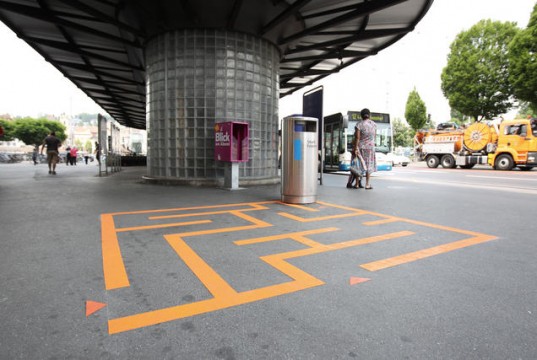
Lucerne’s Clever Street Decals Make Taking Out the Trash Fun | Inhabitat – Green Design Will Save the World

More ways to make social responsibility fun! I love the idea of turning the act of throwing away your trash into a game.

To discourage residents tossing their empty cups and wrappers on the streets and sidewalks, the city of Lucerne launched its “Lucerne Shines” program, which rolled out mazes, hopscotch boxes, and three point lines to make the act of trash disposal more fun. The project appeals to kids and is a great nostalgic throwback for adults alike — kudos to the Swiss town for this creative idea!

check out more games, like hop-scotch and puzzles, via Lucerne’s Clever Street Decals Make Taking Out the Trash Fun | Inhabitat – Green Design Will Save the World.