A recent Finnish research study suggests that a decline in biodiversity in the plants, animals and microbes in our daily environment may be linked to rising rates of allergies and asthma.Researchers studied 118 Finnish teenagers and found links between a healthy immune system, growing up in more rural or natural setting, and the presence of certain skin bacteria.This idea supports the biodiversity hypothesis – the idea that an environment with a diverse population of living things including microbes – is important for the development of a normal immune system in children. You may have heard of a similar idea, the hygiene hypothesis, suggesting that being exposed to microbes early in life trains our immune systems not to respond to harmless microbes or foreign substances like pollen. The hygiene hypothesis suggests that we have become too clean for our own good.Increasingly, scientists and researchers are realizing that we know less about many of the microbes that are in our environment, on our skin and inside our bodies. Nor do we know how they affect our health and bodily functions.
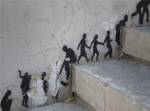
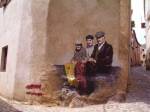
Happy Friday! I was forwarded one of those massive emails with a lot of great street graffiti and art, all of them commenting on their environment, as well as adding beauty and interest. I will add credits and attribute authors as soon as I find out who everyone is (if you know any of the artists please let me know in the comments below), but for now just some nice eye candy to get you ready for the weekend. Enjoy!
Can humans be happy in cities? Ann Arbor as seen from the University of Michigan Stadium. (Photo credit: Wikipedia)
A nice article from The Atlantic about how urban designers can do things to make living in the city a truly happier place to live:
I’ve been looking at some research reports, and confirming that some of the qualities associated with great urbanism – good public transit; easy access to cultural activities, recreation and shops; connectedness – are associated positively with human happiness. I first reported on a study reaching just those conclusions back in early February. Others found the study as well, concluding that residents of “beautiful, well-designed cities” are happier than those living in suburbs.
[Some research] points out, however, that other research contradicts those conclusions, or at least muddies them significantly.
Still another study – this one involving a bit of self-selection, since its data were generated by use of an iPhone app – finds that none of the above is true, since nature is what really produces a good mood.
There are definitely positive elements to living the city: more social contact with others, social and cultural events, potential access to a variety of fresh fruits and veggies, and more. There is also the flip side to all of those positives.
Read the entire article, and write back with your own opinion: do you believe that people can be happier in the city?
Babies are born social scientists. (Photo credit: Wikipedia)
Happy Friday! I read this article in the New York Times about Dr. Liz Spelke, at Harvard University, who studies the neuroscience of babies.
Dr. Spelke is a pioneer in the use of the infant gaze as a key to the infant mind — that is, identifying the inherent expectations of babies as young as a week or two by measuring how long they stare at a scene in which those presumptions are upended or unmet.
While the article primarily focused on what we can glean from babies about human cognition and knowledge, I couldn’t help but pick up on the author’s observations that the main thing the baby test subjects want to do, and the main thing that is enriching to them, is engage with the people around them (and how enriching it is for the grown-ups involved too):
The 15-pound research subject … tracked conversations, stared at newcomers and burned off adult corneas with the brilliance of her smile. Dr. Spelke, who first came to prominence by delineating how infants learn about objects, numbers, the lay of the land, shook her head in self-mocking astonishment.
“Why did it take me 30 years to start studying this?” she said. “All this time I’ve been giving infants objects to hold, or spinning them around in a room to see how they navigate, when what they really wanted to do was engage with other people!”
Babies are born with a desire to learn and engage in their world. They are pretty helpless, and so the only thing they have to defend themselves, as well as learn, is to engage with others and beg for help. As soon as they figure out who’s safe, they look for more people like that:
Katherine D. Kinzler, now of the University of Chicago, and Kristin Shutts, now at the University of Wisconsin, have found that infants just a few weeks old show a clear liking for people who use speech patterns the babies have already been exposed to, and that includes the regional accents, twangs, and R’s or lack thereof. And in guiding early social leanings, accent trumps race.
But, babies are also fascinated with the unknown, and will stare at new concepts and objects for much longer than the known items and individuals.
To me the really interesting thing is that what most interests the baby subjects is getting to know the researchers. As grown-ups we don’t have to lose that sense of wonder. Many people grow up to be researchers (like Dr. Spelke). We can continue to be fascinated by our surroundings and new people and always seek knowledge about what’s around us.
P.S.: Also, just if you’re curious, according to the Spelke lab here are some of the things that babies know, generally before the age of 1:
They know what an object is. They know that objects can’t go through solid boundaries or occupy the same position as other objects, and that objects generally travel through space in a continuous trajectory.
Babies can estimate quantities and distinguish between more and less. They also can perform a kind of addition and subtraction, anticipating the relative abundance of groups of dots that are being pushed together or pulled apart.
Infants and toddlers use geometric clues to orient themselves in three-dimensional space, navigate through rooms and locate hidden treasures.
Living with someone can be tough, but it may pay off, both financially and health-wise.
I came across this article today that focuses on the financial drain of growing old:
More Americans are living alone now than at any other point in history, and one-third of those 32.7 million are older than 65. A rise in the divorce rate in the over-50 set, which has doubled over the past two decades, along with women outliving their spouses by five to six years, is fueling the trend, which will only grow with an aging boomer population.
The older population in 2030 is projected to double from the start of this century — from 35 million to 72 million — representing nearly 20% of the total U.S. population, according to AARP.
Living on your own can be far more costly than sharing expenses like food and housing with a spouse, relative or housemate. Single seniors who also face escalating health care costs are five times more likely to live in poverty as their married peers.
I also feel like an important element was being skipped; the emotional drain and tax on growing old alone. If nothing else, for somebody to have your back.
A study involving more than 138,000 adults in Denmark showed that living alone carries a serious risk of heart disease. The subjects were followed from 2000 to 2002 and during that time 646 experienced severe angina, a heart attack, or sudden cardiac death. The two strongest predictors of these diagnoses, called acute coronary syndrome, were age and living alone. Women over the age of 60 and men over the age of 50, who lived alone, were twice as likely to have the syndrome as the other people. Although women over 60 who lived alone compromised only five percent of the studied group, they accounted for 30 percent of all deaths. Lone men over 50 were eight percent of the group, yet represented two thirds of the deaths.
Middle-aged men who reject family life and choose to live alone are more likely to die earlier than their married counterparts, UK Government figures published yesterday reveal.
They are also significantly more prone than married men to a variety of debilitating illnesses such as diabetes and rheumatism, said the study released by the Office for National Statistics.
The findings come against a backdrop of research which shows that married couples tend to enjoy better health than unmarried people.
A four-year study of 45,000 people from 29 countries. Researchers found that those living solo under age 65 had a 21% greater chance of dying; in their study, 9.3% of those who had a roommate died within the four years, compared to 11.4% of those who had none. The researchers believe the main reason for the bump may simply be that being alone means there is no one around to help when something goes wrong, notes the Orlando Sentinel.
Although, to be fair, the same study found that after a certain age living alone was associated with longer life, but that could also be because older folks who are healthier are able to live alone and not move into assisted living for longer.
“but the hunch is if you make it to 80 and are independent, you’re doing pretty well.”
So, the bottom line of all of this? Think about splitting the rent with someone, even if you don’t technically need to.
A little more play for your Friday. Via Inhabitat and PSFK:
Artist Florentin Hofman’s giant yellow duckie puts a smile on the faces of passers-by as it floats from city to city along the Loire river in France. The hilarious and striking sight has already traveled the world before through cities such as Osaka and Sao Paulo.
The 25 meters tall and 25 meters wide friendly creature’s mission is to provide a joyful interruption to people’s daily routines. People from all over the world connect the rubber duck with their childhood memories and are brought up with positive sensations.
Famous for his humoristic pieces, the Dutch artist Florentin Hofman used rubber coated PVC to built the duck on a pontoon with a generator. Hofman believes that the soft giant can relieve global tensions through delighting people coming from different countries and backgrounds. Hofman has generated smiles many times before. In 2011, the Kobe Frog, an enormous frog wearing a party hat, was sitting on the edge of Hyogo Prefectural Museum of Art in Kobe, Japan.
The duck itself is a durable vessel, made from inflatable rubber-coated PVC, a pontoon boat, and generator to help propel it forward downstream.
Happy Friday! I hope you get a chance to go out and play this weekend. Speaking of play, here is another great find from Milan’s Design week (remember the edible mini furniture from earlier this week?). This exhibit of design focused specifically on children’s spaces, with a focus that was very playful, creative, and also a great idea for grown-ups to incorporate into their own environments.
Students from the HDK master program Child Culture Design created an exhibit to explore new ways of bringing play into everyday objects to help foster imagination and creativity. Dubbed “Play In Progress“, the exhibit was one of our favorites at the Salone Mobile.
Johanna Larsson‘s cool table features transparent color plates that can be arranged and rearranged to create different tabletop scenes that push imaginative thinking.
At first look of Hide||show appears to be nothing special, but just put a kid in front of one of these and you’ll realize that there is definitely something more to this cabinet. The cabinet features two pairs of handles — one ordinary set for adults and a pint-sized set of hole-like handles for children. The variation indicates different accesses to function, and give children the feeling of exclusivity in their own world.
Inspired by the game of “hide and seek”, Behind the Curtain blocks out part of a white curtain with color to create a secret space for a child to be alone in his/her world.Griet Boucique has designed an ‘Alternative Playground’ – a landscape of soft seats – that questions what is a ‘good’ play environment for a child? The design considers material usage, its impact on the environment, and how different textiles can the way a child engages in play.
Check out more great designs at Inhabitat (I love the block table, for example!)
Jeff Ragsdale, the instigator for "One Lonely Guy" (Photo credit: Wikipedia)
More and more studies are coming out about how Americans feel more isolated than ever, and that we have less “close” friends despite being more connected to people via social media and technology.
One book was recently released that explores that idea of loneliness and the need for humans to connect with each other through the case of one man’s ad and the voicemails he received in response. From University of Washington News:
In October 2011, former University of Washington student Jeff Ragsdale, living in New York, had hit a low point — his stand-up comedy and acting career had stalled, he had been through a bad breakup and he was living in a cheap rented room. Despondent, Ragsdale posted a flyer around the city that said, “If anyone wants to talk about anything, call me. (347) 469-3173.”
To his surprise he got about 100 calls and texts the first day alone, and they kept on coming, finally numbering in the thousands. In time he brought the messages to the attention of his former teacher, UW English Professor David Shields. From that came the book “Jeff, One Lonely Guy,” edited by Ragdsale, Shields and Michael Logan of Seattle.
“I had kept in touch with Jeff over the years; I knew he was always up to interesting projects,” said Shields. “Jeff kept sending me the most amazing transcriptions of phone calls and texts that he had received. At a certain point, I just couldn’t say no. The material was simply too interesting; it spoke too deeply to the culture.
“What I love about the book (and I can say this because it’s less anything any of us did, and it’s more the voices that came in on Jeff’s cell phone) is what it tells us about what it’s like to live in America right now. I can’t think of a book that evokes more specifically how people talk now (the new words and phrases and sayings are extraordinary — it’s a virtual Roget’s of contemporary slang); how much they/we hunger for connection to themselves/ourselves, to each other, to a larger community; how energized and enervated they are/we are by Big Media and digital culture; how confusing love is in a 24/7 porn environment; and how baffling transcendence is — how fame or brief flickers of fame seem to beckon out of every internet portal. This book is a remarkable document of contemporary existence.”
The explorations of loneliness and connectedness sparked by one simple ad is pretty incredible. The book itself is also pretty powerful in that it truly is a collaborative effort, not only edited by three guys, but the content of the book is created from the voicemails of 100’s of individuals who were looking to connect with another individual in some way.
In Seattle we talk about the “Seattle Freeze,” this phenomenon where it’s hard for newcomers to make friends, but it sounds like it’s a problem all over the U.S. Would you say you have a close friend, or close friends? Would you say you feel connected to where you live, to your community? Why do you think we feel so disconnected from our neighbors compared to 30 years ago? Leave your thoughts in the comments below.
On this blog we often talk about the importance of being more playful and fun. Two great ways to be more playful are with design and food. One designer decided to combine both!
I was glad to see that this year’s [Milan Furniture Fair] show offered more tongue-in-cheek pieces that played around with the idea of furniture in a fun and fresh way. This “furniture tasting” waffle iron is from Ryosuke Fukusada and Rui Pereira, and it allows you to produce, essentially, a completely edible collection of dollhouse living room furniture. Is this a super functional design? Perhaps not (although you can eat what you make), but it’s a clever way to play with design while bringing up the topic of mass production. Although I may have to be in favor of mass production if it means plates full of tasty furniture-shaped waffles. Click here for more information and details over at the 2DM Magazine blog. Thanks to our resident foodie, Kristina, for the tip.
I am always interested in “green” practices as I believe they help make our environments healthier and more enriching, and us happier. This post is a great conversation about what makes urban environments “green.” Is it the street itself? The landscaping? The materials used? The amount of materials?
I am always interested in “green” practices as I believe they help make our environments healthier and more enriching, and us happier. This post is a great conversation about what makes urban environments “green.” Is it the street itself? The landscaping? The materials used? The amount of materials?





































 Mental Flowers