
community · environment · play · Social

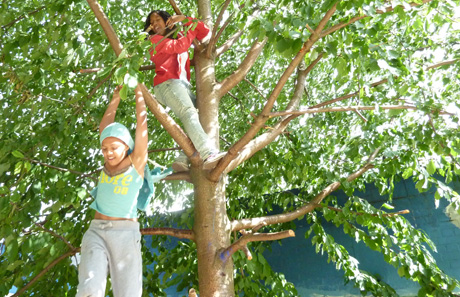
Fear, Traffic Largest Inhibitors of Outdoor Play in UK

This makes me sad to see that fear is stopping a lot of kids from playing outdoors in the U.K. From the national organization Play England:

Traffic and a fear of strangers are preventing children from playing outdoors, new research released for Playday 2012 has found. Almost half (49%) of parents report that fear of strangers stops their children from playing out, while 46% say traffic and almost a third (31%) highlight fear of accident and injury as barriers to outdoor play.

The findings of the survey have been released today as an estimated half-a-million children and families nationwide celebrate Playday- the national day for play in the UK, held this year on Wednesday 1st August. Around 500 community events are taking place across the UK to celebrate 25 years of the campaign, which raises awareness about children’s right to play and the importance of play for children’s health, wellbeing and happiness.

The Playday 2012 theme isGet out and play! The campaign, which is co-ordinated by Play England (part of the National Children’s Bureau), Play Wales, Play Scotland and PlayBoard Northern Ireland has gone from strength-to-strength since its conception in London in 1987, when the first events were held to raise awareness about the effects of cuts to local play services.

Cath Prisk, Director of Play England, said: “Simply playing outside should be a normal, everyday event for all children. If we want to foster the next generation of Olympians and sports stars, then we need children with confidence, who love being active and are confident in tackling challenges. If parents are too afraid to let their children play out – because of fear of strangers, traffic or their children having accidents – then we as a society need to address this fear. Whether that’s a community living in a cul-de-sac agreeing children will be playing out every day, a street applying to the council to close the road for play regularly, or residents volunteering to help local play projects reach more children, we can all do our bit to make sure every day is a Playday.”

Mike Greenaway, Director of Play Wales, said: ‘… As a society we have developed an irrational fear that our children are unsafe outside. Compound this with the domination of cars and their drivers, and the world outside the front door doesn’t look particularly attractive for anyone who wants to play there … and children regularly tell us that outside is where they want to play. Children value time, quality places and freedom to play in their own way; we need to support them, recognise that for their wellbeing, they need to play outside and that it’s safer than we think.’

Read the full release.

I am glad, however, that the U.K. seems to be taking play more seriously than the U.S.; just the fact that they have a Play Day (August 1), is pretty cool. And the Quote from Mike Greenaway is as accurate for the U.S. as it is for the U.K.: serious crime has actually been decreasing since the early 1990s.

Thankfully where I grew up was pretty rural, so as long as we were within whistle-shot (my mom would blow a whistle rather than yell), we could roam as far and wide as we wanted. What rules did your parents have about playing outside? What rules do you have for kids you are in charge of (kids, nieces and nephews, neighbor kids, grandkids, etc.)? Leave a note in the comment below.

anthropology · behavior · environment · Social

Letting the seasons influence work hours

English: New York, New York. Newsroom of the N...
Do you find yourself more or less productive during certain times of the year? (Photo credit: Wikipedia)

In this blog I often talk about play and creating space for play in our busy lives.  A recent article in Good magazine discussed the idea of changing our work habits to match the seasons, making more room for play (or at least less work time) in the summer:

Jason Fried, CEO of 37Signals, recently wrote for the New York Times that his company’s work schedules change with the seasons.

“For example, from May through October, we switch to a four-day workweek. And not 40 hours crammed into four days, but 32 hours comfortably fit into four days. We don’t work the same amount of time, we work less.”

We work less, he says. I can imagine it’s pretty easy to get buy-in for that idea around the office.

“When there’s less time to work, you waste less time. When you have a compressed workweek, you tend to focus on what’s important. Constraining time encourages quality time.”

This is a pretty rare set-up, but I have worked at places where they did offer 4 10-hour days in the summer, or 4 9-hour days and a half day on Friday, or some other kind of flexibility so people could take advantage of the nice weather. Europeans will often take a month off in later summer for vacation.

First, I think this is a great idea, and I think Fried makes a good argument that with less work time, people will prioritize work and really get the essential stuff done. From an anthropologist’s perspective, however, this dichotomy of summer equaling less time in the office, and theoretically less work, I find somewhat interesting, since as humans we traditionally tend to be MORE active and alert when we have more sunlight. In winter there was traditionally less food and worse weather conditions, so we would stay inside, hunkering down with our tribe or family, and maybe catch up on repairing clothing or tools. Late spring (when it stays light the longest) and late summer/early fall (just after the hottest temperatures) was a time of planting, hunting, gathering, harvesting, and getting stores up for the long winter months.

Today, we still hunker down inside during the colder months, but I find it interesting that this has translated into a tendency to stay inside busy over paperwork or computer work while summer, our traditionally busier work time, has become a time associated with leisure and play, or at least that’s what many of us would like it to be.

What are your thoughts? Do you like the idea of having work schedules that adjust with the seasons? Do you find yourself more or less productive in summer or winter, ignoring factors like kids home from school, etc.? Leave your thoughts in the comments below.

behavior · children · cognition · creativity · happiness · health · learning · play

Play is cheap!

toys
Kids don’t need a mountain of toys to stay entertained; in fact fewer turns out to be better (Photo credit: red5standingby)

I came across an interesting commentary from the Telegraph in the UK anecdotally supporting a new study that claims it only costs 6 pounds (about $10) to keep kids entertained.

A study by child development experts has concluded that the average family forks out £10,000 on toys and gadgets before their offspring turns 18. That’s a potential £20,000 on my two girls – cue a Munchian scream of Lebensangst.

Psychologists say that despite this casual largesse, youngsters are better off with colouring pencils and embroidery threads than computer consoles. While it might be hard to convince a surly 13 year-old that modelling clay and beads are more fun than a Wii, I couldn’t agree more. Are beads as thrilling as shooting baddies or crashing aeroplanes? Hardly, but it’s all about the social interaction, stupid.

It’s a rare and lovely feeling to be vindicated as a parent, so forgive me if I bask. You see, I am usually regarded (especially by my husband) as a bit of a skinflint who is too tight to buy the big one a Nintendo DS and the wee one, well, pretty much anything.

If my youngest asks for an ice lolly, we make them with apple juice. If they’re bored, I give them each a tray and send them outdoors to make a garden.

To the casual observer, this makes me a sickeningly virtuous hands-on mother. But it is merely the happy by-product of the fact that I am mean-fisted when it comes to frivolous expenditure. It goes against my grain to throw money at the children just to keep them amused and out of my hair. It feels wrong, and, worse, it feels lazy.

The truth that all parents know, deep down, is that what kids really crave is attention, not stuff. Stuff is a pretty good, if pricey opiate, but it never quite satiates, hence the ongoing clamour for more of it, except faster and louder to excite pleasure centres inured by computer-generated over-stimulation.

Read the whole article at the Telegraph.

Lots of parents have the old joke that at Christmas their kids spend more time playing with the box a toy came in than the toy itself. Now research is finding this to be more true than we realized.

It’s nice to hear that even in an age when children of younger generations appear to use advanced devices and technology as if it were second nature, nothing beats some old fashioned string and beads, or sticks and mud, for a good time. It can take a little bit more creativity on the parent’s end, but that can be a good thing, AND it also encourages more creativity and problem-solving in the child.

My personal favorites were pieces of wood and nails, and just hammering them together into odd art shapes, or just nailing them onto a tree. What were your favorite tools and environments for play when you were a kid? Let me know in the comments below.

behavior · community · creativity · happiness · play · Social

Why The Nose working to get a laugh out of the world

A clown nose

Happy Friday! Have you been waiting all week for some fun? Why the wait? Why not get a quick giggle in now? All it takes is a little red piece of foam, and the ability to not take yourself too seriously. I saw this shared on Facebook and had to spread the good cheer.

Why The Nose is a movement in clown accessories laughter and clowning around:

Whythenose.com is dedicated to the act of wearing a clown nose everyday, in order to make people smile.

It’s here for YOU…to encourage you with an act of Heroic Uninhibited Innocence :)

It’s really that simple. In a world filled with distractions and distrust, you’d be amazed at how many people (of all ages) have lost a sense of childlike wonder. Or maybe you wouldn’t…

Wearing a clown nose is fun, it’s easy, and it’s free (if you already have the nose).

We’re not trying to sell anything, we’re only showing you how joyful it is to change someone’s day.
Trust us, the nose breaks through barriers and opens doors every time you wear it…give it a try!

This phenomenon of adults wearing silly noses has been seen around both the 2011 and 2012 Burning Man Festival and other playful grown-up events courtesy of Tex Allen, who according to the website is a “responsible burner” but also wants to encourage people to enjoy themselves and enjoy their lives. I honestly hope this becomes a movement beyond just the Burning Man circuit, although I don’t think you’d need to wear the nose all day to get the effect he’s looking; maybe just for a quick trip to the grocery store. Visit the website for videos of some high quality goofing off. Or visit them on their Facebook page to see who else is getting their silly on.

Check out the video from Burning Man 2011 for more examples and maybe some inspiration.

community · creativity · design · environment · play · Social

Buses converted to portable public art spaces

After all the great stories about zoos adapting their spaces for their animals I’ve stumbled across recently, I was starting to feel a little sad for us humans. Thankfully, here’s another story I found from Inhabitat about re-purposing spaces for human play:

On the Plaza Luis Cabrera in Mexico City, two 1960’s Mitsubishi trolleybuses have been permanently parked for public use as part of a larger arts initiative in the Roma, Condesa and Hipodromo districts of Mexico City. The gutted and repurposed trolleys currently serve the city as vibrant spaces that engage residents and visitors in new art and cultural activities.

The vintage rides, which were donated to Mexico City by the government of Japan in the year 2000, were originally used to host the Galeria Trolebus initiative — a space used to showcase non-traditional art projects. Today the repurposed busses are public spaces for everyone to enjoy. On weekends and afternoons, visitors may stumble upon sculpture arts, free theater, music workshops, as well as concerts. The cultural activities on the trolleybuses even help to activate adjacent public parks, encouraging locals to take advantage of the ample and free space right before their eyes.

In order to keeps things dynamic, each month the buses on Plaza Luis Cabrera are re-painted in mural styles, with bright colors and bold prints by artists, community members and advertisers who volunteer their talents.

In brilliant fashion, the city has come up with a community-sustaining way to keep an outdated trolleybus model in style and out of the junkyard!

What a great reuse of an item, that is dynamic and allows the public to truly get creative together.
creativity · environment · learning · Nature · play

Create your own science station

When I was a kid I loved to collect beach glass, shells, pretty rocks, leaves, feathers, or whatever cool stuff I found. I would take them home and want to display them somewhere to admire and study them further. My mom was gracious enough to give me vases to hold the feathers, and let me keep my rock collection on top of our wooden fence (the brace that goes along the top) for years. Eventually I had quite the collection of feathers or rocks or whatever grouping I had come up with. It was not only educational, it was just fun and inspired a lot of creativity, either by arranging the items in new ways or imagining where they came from.

I think most kids really like to do this kind of treasure hunting, and in fact I don’t think it goes away as grown-ups; we just find reasons to stop collecting. Some of them are legitimate, like the fact that it’s illegal to remove items from state parks and beaches, even teeny tiny shells. Some grown-ups I know also replace this urge of hunting for feathers by going to yard sales or reused building material stores like the ReStore (hey, I’m guilty as charged). BUT, for the places it IS legal, and for a free version of this activity, I would encourage people to not only continue collecting, but to also make a space in your home specifically dedicated to your recent finds. For one thing, it’s fun, but it is also a great way to learn more about your environment, even just your own backyard. You may notice new colors or shapes and be inspired to draw the feathers you find, or explore the geology of a strange rock.

Mary Mullikan at Tree Life Coaching has created a “Found” table, or officially known as a Home Science Station, for her child, but I think this is a great idea for people of all ages:

I made the very easy one-word banner from Handmade Home and within an hour had the whole bite-size Science Station assembled.  A few garage sale items re-purposed (like the little wooden board which is actually an old game piece), some family heirloom pottery, a few sprigs of lavender from our driveway and some mint from our herb garden, some of the rocks Orlis has been bringing indoors, a handful of sand and a postcard procured from our recent trip to the coast, and a flower in a jelly jar, Orlis’ collection basket, and a beloved piece of feedsack fabric to provide a backdrop.  All of it was in the house or just outside, and now it’s here, displayed, for further discovery.

Oh, I love this little table already, and I know, as time passes it will change and change a hundred times as the seasons do and so do our fascinations with the great big world.  I know we’ll easily find many things to pile and gather in the shelf below, and I know the living things will die and be replaced with other tangible items of interest.  For now, it’s simple and easy, this little science station — the perfect place for a toddler to bring in his outdoor treasures for more handling and organizing, and deeper relationship.

I am excited to see this idea get picked up by different people and in different ways, and to see how easy it can be. Whether you have some wall space, a shelf, or even a window sill, it can be very fun and insightful to create a “science station” of your own to inspire you.

Have a science/creativity station already set up in your home? Send me a picture of it, or tell me about it in the comments below.

behavior · creativity · environment · happiness · health · mental health · play

Penguins get their own watery highway

I recently posted about the Philadelphia Zoo’s plans to open up their overhead walkways to a variety of different mammals. Well now an aquarium in Tokyo has opened a similar skyway… for penguins!

From Inhabitat:

The Sunshine Aquarium is the only place where you can see penguins fly (almost). -Inhabitat

At Tokyo’s Sunshine Aquarium, penguins are getting a taste of what flight might be like. The aquarium is currently hosting a special penguin exhibit that involves letting the penguins swim in the “Sunshine Aqua Ring”— which is normally reserved for the sea lions — for one hour each evening. So while they aren’t exactly taking flight, it’s still a unique way to view penguins that probably can’t be replicated anywhere else in the world.

On the roof, the open-air “Aqua Ring” is elevated about 7.5 feet off the ground, giving visitors an opportunity to view sea lions — and now penguins — swimming from beneath. (This videoshoes sea lions swimming laps in the Aqua Ring.) The “flying penguin” exhibit currently runs from 6:30 and 7:30 PM, and it is expected to run through September 2, 2012.

IF you just happen to be in Tokyo soon, do “fly” by and let me know what you think. This sounds like a great enrichment for the penguins as well as human visitors.
creativity · play

RIP, Phyllis Diller

Phyllis Diller research.
Phyllis Diller died today at age 95. (Photo credit: Jeff Tidwell)

To a groundbreaking comedian, and one of the most playful people of the 20th century.

From the New York Times:

Phyllis Diller, whose sassy, screeching, rapid-fire stand-up comedy helped open the door for two generations of funny women, died on Monday at her home in Brentwood, Calif. She was 95.

Ms. Diller, who became famous for telling jokes that mocked her odd looks, her aversion to housekeeping and a husband she called Fang, was far from the first woman to do stand-up comedy. But she was one of the most influential. There were precious few women before her, if any, who could dispense one-liners with such machine-gun precision or overpower an audience with such an outrageous personality.

One chestnut: “I once wore a peekaboo blouse. People would peek and then they’d boo.”

Another: “I never made ‘Who’s Who,’ but I’m featured in ‘What’s That?’ ”

Ms. Diller, a 37-year-old homemaker when she took up comedy, mined her domestic life for material, assuring audiences that she fed Fang and her kids garbage soup and buried her ironing in the backyard. She exudedan image that was part Wicked Witch of the West (a role she actually played in a St. Louis stage production of “The Wizard of Oz”) and part clown.

Thanks for making everyone’s lives a little more playful, and to remind us that sometimes the best person to make us laugh is ourselves.

behavior · brain · creativity · happiness · health · mental health · play

6 Tips to Stay Playful Your Entire Life

Stella meets a friend on the trail.
A good way to stay playful: be open to new creatures and experiences. (Photo credit: Wikipedia)

Happy Friday! Lately on Fridays I’ve been sharing my next great adventure destination, but this weekend that destination is staying put! And boy am I gonna have fun doing it! 🙂

For those of you who are also staying home this weekend and don’t know what to do about it, or maybe you had a loooooong week and you know you need to inject some fun into your day but your brain is so fried you can barely talk or type straight, here are some great suggestions from Remembering to Play. In fact, they recommend these tips for living an overall playful life, not just a playful day or two (although that is certainly a good start):

1. Play with movement:  Children have a wider range of body expression than adults.  We tend to move our bodies in the same, often rigid and predictable way. When walking down the street try moving your body differently. Start in small ways. Swing your hands in a different way, bounce your head from side to side, or shift your shoulders back and forth, one at a time. After a while try something bigger. Zig zag or walk backwards or sideways, or skip over the lines on the sidewalk. Or while walking in your office hallway twirl around one time…or perhaps more than once, tap the walls, or strut like you just made a million dollars for your organization!  Walk like you are the bees knees…because you are!
 
2. Play with perspective:  Instead of always looking straight ahead, or in your usual direction, look up or down, and in a direction you would not normally point your eyes. You may notice something different that you have never seen before.  A bird, a lovely coloured leaf, a funny looking cloud, a happy couple cuddling. It is easy, especially in big cities, to point our nose to ground and plow forward. Let’s remember that life is not about getting there but rather enjoying the ride. As you point your eyes in new directions, you never know what you might see, and what may come about from this new perspective.
 
3. Play with words/conversation: Whether it is, How’s it going, How was your day, or our conventional ways of starting a Monday morning meeting, we have many verbal or conversational routines.  It takes awareness and creativity to inject something new and fresh into the mix. For instance, instead of saying Hello to your friend, you could say Hey Hey, what do you say!?  Instead of calling your friend by their name, give them an unexpected nickname. Call them Sunshine or Peaches. (For over three years, a friend and I have consistently called each other Steve. It still brings us and others a good chuckle!) Or start your meeting off by having everyone share the last time they had a really good laugh. Read Creative Connections for more ideas.
 
4. Play with your surroundings:  What you surround yourself with either feeds or depletes your creative, authentic Self.  How often do you watch the news? Is the TV blaring in the background? What books do you read?  Do they inspire you?  What colour are your walls and what pictures do you hang from them. What music do you listen to?  Could you play more music in the background, say when cooking dinner or cleaning your home?  Do you have plants, or earth coloured tones in your home? Who do you spend your time with? Do your friends support your playful, authentic Self?  Can they hold space for the fullness of You?  Part of living a playful life is creating the container for playful living, and this means being clear on what supports or does not support authentic living.
 
5. Play with diverse activities:  As creatures of habit, it is easy to always order the same food, buy the same groceries, visit the same theatre and run the same route. Play means looking up when we normally look down, turning left when right is our regular choice. As we expand our range of choices and travel down new paths, we improve our brain functioning by building new neural pathways, and open to new possibilities. So instead of always seeing a movie, go to a live show instead. Instead of always eating the same meals, try to make one new meal a week.  Join a class, take a spontaneous road trip, visit a local museum, volunteer your time for a good cause, talk to a homeless person, pay for your friend’s meal, stop to smell a flower, play with a dog that is waiting for its owner, organize a games night, or start a book club. Do one thing different and you never know who you might meet or what adventure may unfold!
 

6. Play with your smile:  A single smile can change someone’s day for the better. I have experienced this when feeling a bit down, someone offers me a warm smile and suddenly I can feel my heart again. Life is not so bad anymore. In the same way that a picture is worth a thousand words, so too is a smile. So share your smile freely and fully. And share your smile with You as well. When feeling down, close your eyes and imagine a soft, warm, loving smile slowly appearing inside you. Allow it to get brighter, filling you with joy and light. Let your inner, playful spirit smile at you from the inside.

Read the original article.

Have a play-filled day! It will help you be more productive at work overall.

anthropology · behavior · community · design · environment · happiness · mental health · Nature · psychology

Animals get their own trail systems at Philadelphia Zoo

Lonely Monkey Ape at Zoo
Soon this guy will be able to take his own self-guided tours of Philadelphia zoo. (Photo credit: epSos.de)

I am so excited about this I’m practically jumping out my seat to tell people. I first read about it in USA Today; animals are getting to wander outside of their exhibits, share spaces with other animals, and over all just chill around the zoo. Yup, that’s right:

The Philadelphia Zoo on Thursday opens the first leg of an ambitious enclosed trail system designed to allow large animals such as great apes, bears and big cats to roam throughout the zoo. It will give them access to one another’s habitats in a kind of time-share arrangement and offer visitors a closer look at wild animals behaving like wild animals.

Other U.S. zoos have created paths between exhibits, mixed habitats, elevated paths or rope swings for apes.

“This is an emerging trend” among zoos accredited by the Association of Zoos & Aquariums, says the group’s senior vice president for external affairs, Steve Feldman. “Great animal care means providing for animals’ physical and psychological welfare. These pathways and rotations really allow them that kind of stimulation.”

The Philadelphia Zoo’s program is the first to encompass the entire zoo. “This campus-wide effort to build this trail system is unique,” Feldman says. “It’s innovative and is really taking that trend to the next level.”

Because it’s the first effort of its kind, “we don’t have a road map to see how others have done it,” says Vik Dewan, the Philadelphia Zoo’s chief executive officer. The system “puts animal well-being first and foremost,” he says, and gives visitors “an experience here, that when combined with other experiences, paints the bigger picture of how they could be more effective stewards of the world.”

The critters will have to “timeshare” so the orangutans won’t be hanging out with the brown bears. In fact the bears might not get a chance to use the pathways until winter when it’s too cold for the primates. But that said, it’s sure to be a boon for the animals, as well as for the people. The zookeepers already report seeing a positive result from a similar vine system in their primate exhibit.

The article mentions other zoos starting to move in this direction. But which ones, and what exactly are they up to? I’m curious to learn more. Any hints? Leave them in the comments below.

animals given access to the new trail are expected to be more active and
to benefit from the stimulation of being able to see visitors and other
animals from a new perspective.