behavior · creativity · education · health · music · play · school

Remembering to play even as the sun goes away

Happy Friday!

Now that we’re officially into fall, with the weather getting colder and wetter by the day, and all back to school or indoors,it’s important to remind ourselves of opportunities to get out and play.

Idea is Free Museum and Park Day tomorrow; September 28: over 1500 museums, and national and state parks, are opening up their doors to the public for free!

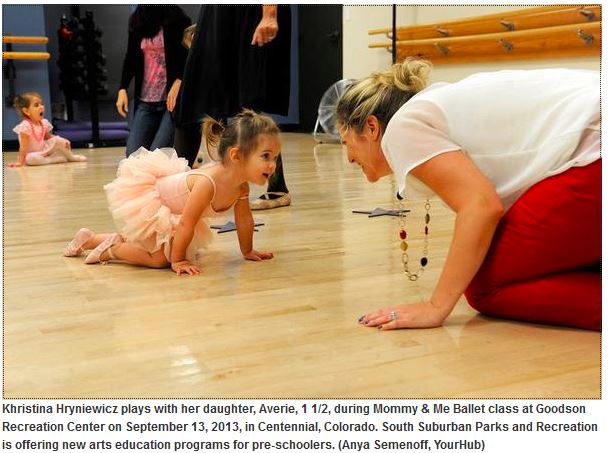
For some more structured play, there are great art, dance, and play-based programs for little and big kids. One just opened up in Colorado, and definitely understands the value of play:
dance

The Curious About Art program is just one of many preschool arts education programs the South Suburban Parks and Recreation District offers throughout the year. It’s not so much about the final product the kids create, but the journey and experiencing sensory exploration with their parents.

“It will probably look like something you expect an 18-month-old to make, something unrecognizable but still pretty wonderful,” said Vickie Willis, culture and enrichment supervisor for South Suburban.

“Everyone needs to play,” Willis said. “It makes us feel good, it unleashes possibilities in our brain, it makes us think better.”

Aside from encouraging play, the purpose of the classes is to prepare kids for a school environment by getting them socialized to being around other children, as well as developing motor skills.

“It’s to develop the motor skills, and the little ones just want to explore their world so music and art is a good way of doing that,” said Janice Schindler, the culture and enrichment coordinator at Goodson Recreation Center

more via Arts education programs in Centennial open possibilities – The Denver Post.

Seattle has a newly-minted hip-hop program for little kids that also focuses on the value of play and silliness in education:

Mini BREAKS is the original hip-hop dance class (breakin’ or “break dance”) for toddlers and preschoolers.

In this unique class, young students will have fun while they exercise, express themselves, think creatively, build self-esteem, practice respect, learn discipline and make new friends!

Outside of a dance studio, hip-hop culture (including breakin’) is not taught through choreography or 8-counts but more intuitively through interactive demonstration. Mini BREAKS focuses on encouraging young children to be creative and courageous – to come up with their own ideas and be able to express themselves by sharing those ideas with others. All children are artists – Mini BREAKS helps them remain artists as they grow up!

more via: Seattle’s Massive Monkees Open Hip-Hop Dance Studio

So remember to play and wiggle even as the weather gets cold and dark.

Uncategorized

Coming to an Empty Lot Near You: Free Mini Golf

Yes! What a great use of otherwise empty space. You could turn these lots into all sorts of creative playful spaces.

Unknown's avatar

Yes! What a great use of otherwise empty space. You could turn these lots into all sorts of creative playful spaces.

View original post

behavior · design · emotion · environment · happiness · health · mental health · psychology

Modular Glass Bedroom Helps Researchers Investigate Light’s Infinite Health Benefits – PSFK

Do you notice you have different moods depending on how bright or dark it is outside? Do you notice the warmth or cold feeling emitting from a light bulb? Whether you consciously notice them or not, they do have an effect on your brain and body. Since these days most of us don’t get to work outside and absorb natural light, scientists are working on the right kind of artificial light for us.

The light emitted from our lamps and fixtures at home doesn’t just spruce up a room; it has the power to significantly augment our mood and lift our spirits.To explore further the link between lighting and personal wellbeing, glass engineering company Cantifix and Oxford University have collaborated to create the Photon Project. This scientific study comes to life at this month’s London Design Festival in the form of the Photon Pod, an all-glass living space that will help the Photon Project gather data and insights on the links between light and health.Resembling a futuristic bedroom, the pod invites visitors to experience what life is like in a completely translucent living space, as well as take part in simulations that measure levels of alertness or relaxation under varied light conditions.

more via Modular Glass Bedroom Helps Researchers Investigate Light’s Infinite Health Benefits – PSFK.

anthropology · community · culture · environment · play · Social

Happy Park(ing) Day 2013!

Parking Day, Pioneer Square Seattle
Participants of Parking Day setting up a game in Pioneer Square, Seattle. Photo by author.

Today is PARK(ing) Day, “an annual worldwide event where artists, designers and citizens transform metered parking spots into temporary public parks.”

Every year I see some amazing games, maps, and other cool uses of parking spaces set up all over Seattle.

Go out and explore the different parklets!

more via Park(ing) Day 2013 | PARK(ing) Day 2013 is Friday, September 20th.


Side View on Park(ing) Day aktivity by Green C...
Side View on Park(ing) Day aktivity by Green City in Munich. Two Parking spaces were transformed into a small park. (Photo credit: Wikipedia)
behavior · emotion · psychology

The ‘Mood Graph’: How Our Emotions Are Taking Over the Web | Wired Opinion

Happy face high res
Do emoticons box you in or set you free?


More analysis and research looking into how we interact with and effect the digital space, and how that space in turn effects us, emotionally and mentally.

[Facebook, Bitly, Google+]… all these interfaces are now focusing on the emotional aspects of our information diets. To put this development in a broader context: the mood graph has arrived, taking its place alongside the social graph (most commonly associated with Facebook), citation-link graph and knowledge graph (associated with Google), work graph (LinkedIn and others), taste graph and interest graph (Pinterest and others).

Like all these other graphs, the mood graph will enable relevance, customization, targeting; search, discovery, structuring; advertising, purchasing behaviors, and more. It also signals an important shift in computer-mediated communication.

But placing a digital mood ring on users also has the power to change us — how we express ourselves. Especially when one considers that the data populating mood graphs comes from our encounters with behavior-altering interfaces packaged as fun little emojis and innocuous, “handy-dandy buttons”…

…drop-down expression makes us one-dimensional, living caricatures of G-mail’s canned responses — a style of speech better suited to emotionless computers than flesh-and-blood humans. As Marshall McLuhan observed, just as we shape our tools, they shape us too. It’s a two-way street.

more via The ‘Mood Graph’: How Our Emotions Are Taking Over the Web | Wired Opinion | Wired.com.

The author of the opinion, Evan Selinger, is a Fellow at the Institute for Ethics and Emerging Technology who focuses on the collisions between technology, ethics, and law.

He seems hell bent against putting a happy face next to his Facebook post, and I hear what he’s saying about the dangers of trying to sum up a concept with a parenthesis or semicolon. And I agree that companies are offering these emoticon options often just so they can collect more data on their users, rather than be focused on helping their customers express themselves more fully.

But, as Selinger also points out, spoken language itself can be nuanced and tricky, in the digital or non-digital world, and it can be nice to have more tools to express yourself in the digital space. People also post songs or pictures in order to share their mood or sentiment with others.

I feel that these are enhancements for people to share more ideas, not have them boxed in. Sometimes creativity is aided with a few rules. All language has restrictions, whether you’re coding or signing or chatting. Yes these restrictions should be recognized, but not

Do you feel that a smiley face or frowny face limits your ability to communicate and express yourself with others online? Leave your thoughts in the comments below.

behavior · emotion · happiness

Get in the Habit of Being Happy

Brain chemistry is a powerful thing, and as much as environments can shape our happiness, more research is finding we can consciously influence happiness.

Martin Seligman, the father of positive psychology, theorizes that while 60 percent of happiness is determined by our genetics and environment, the remaining 40 percent is up to us.

In his 2004 Ted Talk, Seligman describes three different kinds of happy lives: The pleasant life, in which you fill your life with as many pleasures as you can, the life of engagement, where you find a life in your work, parenting, love and leisure and the meaningful life, which “consists of knowing what your highest strengths are, and using them to belong to and in the service of something larger than you are.”

After exploring what accounts for ultimate satisfaction, Seligman says he was surprised. The pursuit of pleasure, research determined, has hardly any contribution to a lasting fulfillment. Instead, pleasure is “the whipped cream and the cherry” that adds a certain sweetness to satisfactory lives founded by the simultaneous pursuit of meaning and engagement.

And while it might sound like a big feat to to tackle great concepts like meaning and engagement (pleasure sounded much more doable), happy people have habits you can introduce into your everyday life that may add to the bigger picture of bliss. Joyful folk have certain inclinations that add to their pursuit of meaning — and motivate them along the way.

Some of my favorites:

  • They unplug
  • They make exercise a priority.
  • They go outside.

Continue reading at  Huffington Post for the full list.

This is certainly something I strive for rather than achieve as much as I’d like, but the idea of cultivating your own happiness is an important one. Even giving the agency back to ourselves to be happy, rather than waiting for the right environment, job, or person to come along to make us happy, has been found to make us happier.

So go get happy. 🙂

behavior · children · creativity · family · play

Goodbye screen time, hello awesome kid | Offbeat Families

A great example of how letting your kid have free play, and encouraging it over screen time, can have wiiiiide reaching positive consequences.

Four months ago, I told my husband that we needed to cut out all screen time during the week. While he understood the merits of the proposal, he balked at the logistics, telling me that there was no way that he could handle morning routine alone without television (to accommodate preschool hours we stagger our work schedules, with one parent leaving an hour or two before the other). I disagreed, and, being the bull-headed lady that I am, waited him out until he agreed to a screen-free weekday existence on a trial basis.

To prepare for the transition, I devised a series of “Mystery Boxes” for each day of the week. These boxes were stacked on the table each morning, and Uli got to choose one for each morning. Inside, I placed a project or special toy that would keep him occupied while Dad showered and fixed breakfast. One morning it was a Spider-Man puzzle, the next colored pencils and pictures I’d drawn for him to color. All of the toys or projects were sourced from forgotten objects in his toy box or from our craft and art supplies. His favorite Mystery Box item, though, was an old digital camera that he used to snap the most unflattering photos that have ever existed of myself and his father.

We only used the Mystery Boxes for about two weeks, and after that Uli was able to play in a more self-directed and creative manner than he ever was able to when he had weekday screen time. We were actually shocked by how quickly he adjusted to the no-tv-during-the-week proclamation. His teachers at school also noticed a difference, telling us that Uli was more engaged than he had been previously — a side benefit we hadn’t expected.

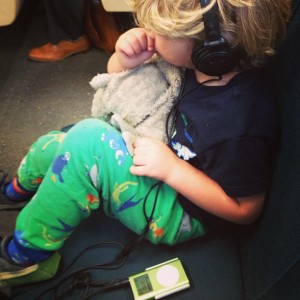
And in August, Uli and I took our first long plane trip without the iPad — including one fourteen-hour travel day. His dad had loaded a nine-year-old iPod with Uli’s favorite songs, which amused him for most of the plane trip, and in the airport, he did relay races in the terminal. It was a really successful experiment, and we have no plans to use the iPad again for travel.

read more about Uli’s transition via Goodbye screen time, hello awesome kid | Offbeat Families.

What have you done to encourage free play for your kids or yourself? Share in the comments below.

anthropology · behavior · brain · community · emotion · happiness · mental health · Social

Social Media Isolates But Also Binds

Flickr friends
How many of your virtual friends would you actually invite over for lunch? (Photo credit: Meer)

Does social media make us feel more or less connected? How does connecting and communicating in a digital space impact us differently than connecting and communicating in a physical space?

There are mixed results from various studies, but recently more studies have come out finding that we actually feel less connected to each other the more we use social media like Facebook:

Kross found that the more people used Facebook, the less happy they felt—and the more their overall satisfaction declined from the beginning of the study until its end. The data, he argues, shows that Facebook was making them unhappy.Research into the alienating nature of the Internet—and Facebook in particular—supports Kross’s conclusion. In 1998, Robert Kraut, a researcher at Carnegie Mellon University, found that the more people used the Web, the lonelier and more depressed they felt. After people went online for the first time, their sense of happiness and social connectedness dropped, over one to two years, as a function of how often they used the Internet.Lonelier people weren’t inherently more likely to go online, either; a recent review of some seventy-five studies concluded that “users of Facebook do not differ in most personality traits from nonusers of Facebook.”

But, as with most findings on Facebook, the opposite argument is equally prominent. In 2009, Sebastián Valenzuela and his colleagues came to the opposite conclusion of Kross: that using Facebook makes us happier. They also found that it increases social trust and engagement—and even encourages political participation. Valenzuela’s findings fit neatly with what social psychologists have long known about sociality: as Matthew Lieberman argues in his book “Social: Why Our Brains are Wired to Connect,” social networks are a way to share, and the experience of successful sharing comes with a psychological and physiological rush that is often self-reinforcing. The prevalence of social media has, as a result, fundamentally changed the way we read and watch: we think about how we’ll share something, and whom we’ll share it with, as we consume it. The mere thought of successful sharing activates our reward-processing centers, even before we’ve actually shared a single thing.

Virtual social connection can even provide a buffer against stress and pain: in a 2009 study, Lieberman and his colleagues demonstrated that a painful stimulus hurt less when a woman either held her boyfriend’s hand or looked at his picture; the pain-dulling effects of the picture were, in fact, twice as powerful as physical contact.

more via How Facebook Makes Us Unhappy : The New Yorker.

So what does this all mean? That we are complicated. And so is how we use social media.

“What makes it complicated is that Facebook is for lots of different things—and different people use it for different subsets of those things. Not only that, but they are also changing things, because of people themselves changing,” said Gosling. A 2010 study from Carnegie Mellon found that, when people engaged in direct interaction with others—that is, posting on walls, messaging, or “liking” something—their feelings of bonding and general social capital increased, while their sense of loneliness decreased. But when participants simply consumed a lot of content passively, Facebook had the opposite effect, lowering their feelings of connection and increasing their sense of loneliness.

I have seen forums used to create physical communities (I don’t want to say “real world” because virtual is real, it’s really happening) and create friendships that crossed continents, but I have also heard of and seen virtual bullying that in some very sad cases led to a person’s death. We can be cruel to others by hiding behind that veil of anonymity, or even just by creating a lack of physical presence which also creates a mental separation which makes it easier for us to feel isolated or intentionally isolate others. But we also want to share and connect with others, even if we can’t be physically near them, and share very intimate details with people we may not otherwise have given the time of day, which can be a good or bad thing depending on the context and situation.

How do you use social media? Does it make you feel more connected to your tribe, or do you feel left out or perhaps even more isolated? Do you bridge the gap between your virtual world and physical world, or does the slogan “What happens in Vegas stays in Vegas” also apply to your social media and physical lives? Leave your thoughts in the comments below.

community · happiness · mental health

North America’s Largest Urban Orchard Transforms an Old Gas Station in Downtown Vancouver | Inhabitat – Sustainable Design Innovation, Eco Architecture, Green Building

While most of my blog posts focus on playful design and things that create a playful atmosphere, a lot of us don’t have all of our basic needs met in order to be in a playful state. We are often overstressed, underslept, overworked, and detached from community. Play researchers have found evidence that goes along with Maslow’s hierarchy of needs that find we need these things in order to be ready to explore, create, and be healthy. That’s why I also like to talk about what it takes to get us to a space where we feel safe, healthy, and ready to be playful.

Going with the philosophy that gardening is good for the soul, as well as aiming for convenience, a group in Vancouver has opened a huge urban farm and orchard.

Vancouver’s Sole Food Farms has transformed an old gas station into North American’s largest urban orchard! Located in Downtown Eastside, the orchard provides jobs to recovering addicts and those with mental illness, giving them a chance to make a living while raising organic food. The organic fruit, along with produce from three other sites, is sold to local restaurants and grocery stores.

more via North America’s Largest Urban Orchard Transforms an Old Gas Station in Downtown Vancouver | Inhabitat – Sustainable Design Innovation, Eco Architecture, Green Building.

Adding green space to a city, whether it’s a garden, park, or a single tree, has also repeatedly shown to be valuable even to those who just observe the space, they don’t need to even be actively engaged in maintaining it. The garden adds connection to and investment in the land, which is good for building community, and provides a sense of agency for those who might not otherwise have one.

Where have you seen community gardens spring up? What works, what doesn’t? Leave your thoughts in the comments below.

behavior · children · environment · happiness · Nature

Make-A-Wish, Woodland Park Zoo grant a child’s wish to play with animals.

When 2 1/2-year-old Rylee, a Make-A-Wish Alaska and Washington kid, said she loved animals, we wanted to give her an unforgettable day at Woodland Park Zoo. Two weeks ago, Rylee arrived in a stretch limo, fed elephants Chai and Watoto, pet and fed the goats, pigs and bunnies, enjoyed a picnic and rode the carousel—and had a wonderful time sharing it all with her family. We’re so sorry to learn that Rylee has since passed. But we know that while we gave Rylee and her family the gift of nature, they gave us the gift of sharing one of Rylee’s last days with her. Go outside and play today—nature and time are gifts we should all treasure together. (Photo: Jessica Johnny Photography)

Photo: When 2 1/2-year-old Rylee, a Make-A-Wish Alaska and Washington kid, said she loved animals, we wanted to give her an unforgettable day at Woodland Park Zoo. Two weeks ago, Rylee arrived in a stretch limo, fed elephants Chai and Watoto, pet and fed the goats, pigs and bunnies, enjoyed a picnic and rode the carousel—and had a wonderful time sharing it all with her family. We’re so sorry to learn that Rylee has since passed. But we know that while we gave Rylee and her family the gift of nature, they gave us the gift of sharing one of Rylee’s last days with her. Go outside and play today—nature and time are gifts we should all treasure together. (Photo: Jessica Johnny Photography)

Biophilia is amazingly strong for all kids, and it’s simultaneously wonderful and heartbreaking that this was a little girl’s last wish.