Uncategorized

Fighting for urban trees in Vancouver

Great article from the Vancouver Sun (that’s Vancouver, BC, not Vancouver, WA), about residents fighting to protect their environmental enrichment. No joke; the loudest argument for protecting the trees is "we LIKE them!":

So why do people feel so passionately about the trees in their neighbourhood, passionate enough to throw eggs and compare the act to murder?

Trees certainly have an immediate impact on our senses. We love the way they look, sound and smell.

The breath of a gentle breeze rustling leaves can be immensely soothing. The swaying of taller, slender trees in the wind can be hypnotic to watch. Trunks are huggable. There are books that focus entirely and enthusiastically on the colour and texture of bark.

Lush canopies, as vast as clouds, shade us in summer. Leafless in winter, the graceful framework of a tree’s dark branches can be transformed into art when the contorted shapes are set naked against a cool blue or silver sky.

If a beautiful tree rises up in another’s yard, even in the next street or two lanes over or on a hill at the end of the road, we still somehow feel a compelling sense of ownership.

It may not be legally true, but we feel such a tree belongs to us, all of us; it is a community treasure, a gift, an essential component of the visible landscape, a landmark, a priceless gem of nature that deserves to be admired, maintained and protected.

The article goes on to offer different possible solutions to managing and maintaining community trees.

Go Canucks! 🙂

Uncategorized

Levi’s waterless pants game/campaign

Mwamanongu Village water source, Tanzania. &qu...
Drinking hole in Tanzania. Image via Wikipedia

Since my day job is looking at how messages are spread through social media, it’s hard to miss some of the interesting ways corporations are trying to tap into it. There is an interesting trend of companies supporting global campaigns for water rights, raising money for earthquake victims, or other humanity efforts. Some people just see it as corporations trying to make themselves look nicer, and in some ways that’s probably right, yet maybe despite their marketing efforts, or on top off, they’re also promoting community, group involvement, and making a change.

For example, Levi’s recently launched a game that also supports water rights around the world. Sure it’s raising awareness about Levi’s, but it also supports the efforts of clean drinking water, and play!

Through the initiative, Levi’s plans to donate $250,000 to Water.org to fund programs that will provide at least 200 million liters of water to the more than 1 billion people who lack access to potable sources. The point of the game goes beyond Levi’s largesse, however. Participants also help telegraph word of the water crisis while reexamining their own use of the precious commodity. (Pledging to wash your jeans less and take shorter showers is another challenge.

I say, go play the game, and when the boss comes by, explain it’s for humanitarian reasons. She’ll buy it, really! 🙂

community · education · emotion · happiness · hugs · mental health · Uncategorized

Yale law students can (maybe?) check out a dog for stress relief

For me, it is soooo one of those Fridays where everything is blowing up after a long week and you have a doctor’s appointment that took a month to schedule so you really don’t want to miss it, and the coffee’s worked a little TOO well this morning…

For days like this, I have my dog waiting for me at home (assuming I ever get home); for students away at school, they may not have that option.

There are now rumors circulating about Monty, a border terrier at Yale who is available for some quality time with Yale Law students who really need some good adorable animal therapy. While Yale has officially denied this, unofficially they announced he is available for therapy services.

The myth of Monty—short for “General Montgomery“—first surfaced last fall on the popular blog Above the Law. The border terrier was allegedly in a basket behind the circulation desk, but the school later issued a denial about Monty’s existence. Now New York Magazine’s reporting that Yale students have received a memo saying that, Monty is back and available for checkout.

It sounds like they’ve made Monty fully available to students now:

And, even though Monty is hypoallergenic, “visits will be confined to a dedicated non-public space in the library to eliminate potential adverse reactions from any library user who might have dog-related concerns. Kauffman also says they’ll be looking for student feedback on whether to have therapy dogs available “during stressful periods of the semester, for example during examinations.”

My firs thought? Why don’t they have this instituted in MORE high-stress places like graduate school? I can understand businesses not wanting people to bring their dogs into work, but a fully vetted and therapy-trained dog for as-needed therapy? Brilliant!!!!

Uncategorized

Low-tech community engagement, community planning

From GOOD magazine:

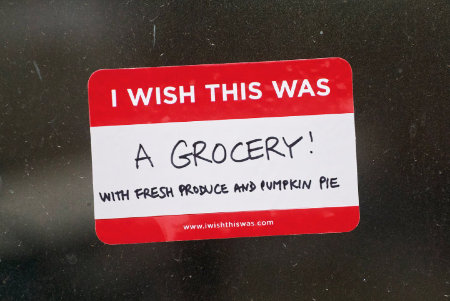
Candy Chang is a public installation artist, designer, and urban planner who likes to make cities more comfortable for people. She’s also a 2011 TED Fellow and will be at the mythic conference this week to talk about I Wish This Was, her endearingly low-tech community engagement project.

Chang believes that public space can better serve the people who live, work, and play in them. Cities like New Orleans, where she lives, are filled with abandoned buildings, empty storefronts, vacant lots, and people who need things, but are devoid of the most basic necessities like grocery stores. So Chang came up with the project, ideal for its super low barrier of entry, to allow her fellow citizens to offer their ideas. The responses, which run the gamut from Disneyland to a bike rack, heaven to an art supply store, reflect, says Chang,"the hopes, dreams, and colorful imaginations of different neighborhoods."

More…

Do you know of a city or neighborhood that could use this kind of survey or community brainstorming? Post it in the comments below, or look for her forthcoming site Neighborland, which will, she explains, "help residents and community leaders self-organize over shared goals, whether that be the desire for a local grocery store, bike lanes, more trees, less blight, a cafe with WiFi, a taco stand, a recreation center, and beyond."

behavior · brain · happiness · health · Uncategorized

Note to self: the universe says go easier on yourself

After going, going, going, I need a break, and research agrees; from the New York Times’ Well Blog:

Do you treat yourself as well as you treat your friends and family?

That simple question is the basis for a burgeoning new area of psychological research called self-compassion — how kindly people view themselves. People who find it easy to be supportive and understanding to others, it turns out, often score surprisingly low on self-compassion tests, berating themselves for perceived failures like being overweight or not exercising.

The research suggests that giving ourselves a break and accepting our imperfections may be the first step toward better health. People who score high on tests of self-compassion have less depression and anxiety, and tend to be happier and more optimistic. Preliminary data suggest that self-compassion can even influence how much we eat and may help some people lose weight.

This idea does seem at odds with the advice dispensed by many doctors and self-help books, which suggest that willpower and self-discipline are the keys to better health…

More at NYT’s Well Blog.

Now I’m off to go breath, eat a banana, and get a good night’s sleep.

Uncategorized

The art of communication, from an architect’s point of view

I often post events on behalf of Science Gallery, and I’ve never even been, but soooo want to go, especially to this event:

17:02:11 18:00 – 20:00
COMMUNICATING COMMUNICATIONS: An illustrated lecture inspired by Ray & Charles Eames’ film A Communications Primer (1953)

CTVR and Hugh Campbell, Professor of Architecture UCD, invite you to a lively discussion about contemporary understanding of communication and design, particularly questioning how we communicate complexity, and how we design for communication. Inspired by the work of Charles & Ray Eames, CTVR presents a cinema-style screening of the 23 min film A Communications Primer (1953), introduced by Linda Doyle and Jessica Foley, followed by an illustrated lecture presented by Hugh Campbell, which will explore Eames’ design thinking using A Communications Primer as a starting point.

Tickets are free but pre-booking is essential: http://www.sciencegallery.com/events/2011/02/communicating-communications-illustrated-lecture-inspired-ray-charles-eames-film-comm

It’s got everything: film, art, history, communication, design, and manipulation! 🙂

Uncategorized

Happy Winter Solstice!

On this, the shortest day of the year in the Northern Hemisphere, many wishes of warmth, sun, and a good new year to come! 🙂

Uncategorized

Loud workplaces may increase heart problems

From Associated Press (October 5, 2010):

LONDON – What’s bad for your ears may also be bad for your heart. According to a new study, people who work in noisy places for at least a year and a half could have triple the risk of a serious heart problem compared to those who work in quiet environments.

Gan Wenqi of the University of British Columbia examined more than 6,000 people who were at least 20 years old and employed, in a U.S. health survey from 1999 to 2004.

Most of the study participants working in loud workplaces were men aged 40 and were more likely to have other heart risk factors like having a higher than normal Body Mass Index and smoking. After statistically adjusting for those variables, Gan still found people working in loud places had a higher chance of heart disease.

Participants were asked to rate how noisy their workplace was and how long they were exposed to it. A workplace was classified as noisy if people had to raise their voices to have a conversation.

Gan found people who worked in loud environments for at least one year and a half years were two to three times more likely to have problems including a heart attack and severe chest pain.

In the U.S., more than 22 million people work in environments with a hazardous noise level. Some previous studies have already identified noise as a possible warning signal for heart problems.

The study was published online Wednesday in Occupational and Environmental Medicine.

Read the full story.

Uncategorized

Lion lure line – Woodland Park Zoo

It’s like watching a giant cat play with a piece of string – with a chicken attached:
http://woodlandparkzblog.blogspot.com/2010/09/lion-lure-line.html

Lions sleep. A lot. But when not sleeping, their instinct is to stalk and hunt prey. To nurture those instincts and add some excitement to our lion exhibit—both for the lions and for visitors—our keepers recently experimented with the addition of an enrichment lure line. The lure line is basically a pully system stretching across the exhibit that allows the keepers to whiz a piece of meat or other tempting treat through the air, enticing the lions’ instincts and springing them into hunting action…

community · Uncategorized

Scent Map of Seattle’s Burke-Gilman Trail

"When you’re riding a bike and breathing deeply, something about the blood flowing fast and oxygen flooding your system heightens the senses — especially the sense of smell, it seems. Sometimes that’s a good thing. Not always. Here’s a map of sensational sniffs discovered along the western legs of the Burke-Gilman Trail during commutes between Shilshole and Fremont. –Brian Cantwell"

http://seattletimes.nwsource.com/html/outdoors/2013025700_nwwburkearomas30.html?cmpid=2628