There’s a part of me that always says “well yeah, duh!” to this kind of talk, but I think it’s also one of those things that needs to be repeated over and over and over until people get it and start acting on it.
Category: Nature

Indeed! Fascinating findings and I like how they’re being applied.
For developing brains and global health, it’s all about the trees

As I head off on my latest grand adventure (a road-trip across Washington State), I will be driving through some fairly pristine landscapes; prairies, desert, forests, river basins. I love experiencing natural environments, even if it’s only from my car window. I find it rejuvenating and relaxing, more than a 90-minute massage! And enough research is coming out these days that finds I am not alone in my need for green spaces. So these two articles that were recently published seemed very timely for me. I know a lot of people wonder, “what does saving trees have anything to do with play?” Well, in a word, LOTS!
A new blog post by No Child Left Inside writer Richard Louv states:
From conception through early childhood, brain architecture is particularly malleable and influenced by environment and relationships with primary caregivers, including toxic stress caused by abuse or chronic neglect. By interfering with healthy brain development, such stress can undermine the cognitive skills and health of a child, leading to learning difficulty and behavior problems, as well as psychological and behavior problems, heart disease, obesity, diabetes and other physical ailments later in life.
A growing body of primarily correlative evidence suggests that, even in the densest urban neighborhoods, negative stress, obesity and other health problems are reduced and psychological and physical health improved when children and adults experience more nature in their everyday lives. These studies suggest that nearby nature can also stimulate learning abilities and reduce the symptoms of attention deficit hyperactivity disorder, and we know that therapies using gardening or animal companions do improve psychological health. We also know that parks with the richest biodiversity appear to have a positive impact on psychological well-being and social bonding among humans.
While we can’t say with certainty that these influences play a direct role in early brain development, it’s fair to suggest that the presence of nature can soften the blow of toxic stress in early childhood and throughout our lives. It’s understandable that researchers have yet to explore the natural world’s impact on brain development because the topic itself is rather new. Also, scientists have a hard time coming up with an agreed-upon definition of nature – or of life itself.
He’s right that we can directly link the two, but we do have research that demonstrates all of the following:
- play is good for you
- stress is bad for you
- less stress = more play
- more nature = less stress
- more nature = more play
- The environment you grow up in as a kid leads to permanent learned behaviors as an adult.
So there is a STROOOONG correlation to more exposure to nature as a kid leading to a less stressed, healthier, more playful brain.
Fortunately or unfortunately, there are now calls out to step up preserving natural forests, with some researchers claiming deforestation poses more of a threat to the planet’s health than global warming:
Bill Laurance, a professor at James Cook University in Cairns, Australia, studied 60 protected areas in tropical regions around the world and is the lead author of an article that will be published in tomorrow’s issue of Nature.
Tropical forests are the most diverse ecosystems on Earth, and failing to maintain them may drive more species to extinction, he said. To serve as a sanctuary for wildlife, the areas must also be protected from nearby development and other activities in adjacent lands that will have impact on designated preserves.
Protecting nature is important for our own health, as well as our children and grandchildren. Remember to be thankful for nature this weekend, and maybe even give a tree a hug; it’s playful and gets you closer to nature, literally.
Related articles
- You: Social deprivation hurts child brain development, study finds (latimes.com)
- Rainforest wildlife havens on brink of collapse (independent.co.uk)
- Your great grandparent’s experience might have altered your stress response. (mindblog.dericbownds.net)
- The Kiss of Health (psychologytoday.com)
- If I ruled the world – Richard Louv (outdoornation.org.uk)
- Richard Louv: 10 Benefits Of The Great Outdoors (huffingtonpost.com)
- Playing out – reclaiming the streets (outdoornation.org.uk)
- 20 Ways to Create a Naturally Restorative Home and Garden (my.psychologytoday.com)
The office for people who hate offices

This is a great idea! So many people have told me how they hate being inside the office all day, especially on nice summer days like this. We NEED exposure to the outdoors and nature in order to stay productive, mentally healthy, and physically fit. Just a 20-minute walk in the woods can have the same productivity benefits as an hour-long nap.
What’s your dream office? If you fantasize about bouldering on your lunch break–and appreciate being in a zero-waste, net zero-energy environment–you might want to take a look at the soon-to-be-completed space in the slideshow above: the new Alameda, Calif. headquarters of VF Corporation‘s outdoor and action sports coalition brands, which include The North Face, Lucy, and Jansport.
Now that VF’s outdoor brands are on good financial footing (especially The North Face), the corporation is working on a headquarters–set to be completed this summer–that was built with employee wish lists in mind. It shows.Below, some of the amenities available at the new 160,000-square-foot complex (many of them suggested by an employee task force).
- A large onsite garden that will grow things like kale, tomatoes, and basil. VF expects to grow so much that employees won’t even be able to consume all of it. Leftover will be donated to a local food bank. Employees will be encouraged to help out with the garden, but local volunteers will also pitch in. A side note: Originally, VF toyed with the idea of installing a volleyball court, but employees elected to grow a garden instead.
- Lots of natural light. 90% of employees will have access to direct sunlight, and in many areas of the complex, the overhead lights can often be kept off. Bonus: All the windows in the complex open (this should be a given, but it isn’t always).
- Opportunities for onsite fitness, including an indoor fitness area and yoga room, an outside training area for bootcamp, an outside bouldering space, and an outdoor gear rental and repair shop.
- A cafe serving the vegetables grown in the garden, among other things.
- Eventually, if employees are really lucky, the ability to kayak out into the water just outside the complex (VF would need to make sure this is feasible and legal first, but employees have been asking for it).
- A convenient location for almost everyone. When VF first started thinking about the new complex, it “took employee addresses and mapped out where they were” to figure out an ideal spot, according to Steve Rendle, group president of VF’s Outdoor & Action Sports Americas.
- The office space is inside out: executive offices are in the middle of the room, and other employees sit by the windows.
VF is far from the only corporation to have an environmentally and outdoors-friendly campus. New Belgium Brewing Company, for example, buys clean energy, powers itself partially with methane from an on-site water treatment plant–and it offers perks like free bicycles and volleyball.
But the idea of a company keeping employees active, innovating, and considering the environment shouldn’t be a novel one. We hope, in other words, that this becomes a trend well outside the outdoor apparel industry.
The only thing I’m bummed about is that they didn’t use one of the hangars on the old Alameda Air Base, that closed down just over 12 years ago and hasn’t had much development done with it since. It would have been very “green” to recycle those old structures, but I also understand the price and space limitations. Still, very exciting overall, and I hope this trend continues with new office buildings.
Related articles
- An Office Created For People Who Would Rather Be Outside (fastcoexist.com)
China’s architects work to preserve natural environment
It is great to hear that Chinese architects and planners are working to retain and or restore the natural environment and beauty of China. And great to hear that Chinese government is more open to preservation rather than focusing purely on “progress.” Restoring and/or preserving the environment is good for China’s people’s physical and mental well-being, and healthier for the world at large.
Movement study using Parkour athletes reveals orangutans’ climbing secrets

My M.A. thesis was on parkour, and how traceurs’ movement compared similarly to other primate movement behaviors, particularly the great apes. Now, a researcher in the U.K. has used traceurs to demonstrated how orangutans can move efficiently and effectively through the trees. Never would have thought of that, awesome!
From Io9:
Orangutans spend their lives swinging in trees and eating fruit… a fruit-based diet like the one orangutans prefer won’t provide much raw energy, while choosing to live up in the trees instead of padding about on the ground really should require a lot of it. To solve this apparent paradox, Dr. Lewis Halsey and his team at the University of Roehampton enlisted some expert practitioners of parkour to simulate orangutan movements in a controlled environment.
…According to the researchers, the orangutans’ secret is to use the natural moment of the trees to keep their own energy costs down. Here the primates’ extra mass is actually a benefit, allowing them to make their tree sway back and forth until it’s close enough to the next tree to move on. It’s not necessarily going to be the quickest way to move about, but it is energy-efficient, saving about 90% of the energy it would take to climb down one tree and up the next one.
It’s also considerably safer than going to the ground — as the researchers point out, the orangutans of Sumatra share their environment with tigers, which means any time spent out of the trees is time spent courting death.
From the BBC:
The results could help explain how orangutans are likely to be affected as their forest environment is cut down.
“We wanted to measure the energy expenditure as they moved through the trees,” he told BBC Nature, “so we put a mask on [the athletes] to measure their oxygen consumption.”
For one particularly precarious-looking test, the team designed a tall pole that mimicked the flexibility of a tree. The participants then used this to recreate a “tree-sway manoeuvre”.
“This is something the orangutans use to cross gaps,” said Dr Coward. “They sway [the tree] backwards and forwards until they’re able to get across.”
The team found that this method of moving from tree-to-tree used just one tenth of the energy that it cost to climb down and back up.
“As their environment is affected by humans cutting down trees, they are coming across more gaps and those gaps are bigger and more expensive.”
Dr Coward added that, for Sumatran orangutans, climbing down was not an option.
What a great study that not only demonstrates how a sport based on play can help researchers understand other primate behaviors, but it also helps promote conversation for orangutans. 🙂
Related articles
- Urban athletes show that for orangutans, it pays to sway (eurekalert.org)
- Parkour reveals the secrets of orangutan movement [Video] (io9.com)
- Parkour shows ape climbing secret (bbc.co.uk)
- Urban athletes show that for orangutans, it pays to sway (sciencedaily.com)
- Urban athletes show that for orangutans, it pays to sway (phys.org)
Kids’ playground goes back to nature – Edmonton Journal
I love the fact that playgrounds are incorporating the stuff that kids love to play with the most – dirt, rocks, and sticks!
Children won’t find new monkey bars and bright plastic play structures at the upgraded Donnan Park.
Instead, the aging playground at 9105 80th Ave. will become Edmonton’s first “natural playground,” part of a growing trend in playground design.
Children in the redesigned Donnan Park will entertain themselves with such timehonoured playthings as rocks, sticks, sand and dirt. The overhauled space will feature a slide built into a hill, a sideways-growing tree, a boulder spiral, a hand pump to pour water into a small stream and plenty of plants, trees and greenery.
It will be “a beautiful garden that everyone plays in,” says Kory Baker-Henderson, co-chair of the neighbourhood committee that worked on the preliminary playground design with expertise from Ontario-based Bienenstock Natural Playgrounds.
“Around us there are already some typical playground structures, so we wanted to have something different that blends in with the (Mill Creek) ravine,” Baker-Henderson says.
“Studies have shown imaginative play is much more stimulated (in natural settings) and children actually will play longer and become much more involved than on a typical red, plastic slide structure. Their games will just get much more imaginative. There’s that connection with nature. We have plans for a community garden, so it’s a learning and teaching tool, too.”
The playground at Donnan Park currently has swings and a slide that will remain for now, but won’t be replaced, she says.
Awakening Our Species to Nature Through the Eyes of Children
It’s written a bit like a public service announcement, but I still appreciate this article written by Izilwane, a non-profit group that deals with biodiversity internationally (full disclosure: I have contributed a free article to this group about research I have done on informal education. You can read it here), and featured on National Geographic News:
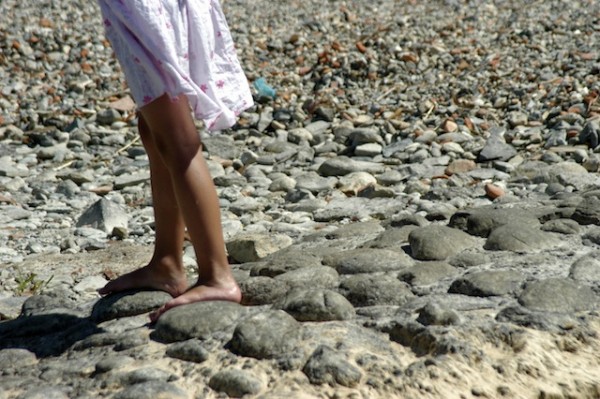
Children see the world through innocent eyes, eyes that see the unique beauty in even the most unimpressive puddle. To them, a tree is not just a plant but an entire jungle gym of adventure; a small plot of pines is not just a barrier between yards but an entire forest full of mystical creatures; a day at the beach is never simply sun and sand but the search for pirate treasure and lost shipwrecks.
By nurturing our species’ youngest members, by encouraging them to play outside, we are not only bolstering their imaginations but also encouraging creative problem solving, better concentration and social development. Kids who enjoy nature also grow up with an innate sense of responsibility and respect for the environment and all it has to offer.
How do we reconnect our youth with nature? How do we continue to teach our kids the importance of protecting our wild places? How do we reinvigorate children’s enthusiasm for playing outside? Here at Izilwane, we’re trying to combat the ever-growing apathy toward nature and provide youth – and those who work with them – with tools they can use to both learn and teach: a comprehensive and ever-growing list of resources for teachers; a story corner, which will feature anecdotal tales of youth connecting to nature; photo and video galleries that illustrate Izilwane’s work with students from around the world; and articles that highlight some of the strategies international educators are using to reach out to local children.
Read more at: Awakening Our Species to Nature Through the Eyes of Children.
I think they make a very good point about the importance of getting kids involved and engaged with animals and biodiversity at an early age. Not only does it help cultivate more empathy for animals and an appreciation for biodiversity, it’s also good for kids to learn about their environments and nature in order just to understand how the world works.
Related articles
- Biodiversity and Human Health (inimese.wordpress.com)
- Biodiversity in Kanazawa: Spring´s lesson (greenconduct.com)
Exploring some of London’s most playful spaces and places
Interesting exploration of the playful spaces around London:

I’m still buzzing after last weekend’s Open House play space tours. Why?
Simple: I saw some inspirational work, and had some immensely rewarding conversations.
We took a meandering and surprisingly green route across most of the NDC area to Radnor Street Gardens.
This is one of London’s best examples of a ‘playable space’ – in other
words, a space where offering opportunities for play is only one of the
jobs that has to be done. My work for the GLA
[pdf link] helped to embed this idea in London’s planning system. In my
view, it is fundamental to the success of public play facilities in
almost any urban area.What struck me was how the programme combined park, amenity space and
play projects, along with streetscape and highways initiatives, so that
the whole far exceeded the sum of its parts. The ingredients we saw
included [*deep breath*]: new play spaces and toilet blocks in parks and
estates, new public squares from reclaimed street space and car parks, ‘home zone’-style
shared road surfaces, landscaped road closures, greening up an
adventure playground, estate-based allotment projects, cycle lanes,
shared use ball game areas, pushchair-friendly pavements, even (on one
estate) new refuse bin sheds with green roofs. Her approach to
engagement was revealing. Local people were closely involved at all
levels, right up to the NDC board. However, they were seen not simply as
‘stakeholders’ or ‘consumers’, but as people who needed to be inspired,
debated with, and (hopefully) won over.
Read more of Exploring some of London’s most playful spaces and places.
I think this is a great idea; just as we have garden tours, we should have playground tours! Areas that introduce parents and officials alike to playful, fun spaces to take their kids.
This blog actually has some great conversations about play and the need for children to get outside and play more.
via Exploring some of London’s most playful spaces and places.
Related articles
- Play Streets (dundeestreetfestival.wordpress.com)
Mappiness: Mapping Happiness

From the blog How Do you Landscape; a group from the UK has created an app that can be used to measure our happiness based on our surroundings, and using maps to look at the data:
“People feel better outside than inside”. “People feel better in the park/woods/nature than in the city”. These are some of the conclusions from a project with the telling title ‘Mappiness’ Good news for landscape and Landscape Architecture on first sight. But are these only one-liners or firmly based scientific statements? Well, that depends on the quality of the empirical evidence of course. Most experience sample methods (ESM) have a hard time getting a representative group (in the end almost only colleagues) that has to struggle trough tedious interview forms (“it will take only twenty minutes”) to step-by-step end up with modest results. How about a sample group of 47.331 people (and growing by the day) who willingly support their data three times a day to the researchers that by now collected over three million forms in a few months? I stumbled upon these remarkable Experience research feats in a TedxBrighton 2011. In this “Twenty minutes lecture” George MacKerron explains why and how he and Susana Mourato (both from the Department of Geography & Environment at the London School of Economics and Political Science) created ‘mappiness’. They want to better understand how people’s feelings are affected by features of their current environment. Things like air pollution, noise, and green spaces influence your well being is their hypothesis.
This is how it works. They developed an app that can be downloaded for free. It must be one of the most irritating apps around on the web because it rings you (with your approval, you can influence the settings) three times a day to ask you three simple questions.
When put through a big regression model they can gauge the happiness as the function of habitat type, activity, companionship, weather conditions (there is of course a link between meteorological data and the GPS data), daylight conditions, location type (in, out, home, work, etc), ambient noise level, time of the day, response speed, and individual ‘fixed-effects’ (that come out of your personal Mappiness-history). Factors can be plotted out against each other.
How awesome is that? What a neat piece of technology to measure our surroundings and how they influence us!
 Mental Flowers