brain · children · creativity · education · learning · play · school

Games Without Frontiers: Games, simulations, and the new school year.

Tic tac toe. Español: Ta te ti Polski: Kółko i...
Tic tac toe. (Photo credit: Wikipedia)

For teachers, it’s time to start thinking about Back-to-School planning. Thankfully this teacher’s got an awesome plan to teach world politics:

Ask any student the following question; would you prefer to start the year with a lecture or playing a game? I’d wager the that nearly all learners would choose to spend their time with the game. As a younger student, I recall only being able to play in class once all of the curriculum was “done”, usually at the end of the school year. Of course, we know that learners of all stripes acquire, apply, synthesize, and communicate knowledge through participation in games and simulations. As a result, there’s a strong case to be made to embed complex critical thinking simulations and games right from the outset of the school year.

I’m currently putting the final touches on all of my lesson plans for the first term of both years of IB Global Politics. Here’s a partial list of the games and simulations the students and I will be playing in the first thirteen weeks:

Against All Odds; Fish Forever; Half the Sky; Malaria in Wanzuzu; Model United Nations; Pandemic; Prisoner’s Dilemma; Rock-Paper-Scissors-Lizard-Spock; Rushing River Cleanup; Survival; Tic-Tac-Toe; The Walking Dead

To say that I’m completely nerded out by all of this is an understatement; I can’t (hardly) wait for school to start on the 26th!

via Games Without Frontiers: Games, simulations, and the new school year.

I’m looking forward to seeing how the year unfolds for this class! If the teacher is excited, that’s definitely a good sign.

autism · behavior · brain · children · learning · mental health · Nature · play · school

Outdoor Play Helps Improve Autistic Symptoms

Reposting this from a fantastic blog Free Range Kids, run by Lenore Skenazy, a huge advocate for letting children be children and just playing, especially outdoors:

Readers — In our desperation to create “smarter” kids, we have practically pinned them to their desks. Now educators are realizing this may be just the opposite of what is best for kids — including those with special needs, as Andrea Gordon writes in Toronto’s TheStar.com (a paper run by my favorite editor-in-chief from back when he and I were at the NY Daily News, Michael Cooke). – L.

It was a crisp March day outside Blaydon Public School when teachers discovered that 4-year-old Alex Wong could spell his name.There were no pencils or paper in sight. Everyone was bundled in winter jackets. Alex, who has autism, was in the outdoor classroom where his special-needs class played and explored for at least an hour every day, alongside 25 kids from the mainstream kindergarten class.

Teacher Sue Cooper noticed Alex march over to a pile of wood, put three sticks in a small wheelbarrow and push it to a spot on the pavement. One by one, he placed the sticks on the ground, forming the letter A. He made three more trips and came back with sticks to make three more letters, which he placed in a row: L, E and X.

Cooper’s jaw dropped. The teachers ran for a camera.

Alex is non-verbal and for a long time, his only interactions had been to throw things or hit. But in the fresh air, day after day, something started to change. Over several months Alex had watched the other children making structures. And that March morning, he was ready to take his turn.

The teachers say his is one example of how daily outdoor time is changing the way their young students — including those autism and other special needs — learn and behave.

Full post.

Obviously more research needs to be done, but there has been strong correlations drawn between outdoor time and decreasing of ADD and dementia symptoms, so it makes sense that putting humans in our natural surroundings would also help other mental disabilities and ailments.

There are a growing number of outdoor preschools, and I’d argue that there should be more outdoor elementary and even middle schools.

anthropology · brain · children · education · health · learning · mental health

Attention Disorder or Not, Children Prescribed Pills to Help in School – NYTimes.com

English: Adderall
Doctor’s are prescribing Aderall to kids without ADHD (Photo credit: Wikipedia)

I find this article in today’s New York Times extremely disturbing:

When Dr. Michael Anderson hears about his low-income patients struggling in elementary school, he usually gives them a taste of some powerful medicine: Adderall.

The pills boost focus and impulse control in children with attention deficit hyperactivity disorder. Although A.D.H.D is the diagnosis Dr. Anderson makes, he calls the disorder “made up” and “an excuse” to prescribe the pills to treat what he considers the children’s true ill — poor academic performance in inadequate schools.

“I don’t have a whole lot of choice,” said Dr. Anderson, a pediatrician for many poor families in Cherokee County, north of Atlanta. “We’ve decided as a society that it’s too expensive to modify the kid’s environment. So we have to modify the kid.”

via Attention Disorder or Not, Children Prescribed Pills to Help in School – NYTimes.com.

Sadly the doctor is correct that many schools refuse to change a child’s environment to improve academic success, namely that they are cutting out activities like recess and P.E. in order to make more time for studying.

However, P.E., recess, and just getting outside for a quick breath of fresh air have all shown to also be extremely effective ways to improve attention and academic success. Yet because these activities are getting cut out of the school day, doctor’s feel like they must prescribe these incredibly strong, brain-chemistry changing medications to growing brains, many of these drugs with strong side effects .

I have no problem with using these drugs for what they were originally intended for, but prescribing them basically as “performance-enhancing” drugs just seems unethical to me. We frown upon athletes and grown-ups in the business world from taking speed and other kinds of drugs that are supposed to improve performance (other than coffee of course, that seems pretty much like a must-have for adults), but it’s okay for students so they can do well in elementary and middle school? To put in mildly, yuck!

I hope other people will be as outraged as I am and stand up for a child’s right to recess and P.E., and actually NOT studying from time to time, rather than encouraging giving them strong medications in order to perform well on standardized tests.


behavior · children · cognition · education · learning · play · Social

Montessori Google Doodle

Friday’s Google doodle honoring Maria Montessori’s 142nd birthday.

Have you noticed Google’s doodle for today yet? It is in honor of Maria Montessori, founder of the Montessori style of learning, which focuses on open-ended, free-form learning, which involves a lot of play. From PC Magazine:

Google on Friday honored Italian physician and educator Maria Montessori with a homepage doodle celebrating her 142nd birth anniversary.

The drawing features some of the tools that form the basis of Montessori’s educational methods, which emphasize hands-on, individualized learning within mixed age groups in a child-friendly setting.

After working in insane asylums with mentally handicapped children, in 1904 she began re-engineering the field of children’s education. She believed that all children have an inner drive to learn, and that children learn best when in a safe, hands-on learning environment.

Montessori also found that children help teach each other when put into groups with other kids of their own age range. She believed that teachers should pay close attention to students, not the other way around.

Her early efforts were so successful that she amassed a large following of parents and teachers who wanted to learn her methods. She later gained support from Thomas Edison, Helen Keller, and Alexander Graham Bell, who founded the Montessori Educational Association, headquartered in Washington D.C.

Read the full article.

Thanks Google for showcasing a great woman who was a pioneer in creating more playful and therefore better learning environments for kids.

Hope everyone has a great looong weekend before school starts up for a lot of people (appropriate timing to honor Montessori, eh?), filled with lots of learning, exploration, and playful environments.


behavior · children · cognition · creativity · happiness · health · learning · play

Play is cheap!

toys
Kids don’t need a mountain of toys to stay entertained; in fact fewer turns out to be better (Photo credit: red5standingby)

I came across an interesting commentary from the Telegraph in the UK anecdotally supporting a new study that claims it only costs 6 pounds (about $10) to keep kids entertained.

A study by child development experts has concluded that the average family forks out £10,000 on toys and gadgets before their offspring turns 18. That’s a potential £20,000 on my two girls – cue a Munchian scream of Lebensangst.

Psychologists say that despite this casual largesse, youngsters are better off with colouring pencils and embroidery threads than computer consoles. While it might be hard to convince a surly 13 year-old that modelling clay and beads are more fun than a Wii, I couldn’t agree more. Are beads as thrilling as shooting baddies or crashing aeroplanes? Hardly, but it’s all about the social interaction, stupid.

It’s a rare and lovely feeling to be vindicated as a parent, so forgive me if I bask. You see, I am usually regarded (especially by my husband) as a bit of a skinflint who is too tight to buy the big one a Nintendo DS and the wee one, well, pretty much anything.

If my youngest asks for an ice lolly, we make them with apple juice. If they’re bored, I give them each a tray and send them outdoors to make a garden.

To the casual observer, this makes me a sickeningly virtuous hands-on mother. But it is merely the happy by-product of the fact that I am mean-fisted when it comes to frivolous expenditure. It goes against my grain to throw money at the children just to keep them amused and out of my hair. It feels wrong, and, worse, it feels lazy.

The truth that all parents know, deep down, is that what kids really crave is attention, not stuff. Stuff is a pretty good, if pricey opiate, but it never quite satiates, hence the ongoing clamour for more of it, except faster and louder to excite pleasure centres inured by computer-generated over-stimulation.

Read the whole article at the Telegraph.

Lots of parents have the old joke that at Christmas their kids spend more time playing with the box a toy came in than the toy itself. Now research is finding this to be more true than we realized.

It’s nice to hear that even in an age when children of younger generations appear to use advanced devices and technology as if it were second nature, nothing beats some old fashioned string and beads, or sticks and mud, for a good time. It can take a little bit more creativity on the parent’s end, but that can be a good thing, AND it also encourages more creativity and problem-solving in the child.

My personal favorites were pieces of wood and nails, and just hammering them together into odd art shapes, or just nailing them onto a tree. What were your favorite tools and environments for play when you were a kid? Let me know in the comments below.

creativity · environment · learning · Nature · play

Create your own science station

When I was a kid I loved to collect beach glass, shells, pretty rocks, leaves, feathers, or whatever cool stuff I found. I would take them home and want to display them somewhere to admire and study them further. My mom was gracious enough to give me vases to hold the feathers, and let me keep my rock collection on top of our wooden fence (the brace that goes along the top) for years. Eventually I had quite the collection of feathers or rocks or whatever grouping I had come up with. It was not only educational, it was just fun and inspired a lot of creativity, either by arranging the items in new ways or imagining where they came from.

I think most kids really like to do this kind of treasure hunting, and in fact I don’t think it goes away as grown-ups; we just find reasons to stop collecting. Some of them are legitimate, like the fact that it’s illegal to remove items from state parks and beaches, even teeny tiny shells. Some grown-ups I know also replace this urge of hunting for feathers by going to yard sales or reused building material stores like the ReStore (hey, I’m guilty as charged). BUT, for the places it IS legal, and for a free version of this activity, I would encourage people to not only continue collecting, but to also make a space in your home specifically dedicated to your recent finds. For one thing, it’s fun, but it is also a great way to learn more about your environment, even just your own backyard. You may notice new colors or shapes and be inspired to draw the feathers you find, or explore the geology of a strange rock.

Mary Mullikan at Tree Life Coaching has created a “Found” table, or officially known as a Home Science Station, for her child, but I think this is a great idea for people of all ages:

I made the very easy one-word banner from Handmade Home and within an hour had the whole bite-size Science Station assembled.  A few garage sale items re-purposed (like the little wooden board which is actually an old game piece), some family heirloom pottery, a few sprigs of lavender from our driveway and some mint from our herb garden, some of the rocks Orlis has been bringing indoors, a handful of sand and a postcard procured from our recent trip to the coast, and a flower in a jelly jar, Orlis’ collection basket, and a beloved piece of feedsack fabric to provide a backdrop.  All of it was in the house or just outside, and now it’s here, displayed, for further discovery.

Oh, I love this little table already, and I know, as time passes it will change and change a hundred times as the seasons do and so do our fascinations with the great big world.  I know we’ll easily find many things to pile and gather in the shelf below, and I know the living things will die and be replaced with other tangible items of interest.  For now, it’s simple and easy, this little science station — the perfect place for a toddler to bring in his outdoor treasures for more handling and organizing, and deeper relationship.

I am excited to see this idea get picked up by different people and in different ways, and to see how easy it can be. Whether you have some wall space, a shelf, or even a window sill, it can be very fun and insightful to create a “science station” of your own to inspire you.

Have a science/creativity station already set up in your home? Send me a picture of it, or tell me about it in the comments below.
creativity · design · learning · play · Social

Making stuff at Science Gallery

Makeshop
Picture from Science Gallery’s Makeshop. (Photo credit: David Ramalho)

I used to write about Science Gallery in Dublin, Ireland, a lot on my now defunct blog The Art of Science. They have now been open for a couple of years, and are huge proponents of hands-on science, art, and learning. This week they’re debuting their new MAKESHOP.

MAKESHOP is a new collaborative workshop space where you can learn everything from cross-stitching to DIY robotics, from origami to 3D printing. It’s for everyone from novices to advanced makers, the only thing you need to get involved is a curious mind and a yearning to make stuff.

We’ll be running these free, drop-in workshops over the weekend to celebrate the opening:

  • LED throwies – LED throwies were developed by the Grafitti Research lab at Eyebeam’s R&D OpenLab. LED throwies are a simple combination of a magnet, LEDs and some sticky tape and allow you to attach coloured lights to any (ferromagnetic) metal surface. They are called throwies because they can be thrown in clusters to attach to high up metal objects and structures for impressive colourful interventions in public space or simply to liven up your fridge door.
  • Paper Toys – The status of the paper toy lies somewhere between an art object, admired for it’s ultra cool design and a quirky DIY aesthetic. Choose from a range of templates in the form of flat 2D pattern that you can fold together and transform into awesome paper toys by some of the worlds best paper toy designers. Alternatively you can colour in your own blank template to give your paper toy a unique look.
  • Extract your DNA – Ever wonder what your made up of? In this simple extraction workshop you will be able to isolate your own DNA strands from your saliva and take home a sample to keep.
  • 8 bit Cross Stitch – Inspired by the simple grid layout of retro computer characters, 8 bit cross stitch combines old world craft with old school aesthetic. You’ll learn the basics of needle work and take home a starter kit that will get you well on your way to making a wonderful wearable.
  • Drawing Robots – Drawing Robots are autonomous drawing robots that people can make without any knowledge of electronics. Participants connect a battery pack to a weighted motor, some paper cups and magic markers and watch as the drawbots begin to draw incredible images by bouncing around on paper.
  • Read about more activities here.

What a great space to explore and play! The Science Gallery is one of the many reasons I’d love to visit Dublin someday. Science Gallery has lots of exhibits rotating in and out throughout the year, and a coffee shop to hang out at after your science-y/artistic adventures.

Have you ever been into the Science Gallery? What was it like? What about the one opening in London (see related articles below)? Share your experience in the comments below.

anthropology · behavior · brain · children · community · education · environment · family · learning · mental health · psychology

Let the children play outside, darn it!

English: Children in Khorixas, Namibia Deutsch...
Why aren’t American kids allowed to play outside anymore; Children in Khorixas, Namibia (Photo credit: Wikipedia)


While summer may just be getting into full swing in my neck of the woods, it’s almost over for most everyone else (*sob!*). It seems everyone is trying to take advantage of a few last weekends of summer before school starts back up. But for some kids, that is a lot harder than it sounds. Free Range Kids recently posted about separate instances of a mom and a dad getting in trouble for letting their kids play outside unattended.


The mom’s story:


Today the police visited my home after one of my neighbors called in about my children being outside alone…in our yard with a home on two sides and six foot fence on the other two sides. The officer said, “Don’t have me called back out.” So now, do I have to go outside with my children every time they go out? I have a chronic illness and sitting outside all day sucks for me. They love being outside. They come in for bathroom breaks, they come in to tattle, they come in to say “I Love You”… they are in and out every 5-10 minutes. I check on them anytime I pass the door, and I lay or sit next to an open window. If I call for them, they come to the door/window and answer as a “check in.” They will literally stay outside from wake up to 9 pm, when I force them to come in, with breaks for the above and for food. They were perfectly safe. I don’t know what to do.


The dad’s story:


Dear Lenore: A neighbor of mine called the Texas CPS (Child Protective Services) and the Police on my wife and I because we allow our children, ages 6 and 8, to play in the courtyard directly in front of our apartment. CPS has been investigating my family since April 4th 2012, it is now August 12 2012, and all they have come up with is the one report to Police about my 6-year-old being outside in front of his home. Now we are dealing with the courts in a “Negligent Supervision” case, which makes absolutely no sense because my child wasn’t hurt or asking anyone for help. I was outside with my son when the Police arrived, but the CPS caseworker insists that I take drug tests and parenting classes. People are not neighbors anymore, they are just @$$holes. – A Texas Dad


Unfortunately the Free Range Kids blog has waaaay too many examples of this kind of reaction from authorities.


I find this really concerning, since we’re basically telling children they can’t be responsible for themselves when parents are trying to teach their children independence and responsibility, we’re not allowing them unstructured play time which is crucial for learning and brain development, that it is a way more dangerous world out there than it really is, AND it discourages them from exploring and getting exposure to nature and natural sunlight, both things that are crucial for growing bodies.


Why are children no longer allowed to play in their own front yards? I’m sorry if this comes off as a rant, but I feel not letting children play outside and learn on their own is a serious problem if we are simultaneously so concerned about “winning” the education race against other nations.

Aside from yelling at CPS and the police, what can we do as concerned citizens, either with children or without, to encourage and enable children to play outside and allow parents to let their children roam a little bit freer and get the unstructured, unsupervised play time they need in order to develop normally? Ideas welcome in the comments below.


children · community · education · happiness · health · learning · Social

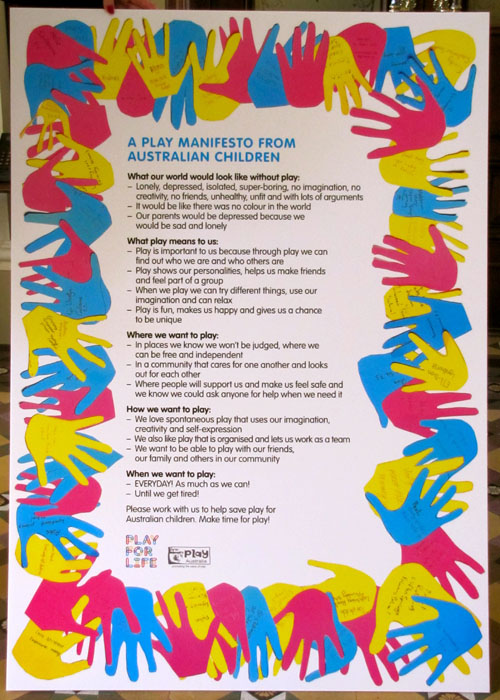
Australian Children’s Play Manifesto Poster

Play Based Learning in Australia is sharing a poster that captures the play manifesto of its children; how awesome!

After the overwhelming reaction to the success of the Australian Children’s Play Summit held in Melbourne on May 17th and 18th 2012 Play for Life Australia is kindly making available a copy of the Play Manifesto created BY Australian children FOR Australian children as a download. Play for Life believes that if we put the future of PLAY back into the hands of Australia’s children, then PLAY will be in very good hands!

Visit the original site for the full size poster.

anthropology · behavior · health · learning · mental health · psychology

I will be speaking on play this Friday, July 20, in Seattle at Parkour Visions

Me showing my serious anthropologist side.

Hi everyone. Just a little self-promotion, plus some promotion for a great organization:

I have been asked to speak this Friday, July 20, at 7:20 pm about play and parkour, at the 3rd annual Parkour Summit hosted by Parkour Visions in Seattle, WA.

As some of you know,  I received my MA in Anthropology this past winter, which focused on play and parkour. My play research has included studies of human-gorilla interaction at Woodland Park Zoo in Seattle, the primary physical play behaviors found in all primates (including traceurs), and how traceurs redefine and interact with space in new and creative ways.

Full disclosure, I have also been an advisory board member for the Pacific Northwest Parkour Association (the nonprofit behind Parkour Visions) since 2006, when it was having board meetings in my kitchen and I would feed all the board members banana coconut pancakes.

I have been asked by Parkour Visions to discuss my findings about parkour and play, why play is vitally important across the human lifespan for physical and mental health, what human play looks like, and how parkour reflects and answers the need for lifelong play.

There will also be lots of other great speakers talking about how movement plays into health in other ways than just strong muscles, including gut health, mental health, and long life, and ways to incorporate movement and play into ones lives. See a list of speakers here. The talks will be after a community dinner, so if you’re interested you can also bring $5 or a plate of something healthy (think fruit or meat) starting at 5pm, and mingle with the speakers before the talk.

The summit also includes an invitational competition of some of the best traceurs in the world, which is free to the public, on Saturday morning, so if you can’t come to the talk please come by and check out these amazing athletes. There are lots of other events taking place, so check out the itinerary and see if there’s something that sparks your interest.

I look forward to seeing you there!