I don’t normally promote my husband Rafe Kelley’s work with Evolve Move Play all that much, but this challenge is too good to pass up.
Starting on Arbor Day (but you can really start any time), Rafe is inviting people to climb a tree for 30 days, and tag their friends to climb three trees or donate to the Arbor Day Foundation, or plant a tree! Use the hashtag #treeclimb30 to tag your posts.
Rafe is doing this for many reasons, including…
Promote outdoor physical play and movement,
Foster a love of trees and the outdoors,
Get people playing in their local communities,
Remind people that it’s okay to climb trees, and
To have fun!
This is an international push, bringing in participants from Europe as well, including certified Evolve Move Play (EMP) coach Ben Medder, based just outside of London (UK).
He is also trying to motivate participating with prizes, so stay tuned to his channels for more details:
Preface to anyone who has children in a corporate-owned daycare that could be encompassed in the below description: I in no way mean to critique you or your child-rearing decisions, I am criticizing the system that has built up around these behemoth corporations that are more interested in making money rather than caring for kids.
In Washington State, small in-home day-cares are getting pushed out of business.
The push for large corporate, academics-based daycare and preschools in the U.S. to monopolize the industry and childhood development practices has gone too far!
My daycare provider this month had to bump up her prices 150% due to new regulations passed by legislators that were pushed through by big daycare corporations; supported with the sole intention of driving smaller in-home daycares like my provider’s out of business.
This kind of “pay to play” legislation is not only unethical, this particular one is supporting a system of large, low-personalization, academics-driven style of daycare that is not only inappropriate for children but downright HARMFUL to their development. Eight-month-olds do not need to be studying the alphabet! They need to be playing blocks with their friends and learning colors and counting through unstructured play time, not forced circle time and flash cards!
It is better for children to have smaller groups of kids to play together, with regular, consistent caretakers that can provide personal touch and unstructured play time.
This kind of system is also a HUGE burden on working parents. This kind of price increase – $100’s of dollars in my daycare’s case – is unmanageable for so many working families, and the high prices of childcare means that it pushes hundreds of thousands of well-educated, highly motivated parents out of the workforce during their prime working years. In-home daycares are also more flexible on hours and more understanding if a parent is 5 minutes late with pick-up.
This is also incredibly anti-small business; my daycare provider is strongly considering retirement after this last batch of legislation and required price increases, not to mention potential loss of revenue due to parents pulling their kids out of her daycare because they can’t afford it. I can only imagine other daycare providers are struggling with the same dilemma.
I support paying higher prices for higher quality child care, but this price increase is purely due to new legislations, fees, and bureaucracy that can be absorbed by larger corporations but not smaller businesses. I support safety and regulations of childcare, but not to the point where businesses are required to feed children only cow or soy milk (yes, that is a rule in Washington State).
If the government is really interested in creating a strong, resilient, competitive workforce, AND/OR is really interested in supporting small businesses, this is NOT the way to do it!
As soon as I figure out which congress person to write to I will do it and share it here! If there is specific regulations you are aware of that are impacting costs or food options, or even play time, please comment and post them below, so when we write our emails, postcards, or angry YouTube video rants we’ll know exactly which regulations to call out as unjust.
In the meantime, please give your daycare provider a hug, no matter who they are, and let them know we care.
After posting a blog about why I choose to play fight with my kids, I got a great response from parents and non-parents alike. What surprised me however was how many people – moms, uncles/aunts, non-kid affiliated adults – reached out to me and asked, “How do I even get started?”
It turns out a lot of people never play-fought as a kids…
They were told to never hit, never push, never poke.
Or they just never had a good example from their parents or older siblings or relatives.
Or as parents now, they have played with older kids but when they try to do the same thing with their little one she just cries and runs away.
That makes me so sad. There are so many benefits to play-fighting as a kid, and as a grown-up. Both my husband and I are huge advocates of physical play, including roughhousing. Play-fighting doesn’t have to be rough and tumble all the time either; there are some great games that involve the same elements as physical play but are more gentler on the body than traditional wrestling or punching games (pretending to be movable mannequins is one of my favorites).
Based on my research of studying physical play behaviors, and my own experience with my kids, not to mention observing my husband coach and facilitate grown-ups on how to play for the past 10+ years, here is what I’ve found to be good tips to get started:
Let the kids lead: Young animals of all species, including kids, are naturally the best players in the entire animal kingdom. It is how they learn about their world. So let them lead. You can come up with the game, but often times the kids already have a game in mind. Or, give them a gentle poke or push and see how they respond. Sometimes they might not be in the mood, but sometimes they will take your cue and run with it.
Anecdotally, I’ve noticed often girls will be done rough-playing sooner than boys or need more breaks, whereas little boys will often go and go until they start to cry, so don’t be surprised if either happens.
Match their strength…: When we see big dogs and little dogs play together, often the big dog will handicap themselves; they won’t push as hard, or they’ll get down on the ground so the little dog can actually reach them. Similarly, match your play partner’s strength. Push only has hard as they push, or hit only as hard as they hit.
…But show off yours too: Of course you can and should try doing lifts, carries, spins, gentle knock downs, and other things that require you to have more strength. That’s part of the fun of playing with someone bigger than you!
Let them win (sometimes): Similar to the dog play example above, if you want the game to keep going then make sure they’re having fun, which means letting them get a few punches in on you or knocking you down. (If you aren’t comfortable yet with falling down, think of this as a great way to practice slowly falling down in a safe way.) But that also means you get to win sometimes too; don’t be a punching bag, but it’s all about taking turns so you are both having fun.
Communicate: Check-in, see how they are doing. Ask if they want to switch up the game, or if you’re ready to switch it up or take a break, tell them. Which leads to…
Teach them no: The whole joy of play-fighting is the give and the take (have I said this enough times yet?). When it’s not fun anymore, both you AND your child get to say no, stop, time out, or I’m done. At any time. And, as the grown-up, you also need to be able to read your play-partner’s cues and tell when they’re not having a good time, even if they’re not specifically saying no.
Tickling is a great example. A lot of people see ticking as “harmless fun” and it’s tricky when a little kid is laughing and saying no at the same time, but it can be quite scary for a kid (or a grown-up) if they mean no and it isn’t respected. But, it’s also a great way to build trust with your play partner, whether they are a kid or a grown-up. Now, I HATE being tickled! HATE it! No tickles ever, thank you! Ever since I was little. My mom has stories of her trying to tickle me as a tiny baby, and even so much as putting her fingers out to say “coochie coochie coo” and I would just freak out! And she listened. So no tickles. As a grown-up I have not always had partners that understood that tickling is not fun for me, or when to stop tickling (as in immediately). But thanks to my mom I knew that I could choose to say no and that needed to be respected.
The same goes for tickling your kid; if they say stop, even if they’re laughing, stop. If they want more, they will ask for it (kids are good at that sort of thing).
And this can be expanded to all kinds of physical play; we need to learn how to listen to our bodies and our limits. If we get scared or frustrated, we need to learn to take a step back and regroup, and that we’re safe to do so. Physical play with a safe person like your parents is a great place to practice that.
Have fun!: In the end, that’s what this is all about. Sometimes you’re not in the mood to wrestle, and sometimes you are, or maybe you’ve got knee pain and can’t get on the ground, so just go with what feels right in the moment. Make up stories (“we’re bears, rawr!”), give yourself challenges (you can’t move from one spot; you can only use one arm), and just see what happens.
There are lots of different fun games you can try out with your kids and prompt you both to play more. Here is a great example of kid-led play fighting: https://www.youtube.com/watch?v=wqFJEQopKdY
I’d love to hear some of the games you have come up with with your little play partners, so share them in the comments below.
In some ways this seems like an overly obvious, unnecessary post. Of course parents play fight with their kids! Right? Yet I am surprised by how few MOMS play fight with their kids.
I do. And I love it! I didn’t think I would enjoy it as much as I do, but I do. Here are my top reasons why.
1. It teaches them body awareness – How hard do I have to push to make something happen? How strong am I before I get pushed over? How do I get myself back upright? How hard is too hard to hit? Also being aware of how strong they are now versus a month from now is important too as they grow and get bigger and stronger; I’ve known too many bigger little kids that don’t know their own strength.
2. It teaches them spatial awareness – How far away is that body I am playing with? Where are my legs and arms while I’m wrestling? Oops, now I’m upside down, how does that make me feel?
3. It makes them feel loved and given attention.
4. It’s fun! I’ll bet almost everyone at one time or another has played slug bug, tickle time, or wrestled with your sibling, or started a real fight with your sibling that by the end you two were both on the floor laughing.
5. They feel safe acting out being big and strong and knocking me down or punching me and knowing that I can take it.
6. Kids who play fight with their dads are being shown that men are big and strong. For somewhat feminist but mostly totally selfish reasons, I want them to know that women (i.e. ME!) can be big, strong, and tough too.
7. Along those same lines, grown-ups who play fight with kids are demonstrating that when people play or play fight, they are being respectful of each other’s boundaries, and if you don’t feel safe you can and should ask the other person to stop. If the other person doesn’t respect your boundaries then kids learn that’s not okay and they get time out or kids or grown-ups stop playing with them. This is a super-critical skill that is missing in so much rhetoric, both physical and verbal, in our society today.
8. As their mom, it is so fun to watch my kids get stronger, faster, more coordinated, and more creative in their physical play. They mix strategies, including saying silly things to catch me off guard, which is all part of the art of play.
9. Finally, I want to promote physical play of all kinds with kids and grown-ups alike. Whether that’s boxing, hiking, jump rope, tricycles, making forts, tree-climbing, or just going for an exploratory walk around the neighborhood, I support it.
I’m sure there are other reasons I’m forgetting, but those are my main ones.
My husband teaches natural movement classes, and before that parkour and martial arts. Slowly more women are joining the adult classes in all of those fields. But especially in the kids’ classes, the moms are just as likely to join their kids, but almost none participate given the opportunity. Why?! Some women (and men) don’t like physical contact activities. And that’s totally fine. But more often than not women are intimidated. I say no more fear! Get in there and push someone.
Why do you play fight with your kids? Or why don’t you? Leave your thoughts in the comments below.
UPDATE: I wrote a follow-up post about safe ways to roughhouse with your children that you can find here.
I heard an interesting story on NPR today: the increase in doll therapy for patients with dementia:
Guzofsky, who has Alzheimer’s disease [pictured above], lives on a secure memory floor at a home for seniors in Beverly Hills, Calif. She visits the dolls in the home’s pretend nursery nearly every day. Sometimes Guzofsky changes their clothes or lays them down for a nap. One morning in August, she sings to them: “You are my sunshine, my only sunshine. You make me happy when skies are gray.”
No one knows whether she believes she is holding a doll or a real baby. What the staff at Sunrise Senior Living do know is that Guzofsky, who can get agitated and aggressive, is always calm when caring for the dolls.
Doll therapy is catching on at nursing homes and other senior facilities across the country. It’s used to help ease anxiety among residents with dementia, who can experience personality changes, agitation and aggression. But the therapy is controversial.
Supporters say the dolls can lessen distress, improve communication and reduce the need for psychotropic medication. Critics say the dolls are demeaning and infantilize seniors.
I understand the concern that critics may find this kind of treatment demeaning to seniors who now need care to do basic everyday tasks.
However, let’s think of this as something else: Play Therapy.
It’s true that it can be hard to tell if the patients realize this is a toy doll or real baby. However this could potentially be very similar to a child’s imaginary play with dolls or an imaginary friend: kids know it’s pretend, but also get very invested in their pretend world, taking care of their babies, feeding them, changing them, snuggling them for comfort.
I also agree that the positive results – reduced stress, increased verbalization, and more – without the use of medication, make it worth more exploration rather than outright rejection because of its use of toys and play. Maybe the nay-sayers should give it a try.
Staring out the window is often associated with a lack of attention or productivity, but in this film from The School of Life, we examine the activity (or lack of activity) as a highly productive pursuit that we might rarely make time for anymore: Discovering the contents of our own minds.
According to blogger Hansi Johnson, it used to mean someone who likes going outdoors. But now, Hansi argues, the outdoors have become elitist to the point of making it seem inaccessible to most.
I’ve observed how the outdoor industry and the media have portrayed getting outside for nearly my entire life, and what used to be a very “volkssport,” inclusive, hippy-like identity has transformed into a super-elitist and entitled one. The destinations presented in the media are generally so unattainable by most people that they might as well be on the moon–and don’t even bother going if you’re not wearing expensive, high-tech apparel and using modern, high-priced gear.
Why does this matter? Because the majority of people in both the developed and developing world already feel like they don’t have time, energy, or resources to “go outside” and get exposure to nature, whether that’s to hike, bike, or just have a picnic. Creating this illusion of exclusivity is bad for everyone. Feeling like you don’t belong – of all places – in NATURE is frankly inhumane. Research has demonstrated over and over how our bodies and brains NEED nature and natural environments.
Get outside, hug a tree, pick a flower, fall into some snow, stomp in puddles.
A week ago I got to participate in a 7-day movement experience. Not a fitness camp or sports camp, or dance seminar or MMA workshop. Instead it was a collective gathering of 30 individuals with multiple movement backgrounds coming together to train, learn, and collaborate on understanding movement and how to push our bodies in a healthy way.
This event was designed for professional movers – dancers, fighters, clowns, capoeiristas, tree climbers, traceurs, and more. But what I took away from this experience as essentially a non-mover with a 9-5 desk job was just how accessible movement really is for all of us. How it does not have to be a scary, grueling, sweaty, or complicated thing. It does not have to break your body, but instead can heal it. Movement is innately fun and enjoyable for humans, yet somehow we have forgotten that.
This week-long workshop brought together coaches from all movement backgrounds who had all come across the same question: why wasn’t their practice fun anymore? Why did they feel constrained, injured, or simply broken? All of them had gone on different journeys but had all come to the same conclusions of using movement as joy, as exploration, as celebration, as a way to communicate with others and the world.
Out in the hills of western Massachusetts, near the Deer Hill State Reservation, Kelly Bitov, Aaron Cantor, and Jared Williams organized the M.O.B.I. Camp – Movement Orientation and Body Intelligence.
In addition to Aaron Cantor, the coaches there included my husband Rafe Kelley, founder of Evolve Move Play; Shira Yaziv, owner of Athletic Playground; Nuria Bowart, and Tom Weksler. That said, almost everyone there were expert movers, dancers, musicians, and players, with some movement background and area of expertise.
This was truly a bit of an expedition into the unknown for me, not just in the location but what a non-mover like me would and could do.
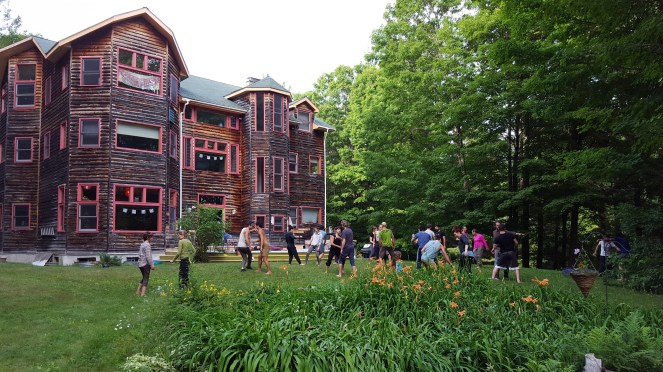
Single-handing it with two toddlers, car seats in tow, we flew from Seattle, through Boston Logan Airport, and thanks to a generous M.O.B.I. Camp participant carpooling us 2.5 hours west, we arrived in the peaceful quiet of Nine Mountain Retreats.
For seven days we and about 30 other people made food as a community, explored movement as a community, and slept under one roof or nearby in tents.
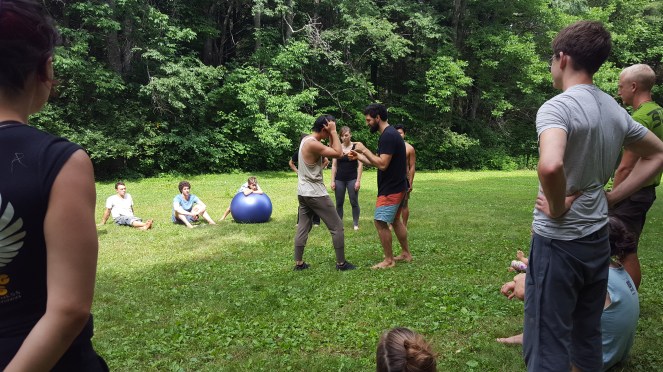
We would meet every morning at 8am on the deck and start moving, mostly outside, and basically not stop until bed. There were breaks in between workshops, but there was always some movement challenge or game to try in between class, helping with meals and clean-up, re-filling the water cooler, or in my case chasing the kids around, and chasing or carrying them up and down two flights of stairs.
The one core element that I noticed about the entire week was how every single teacher, regardless of their background or emphasis, had one underlying criteria to their movement: PLAY!
Tom Weksler and Mayumu Minakawa having fun in trees.
Each one of them had the same overarching instructions: Explore! Try this! Be open to new experiences! Don’t worry about looking wrong or silly, as long as your intention is real. We are all here doing this single practice together and trying new things together. Exploration is scary but necessary.
All of these teachers shared a similar story of evolution – they had trained deeply in one or two or more systems, and found each lacking, either missing something they craved or disallowing things for seemingly arbitrary reasons or worse breaking down their bodies and feeling worse after doing a movement practice that was supposed to make them feel better.
So often physical training and movement has been focused on goals – lift this much weight, run this fast, point your toes just so. By stripping all of that away – helped in large part by stripping away the gym or classroom and just being outside – people were invited to try new things, explore new paths, and mostly just remember that movement is supposed to be fun and enjoyable and a celebration of what our bodies can do.
For me, someone who is very goal oriented or achievement oriented, it can be hard to let go of that and just be a novice, especially when I am the “only” novice, surrounded by professional movers. There was even a time mid-week where I cried myself to sleep because I caught a glimpse of myself in a video looking totally awkward. BUT, I came back to class the next day, and for the first time I noticed other professional movers looking or feeling awkward in new types of movement they had never tried before. But they did it anyway! So I did it anyway. And we all felt better after the class for moving, for learning, and for getting outside and feeling the fresh air.
I honestly was nervous about having the kids there, as I didn’t want to interrupt the classes with my kids’ screaming and yelling and chasing balls and asking questions about trees. But in some ways their movement practice was just as genuine and valuable as what the coaches were teaching. I also heard feedback from some that having the kids there was also helpful to get out of their usual headspace and remind them to play and not take the whole process so seriously.
My 3.5-year-old daughter became an honorary member of the group, with lots of adults chatting with her and wanting to dance and play with her. She and her 1.5-year-old brother also benefited from this experience immensely; my daughter only watched a few classes, and participated even less, but just by being around all of these movers and watching the adults play both kids absorbed all of this training and movement and acceptance of physical play like sponges.
I caught them moving, jumping, dancing, and playing more than even at home; they also tried new tools like using the foam rollers and other apparatus people had brought with them, either copying what the grown-ups did or discovering other uses for them.
For me, the biggest take-away was just being accepting of where I am, not following a “system” or specific “method” but using these and thinking of these as tools. Taking what works and playing with them. Being inspired by the art of the possible, by the coaches and the students. That was the most amazing aspect of the week for me.
I sincerely hope they have another event next year. And I hope that other “non-movers” like me will give themselves a chance to go explore their own movement practices, and frankly to just go out and play and rediscover the joy of moving our bodies, no matter what silly, goofy, or wrong shape it makes.
Obviously there is a lot that goes into a “good” job – coworkers, supportive managers, and work you believe in. But there is also a surprising amount you can do within your own environment and office surroundings that will make your day-to-day grind better.
Here are a few compiled by Mashable (P.S.: Manatees are awesome!):
Beautify your work space. You personalize your home; why not personalize your desk? Make your cube or office a pleasant place to work with a few framed photos, a decorative pen holder or a tiny cactus. Image: Mashable/Vicky Leta
Fall is finally upon us here in the Pacific Northwest. I’m not going to deny it anymore. But even as the weather gets cooler, my family and I are still finding ways to get outside and play.
I have always loved playing outside, climbing on rocks, trees, hiking, and splashing in puddles, and really want to pass this love of nature and outdoor movement on to my kids. It is so great to see other parents encourage their kids, and other grown-ups, to discover and recover their biophilia and love of playing outdoors.
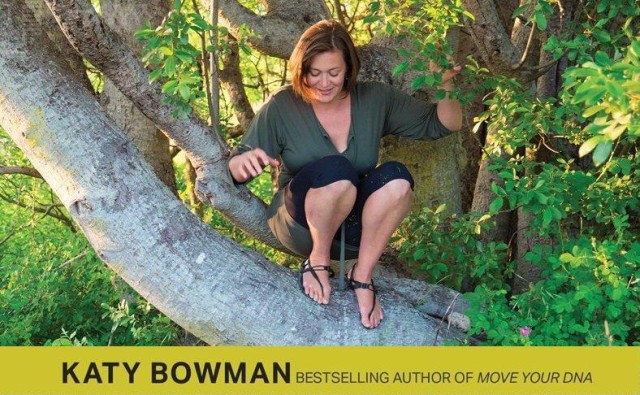
One of the best outdoor play advocates I have met in a long time is Katy Bowman, although for her, moving and exploring the outdoors is simply behaving like a normal human.
Katy Bowman doing her thing
Katy is a biomechanist with a deservedly large following of movement practitioners using her Restorative Exercise program. Katy is a huge advocate of natural movement and getting outside as much as possible, and encourages it with her kids as well. Katy talks about their experience in their outdoor “nature” preschool on her blog and podcast, but the enriching environments she has set up for her kids at home is in a class by itself.
Katy graciously invited my family out to her house outside of a small town on the Olympic Peninsula earlier this summer.
When we pull up to her house, the front yard looks fairly typical for any house containing small children; a few toys are strewn around the yard, slightly hidden by the uncut grass. Her husband and children have just headed off down the road for a walk. She helps us unload our brood out of the car after the long drive and immediately invites my daughter to explore, with me in tow.
We step out of the house into the backyard, and it is perfect.
My three-year-old daughter’s eyes light up like she’s hit the motherlode.
The lawn is littered with toys – costumes, stuffed animals, balls, a Little Tyke’s scooter car. There is a big basket of LEGOs sitting on the porch waiting to be dumped over and played with.
There are also complex toys laid out intentionally by Katy and her husband Michael for her kids to play with. A tippy rope ladder strung between two trees with a foam mat underneath; ladders laid on the ground for balancing, a jungle gym, a circle swing, large wooden ramps placed strategically up to table tops. The cherry tree is also filled with cherries, for good measure.
The kids have gotten creative with some of their building materials, including taking a couple of blocks from the flower box and made a corral for their plastic farm animals. They have also left little illustrations stealthily added around inside the house: on the wooden bed frame, the balance ball in Katy’s office, and on a couple of door frames.
And that’s before we even meet the chickens or go down to the Dungeness River to throw rocks, wade, climb, and make structures in the sand.
It is obvious the kids have the run of the house, and its affect is wonderful.
Katy has created a practice based on her high level training in biomechanics and years of teaching experience centered on creating a healthy, mobile human being, and this practice is reflected in how she and Michael have set up their home environment. Every space is open for movement, jump, climb, and play. There are edges and imperfectly balanced steps and slight risks everywhere. The kids must learn to navigate their environment safely, and have a blast doing it.
Katy often talks about getting her kids outside and exposed to new, playful challenges. And yet, when I ask her about it, she almost baulks at the idea she is supporting a primarily “playful” environment. For her, this is simply survival, teaching her little humans how to be human. She is merely creating and supporting healthy behaviors, what kids and grownups should be doing all the time.
They let their children go slow, at their pace. Their kids learn by doing, by experiencing. As do we all, really. It’s true that, thanks to the visit, I now have more confidence in being able to ford a fast-moving stream carrying my toddler. And it wasn’t part of a survival training camp or an emergency. It was part of our Sunday family outing. It may sound small or frivolous or “not necessary,” but for the survival of our species, that skill is a big deal.
To me, this kind of activity is not just good for restoring our body and capability to move, it is also restorative to our psyches and filling that need to explore and play at our own pace and learn in a playful way.
Finally my family has to head home. We take the time to let our kids say good night to the chickens before we load back into our car, driving away with the sunset on our backs. After getting to see and play in Katy’s backyard, both the grown-ups and the kids in our family feel renewed, replenished, and ready to play and explore our own backyard and our home environment in a new way.
I highly recommend digging in to Katy’s materials. She has some great ideas and thoughts around leading a healthy, restorative, and in my mind playful movement practice, whether it’s in nature or just in your own backyard.






 Mental Flowers