behavior · community · culture · environment · happiness · health · mental health · Nature

Scientists have discovered that living near trees is good for your health – The Washington Post

While it may be better for you to take a walk in the woods than on an urban block, living near trees, even in an urban environment, has been found repeatedly to improve people’s health, even making them feel younger.

In a new paper published Thursday, a team of researchers present a compelling case for why urban neighborhoods filled with trees are better for your physical health. The research appeared in the open access journal Scientific Reports.

The large study builds on a body of prior research showing the cognitive and psychological benefits of nature scenery — but also goes farther in actually beginning to quantify just how much an addition of trees in a neighborhood enhances health outcomes. The researchers, led by psychologist Omid Kardan of the University of Chicago, were able to do so because they were working with a vast dataset of public, urban trees kept by the city of Toronto — some 530,000 of them, categorized by species, location, and tree diameter — supplemented by satellite measurements of non-public green space (for instance, trees in a person’s back yard).

They also had the health records for over 30,000 Toronto residents, reporting not only individual self-perceptions of health but also heart conditions, prevalence of cancer, diabetes, mental health problems and much more.

more via Scientists have discovered that living near trees is good for your health – The Washington Post.

I live in a fairly verdant neighborhood in a very green city, and this report still makes me want to go out and plant some more trees!

community · design · environment · happiness · health · Nature

Green Spaces In Cities Help Close “Well-Being Gaps” Between Rich And Poor | Co.Exist

It’s a morning of enriching spaces! I am so thrilled to see this work come out as part of the advocacy for green spaces for all!

Do Green Spaces In Cities Help Close "Well-Being Gaps" Between Rich And Poor? | Co.Exist | ideas + impact

Can neighborhood green spaces help close the gaps in health between people of different incomes and backgrounds?

That’s the tantalizing proposition of research by Rich Mitchell, a professor at the University of Glasgow, and colleagues. They suggest that green places are not only good for our health and well-being, but could also play an equalizing role in our cities.

Where you live can have a huge bearing on how healthy you’re likely to be. And, sometimes the gaps open up over just a few miles. A few subway stops in New York, for example, could mean up to nine years difference in how long someone might live.

Mitchell’s research, while still at a relatively early stage, suggests green-space might serve to reduce these gaps.

The research doesn’t prove the strength of the relationship between individual neighborhood services and well-being, but does show that well-being gaps are smaller where services are better, Mitchell notes in an email. Research he’s conducting now, which hasn’t been published, does show green spaces having the strongest bearing on well-being differences.

more via Do Green Spaces In Cities Help Close “Well-Being Gaps” Between Rich And Poor? | Co.Exist | ideas + impact.

behavior · creativity · culture · environment · happiness · play

This Public Bench Turns Into A Merry-Go-Round To Connect Strangers On The Street | Co.Exist | ideas + impact

Super cool (sorry it’s been awhile).

Sitting on a bench at a bus stop or in the park, most people tend to focus on their smartphones or a book rather than whoever’s sitting next to them. But a new bench is designed to instantly connect strangers in a moment of play: When you sit down, the bench transforms into a makeshift merry-go-round.

more at via This Public Bench Turns Into A Merry-Go-Round To Connect Strangers On The Street | Co.Exist | ideas + impact.

community · culture · environment · happiness

Seattle Department of Transportation: Seattle Parklet Program & Streatery Pilot Program

Way to go Seattle!

After a successful year-and-a-half long pilot, we’re excited to announce that the Parklet Program is now a permanent program! This means that Seattle businesses and community groups have even more opportunities to enhance our streets with public spaces.

As part of this launch, we’re also rolling out a brand-new approach to activating our streets: the Streateries Pilot Program. What’s a “streatery” you ask? Streateries combine the best features of a parklet and a sidewalk café by allowing a restaurant, café, or bar to use a parking space to create outdoor seating for their customers during business hours (like a café) and for the public during non-business hours (like a parklet).

there is still time to sign up your company if you’re interested via Seattle Department of Transportation: Seattle Parklet Program & Streatery Pilot Program.

I look forward to seeing lots of little Parklets spring up around the city as we start to emerge from the winter wet and dark.

anthropology · behavior · community · culture · environment · happiness · health

Los Angeles has Cancer — Stephen Corwin on Medium

This is a scathing opinion piece looking at the negative influences of space and place, specifically cars and car culture. Corwin argues passionately against the takeover of cars in to the city space and how it is anything BUT enriching. It is full of examples of what NOT to do, and therefore offers suggestions on how to solve it.

Our experiences driving cars in this city are, for the most part, fleeting. We drive somewhere, we get out of the car, we close the door, and we walk away. But to think that we can escape the world that cars have created as easily as we escape the car itself is foolish. In fact, when we leave our cars, we walk into that world. We have to live in that putrid mess.

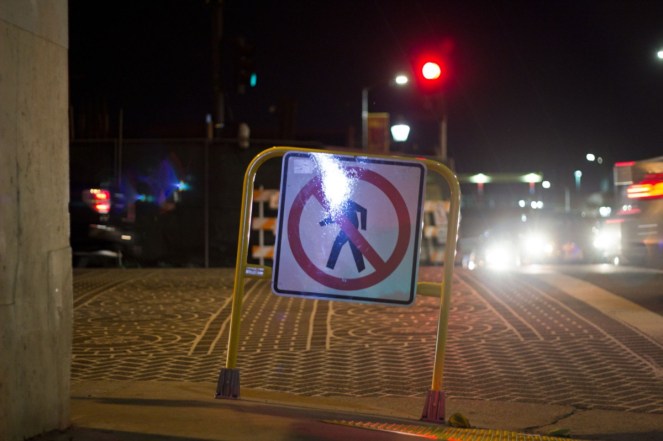
Let’s talk about how Los Angeles is a city where construction projects can fence off whole blocks, including the sidewalks, without offering people on foot an alternative. Let’s talk about how when that happens, no one even considers converting one of the two car lanes into a temporary sidewalk, because dear god, that might cause slight inconvenience to people in cars. And let’s talk about how ironic it is that inconveniencing people in cars is the end of the world, but doing the same to people on foot is a non-issue. Then let’s talk about how when frustrated walkers decide to use the car lane rather than take the ridiculous detour, the city’s totally acceptable solution to that problem is not to concede space to those people, but rather to bolt permanent, metal signs into the middle of the sidewalk to keep them from doing so. That is cancer.

read the whole thing via Los Angeles has Cancer — Medium.

It is worth a read.

creativity · design · environment · happiness · health · play

15 Artists Collaborate To Make London Children’s Hospital Cozier For Kids | Bored Panda

Last year I had a stay at a local hospital. I and the people who came to visit me all found the place hard to navigate (we all got lost more than once), and I found parts of it unfriendly and slightly claustrophobic, and not very warming or healing. They had some nondescript pictures on the walls, and that was the only way I could find to navigate my way out of the maze of white and linoleum.

It doesn’t have to be this way.

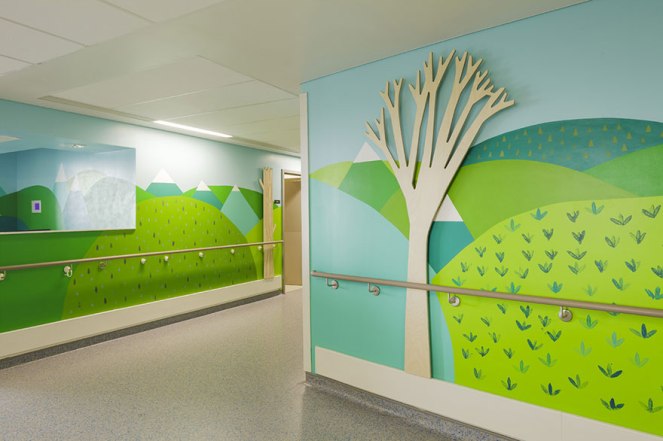
The sights, sounds and smells of a hospital can make it a terrifying place, especially for children, but it doesn’t have to be that way. Vital Arts, a British arts organization in charge of introducing art to Britain’s hospitals, had 15 artists collaborate to turn the interior of London Royal Children’s Hospital into as fun and colorful a place as a hospital can be.

Despite being limited by the fact that hospital environments need to be easy to clean, the artists were still able to use vinyl, ceramics, wood and even rugs to liven up these hospitals, each approaching the wards they decorated with their own unique style.

via 15 Artists Collaborate To Make London Children’s Hospital Cozier For Kids | Bored Panda.

The author Dovas comments that they wish it wasn’t just for kids. It really can be for everyone. Even something as simple as bright colors can be helpful in orienting patients and helping them feel better.

The nurses who helped me all commented about needing to get outside and get away from the sterile white. I think the curtain example illustrates the value of this beautifully:

“A seminal moment for me was when a three-year-old girl stopped crying the moment she saw the curtains, pointing excitedly to the hidden cats and rabbits. That’s when I knew my design had worked”

It is possible to have art and playfulness in sterile hospitals, as part of the healing process. Plus adding some joviality, like staying in the “monkey room” can make a somewhat painful situation seem less heavy.

Maintenance on some of these installations and art pieces may be higher, but if it leads to faster recovery and shorter hospitals stays, which this kind of enrichment has been found to do, then it is a worthy investment.

behavior · community · happiness · hugs · play · Social

McDonald’s will be accepting hugs, calls to mom, and dance moves as payment

OK, so YES it is being sponsored by a huge megacorporation. YES it is a total gimmick. But it is such a COOL gimmick.

“That will be five hugs, please.”

Randomly selected McDonald’s customers will have the opportunity to pay for their meals with various tasks — such as doing a dance or calling their mom — between Feb. 2 and Feb. 14. The deal is outlined in a Super Bowl ad from the company, above, which will air on Sunday but is already posted on its YouTube page.

So, for example, breakfast might cost a fist bump to a McDonald’s crew member; lunch could be paid for with a call to a loved one; and dinner could go for a hug to a family member. But there will only be 100 winners at each store.

https://www.youtube.com/watch?v=HCmh8cBjUeM

more via McDonald’s will be accepting hugs and dance moves as payment. (Mashable)

Last week I also posted about a major paint company that promoted their paint via enabling the handicapped in China to blow up paint balloons onto a canvas.

While to some it may feel “icky” to have mega-sized companies counting this kind of self-congratulating promotion as “spreading the love” or even “charity work,” frankly I am just happy that anyone, either an individual or a giant corporation, is taking steps to making their spaces a little bit happier and more enriching. Companies spend millions of dollars to make their customers happy, so why not spend a little bit of that on a smile?

When has a corporation made your day better, either through a promotion or just because an employee took some time to acknowledge you? Leave it in the comments below.

behavior · culture · design · emotion · happiness · technology

Daniele Quercia’s Happy maps and happier travelling

Can you map your happiness?

Mapping apps help us find the fastest route to where we’re going. But what if we’d rather wander? Researcher Daniele Quercia demos “happy maps” that take into account not only the route you want to take, but how you want to feel along the way.

watch via Daniele Quercia: Happy maps | Talk Video | TED.com.

Coincidentally, another researcher is also working on this problem, and creating maps that find the most relaxing routes based on people’s brainwaves:

MIT Media Lab’s Arlene Ducao is hoping to shed some light on which biking routes promise a more relaxing ride with her Mindreader Map. The project is a continuation of Ducao’s 2012 experiments involving a mind-controlled bicycle helmet that flashes different colors depending on the stress levels of the rider.

Using this type of data city planners could conceivably better plan bike lanes and traffic signals with an understanding of where the most stressful, and potentially dangerous, areas for cyclists are.

Have you changed your commute to be less stressful, even if it means a little longer ride or drive to work? Talk about it in the comments below.

creativity · design · happiness · health · mental health · technology · youtube

Cool Technology Allows Disabled People To Create Incredible Art With Their Minds

Art has the power to soothe, to heal, to empower, to raise awareness and to move people to action. Using technology to enable people to express themselves through art is great, whether it’s for a cause, or a brand in this case.

To raise awareness for their brand, an art supply company created this viral campaign featuring real people using technology to create beautiful abstract art. Sixteen disabled individuals in China (home to the world’s largest disabled population) were invited to participate in the project, which involved using advanced brainwave scanning technology in conjunction with detonator-equipped, paint-filled balloons. The video seems to show that by concentrating really hard, the participants were able to trigger the colorful explosions, resulting in some very unique pieces.

more via Cool Technology Allows Disabled People To Create Incredible Art With Their Minds.

behavior · community · happiness · music · youtube

The Gift of Music In A Nursing Home. – LittleThings.com

Give a little kindness and playfulness in an otherwise stale, quiet, and sometimes depressing space, and see how far it goes!

The Piano Guys is a group of amazingly talented musicians, who are all about putting on a spectacular show and as you’ll see in this video, it was way better than any of the old timers ever expected. The group showed up at Stirling Court in St. George, Utah and surprised the residents with a truly incredible Charlie Brown medley.

As you’ll see, the senior citizens were delighted by the classic “Peanuts” tune on piano and couldn’t stop moving their feet. This video is undeniable proof that music is good for the soul. Just look at how the performance lifted their spirits!

video via She Heard Music In The Nursing Home. Her Reaction? HEART MELTING!! – LittleThings.com.