anthropology · behavior · brain · community · happiness · health · mental health · psychology

Life Lessons Passed On

English: Elderly Muslim during the Republic of...

I was really inspired by that blog post I shared a couple of months ago about cancer survivors and what they’d learned about life. I also posted a survey done with older folks last year giving advice on what NOT to do.

Well, thankfully all of that hard-earned knowledge is coming out in book form. Many of the interviews can also be at legacyproject.human.cornell.edu. From the NYTimes:

Eventually, most of us learn valuable lessons about how to conduct a successful and satisfying life. But for far too many people, the learning comes too late to help them avoid painful mistakes and decades of wasted time and effort…

Enter an invaluable source of help, if anyone is willing to listen while there is still time to take corrective action. It is a new book called “30 Lessons for Living” (Hudson Street Press) that offers practical advice from more than 1,000 older Americans from different economic, educational and occupational strata who were interviewed as part of the ongoing Cornell Legacy Project.

Its author, Karl Pillemer, a professor of human development at the College of Human Ecology at Cornell and a gerontologist at the Weill Cornell Medical College, calls his subjects “the experts,” and their advice is based on what they did right and wrong in their long lives.

You can also read a summary of their advice in the article: Advice From Life’s Graying Edge on Finishing With No Regrets

What are your life lessons?

behavior · community · culture · environment · happiness · psychology

The Psychological Importance of Home

English: Clayton H. Delano House, Ticonderoga,...
Our sense of place, and particularly our home, can be very intricately woven into our identities. Image via Wikipedia

As the weekend, approaches, many of us are making plans to go out to events in our local cities, or work around the house, or just sleep in our own beds after several weeks of visiting and traveling. The psychology of home is very important to us humans, and was captured really well in an article by Julie Beck in The Atlantic:

Susan Clayton, an environmental psychologist at the College of Wooster, says that for many people, their home is part of their self-definition, which is why we do things like decorate our houses and take care of our lawns. These large patches of vegetation serve little real purpose, but they are part of a public face people put on, displaying their home as an extension of themselves. It’s hardly rare, though, in our mobile modern society, to accumulate several different homes over the course of a lifetime. So how does that affect our conception of ourselves?

When you visit a place you used to live, these cues can cause you to revert back to the person you were when you lived there.

For better or worse, the place where we grew up usually retains an iconic status, Clayton says. But while it’s human nature to want to have a place to belong, we also want to be special, and defining yourself as someone who once lived somewhere more interesting than the suburbs of Michigan is one way to do that. “You might choose to identify as a person who used to live somewhere else, because it makes you distinctive,” Clayton says. I know full well that living in Paris for three months doesn’t make me a Parisian, but that doesn’t mean there’s not an Eiffel Tower on my shower curtain anyway.

We may use our homes to help distinguish ourselves, but the dominant Western viewpoint is that regardless of location, the individual remains unchanged. It wasn’t until I stumbled across the following notion, mentioned in passing in a book about a Hindu pilgrimage by William S. Sax, that I began to question that idea: “People and the places where they reside are engaged in a continuing set of exchanges; they have determinate, mutual effects upon each other because they are part of a single, interactive system.”

Read the full article here.

I definitely feel like I have a connection and identify with every place that I’ve lived, although some have felt more like home and have shaped me more than others. A lot of that has been due to how safe or at peace I feel in a place, and how much I have bonded with the people around me.

I also think one thing that was so traumatic about the housing bubble was that sense of losing your home. Not just a piece of property you owned, but this landmark of who you were, the space where you kept all of your memories and built new ones, your safe house, literally.

What is your experience with home? What makes a place “home” for you?

behavior · community · creativity · happiness · youtube

Slide into 2012

Happy New Year. One more great campaign from Volkswagen about having fun in your life and finding fun in the space that surrounds you:

behavior · community · emotion · happiness · play · youtube

Laughter infects Berlin Train – the power of others and place

People often wonder just how powerful the people and spaces around us can be. Well, it turns out they can be pretty dang powerful! Just check out the video. Thanks Guy Kawasaki for sharing this out:

Giggles spread through an U-Bahn train in Berlin after one woman starts laughing. Happiness: the best infectious thing you can catch on a train.


brain · happiness · mental health · music

Treating the Whole Patient

Icon from Nuvola icon theme for KDE 3.x.
Treating the whole patient, including mind and body, is becoming "cool" again. Image via Wikipedia

The faculty at University of Washington is pretty progressive in a lot of its research surrounding neuroscience and the mind, especially when it comes to Mental Health Care:

Researchers and professors at the UW, such as Dr. Jürgen Unützer, are driving innovative ways to improve access to high quality mental health care delivered in a manner that treats the whole person. Their efforts are focused on health care models that integrate behavioral health services into the primary care clinic and other heath care arenas, where the patients already receive care and have established provider relationships. Known as collaborative or integrated care, these models put the patient at the center of a health team – including their physician, a care coordinator and a psychiatric consultant – that collaborates on a patient’s treatment plan.

Unützer says he knew his research into new models of mental heath care delivery was on the right track when a patient described feeling like a tennis ball. This patient had a combination of health problems associated with diabetes along with alcohol problems and depression. As is common in the current health care system, the patient was being bounced around to different specialists to treat his individual symptoms. Dr. Unützer was concerned that patients like this, with a combination of behavioral health and medical conditions, were falling through the cracks and not receiving care that treats the whole person.

“The patient expects that the various providers are all talking to each other, but that is often not the case,” he says. “Who’s connecting the dots? Patients expect their care providers to sync up and know what’s going on with all of their conditions.”

More at UW Professional & Continuing Education.

behavior · design · happiness

Designing for solitude

Sometimes we need to be alone. But it can be hard in an urban environment. How do we design a space to provide a quiet place to re-center ourselves, or just hear a phone call.

From IxDA, designing for solitude:

We live in a world where our ability to be connected and constantly available has changed in a remarkably short period of time, with profound effects on our behaviour. As designers, we are often asked to reflect this always-on state in the products, software and services we help to create.

Because of this, finding solitude – our ability to switch off and contemplate – is becoming more difficult. What are the affects of this on us and our relationships with each other? Is it important for our creativity to detach ourselves from the world around us? And what might the products and services we design for an off state look like?


behavior · brain · emotion · happiness · mental health

How being grateful for the little things makes a big difference

The First Thanksgiving, painted by Jean Leon G...
Being thankful for the little everyday things, like just being able to eat, is better for you psychologically over the long haul. Image via Wikipedia

I received this newsletter post from financial advice blog LearnVest. It provided some interesting insight into another reason why practicing how to be grateful in itty-bitty ways (see my earlier post) is actually better for you in the long run.

Lately, I’ve been thinking a lot about gratefulness and what really makes us happy. This has been a truly happy year for me personally—the LearnVest audience has grown 310%, our company is celebrating its two-year anniversary, our team has tripled in size, and, to top it all off, I got engaged last month to the best guy I know.

All of this has reminded me of the “happiness lab” I worked at back in college, where I witnessed one psych study that changed my life:

When given the hypothetical choice between lots of big wins in a short amount of time (like all of your dreams coming true in a week) and one consistent thing they already liked, guaranteed forever (like a warm cup of coffee every morning), most people chose the big wins: a bigger house, a fancy car, a promotion, winning the lottery.

But the lab’s researchers found that the coffee-every-day-forever approach really makes people happier when push comes to shove. Why?

We say we want a bigger house, but then we have to maintain it. We say we want a promotion, but it comes with more stress and longer hours. Meanwhile, one reliable, comforting constant in our lives—like a soothing cup of coffee every day—can make us feel great. In general, the big things we strive for don’t necessarily make us happier.

This study proves scientifically what many of us have always known: Money can’t buy happiness.

This Thanksgiving, I encourage you to think about what really makes you happy. Is it writing? Taking pictures? Giving back to the community? I have a feeling you’ll find that many of the best things in your life don’t cost a thing, or are well within your reach right now.

I hope you can find the laughter and the joy in every situation. May this year and every year bring you a lot to be thankful for.

Toward a richer life,

Follow @alexavontobel

behavior · emotion · family · happiness · mental health

Steps to ease into being grateful, and how it benefits you psychologically

"The most psychologically correct holiday of the year is upon us." according to the New York Times article, A Serving of Gratitude May Save the Day.

Cultivating an “attitude of gratitude” has been linked to better health, sounder sleep, less anxiety and depression, higher long-term satisfaction with life and kinder behavior toward others, including romantic partners. A new study shows that feeling grateful makes people less likely to turn aggressive when provoked, which helps explain why so many brothers-in-law survive Thanksgiving without serious injury.

But say you’re not in the habit of giving thanks. After all, we’re only asked to officially do it once or twice a year. Well, there are some pointers in the article to get you going:

Start with “gratitude lite.” – start out with writing just five things, and maybe a sentence or two about why you’re appreciative of them.

Don’t confuse gratitude with indebtedness
– you don’t need to owe anybody anything to be grateful for them.

Try it on your family
– even if they are horribly dysfunctional, you can still be grateful they passed the peas without throwing you a dirty look.

Don’t counterattack
– okay, so maybe they did throw you a dirty look. By being grateful to them anyway, it puts individuals off guard and makes them more likely to be kinder in the future, according to some studies.

Share the feeling – … “More than other emotion, gratitude is the emotion of friendship,” Dr. McCullough says. “It is part of a psychological system that causes people to raise their estimates of how much value they hold in the eyes of another person. Gratitude is what happens when someone does something that causes you to realize that you matter more to that person than you thought you did.”

Try a gratitude visit.This exercise, recommended by Martin Seligman of the University of Pennsylvania, begins with writing a 300-word letter to someone who changed your life for the better. Be specific about what the person did and how it affected you. Deliver it in person, preferably without telling the person in advance what the visit is about. When you get there, read the whole thing slowly to your benefactor. “You will be happier and less depressed one month from now,” Dr. Seligman guarantees in his book “Flourish.”

Contemplate a higher power. Religious individuals don’t necessarily act with more gratitude in a specific situation, but thinking about religion can cause people to feel and act more gratefully, as demonstrated in experiments by Jo-Ann Tsang and colleagues at Baylor University. Other research shows that praying can increase gratitude.

Go for deep gratitude. Once you’ve learned to count your blessings, Dr. Emmons says, you can think bigger…

And if that seems too daunting, you can least tell yourself —

Hey, it could always be worse. When your relatives force you to look at photos on their phones, be thankful they no longer have access to a slide projector. When your aunt expounds on politics, rejoice inwardly that she does not hold elected office. Instead of focusing on the dry, tasteless turkey on your plate, be grateful the six-hour roasting process killed any toxic bacteria.

Happy Thanksgiving!

anthropology · behavior · community · happiness · hugs · psychology · Social

For those days you really need a hug

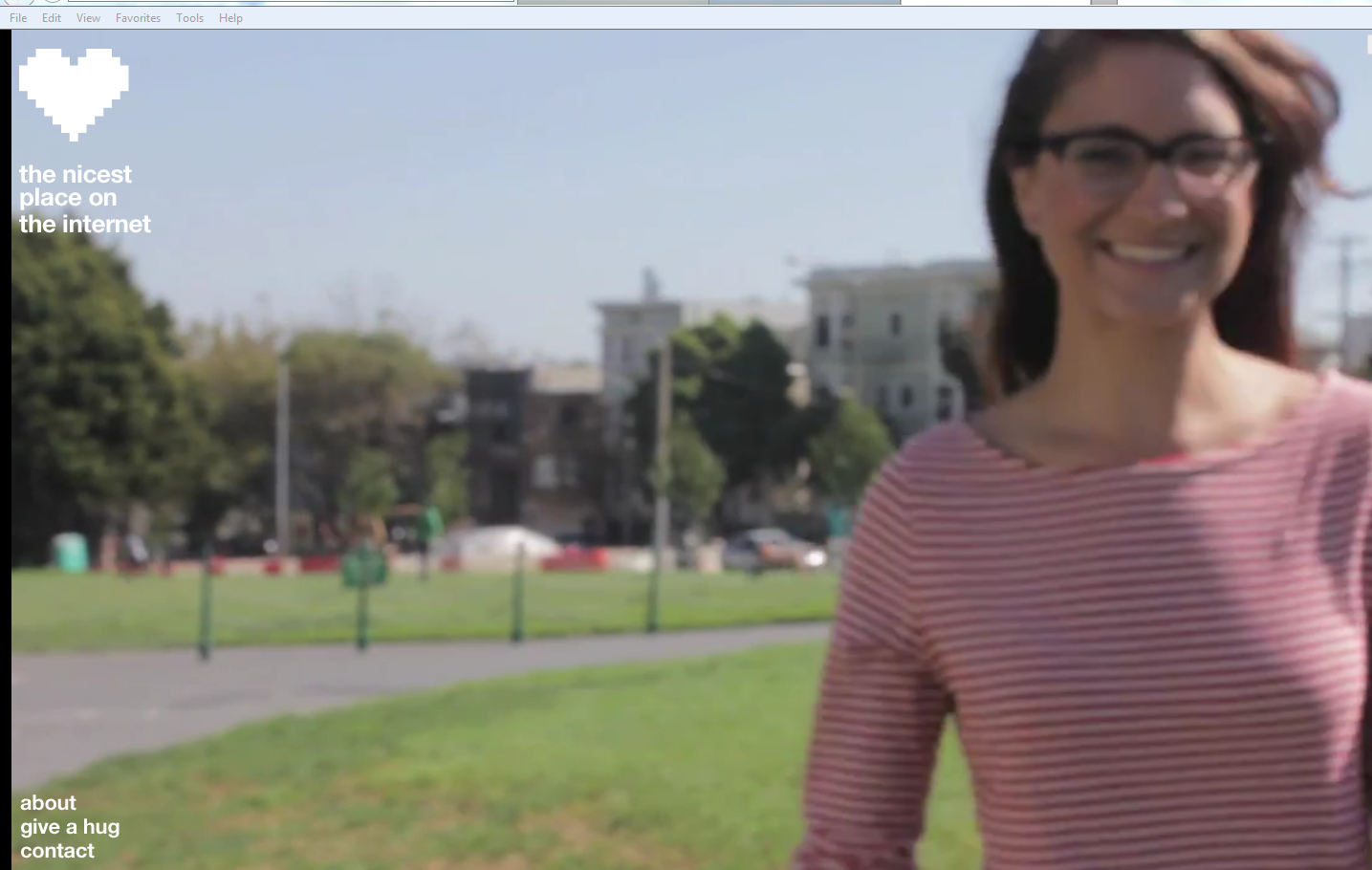
Ever have a day when you just really need a hug, like, right now? Well now you’re in luck:

"Jeff Lam and Lauren Perlow created The Nicest Place on the Internet, a place where you can feel warm and fuzzy with virtual hugs, because they were having an off day. It’s perfect for those chilly winter days."

Check out Creativity Online.

You can also go directly to the site: The Nicest Place on the Internet

You can also contribute your own hug.

I love this idea of virtual kindness; it’s a weird concept in a way, of people donating hugs (so to speak) to complete strangers. But, it’s great because it’s using the World Wide Web to create community and connections with people all over the world. Somehow, by being open to receiving a hug, even a virtual one, we are able to create connections and feel like part of a larger tribe or cohesion.

So often online communities can turn harsh or downright mean; it’s great to see online crowdsourcing being used for positive psychological benefits!

anthropology · community · education · happiness · school

Creating tribe through education

Students at Washington High School at class, t...
Working on a project together with a group can create a sense of "tribe." Image by The Library of Congress via Flickr

Having a community or “tribe” is one of the essential things all humans need in order to be happy, healthy, and really survive. In the predominantly urban, mobile environment most of us live in now, it can be hard to develop and maintain a tribe.

The UW Professional & Continuing Education Program recently published a blog post addressing the idea of tribe, and how we create that in modern, usually urban settings through education. One of the most common ways we create tribe is through what we spend time learning; taking Yoga, getting certified in Fiber Arts, sharing this knowledge, love, and in a way a rite of passage with others definitely creates a sense of community and tribe.

History defines tribes as groups united by shared ideas, values and goals. Godin and others put a 21st century spin on the term to empower ordinary people to lead big changes, including the pursuit of a new career.

For Tammie Schacher, the big change was to transition out of the architecture profession and into the nonprofit sector, where her goal was to align her values and passions with a new career. To get started, Schacher enrolled in the UW Certificate in Nonprofit Management where she joined a cohort of fellow students who would go through the program together.

“At the beginning the instructor told us that these groups become very tight knit and that we’d start relying on each other,” she says. “We didn’t necessarily believe that, but by the second quarter we realized we had not only started to rely on each other but that we’d become a family.”

The blog post goes on to discuss how to get the most out of putting yourself in this new, tribal situation:

Both Matthews and Schacher believe that getting the most out of being part of a tribe that starts in a continuing education classroom is fairly simple. First, say both, be open. “Have a little courage and put yourself out there,” says Matthews. “The structure of a classroom is a great place to try something out.”

Read more at: Find Your Tribe, Foster Your Future

There are lots of opportunities to create a tribe based on shared knowledge, and to create new ones based on group learning. We can also create tribes online through forums and blogs, as well as allegiances to sports teams or other athletics. Anything from military service to attending a concert can create a sense of tribe.

What are some of the surprising places you have found and/or created a tribe of like-minded people?