behavior · emotion · family · happiness · mental health

Steps to ease into being grateful, and how it benefits you psychologically

"The most psychologically correct holiday of the year is upon us." according to the New York Times article, A Serving of Gratitude May Save the Day.

Cultivating an “attitude of gratitude” has been linked to better health, sounder sleep, less anxiety and depression, higher long-term satisfaction with life and kinder behavior toward others, including romantic partners. A new study shows that feeling grateful makes people less likely to turn aggressive when provoked, which helps explain why so many brothers-in-law survive Thanksgiving without serious injury.

But say you’re not in the habit of giving thanks. After all, we’re only asked to officially do it once or twice a year. Well, there are some pointers in the article to get you going:

Start with “gratitude lite.” – start out with writing just five things, and maybe a sentence or two about why you’re appreciative of them.

Don’t confuse gratitude with indebtedness
– you don’t need to owe anybody anything to be grateful for them.

Try it on your family
– even if they are horribly dysfunctional, you can still be grateful they passed the peas without throwing you a dirty look.

Don’t counterattack
– okay, so maybe they did throw you a dirty look. By being grateful to them anyway, it puts individuals off guard and makes them more likely to be kinder in the future, according to some studies.

Share the feeling – … “More than other emotion, gratitude is the emotion of friendship,” Dr. McCullough says. “It is part of a psychological system that causes people to raise their estimates of how much value they hold in the eyes of another person. Gratitude is what happens when someone does something that causes you to realize that you matter more to that person than you thought you did.”

Try a gratitude visit.This exercise, recommended by Martin Seligman of the University of Pennsylvania, begins with writing a 300-word letter to someone who changed your life for the better. Be specific about what the person did and how it affected you. Deliver it in person, preferably without telling the person in advance what the visit is about. When you get there, read the whole thing slowly to your benefactor. “You will be happier and less depressed one month from now,” Dr. Seligman guarantees in his book “Flourish.”

Contemplate a higher power. Religious individuals don’t necessarily act with more gratitude in a specific situation, but thinking about religion can cause people to feel and act more gratefully, as demonstrated in experiments by Jo-Ann Tsang and colleagues at Baylor University. Other research shows that praying can increase gratitude.

Go for deep gratitude. Once you’ve learned to count your blessings, Dr. Emmons says, you can think bigger…

And if that seems too daunting, you can least tell yourself —

Hey, it could always be worse. When your relatives force you to look at photos on their phones, be thankful they no longer have access to a slide projector. When your aunt expounds on politics, rejoice inwardly that she does not hold elected office. Instead of focusing on the dry, tasteless turkey on your plate, be grateful the six-hour roasting process killed any toxic bacteria.

Happy Thanksgiving!

behavior · brain · children · environment · family · learning · psychology

How To Help Your Child’s Brain Grow Up Strong : NPR

A lot of parents freak out about how to provide enriching environments for their children and help them grow, from music lessons to early reading to math flash cards.

In one of those “well duh” books, two neuroscientists, Sandra Aamodt and Sam Wang remind us it doesn’t take all that much…

Babies may look helpless, but as soon as they come into the world, they’re able to do a number of important things. They can recognize faces and moving objects. They’re attracted to language. And from very early on, they can differentiate their mother from other humans.

“They really come equipped to learn about the world in a way that wasn’t appreciated until recently,” says neuroscientist Sandra Aamodt. “It took scientists a long time to realize that their brains are doing some very complicated things.”

Aamodt and fellow neuroscientist Sam Wang explain how the human brain develops from infancy to adolescence in their new book, Welcome to Your Child’s Brain. The two researchers also offer tips for parents to help their children eat their spinach, learn their ABCs and navigate elementary school.

more via How To Help Your Child’s Brain Grow Up Strong : NPR, on Fresh Air.

They talk with Terry Gross about complicated concepts like self control, abstract thought, and things that are even hard for some grown-ups, and how to create an environment that makes kids want to practice these things.

behavior · children · community · environment · family · learning · Nature

7 Creative Ways to Experience your Local Farm this Spring | Inhabitots

A pastoral farm scene near Traverse City, Mich...
Image via Wikipedia

Where I grew up and where I live now, though focusing on very different kinds of agriculture, were both very farm-focused communities, and I always encourage people to  go out and see what a working farm is all about. It is a great way to learn about where your food comes from, different jobs, and all about nature.

Beyond simply stopping by to view the animals at your local farm, there are many other hands-on and creative activities you can do with your family — and the spring is a great time to go. Visiting your local farm during the spring comes complete with baby animals, plus the weather is warming up and it’s the perfect opportunity for outdoor learning time with your children. To get the most out of your springtime visit to the farm, you’ll want to explore it with a different lens and look at your local farm as more than just a place that keeps animals and agriculture. Read on to learn seven creative ways to experience your local farm this spring with your family.

more via 7 Creative Ways to Experience your Local Farm this Spring | Inhabitots.

anthropology · behavior · children · culture · education · family

Children’s past role and identity as worker

Children in Jerusalem.
The role of children has changed significantly over the past 100 years. Image via Wikipedia

This call for paper submissions from the The Society for the Study of Childhood in the Past got me thinking about how actively children used to participate in the daily household and economic life of families, from general maintenance like sweeping the kitchen to vital income by helping during harvest time.  Children used to have to help out on the farm, and later work in factories, in order to help their families make ends meet. While some of the work was dangerous and unhealthy, some of the work was beneficial to both the kid and the family. Kids felt like they contributed to their family, and learned skills from farming to general entrepreneurship. I wonder what kids are missing out on by not having as many daily chores to do, or summer jobs like mowing lawns and lemonade stands, and how children fit into our idea of work now.


In 2011, the themed session will be on children and work. The aim of the themed papers will be to bring together scholars from a wide range of academic disciplines who are studying any aspect of children and work in the past – children as economic contributors, children as slaves, elite children taking on adult roles, children as carers, children as consumers, the impact of working in childhood on children and society. The aim will be to advance cross-cultural knowledge and understanding of childhood and children in the past, and in particular to evaluate the varying nature and impact – social, economic, cultural, medical – of work performed by or for children in the past. Archaeology, history, literature and other sources will be explored.
In providing this opportunity for scholars of childhood to present their work to an international, interdisciplinary audience, the SSCIP International Conference aims to generate new perspectives on existing knowledge and to stimulate new avenues of research for the future.

I’d be interested to hear what jobs you had growing up, before the age of 18. Did your parents encourage you to work? Did you get an allowance or did you get paid by the job, or were you just expected to “earn your keep”? How is it different with your own kids, or nieces and nephews?

community · design · family · health

Granny Pods Keep Elderly Close, At Safe Distance : NPR

His idea might seem strange, but “granny pods” are catching on.The granny pods real name is the MEDCottage, and its basically a mini mobile home that rents for about $2,000 a month. You park one in the backyard, hook it up to your water and electricity, and it becomes a free-standing spare room for Grandma and Grandpa.The concept is catching on all over the country, but nowhere more so than Virginia, where the state government has eased zoning restrictions on these high-tech hideaways, which go on the market early next year.The MEDCottage is homey on the outside, with taupe vinyl siding and white trim around French doors. Inside, it looks like a nice hotel suite, complete with kitchen and bathroom — and security cameras.

more via Granny Pods Keep Elderly Close, At Safe Distance : NPR.

children · cognition · education · family · learning · technology

Using the Internet as a Learning (and play) Tool

Great article from Cory Doctorow and BoingBoing:

http://www.boingboing.net/2010/11/02/how-i-use-the-intern.html

…my 2.5-year-old daughter and I use my computer as part of our imaginative play and storytelling, using YouTube searches, Flickr image searches, paper story books, toys, and trips around town to play and explore.

Now that she’s more active, she usually requests something – often something from YouTube (we also download her favourite YouTube clips to our laptops, using deturl.com), or she’ll start feeding me keywords to search on, like “doggy and bunny” and we’ll have a look at what comes up. It’s nice sharing a screen with her. She points at things in her video she likes and asks me about them (pausable video is great for this!), or I notice stuff I want to point out to her.

But the fun comes when we incorporate all this into our storytelling play…

This is great that Doctorow is using YouTube as scaffolding to teach his daughter, rather than just plopping her in front of the TV. The interaction is the most important part here, and it’s great that he’s incorporating digital media into the lesson plan, encouraging her to think critically even at a little itty-bitty age. 🙂

community · culture · education · family · learning · play · school · Social · technology

HASTAC, Superman, and the school fair

The Education system in the U.S. has reached a pretty low low right now. This is currently being displayed on the big screen in the documentary “Waiting For Superman.” Film-maker Davis Guggenheim “follows a handful of promising kids through a system that inhibits, rather than encourages, academic growth, and undertakes an exhaustive review of public education, surveying ‘drop-out factories’ and ‘academic sinkholes’.” (IMDB)

So, what do we do about it?

Lots of things.

One idea is HASTAC, or Humanities, Arts, Science, and Advanced Technology Collaboratory. Pronounced “haystack”, it is “a network of individuals and institutions inspired by the possibilities that new technologies offer us for shaping how we learn, teach, communicate, create, and organize our local and global communities.” They’re the group behind Reimagining Learning (DMLcompetition.net), and other scholarly workshops.

Cathy DavidsonDuke University Co-founder, HASTAC; Co-PI, HASTAC, writes:

Traditional education too often forgets its precious social condition of face-to-face interaction and takes its collective opportunity for granted. If your classroom can be replaced by a computer screen, maybe it should be.

We are using lessons from collaborative open web development and peer-to-peer learning and assessment to storm the academy at the first international Drumbeat Festival in Barcelona, Nov 3-5. Surrounded by pioneering open source web developers and experimenters in online peer-to-peer learning, we are using methods of the open web to look back and at shake up traditional learning institutions. Were looking at four key areas that need storming: collaboration, syllabus building, assessment, and publishing (including peer review). Our chief idea is that face-to-face learning should not be taken as a given in education but as an affordance, as an opportunity not a default. How does thinking about the unique opportunity to learn together change the components of traditional learning?

more via We’re Storming the Academy! A Provocation and a Promise | HASTAC.

Teachers are already spending their own money to provide supplies for a fuller education experience.

“Vicky Halm spends a $1,000 a year out of her own pocket to equip her Brooklyn classroom. She buys star stickers to help motivate her students, but she also spends a great deal on basic supplies — such as pencils and paper.
A whopping 97% of teachers frequently dip into their own pockets to purchase necessary classroom supplies, according to a national survey conducted by Kelton Research. Last year, teachers spent more than $350 on average from their own income on school supplies and instructional materials, according to the National School Supply and Equipment Association” (CNNMoney)

There are lots of opportunities for students to gain hands-on learning outside of the classroom too. Zoos and Universities often have family or kid-only programs to try out.

“Children and parents hummed through wax paper-covered combs while jazz singer Jeni Fleming sang the “Science Saturday” version of “Hound Dog,” everyone rocking out to their newly learned blues chord progression. And so — with tingling lips and a room full of smiles — the second season of Science Saturdays came to a close. Over 900 children from Bozeman, communities as far away as Helena, Stevensville and Glasgow; and the Crow Indian Reservation have participated in Science Saturdays since MSU started offering the program in the fall of 2008, said Suzi Taylor, outreach director for MSU’s Extended University. (MSU News)

Parents can also organize these events. A blogger on GeekDad describes his son’s school fair:

For our school fete we blacked out a classroom with curtains and asked for donations from people to enter the “Corner of Curiosity.” It was amazing what people came up with. There was a delightful Plasma Ball near the entrance which was a favorite of the younger children, and a beautifully faded yellow newspaper from 1938 headlining concerns about Hitler’s leadership in Germany. One parent produced a display of the “history of mobile” phones and others had insect collections.

One student produced what has to be the most curious of collections – a collection of animal scats. A local community member supplied a whale vertebrae (and a kangaroo vertebrae for comparison). But, the real value was being able to present a fund raising activity for the school that was also educational. (GeekDad)

Any small measure, from buying markers to throwing a curiosity fair, helps enrich kids’ learning and keeps them wanting more. Even just a little bit of time each week adds up quickly.

family

Playing with the gorillas

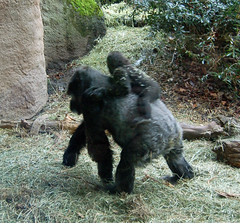
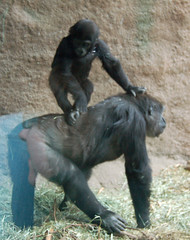
Rafe and I once again ventured to the zoo. Our primate highlight this trip: the baby gorilla! The last time we were there the little girl was more interested in snuggling with her mom and sister, but this time she was ready to play!(and eat bark, but to each her own).

It was fascinating to see the baby and her older sister playing together. The sister would pound her chest as the play signal to start chasing her, and the baby would start chasing the sister in circles around their mom. The baby tried it a couple of times, but couldn’t quite get it down, so she looked like she was trying the rub-belly/pat-head trick that kids try. The two would also play wrestle a little, and then start chasing again. Usually the baby chased the sister, I think the sister chased the baby once.

The sister also carried the baby under her belly and on her back, letting the baby jump off.

The mom was pretty patient with the whole thing, only reaching in a couple of times and pulling the baby out of the play fighting to calm her down, or to breastfeed her. The way that kid went for the nipple man, WOW, poor mom.

Since I am studying play right now for my thesis, watching these two spend time playing was just fascinating and made my week!

I felt so honored to see this family hanging out, getting along, and playing.

See more photos on my flickr.

family · language

Yelling’s not going to change anything (well, maybe)

This article discusses a study that finds oldest siblings really are disciplined the most sternly. Being an older sister, in some ways that makes me feel better, but not entirely.

This article is about a linguist at my university who has found close connections between indigenous languages here in the Pacific Northwest and indigenous languages in Asia. Language is awesome!