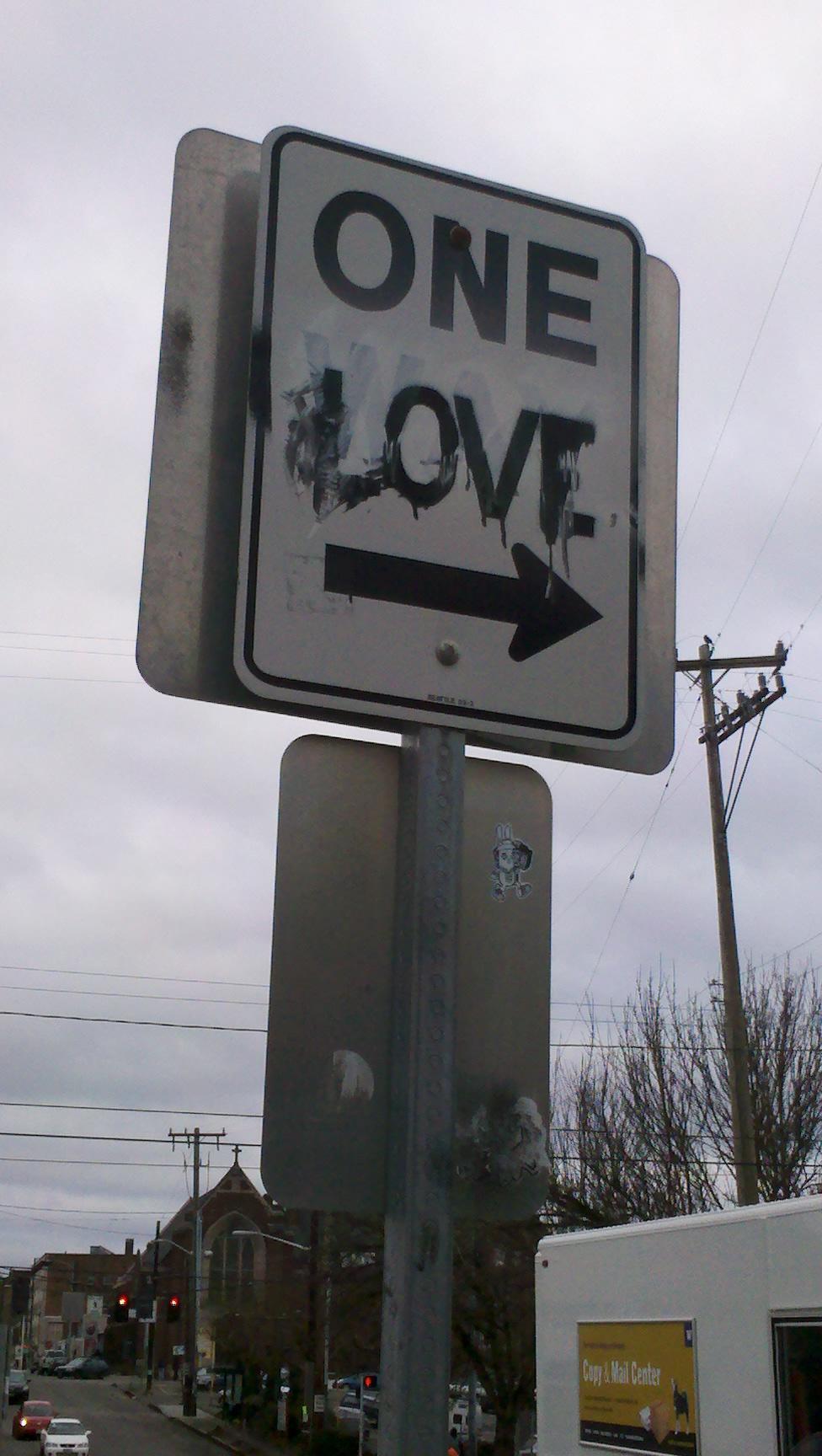
While I don’t condone defacing public street signs, I liked the sentiment. It made me think about how easy it is to make people smile and make a space more friendly with a word.
Happy Friday!
Exploring Enriching Environments
While I don’t condone defacing public street signs, I liked the sentiment. It made me think about how easy it is to make people smile and make a space more friendly with a word.
Happy Friday!
I can see this roof garden from my office window.
Even in a city like Seattle where trees and moss are threatening to take over every unclaimed even-slightly-damp area, it is nice to see some greenery mixed in to the rooftops. I’m sorry to see they’ve let the grass go brown, but it is winter so that could be part of it. I notice so many other rooftops surrounding it have not taken advantage of their nice flat roofs, either for gardens or just "green roofs" or even solar panels. There is just so much wasted real estate up there it makes me sad.
Hooray rooftop gardeners, where ever you plant yourself!

I’m a huge fan of toys in the workplace. They help me think, they can trigger creative ideas, and they make me smile. But some people consider thema distraction.
What’s your opinion of toys in your cubicle? Do they delight or distract you? Leave your thoughts in the comments.

Promoting backyard farms, (or even large scale farms and modern-day homesteading), has a new term: "Ag"tivism. From the young and idealistic to the old and curmudgeonly, many people are finding time, space, and energy to grow their own tomatoes.
From The New Agtivist: Edith Floyd is making a Detroit urban farm, empty lot by empty lot:
Edith Floyd is the real deal. With little in the way of funding or organizational infrastructure, she runs Growing Joy Community Garden on the northeast side of Detroit. Not many folks bother to venture out to her neighborhood, but Edith has been inspiring me for years. I caught up with her on a cold, rainy November afternoon. While we talked in the dining room, her husband Henry watched their grandkids. Q. What neighborhood are we in? What is it like?
A. This is the northeast side — near the city airport. It’s surrounded by graveyards on three sides and then the other barrier is the railroad track; we are surrounded by railroad tracks, and sometimes those trains stay for like 30 minutes, so you are trapped; ain’t no way out.
Q. So you’ve seen a lot of changes.
A. Yeah, when I came it was beautiful — there were grocery stores in the center, like in the middle of the neighborhood, but … There was like 66 houses on this block, and now [there are] about six that people live in, and three need to be torn down, and the rest of it is empty. That’s where I’m putting my farm on, all the lots. [Editor's note: some are calling this practice "blotting." Here's a recent NPR story on blotting in Detroit.] …
Q. What are you growing on those lots?
A: Across the street I have my strawberry lot. I try to plant by lot. I have a collard green lot, a kale lot, an okra lot, an eggplant lot, green bean lot. I had a corn lot, but it didn’t work so well. Right now I have a garlic lot, I had a tomato lot, cucumber lot, squash, cabbage, broccoli, watermelon, cantaloupe. I like flowers, so I planted some of them. I had potatoes, mustard greens, turnip greens.
Q. That’s a lot of food!
A. Well, if it comes up it’s a lot, but I give some to the Capuchin Soup Kitchen. I sell some at Eastern Market, and Wayne State Market, but the cabbage does not sell so I don’t take cabbage there. (I still have about two of 300 pounds of cabbage I need to harvest.)
More at The New Agtivist: Edith Floyd is making a Detroit urban farm, empty lot by empty lot
NPR recently had an article about how people of my generation are also taking up organic farming with a passion:
…there’s a new surge of youthful vigor into American agriculture — at least in the corner of it devoted to organic, local food. Thousands of young people who’ve never farmed before are trying it out.
Some 250 of them gathered recently at a gorgeous estate in the Hudson River valley of New York: the Stone Barns Center for Food and Agriculture in Tarrytown.
Some of these young farmers already have their own farms. Some are apprentices, working on more established farms for a year or two. And others are still just thinking about it. But the overwhelming majority of farmers here at this conference want to farm without chemical fertilizers or pesticides.
They were there to learn skills — from seminars on soil fertility, handling sheep, and how to find affordable land — and just as importantly, to meet each other. In the evening, they played music and danced.
They represent a new breed of farmer. Very few of them grew up on farms. Most of them went to college. And now, they want to grow vegetables, or feed pigs.
More at Who Are The Young Farmers Of ‘Generation Organic’?
The biggest question interviewers often ask is "why?" Why farm? Why go "backwards" to a life of farming.
For many people, it’s economical (see an earlier blog post about young entrepreneurs making a living farming, growing eggs and herding sheep). But an even bigger driver for most is the desire to feel connected to their environment, to enrich their surroundings with greenery and healthy food.
From Grist:
Q. You haven’t always been an urban farmer. What did you do before this?
A. I worked at Detroit Public Schools. I started out with the Head Start Center and then I went to the middle school, to the Ed Tech, [which is] now the Computer Lab. I started farming because they laid me off and didn’t call me back. Farming is not making a living, it’s just keeping food in my freezer. I try to sell some so I can get some more equipment, so it will be easier for me to farm.
Q. So how much money are you making in a season?
A. I was trying to reach for 3,000, but I only made it to two something. I have to add up the last bit; I haven’t got my last check. Every year I try to up it; the first year I made 1,000. The second year I went 2,000; this year I was trying to go for $3,000.
From NPR:
"It was born out of a concern for the environment," says Brian Bates, who plans to work at a farm in northern Michigan after he graduates from Penn State. "I spent the first two years of college with one question in mind – basically, how can I have the greatest impact in my life in the world. And the thing that I kept coming back to, that everyone connected to, was food."
Others say that they simply enjoy the work, the style of agrarian life, and the connection to food.
"I feel lost when I’m not farming, when I’m not out in the field. It’s where I find the most peace and harmony in my life," says Liz Moran, who helps manage Quail Hill Farm in the eastern end of Long Island, New York.
"When I look around, and you’re amongst the plants and the sunshine – that’s my office, that’s where I want to be," said Rodger Phillips, who grows food on an urban farm in Hartford, Conn.
Others talk about the satisfaction of doing something practical, creating something valuable. "Having a skill was really important to me. Having studied political science, I wanted to do something that was productive, that was real. To have a real skill, and be able to provide my family, my community, a vital element," says Kristin Carbone, who runs Radix Farm in Upper Marlboro, Maryland.
And then there was Lindsey Shute. "How did I get into farming? Because I started dating a farmer!" she says with a laugh. [blogger's note: check out a similar story in the book "xx"]
It seems that people are looking for more control over their wallets, their lives, and what they put in their stomachs, and are doing it through farming.
I know a lot of medical and researched reasons why playing in the dirt is good for you, but I’m curious about anecdotal reasons. Leave your experiences with gardening and farming in the comments.
Ok, maybe a bit of an overstatement, but I still like the infographic; sometimes it is easiest to explain really complicated, heavy issues using an image:
From Sustainable Business Oregon:
If the entire European Union boasted average cycling miles like Denmark’s the region’s emissions would drop by 25 percent. This according to the European Cycling Foundation.
But a cool infographic from a Northwest coalition of health care management advocates also points out the health benefits of bike commuting. For example: The average worker will lose 13 pounds in their first year of biking to work.
The group also posits that Portland’s investment in bike-commuting infrastructure will save the city millions in health care expenses.
Created by: Healthcare Management Degree


I happened upon this tweet today:
@AIASeattle Did you know floor vibrations can affect patient outcomes?
Um, why no, no I didn’t. So I dug around a little bit and affirmed that, in fact, structural vibrations can in fact have an impact on patient recovery:
“Noticeable vibration leads many to fear structural collapse, although such fear is unwarranted in most cases because of the small displacements and stresses produced. Noticeable vibration is nevertheless undesirable in many occupancies because of its adverse psychological effect…It has been observed that continuous vertical floor oscillation becomes distinctly perceptible to people when peak acceleration reaches approximately 0.5 per cent g, where g is the acceleration due to gravity. People in residential, office and school occupancies do not like to feel distinct continuous vibration…
Continuous vibrations, defined here as vibrations lasting more than about 10 cycles, can arise from the periodic forces of machinery, from certain human activities such as dancing, or from vehicle traffic nearby. They can be considerably amplified when the periodic forces causing vibration are synchronized with a natural frequency of the structure – a phenomenon called resonance.”
Not only is shaking a problem, but there is also more and more research coming out that discusses the effects of the overall environment on a care-givers’ professional performance as well as a patient’s healing process:
“In a review of more than 600 articles, researchers found that there was a link between the physical environment (i.e., single-bed or multiple-bed patient rooms) and patient (e.g., fewer adverse events and better health care quality) and staff outcomes (e.g., reduced stress and fatigue and increased effectiveness in delivering care).
“There have been five other significant reviews of the literature relating to the physical environment and patient outcomes. Nelson and colleagues10 identified the need to reduce noise pollution and enhance factors that can shorten a patient’s length of stay (e.g., natural lighting, care in new/remodeled units, and access to music and views of nature); according to their study, patients can benefit from the skillful utilization of music and artwork. Ulrich and colleagues7 found research that demonstrated that the design of a hospital can significantly improve patient safety by decreasing health care associated infections and medical errors. They also found that facility design can have a direct impact on patient and staff satisfaction, a patient’s stress experience, and organization performance metrics. Three other reviews found that hospital design, particularly when single-bed rooms are employed, can enhance patient safety and create environments that are healthier for patients, families, and staff by preventing injury from falls, infections, and medical errors; minimizing environmental stressors associated with noise and inefficient room and unit layout; and using nature, color, light, and sound to control potential stressors.11–13
The Seattle branch of the AIA (that’s the American Institute of Architects) has hosting a talk specifically about how to design better, less drum-like floors, but is a nice indicator of how serious architects, designers, and other groups are taking this need to design and create better care facilities:
“Vibration criteria for hospital floors have become more stringent in the 2010 Edition of the Guidelines for the Design and Construction of Health Care Facilities (the FGI Guidelines). These new vibration requirements will increase structural construction costs in Healthcare construction. Understanding vibrations sources, criteria and benefits of different structural and non-structural approaches will provide healthcare designers with effective strategies to mitigate vibration issues and minimize cost impacts of the new requirements.”
For those who live in Seattle, there is a class on December 14th, 2011.
I’ve found some great examples of designing better medical facilities, but I’d love to hear about other projects you’ve seen, experienced, or even read about. Leave a comment with your thoughts.

I read a great article in Fast Company yesterday by Bruce Nussbaum, the former assistant managing editor for Business Week and a Professor of Innovation and Design at Parsons The New School of Design, about a trend that he refers to as “indie capitalism,” this idea of a homemade economy. Homemade in many ways: products made at home and sold from there, locally focused market, and driven by small, independent entrepreneurs:
You won’t learn about it in business school, hear about it from Wall Street, or see it in Palo Alto. But if you spend time in Bushwick, Brooklyn, or on Rivington Street in Manhattan, you just might detect the outlines of an emerging “indie” capitalism. This new form of capitalism is not just about conventional startups and technology and venture capitalists. If you add up all the trends under way today, I believe we are beginning to see the start of something original, and perhaps wonderful. It may prove to be the economic and social antidote to the failed financial capitalism and crony capitalism that no longer delivers economic value in terms of jobs, income, and taxes to the people of this country.
Indie capitalism is local, not global, and cares about the community and jobs and says so right up front. Good things come from and are made locally by people you can see and know. The local focus makes indie capitalism intrinsically sustainable–energy is saved as a result of a way of life, not in an effort to reach a distinct and difficult goal.
Indie capitalism is socially, not transactionally, based. It’s not just Internet social, involving 5,000 friends, but personally social. Take Kickstarter, for example, where people fund the music, books, and products that they can watch develop over time. In this model, consumer, investor, audience, fan, helper, and producer conflate. People find and prepare their food the same way they find and prepare their music. And then they share it all.
More at 4 Reasons Why The Future Of Capitalism Is Homegrown, Small Scale, And Independent
I am really excited by this idea of a locally-sourced and locally-focused economy. I think it is better for the environment, but I also think it’s better for community building and having a better sense of place, to feel connected to where you live and what you do, and enriched by it.
Please read the entire, well-written article, and let me know your thoughts in the comments below.
I used to be a technology journalist, and got to read a lot about the different ideas for the supposed “smart grid” that was supposedly going to reduce waste, alert emergency workers faster, and make our lives better. A few years later, it looks like it really might be happening!
With a little help from what’s called the Internet of Things, engineers are transforming cities from passive conduits for water into dynamic systems that store and manage it like the tissues of desert animals. By using the Internet to connect real-world sensors and control mechanisms to cloud-based control systems that can pull in streams from any other data source, including weather reports, these efforts enable conservation and money-saving measures that would have been impossible without this virtual nervous system.
Marcus Quigley, principal water engineer at the infrastructure engineering firm Geosyntec, has been tackling this problem using hardware from Internet of Things company ioBridge, whose Internet-connected sensors have been used in everything from location-aware home automation to tide gauges that tweet.
It may sound like a trivial problem, but the EPA estimates that the U.S. has $13 billion invested in wastewater infrastructure alone. More importantly, the majority of America’s largest cities–more than 700 in all–dump millions of gallons of raw sewage into our waterways every time it rains, because their sewer and stormwater systems were designed a century ago.
More at…


I found another great article from Grist magazine about how something as simple as a bucket of paint, or several different colored, buckets of paint, can have a huge positive impact on a neighborhood:
Sunnyside Piazza, it is called, which may seem a bit much for a splash of color on asphalt, but in person, it seemed fitting. This whimsical design, interrupting the functional but monotonous gray of Portland’s street grid, felt like a somewhere. It seemed like a place deserving a name. It even felt like a “piazza.”
That was in 2002. I later learned that the Sunnyside Piazza was the second painted public square in Portland, facilitated by the nonprofit City Repair Project. Now, dozens of painted plazas, dubbed Intersection Repairs, pepper the map not just of Portland but also of Los Angeles, New York, St. Paul, and Seattle.
It all started in the mid-1990s with Share-It-Square, in Portland’s Sellwood neighborhood, where architect and City Repair co-founder Mark Lakeman lives. After visiting villages in Central America where residents gather around common spaces, Lakeman decided to bring similar spaces to Portland. “Putting the public space back where it’s supposed to be may not sound like a huge change,” Lakeman says, “but it has a profound effect on the social culture … We know that Americans are more lonely and isolated than ever before, but we don’t realize that the absence of cohesion in American communities is totally related to the absence of places where people can actually build that.”
more via Coloring inside the lanes: Art that creates community | Grist.
The article goes on to discuss how creating a group mural creates a sense of community:
“It’s not about the paint,” says professor Jan Semenza, a professor of public health at Portland State University who lives near the Sunnyside Piazza and has researched intersection repairs. “It’s about neighbors creating something bigger than themselves.” As an everyday intersection becomes someplace special, residents begin to experience the value of community. Neighbors paint themselves out of a corner — of the intersection, of their individual homes — and into the middle of the street. By turning an intersection from a dividing line between neighbors into a gathering place, residents begin to solve the problems that plague neighborhoods and cities. Where isolation existed, they find community. Where cars dominated, they create a people place. With a little paint, neighbors are solving big problems.
I have seeen some great community spaces also created out of roundabouts, water fountains at outdoor shopping centers, and often at landmarks like stairs or trees. Sometimes, if a natural landmark or meeting space isn’t in place, all it takes is some paint, chalk, or even ribbon to make a place significant and identify it as a community gathering space.
Humans are greatly effected by the greenery in their environments, but remember how a few weeks back I was lamenting that not much robust analysis or study had been done on this kind of positive impact? Well, voila!
ScienceDaily (2011-11-17) — Greening of vacant urban land may affect the health and safety of nearby residents. In a decade-long comparison of vacant lots and improved vacant lots, greening was linked to significant reductions in gun assaults across most of Philadelphia and significant reductions in vandalism in one section of the city. Vacant lot greening was also associated with residents in certain sections of the city reporting significantly less stress and more exercise.
Journal Reference:
 Mental Flowers