How many of your virtual friends would you actually invite over for lunch? (Photo credit: Meer)
Does social media make us feel more or less connected? How does connecting and communicating in a digital space impact us differently than connecting and communicating in a physical space?
There are mixed results from various studies, but recently more studies have come out finding that we actually feel less connected to each other the more we use social media like Facebook:
Kross found that the more people used Facebook, the less happy they felt—and the more their overall satisfaction declined from the beginning of the study until its end. The data, he argues, shows that Facebook was making them unhappy.Research into the alienating nature of the Internet—and Facebook in particular—supports Kross’s conclusion. In 1998, Robert Kraut, a researcher at Carnegie Mellon University, found that the more people used the Web, the lonelier and more depressed they felt. After people went online for the first time, their sense of happiness and social connectedness dropped, over one to two years, as a function of how often they used the Internet.Lonelier people weren’t inherently more likely to go online, either; a recent review of some seventy-five studies concluded that “users of Facebook do not differ in most personality traits from nonusers of Facebook.”
But, as with most findings on Facebook, the opposite argument is equally prominent. In 2009, Sebastián Valenzuela and his colleagues came to the opposite conclusion of Kross: that using Facebook makes us happier. They also found that it increases social trust and engagement—and even encourages political participation. Valenzuela’s findings fit neatly with what social psychologists have long known about sociality: as Matthew Lieberman argues in his book “Social: Why Our Brains are Wired to Connect,” social networks are a way to share, and the experience of successful sharing comes with a psychological and physiological rush that is often self-reinforcing. The prevalence of social media has, as a result, fundamentally changed the way we read and watch: we think about how we’ll share something, and whom we’ll share it with, as we consume it. The mere thought of successful sharing activates our reward-processing centers, even before we’ve actually shared a single thing.
Virtual social connection can even provide a buffer against stress and pain: in a 2009 study, Lieberman and his colleagues demonstrated that a painful stimulus hurt less when a woman either held her boyfriend’s hand or looked at his picture; the pain-dulling effects of the picture were, in fact, twice as powerful as physical contact.
So what does this all mean? That we are complicated. And so is how we use social media.
“What makes it complicated is that Facebook is for lots of different things—and different people use it for different subsets of those things. Not only that, but they are also changing things, because of people themselves changing,” said Gosling. A 2010 study from Carnegie Mellon found that, when people engaged in direct interaction with others—that is, posting on walls, messaging, or “liking” something—their feelings of bonding and general social capital increased, while their sense of loneliness decreased. But when participants simply consumed a lot of content passively, Facebook had the opposite effect, lowering their feelings of connection and increasing their sense of loneliness.
I have seen forums used to create physical communities (I don’t want to say “real world” because virtual is real, it’s really happening) and create friendships that crossed continents, but I have also heard of and seen virtual bullying that in some very sad cases led to a person’s death. We can be cruel to others by hiding behind that veil of anonymity, or even just by creating a lack of physical presence which also creates a mental separation which makes it easier for us to feel isolated or intentionally isolate others. But we also want to share and connect with others, even if we can’t be physically near them, and share very intimate details with people we may not otherwise have given the time of day, which can be a good or bad thing depending on the context and situation.
How do you use social media? Does it make you feel more connected to your tribe, or do you feel left out or perhaps even more isolated? Do you bridge the gap between your virtual world and physical world, or does the slogan “What happens in Vegas stays in Vegas” also apply to your social media and physical lives? Leave your thoughts in the comments below.
While most of my blog posts focus on playful design and things that create a playful atmosphere, a lot of us don’t have all of our basic needs met in order to be in a playful state. We are often overstressed, underslept, overworked, and detached from community. Play researchers have found evidence that goes along with Maslow’s hierarchy of needs that find we need these things in order to be ready to explore, create, and be healthy. That’s why I also like to talk about what it takes to get us to a space where we feel safe, healthy, and ready to be playful.
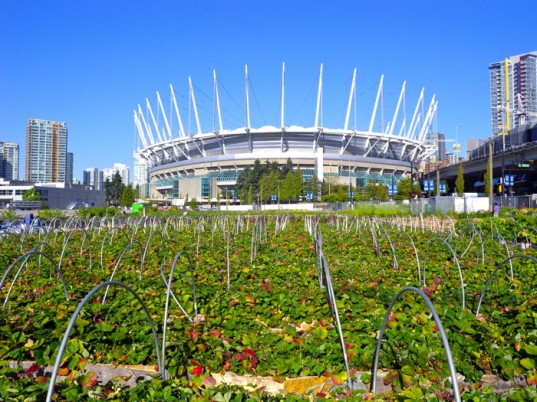
Going with the philosophy that gardening is good for the soul, as well as aiming for convenience, a group in Vancouver has opened a huge urban farm and orchard.
Vancouver’s Sole Food Farms has transformed an old gas station into North American’s largest urban orchard! Located in Downtown Eastside, the orchard provides jobs to recovering addicts and those with mental illness, giving them a chance to make a living while raising organic food. The organic fruit, along with produce from three other sites, is sold to local restaurants and grocery stores.
Adding green space to a city, whether it’s a garden, park, or a single tree, has also repeatedly shown to be valuable even to those who just observe the space, they don’t need to even be actively engaged in maintaining it. The garden adds connection to and investment in the land, which is good for building community, and provides a sense of agency for those who might not otherwise have one.
Where have you seen community gardens spring up? What works, what doesn’t? Leave your thoughts in the comments below.
Virtual space, including friendships there, does not fully replace that real live human interaction we get in real world spaces. More and more studies are finding this out, and people are reacting to it, often on social media.
graphic designer Shimi Cohen, based in Tel Aviv, has provided “a fresh and subtly soul-wrenching reminder of the way our screens can become cells of solitary confinement.”
The animation was Cohen’s senior project at Shenkar College of Engineering and Design. Based in part on MIT professor Sherry Turkle’s book Alone Together and Yair Amichai-Hamburger’s article “The Invention of Being Lonely,” inspiration also came from a personal place. “Like many others,” Cohen tells Co.Design, “I became addicted to socializing through my phone and social media. This started to bother me and intrigue me at the same time.”
Have you ever wandered into a neighborhood or parking lot and thought, “Wow, this space could use a nice mini-park, or even a bench.” Well, here you go!
A colorful banner pasted alongside the bin’s rough exterior cheerfully announces ‘Park-A-Park’, the mobile parklet that launched on Vancouver’s Commercial Drive at the tail end of July. The bin reaches just over three feet high, its inner walls are ringed with wooden bench seating, and planters and tables mingle inside to offer a charming, yet functional environment. The unit is capped by a shade-providing umbrella, and one end of the bin lies open, like a drawbridge, coyly beckoning passersby to enter.
A partnership between Emily Carr University of Art + Design and local Urban Interventionist Julien Thomas, Park-A-Park has been designed to transform an industrial disposal bin into an aesthetic mobile park that can be transported, parked, and enjoyed throughout the city. The unit is a component of Emily Carr’s chART project and aims to support public art and community engagement through creativity and innovation.
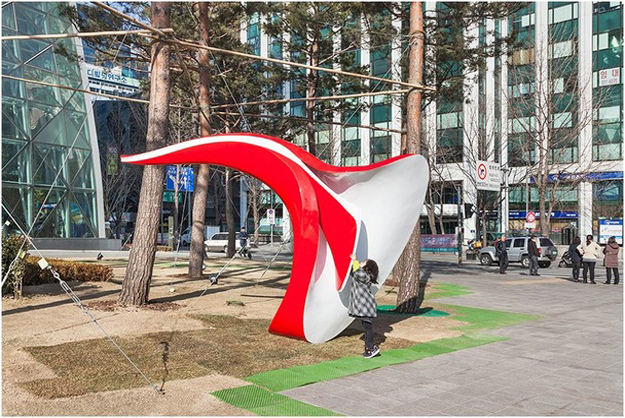
The normal procedure for submitting a complaint to the government is to write a letter, send an email, or make a long drawn-out phone call. In Seoul, South Korea, there’s an alternative – yelling into a giant sculpture shaped like an ear.
Designed by artist Yang Soo-in, and backed by the organization, Lifethings, the sculpture sits outside City Hall in Seoul. It symbolizes the fact that Mayor Park Won-soon and his administration are willing to listen to the people.Since it’s installation, Koreans have lined up to speak their woes or ideas for civic improvement into the impressively sized artificial ear.
When you think of our everyday endeavors and going through life as adults, we’re not really encouraged to be playful. But when we play games, we relax and become more receptive and less judgmental. Games trigger our creative juices—through solving problems, navigating complex systems and managing resources. They present us with hard problems; like solving a puzzle or defeating a boss. As players we need to be creative and come up with good ideas to solve those problems. They make us more playful in our way of being and experiencing life. Best of all, games bring us together. Go ahead, organize an office recess and create your own game—and use the toolkit at the link to help get you started.
Where you live apparently can influence your happiness – or maybe happy people just tend head west?
Which way to happy? Geographically speaking, it’s the route to Hawaii, Maine or one of the clusters of blissful cities in California and Colorado.
The map below is based on results from a study of geotagged tweets published earlier this year in PLoS ONE by researchers at the University of Vermont. The team scored more than 10,000 words on a positive-negative scale and measured their frequency in millions of tweets across the country, deliberately ignoring context to eliminate experimental bias. What emerged was significant regional variation in happiness by this calculation, which correlates with other lifestyle measures such as gun violence, obesity and Gallup‘s traditional wellbeing survey. A sadness belt across the South includes states that have high levels of poverty and the shortest life expectancies.
Hazel Trexler-Campbell throws spray-painted horseshoes during the Senior Games in Cleveland on July 23. (Benjamin Morris for NPR)
Health and fitness is often focused on the young, to the point that as athletes age they often get discouraged that they can’t compete in their old sports anymore. Well fear not, young-at-heart! There is… the Senior Games, with different age brackets.
A lot of what you’d see at the National Senior Games looks familiar if you’ve ever watched the Summer Olympics: there’s track and field, basketball and swimming. At the Summer Olympics, however, you will not hear voices in the crowd cheering “Go, Grandma!”Everyone at these Games is over 50 and they play some sports that will likely never appear at the Olympics.
I JUST discovered the Senior Games this morning, and I’m already excited to sign up when I’m old enough to qualify – that’s only 20 years away, so I better start practicing. 🙂
But for those who already qualify, this is a great sporting event that should be shared out with more seniors. People like my dad, a lifelong athlete who tries to keep up with the young folks perhaps a bit too much, would make a killing in some of these events.






 Mental Flowers