I am often focused on efficiency walking from place to place. But cyclists, runners, and other athletes talk about taking the more scenic route on their commutes or exercise routes, and maybe we should all follow suite.
We’ve all [probably] taken a detour because the path is pleasant and scenic, even if it takes longer. But Google Maps and the like aren’t set up for that. They’re solely about speed and efficiency.Recent research led by Yahoo Labs shows how a planner-for-happiness might work. Using crowdsourced impressions of streets, Flickr data, and survey responses, it looks for a balance between “people’s emotional perceptions of urban spaces” and getting them to a destination in a reasonable amount of time.
Happy Monday. If I ever needed a pick-me-up it is this week, so what’s better than a little music – outdoors – for free – via crowdsourced pianos.
Piano placed in Volunteer Park, Seattle.
Seattle and the Great Northwest are known for their natural beauty. And there is no greater place to enjoy nature locally, than within the hundreds of Seattle and King County parks and open spaces. Regardless of where we live, work or play, parks are great economic equalizers – providing us all with venues for relaxation, exercise, recreation and entertainment. Seattle and King County is also known as a place where music and the visual and performing arts all thrive.
In the Pianos in the Parks public-private partnership, some of the region’s leading music and arts organizations have come together to encourage us all to discover our parks. It all starts with an alluring piano. And not just any old piano – these pianos have been donated, restored and tuned by Classic Pianos and dynamically designed by the students, faculty and friends of Gage Academy of Art. With partners like Seattle Symphony, KEXP, and City of Music who knows who you’ll find tickling the ivories of one of these pianos? From baseball to dog parks, concerts to picnics – we all now have another reason to DISCOVER OUR PARKS: the PIANO. ENJOY!
For the typical American kindergartner, unstructured free play during the school day consists of 20 to 30 minutes of recess, and perhaps some time at indoor “stations” — perhaps creating with building blocks, costumes, or musical instruments. But what if there was more? What if the answer to “what did you do in school today?” was, “I climbed a tree, played in the mud, built a fire”?
That is exactly the kind of learning going on in the Swiss Waldkindergartens, or forest kindergartens, where children ages four to seven spend all of their school days playing outdoors, no matter the weather. With no explicit math or literacy taught until first grade, the Swiss have no set goals for kindergartners beyond a few measurements, like using scissors and writing one’s own name. They instead have chosen to focus on the social interaction and emotional well-being found in free play.
With many parents and educators overwhelmed by the amount of academics required for kindergartners — and the testing requirements at that age — it’s no surprise that the forest kindergarten, and the passion for bringing more free play to young children during the school day, is catching on stateside. Free play and inquiry learning are the cornerstone of Canada’s new all-day kindergarten program; forest kindergartens are popping up in Washington state, Vermont, and even Brooklyn.
At the Waldkindergarten, which takes place in the middle of the woods in Langnau am Albis, Switzerland, dotted with several handmade structures like a rudimentary wood shelter where children and teachers gather around the fire, children play, often away from teachers’ view.
These scenes are captured in “School’s Out: Lessons From a Forest Kindergarten,” a documentary directed by Lisa Molomot. In the 36-minute film, Molomot and producer Rona Richter show scenes from two public schools: the outdoor forest kindergarten in Switzerland and a more typical American kindergarten in New Haven, Connecticut.
Trying to compare “happiness” metrics can be tricky, both because different countries and reports measure “happiness” in different ways, and because a spreadsheet of numbers isn’t all that inspiring (and I work with them, so speaking from personal experience).
I like the fact that they’re using multiple data points to quantify happiness (although it looks more like quality of life, but they definitely overlap).
Data viz wunderkindMoritz Stefaner has been on a happiness kick lately. Earlier this year, he analyzed the data of more than 3,000 images to try to determine the happiness of people New York, Bangkok, Moscow, São Paolo, and Berlin, according to their selfies. And now he’s back, visualizing the happiness of the entire world–using a more objective data source.
Founded in 1961, the Organisation for Economic Co-operation and Development (OECD) is an international policy organization dedicated to stimulating economic progress and world trade. As part of their mission, the OECD has worked to quantify happiness and well-being through their Better Life Initiative, which ranks countries and cities according to metrics such as health, safety, education, jobs, environmental quality, civic engagement, and level of disposable income. Now Stefaner and Dominikus Baur have teamed up with the OECD to visualize this data using a slick, interactive online tool.
Happiness index of France and similar regions
The OECD Regional Well-Being Index tool is easy to use. It asks to access your location, and then visualizes the well-being index of your state or country as a rainbow-hued star, each Pantone-coded arm of which represents one factor of happiness and well-being. You can drill down for more detail, or compare your region’s well-being index to other locations with similar ratings.
Check out how your own neighborhood compares on the OECD Regional Well-Being Index here.
I tweeted about this short film yesterday, but I really feel like this is worth giving some space on the blog for.
The value of play is important for teaching life skills like conflict resolution and collaboration, health lessons, healing from trauma, building community and just overall survival as a child and human being, the work this organization does seems simple but is hugely important.
This short video highlights some of the incredible impact that play can have on a child, or group of children.
You can also visit the organization’s website at Right to Play.
I don’t recall this parable from Dr. Seuss, but I like the idea of a bubblefest!
If you want to recapture your childhood this weekend, head to Cal Anderson Park in Seattle, WA, with a gallon or so of soapy liquid for Bubble Bath Seattle, the biggest bubble fight this city has ever seen.
From 3:00 pm to 5:00 pm, Cal Anderson will transform into a sea of bubbles. Evidently these events have been going on in New York for years, but it’s the first time that Seattle has ever seen something this epic. Organizers draw inspiration from Dr. Seuss’s The Butter Battle Book
Public, collaborative art happening in Seattle. Go be a part of it!
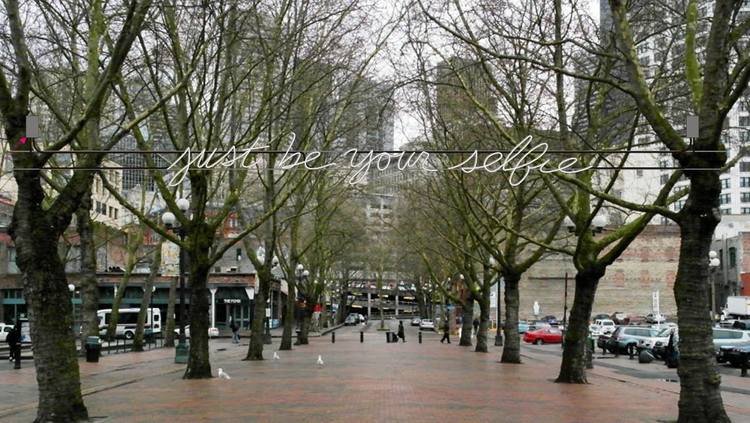
Just Be Your Selfie in Occidental Park, Seattle by Dylan Neuwirth
I am pleased to announce a new large-scale public work coming to Seattle in late May and on display in Occidental Park from June to September, 2014 as a part of ArtSparks.
“JUST BE YOUR SELFIE” is a monumental neon status update rendered in cursive.
Designed to initiate personal and shared, web-based experiences; this social sculpture is an iconic contemporary work of real-time internet art embedded into an urban environment. Not necessarily a solid structure, or a pure concept; this slippery expression bridges the gap between existing in both the analog and digital realities we now accept as inseparable.
The work will have its own Instagram account, associated hashtags, and is intended to take on a life of its own.
Up first: A gong hanging under a U-shaped bike rack that acts as an impromptu musical instrument. “I ride my bike around the city a lot, so I’m always using bike racks,” Zisiadis says. “There’s just this very funny space underneath them, empty and unutilized. It was an opportunity for micro-interaction: The things that we do every single day, all the time, are the largest opportunity for positively affecting people’s lives.”
The sport of Parkour is usually focused on finding your own path in non-planned environments. But having a space designated specifically for exploration is great for both beginners and veterans alike to practice seeing routes and trying new skills.
Traceurs and play advocates all over the world have been trying to start up parkour parks in various cities, so this is really exciting to see another one finally come to fruition after the hard work of local citizens. Well done!
Switzerland finally got their first Parkour park. The past 2 years the team “Parkour Luzern” was planning so hard to realize this project and finally Joel helped them to design and build the park. Jesse, Guilaume and Joel went there for training and now we are proud to put out the first video from this awesome location.
A great article about how building playful spaces leads to more, and better, play.
Can playgrounds make kids smarter? Yes, say the experts, and landscape architects everywhere are responding. Welcome to outdoor play’s new reality.
All work and no play makes jack a dull boy. Granted, Jack does not lack for innovative toys and gadgets. But what Jack really needs is better playgrounds. These days, reality is exchanged for a simulation of reality, and the sandbox is abandoned in pursuit of the virtual. Cognitive scientists, however, are finding that the unstructured activity children engage in at the playground fosters the social and intellectual abilities they need to succeed in life. Monkey bars and swing sets present opportunities to develop new skills, encourage autonomous thinking and promote flexible problem solving – but they also shape the brain. This is good news. With technology taking over so much of our lives, increased pressure on children to compete academically at a much younger age, and helicopter parenting restricting play for fear of potential danger, many experts – such as David Elkind, psychologist and author of The Hurried Child – are drawing attention to the “reinvention of childhood.” It is time we also reinvent the playground.




 Mental Flowers