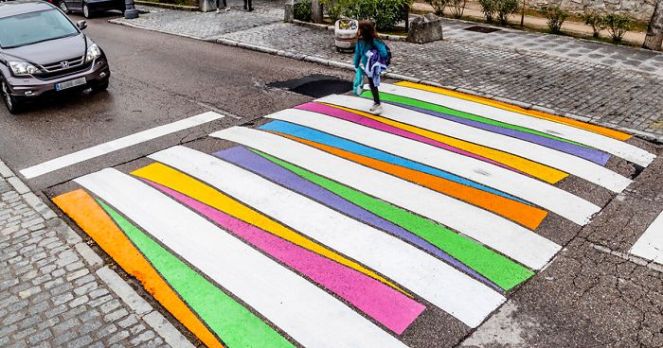
Too often cars ignore crosswalks, causing dangerous environments for walkers and bikers. Painted crosswalks have been found to increase safety AND add aesthetics to a normally fairly mundane part of the urban landscape. It can help add identifiers to neighborhoods and help promote the neighborhood’s culture.
Bulgarian artist Christo Guelov is turning crossings in Madrid into colorful pieces of art as part of his project called Funnycross. Using striking colors and geometric designs, Guelov breathes life into otherwise stale public installations. “Funnycross uses zebra crossings to intervene in the urban landscape,” writes the artist. “The metaphor “A bridge between two shores” is the starting point of this artistic intervention.”
I have read stories about some of these popping up in Seattle and Portland, so it is good to see these painted crosswalks are being implemented in lots of places, including Madrid.
According to blogger Hansi Johnson, it used to mean someone who likes going outdoors. But now, Hansi argues, the outdoors have become elitist to the point of making it seem inaccessible to most.
I’ve observed how the outdoor industry and the media have portrayed getting outside for nearly my entire life, and what used to be a very “volkssport,” inclusive, hippy-like identity has transformed into a super-elitist and entitled one. The destinations presented in the media are generally so unattainable by most people that they might as well be on the moon–and don’t even bother going if you’re not wearing expensive, high-tech apparel and using modern, high-priced gear.
Why does this matter? Because the majority of people in both the developed and developing world already feel like they don’t have time, energy, or resources to “go outside” and get exposure to nature, whether that’s to hike, bike, or just have a picnic. Creating this illusion of exclusivity is bad for everyone. Feeling like you don’t belong – of all places – in NATURE is frankly inhumane. Research has demonstrated over and over how our bodies and brains NEED nature and natural environments.
Get outside, hug a tree, pick a flower, fall into some snow, stomp in puddles.
A week ago I got to participate in a 7-day movement experience. Not a fitness camp or sports camp, or dance seminar or MMA workshop. Instead it was a collective gathering of 30 individuals with multiple movement backgrounds coming together to train, learn, and collaborate on understanding movement and how to push our bodies in a healthy way.
This event was designed for professional movers – dancers, fighters, clowns, capoeiristas, tree climbers, traceurs, and more. But what I took away from this experience as essentially a non-mover with a 9-5 desk job was just how accessible movement really is for all of us. How it does not have to be a scary, grueling, sweaty, or complicated thing. It does not have to break your body, but instead can heal it. Movement is innately fun and enjoyable for humans, yet somehow we have forgotten that.
This week-long workshop brought together coaches from all movement backgrounds who had all come across the same question: why wasn’t their practice fun anymore? Why did they feel constrained, injured, or simply broken? All of them had gone on different journeys but had all come to the same conclusions of using movement as joy, as exploration, as celebration, as a way to communicate with others and the world.
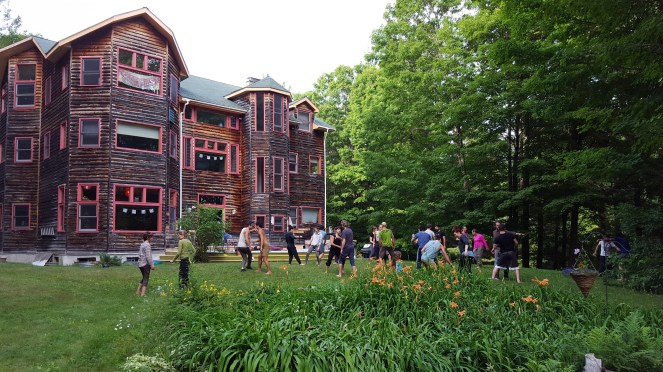
Out in the hills of western Massachusetts, near the Deer Hill State Reservation, Kelly Bitov, Aaron Cantor, and Jared Williams organized the M.O.B.I. Camp – Movement Orientation and Body Intelligence.
In addition to Aaron Cantor, the coaches there included my husband Rafe Kelley, founder of Evolve Move Play; Shira Yaziv, owner of Athletic Playground; Nuria Bowart, and Tom Weksler. That said, almost everyone there were expert movers, dancers, musicians, and players, with some movement background and area of expertise.
This was truly a bit of an expedition into the unknown for me, not just in the location but what a non-mover like me would and could do.
Single-handing it with two toddlers, car seats in tow, we flew from Seattle, through Boston Logan Airport, and thanks to a generous M.O.B.I. Camp participant carpooling us 2.5 hours west, we arrived in the peaceful quiet of Nine Mountain Retreats.
For seven days we and about 30 other people made food as a community, explored movement as a community, and slept under one roof or nearby in tents.
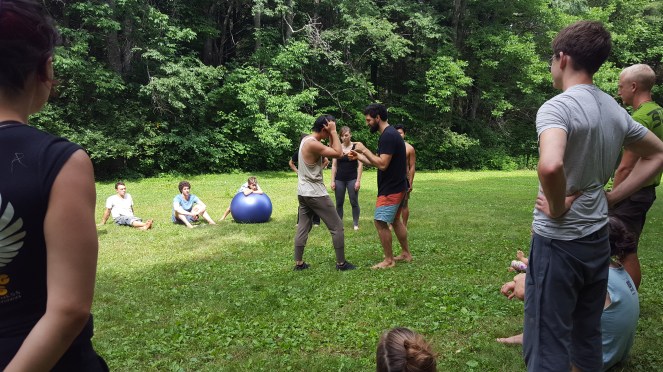
We would meet every morning at 8am on the deck and start moving, mostly outside, and basically not stop until bed. There were breaks in between workshops, but there was always some movement challenge or game to try in between class, helping with meals and clean-up, re-filling the water cooler, or in my case chasing the kids around, and chasing or carrying them up and down two flights of stairs.
The one core element that I noticed about the entire week was how every single teacher, regardless of their background or emphasis, had one underlying criteria to their movement: PLAY!
Tom Weksler and Mayumu Minakawa having fun in trees.
Each one of them had the same overarching instructions: Explore! Try this! Be open to new experiences! Don’t worry about looking wrong or silly, as long as your intention is real. We are all here doing this single practice together and trying new things together. Exploration is scary but necessary.
All of these teachers shared a similar story of evolution – they had trained deeply in one or two or more systems, and found each lacking, either missing something they craved or disallowing things for seemingly arbitrary reasons or worse breaking down their bodies and feeling worse after doing a movement practice that was supposed to make them feel better.
So often physical training and movement has been focused on goals – lift this much weight, run this fast, point your toes just so. By stripping all of that away – helped in large part by stripping away the gym or classroom and just being outside – people were invited to try new things, explore new paths, and mostly just remember that movement is supposed to be fun and enjoyable and a celebration of what our bodies can do.
For me, someone who is very goal oriented or achievement oriented, it can be hard to let go of that and just be a novice, especially when I am the “only” novice, surrounded by professional movers. There was even a time mid-week where I cried myself to sleep because I caught a glimpse of myself in a video looking totally awkward. BUT, I came back to class the next day, and for the first time I noticed other professional movers looking or feeling awkward in new types of movement they had never tried before. But they did it anyway! So I did it anyway. And we all felt better after the class for moving, for learning, and for getting outside and feeling the fresh air.
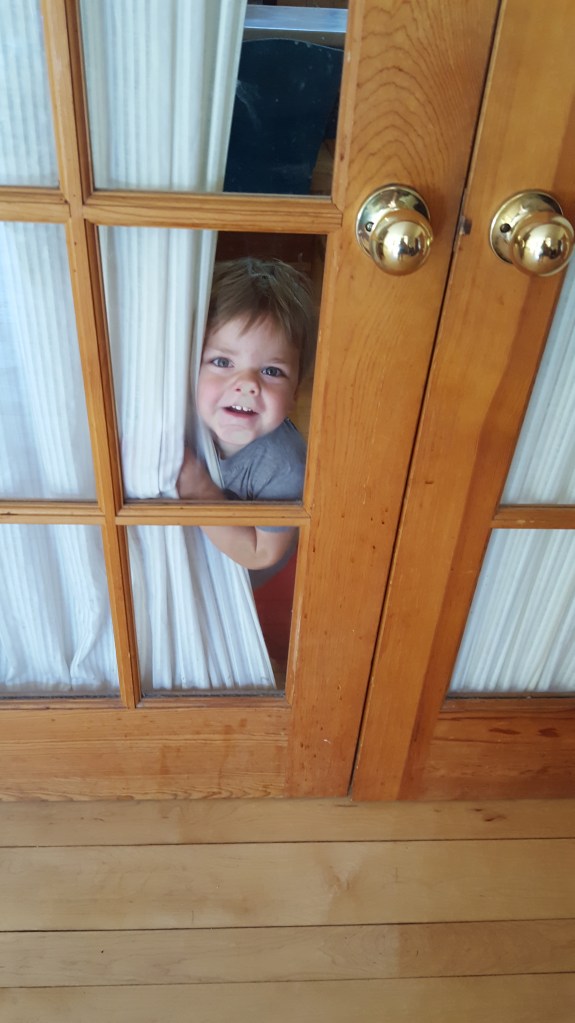
I honestly was nervous about having the kids there, as I didn’t want to interrupt the classes with my kids’ screaming and yelling and chasing balls and asking questions about trees. But in some ways their movement practice was just as genuine and valuable as what the coaches were teaching. I also heard feedback from some that having the kids there was also helpful to get out of their usual headspace and remind them to play and not take the whole process so seriously.
My 3.5-year-old daughter became an honorary member of the group, with lots of adults chatting with her and wanting to dance and play with her. She and her 1.5-year-old brother also benefited from this experience immensely; my daughter only watched a few classes, and participated even less, but just by being around all of these movers and watching the adults play both kids absorbed all of this training and movement and acceptance of physical play like sponges.
I caught them moving, jumping, dancing, and playing more than even at home; they also tried new tools like using the foam rollers and other apparatus people had brought with them, either copying what the grown-ups did or discovering other uses for them.
For me, the biggest take-away was just being accepting of where I am, not following a “system” or specific “method” but using these and thinking of these as tools. Taking what works and playing with them. Being inspired by the art of the possible, by the coaches and the students. That was the most amazing aspect of the week for me.
I sincerely hope they have another event next year. And I hope that other “non-movers” like me will give themselves a chance to go explore their own movement practices, and frankly to just go out and play and rediscover the joy of moving our bodies, no matter what silly, goofy, or wrong shape it makes.
Obviously there is a lot that goes into a “good” job – coworkers, supportive managers, and work you believe in. But there is also a surprising amount you can do within your own environment and office surroundings that will make your day-to-day grind better.
Here are a few compiled by Mashable (P.S.: Manatees are awesome!):
Beautify your work space. You personalize your home; why not personalize your desk? Make your cube or office a pleasant place to work with a few framed photos, a decorative pen holder or a tiny cactus. Image: Mashable/Vicky Leta
I was walking to work today and saw a crew cleaning up from a festival held in the square over the weekend.
One of the installations caught my eye in particular; this one focused on learning and sharing knowledge.
It encouraged people to interact with it by adding some of their own knowledge they wanted to share.
Bits of knowledge scribed on little clear plates.
There were also books to take and read. I hope the crew leaves that one up for awhile.
Almost like a Free Little Library, I would love to see designated learning/book sharing spots like this all over the city.
This is a great example of how easy it is to create playful spaces, especially temporary ones, which can in many ways add to the fun.
Also a good reminder that PARKing Day is happening in the US next week!
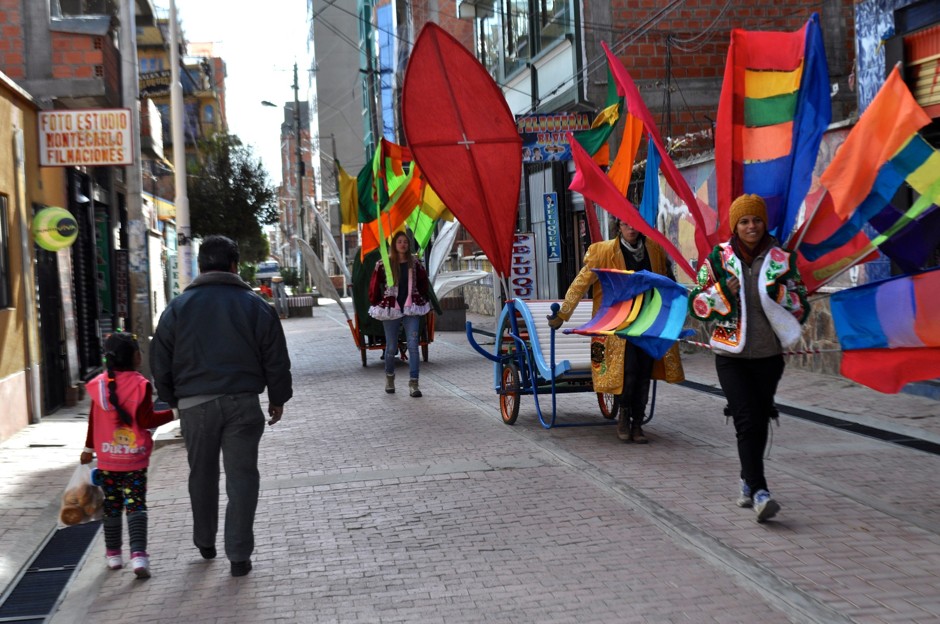
The mobile park on parade in El Alto this summer. (Megan Hoffman)
Working in the harsh sunlight, they set about disassembling the carts. The shell of the bee became a series of green mounds, while the elephant trunk revealed itself as a slide.
In a matter of minutes a playground was born, and the sounds of children playing rippled across the plaza.
By most urban timelines, El Alto itself is a pop-up construction of sorts. The grid that spreads across the barren altiplano was a tiny informal settlement, perched above La Paz, in the early 1950s. Following its establishment as an independent municipality in 1985, its population jumped, by 54 percent from 2000 to 2010 alone. El Alto now has more than 1 million people, approximately 75 percent of whom identify as members of the indigenous Aymara people. (In Bolivia overall, 25 percent of the population is indigenous.) It has even given rise to a bold new architecture, evidence of Bolivia’s recent economic boom.
In this dense city, driven by commerce at all scales, streets, sidewalks, and communal spaces are often transformed into informal markets, where vendors and minibuses compete for real estate. While this competition brings vitality, it requires novel methods of occupying urban space for play.
The pop-up playground aims to do just that. Over three summers, the International Design Clinic (IDC), a “guerrilla design” collective, has collaborated with Teatro Trono to design and build a pair of mutable, movable playspaces that will help the organization expand its activism into El Alto’s public space. The areas currently designated for children in El Alto are scant and often ill-maintained.
Headed by Scott Shall, an architecture professor at Lawrence Technological University near Detroit, the IDC works closely with groups already embedded within communities, lending its own design expertise to support what they do well. “We try to contribute to and intersect their work for a strategic moment, but we always have an exit plan,” says Shall. “We aren’t permanent, they are.”
I wanted to share a great list from full time mom/worker/author/etc. Katrina Alcorn about how to fit in some play and laughs into a busy schedule.
Whether or not laughter is the best medicine, it’s certainly a great coping technique. It may not make you less busy, but it will boost your immune system, protect your heart, help you handle stress, lower your blood pressure, and improve your intake of oxygen. Also, it has zero calories, zero negative side effects, and it’s free.
Katrina also wrote a great book about her experience being Maxed Out and ways that we can all fight for more time and space to play and be balanced in our lives. It is a wonderful, fast, engaging read. Go check it out.
Fantastic! As a fellow resident of a gray and gloomy city, a little splash of surprise color can do wonders!
The grey weather was no match for a new art installation on London Bridge, which transformed the crossing into a rainbow walkway for one day only.
The project was created by Spark Your City, a global movement “dedicated to spark joy in everyday life”.
According to the group’s Facebook page, they are “travelling the world from city to city”, and London was the first major centre to get the spark makeover.
Ah summer, which in Seattle brings out swimmers, cyclists, picnickers… and pianos!
It’s music to our ears: the pianos are back. After a successful first campaign, Pianos in the Parks will be returning for a second season on July 16. The month-long program will add to additional pianos to the roster this year, totaling 22 pianos in Puget Sound-area locations. Seattle Parks and Recreation will host 11 pianos in public parks.
The program, led by Laird Norton Wealth Management, is designed to encourage the discovery of parks through music and art by placing one-of-a-kind, artist-designed upright and grand pianos in parks and public spaces across King County including Seattle, Bellevue, Kirkland, Mercer Island and Sea-Tac, for free public use and music exploration.
All 22 previously owned pianos are procured, repaired, tuned, transported and maintained by Classic Pianos; and are painted by student, alumni and faculty artists of Gage Academy of Art.
The specific parks and public spaces which will host the pianos through Aug. 16 will be announced at a public kick-off celebration from noon to 1:30pm on Thursday, July 16 at Lake Union Park (860 Terry Avenue North) near the park’s model boat pond in downtown Seattle. At the celebration, local artists who painted the pianos will unveil their works of art – followed by a musical performance in which all 22 instruments will be played by local pianists. Also participating in the event are a number of musicians, city and county officials, and program partners. Following the unveiling, the public will have an opportunity to view all 22 pianos, meet the artists and be treated to additional musical performances. – See more at: http://parkways.seattle.gov/2015/07/08/pianos-in-the-parks-encourage-park-discovery-through-music/#sthash.vq7rBMDn.dpuf
There will be a public “opening” of the pianos from noon to 1:30pm on Thursday, July 16 at Lake Union Park (860 Terry Avenue North) near the park’s model boat pond in downtown Seattle.
The pianos will welcome park-goers in their respective locations thru Aug. 16. During this time, people of all skill levels and musical persuasions are urged to enter a Pianos in the Parks video contest for a chance to perform as part of the Seattle Center’s Concerts at the Mural presented by KEXP 90.3 FM on Friday, Aug. 21. Entrants simply need to upload a video of their performance using one of the participating pianos to the Pianos in the Parks website, http://www.pianosintheparks.com beginning July 16.
Find a piano, take a picture or video of yourself with it, and share with the world!
And now, the residents of Melbourne have found a way to express it.
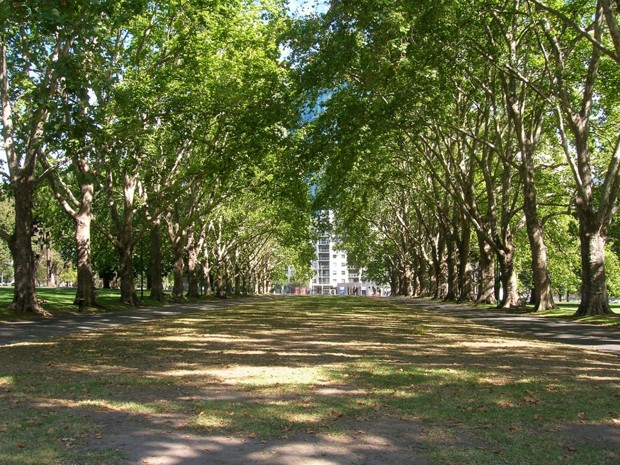
The city of Melbourne assigned trees email addresses so citizens could report problems. Instead, people wrote thousands of love letters to their favorite trees.
“My dearest Ulmus,” the message began.
“As I was leaving St. Mary’s College today I was struck, not by a branch, but by your radiant beauty. You must get these messages all the time. You’re such an attractive tree.”
This is an excerpt of a letter someone wrote to a green-leaf elm, one of thousands of messages in an ongoing correspondence between the people of Melbourne, Australia, and the city’s trees.
Officials assigned the trees ID numbers and email addresses in 2013 as part of a program designed to make it easier for citizens to report problems like dangerous branches. The “unintended but positive consequence,” as the chair of Melbourne’s Environment Portfolio, Councillor Arron Wood, put it to me in an email, was that people did more than just report issues. They also wrote directly to the trees, which have received thousands of messages—everything from banal greetings and questions about current events to love letters and existential dilemmas.
“The email interactions reveal the love Melburnians have for our trees,” Wood said. City officials shared several of the tree emails with me, but redacted the names of senders to respect their privacy.









 Mental Flowers