community · environment · happiness · health · psychology

What trees mean to communities: more than you may think | Kaid Benfield’s Blog | Switchboard, from NRDC

Tree - leaf canopy
Street view of a tree (Photo credit: blmiers2)

This is such a great commentary from Kaid Benfield’s Blog about the importance of trees for urban health and well-being that I just had to share:

…[recently] I was approached by someone from an initiative called San Diego County Trees.  The initiative is the urban forestry project of the Energy Center, and they have all sorts of information extolling the benefits of urban trees along with a crowdsourced inventory of street trees in San Diego.

I just spent time on the website, where the coolest feature is an interactive map of the whole county showing very specific tree locations and information, including quantified benefits to the region stemming (pun unintended but acknowledged) from its trees.  As you can see in the image, these include carbon sequestration, water retention, energy saved, and air pollutants reduced.

You can even click on a specific tree and get detailed information on its species, size, and annual economic benefit to the community.  San Diego County Trees invites its readers to add to the inventory with information on additional trees not presently counted.

If you’re interested in the subject of the community benefits of trees, you can get additional information from the websites of the National Arbor Day Foundation and the US Forest Service.  Among the tidbits I learned on one or the other of those two sites are these:

  • The net cooling effect of a young, healthy tree is equivalent to ten room-size air conditioners operating 20 hours a day.
  • If you plant a tree today on the west side of your home, in 5 years your energy bills should be 3 percent less. In 15 years the savings will be nearly 12 percent.
  • One acre of forest absorbs six tons of carbon dioxide and puts out four tons of oxygen.
  • A number of studies have shown that real estate agents and home buyers assign between 10 and 23 percent of the value of a residence to the trees on the property.
  • Surgery patients who could see a grove of deciduous trees recuperated faster and required less pain-killing medicine than matched patients who viewed only brick walls.
  • In one study, stands of trees reduced particulates by 9 to 13 percent, and the amount of dust reaching the ground was 27 to 42 percent less under a stand of trees than in an open area.

Several years ago, walkability guru Dan Burden wrote a detailed monograph titled 22 Benefits of Urban Street Trees.  Among other things, he calculated that “for a planting cost of $250-600 (includes first 3 years of maintenance) a single street tree returns over $90,000 of direct benefits (not including aesthetic, social and natural) in the lifetime of the tree.”  Burden cites data finding that street trees create slower and more appropriate urban traffic speeds, increase customer traffic to businesses, and obviate increments of costly drainage infrastructure.  In at least one recent study (reported after Burden’s analysis), trees were even found to be associated with reduced crime.

I think some of the most important benefits, though, are felt emotionally…

Read all of: What trees mean to communities: more than you may think | Kaid Benfield’s Blog | Switchboard, from NRDC.

I am a huge proponent of urban trees for all of the reasons stated above, as well as the emotional and psychological benefits that Benfield goes into, but also including the creative and playful benefits of having trees around to swing on, climb, watch animals in, or just sit and ponder under.

Benfield also goes into how trees are often controversial in urban environments because they drop leaves and sticks, and potentially branches, on streets and houses. But to me that is part of living connected to one’s environment, even if it means raking some leaves out of places you’d rather they not be (it’s not like the tree is intentionally dropping them on your lawn).

What are your feelings about urban trees? Have you planted a tree or shrub in your neighborhood? What did you like, or not like, about the results? Let me know in the comments below.

architecture · behavior · community · culture · design · environment · Nature

The office for people who hate offices

This is a great idea! So many people have told me how they hate being inside the office all day, especially on nice summer days like this. We NEED exposure to the outdoors and nature in order to stay productive, mentally healthy, and physically fit. Just a 20-minute walk in the woods can have the same productivity benefits as an hour-long nap.

What’s your dream office? If you fantasize about bouldering on your lunch break–and appreciate being in a zero-waste, net zero-energy environment–you might want to take a look at the soon-to-be-completed space in the slideshow above: the new Alameda, Calif. headquarters of VF Corporation‘s outdoor and action sports coalition brands, which include The North Face, Lucy, and Jansport.

Now that VF’s outdoor brands are on good financial footing (especially The North Face), the corporation is working on a headquarters–set to be completed this summer–that was built with employee wish lists in mind. It shows.Below, some of the amenities available at the new 160,000-square-foot complex (many of them suggested by an employee task force).

  • A large onsite garden that will grow things like kale, tomatoes, and basil. VF expects to grow so much that employees won’t even be able to consume all of it. Leftover will be donated to a local food bank. Employees will be encouraged to help out with the garden, but local volunteers will also pitch in. A side note: Originally, VF toyed with the idea of installing a volleyball court, but employees elected to grow a garden instead.
  • Lots of natural light. 90% of employees will have access to direct sunlight, and in many areas of the complex, the overhead lights can often be kept off. Bonus: All the windows in the complex open (this should be a given, but it isn’t always).
  • Opportunities for onsite fitness, including an indoor fitness area and yoga room, an outside training area for bootcamp, an outside bouldering space, and an outdoor gear rental and repair shop.
  • A cafe serving the vegetables grown in the garden, among other things.
  • Eventually, if employees are really lucky, the ability to kayak out into the water just outside the complex (VF would need to make sure this is feasible and legal first, but employees have been asking for it).
  • A convenient location for almost everyone. When VF first started thinking about the new complex, it “took employee addresses and mapped out where they were” to figure out an ideal spot, according to Steve Rendle, group president of VF’s Outdoor & Action Sports Americas.
  • The office space is inside out: executive offices are in the middle of the room, and other employees sit by the windows.

VF is far from the only corporation to have an environmentally and outdoors-friendly campus. New Belgium Brewing Company, for example, buys clean energy, powers itself partially with methane from an on-site water treatment plant–and it offers perks like free bicycles and volleyball.

But the idea of a company keeping employees active, innovating, and considering the environment shouldn’t be a novel one. We hope, in other words, that this becomes a trend well outside the outdoor apparel industry.

Find out more here.

The only thing I’m bummed about is that they didn’t use one of the hangars on the old Alameda Air Base, that closed down just over 12 years ago and hasn’t had much development done with it since. It would have been very “green” to recycle those old structures, but I also understand the price and space limitations. Still, very exciting overall, and I hope this trend continues with new office buildings.

children · community · education · happiness · health · learning · Social

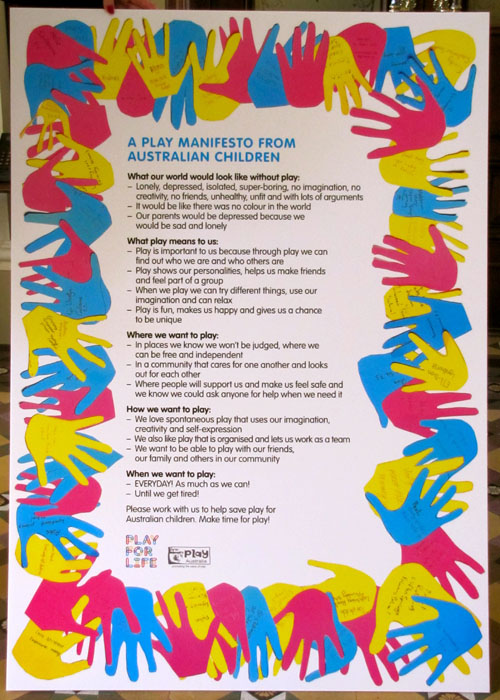
Australian Children’s Play Manifesto Poster

Play Based Learning in Australia is sharing a poster that captures the play manifesto of its children; how awesome!

After the overwhelming reaction to the success of the Australian Children’s Play Summit held in Melbourne on May 17th and 18th 2012 Play for Life Australia is kindly making available a copy of the Play Manifesto created BY Australian children FOR Australian children as a download. Play for Life believes that if we put the future of PLAY back into the hands of Australia’s children, then PLAY will be in very good hands!

Visit the original site for the full size poster.

architecture · community · environment · happiness · health

Parks Are the Foundation for New York City’s Future

Interesting initiative by New York’s Mayor Bloomberg. Nice to see his health campaign includes parks and open spaces.

Unknown's avatar

Interesting initiative by New York’s Mayor Bloomberg. Nice to see his health campaign includes parks and open spaces.

View original post

community · creativity · music · play · Social

Making a little street music

For the past four years, inspired by artist Luke Jerram, donated and painted baby grand pianos have been showing up in London during the summertime. This trend has now started to be picked up in major cities around the world, from Toronto, Canada, to Salem, Oregon.

From Now. Here. This.:

‘Play Me, I’m Yours’, an installation of street pianos created by artist Luke Jerram, is back in the capital for the fourth year. This time, in celebration of the City of London Festival’s Golden Jubilee anniversary, 50 *golden* pianos are popping up across London for three weeks until July 13. They can be found all over the city including Soho Square, St Pancras International Station and Parliament Hill – you may well hear the soft tinkling of the ivories before you see them.

From the Everett City Blog:

Pianos will be out August 1-22, 2012 for the Everett Street Tunes: An Invitation To Jam. Make music in the streets during Everett’s new interactive art project, Street Tunes! Musicians – both professional and novice – are invited to play any of the ten pianos located in downtown Everett.

Everett Street Tunes is an interactive art project, from start to finish, beginning with the commissioning of artists to paint and embellish each piano.

From the source itself, Street Pianos‘ website:

Touring internationally since 2008, “Play Me, I’m Yours” is an artwork by British artist Luke Jerram. Reaching over a two million people worldwide more than 600 pianos have now been installed in cities across the globe, from New York to Sydney, bearing the simple instruction ‘Play Me, I’m Yours’.

Located in public parks, bus shelters and train stations, outside galleries and markets and even on bridges and ferries, the pianos are available for any member of the public to play and enjoy. Who plays them and how long they remain is up to each community. Many pianos are personalised and decorated by artists or the local community. By creating a place of exchange ‘Play Me, I’m Yours’ invites the public to engage with, activate and take ownership of their urban environment.

The pianos are loaned with the understanding that they might not make it back in one piece, but so far in the past four years the most destruction to the pianos has been due to rain or other inclement weather.

Visit the website to find out more about this cool, interactive, playful art project, and locations near you.

architecture · community · design · environment · happiness · Social

This morning on Robson: Constructing an Urban Pasture

Interesting experiment happening in Vancouver, BC. Reminds me of the PARKing days that happen here in the U.S., only this one’s permanent.

Gordon Price's avatarPrice Tags

The City’s Green Team was out shovelling dirt on Robson Street:

.

“Urban Pasture” is another trial project in amenity-making, this time in the parking lane on the south side of the 1000-block Robson – just in front of the Cafe Crepe where the sidewalk narrows.  (Decades ago, the City required six-foot setbacks for any new construction, the intent being to widen the street for another traffic lane to handle vehicle growth.  That ain’t gonna happen – but the setback remains so that now the sidewalks can be widened for pedestrians.  This is one of the remaining choke points.)

Similar to Parallel Park off Main Street, Urban Pasture will provide a small seating space and landscaping.  It isn’t even finished, and already people are filling the seats.

But there are two other aspects of note:  first, this structure is in what was once the rush-hour lane, where the parking was stripped during the morning…

View original post 105 more words

anthropology · architecture · community · creativity · environment · Social · technology

Mapped out Missed Connections

I’m a very visual person, so I like to map stuff out as much as possible. It looks like some artists had the same sentiment and took it to the next level. I argue this is environmental enrichment because it takes human connections (or missed human connections) and marks them in the universe, in a fun way!
From Wired:

You know Craigslist’s Missed Connections, right? The personals page where you log a brief interaction with a stranger who you hope to see again? The posts are a candid, wistful, often hilarious look at interactions — or the lack thereof — between people in the digital age, and beg the question, “Have we become so used to interacting online that we can’t say ‘hi’ in person?”

That question, among others, inspired artists Lisa Park and Adria Navarro to take these digital love notes and turn them back into physical markers. The pair made oversize stickers based on Missed Connections posts, then affixed them at the exact spot where the missed connection occurred. They document the entire project, called I Wish I Said Hello, online, completing the loop.

To me this is kind of like marking your initials in a tree without hurting a living organism. It’s fun, it tells a story, and it helps us make connections with people; even if we never meet them in real life, we learn a little bit about who they are, how they see the world, and a moment in their lives. That helps us in turn feel more connected to our communities and large, ever-expanding tribes.

Locations also hold special meaning to people; pilgrimages to the cafe where their favorite singer performed to Mecca and everything in between. These also create small landmarks that are probably insignificant in the long run, but help orient us in the world in some way.

Have a special place or spot? Why not mark it with a ribbon or rock, or just let us know about it in the comments below.

architecture · behavior · community · creativity · environment · happiness · health · play · Social

Adults for playgrounds? Yes, please!

Playground
Grown-ups often need a little more persuasion to play than kids. (Photo credit: phalinn)

Earlier this week I brought up the importance of spaces for play in the city, and then yesterday mentioned a scientific study that used traceurs or people who practice parkour, a sport that basically makes any space into a play space. Unfortunately park playgrounds are often verboten to grown-ups without a kid companion. But often grown-ups like the play equipment, or similar play equipment, as much as kids do. Now, the cities of New York and Detroit are determining where and whether to put in playgrounds specifically for adults:

New York City is installing adult playgrounds for fitness-hungry grown-ups, touting the benefits of a grade-school workout. …the Big Apple parks are geared more toward workouts than whiling away the summer hours. There aren’t any slides or swings yet at these outdoor gyms.

The City of New York built its first adult playground in the Bronx’s Macomb Dam Park. The New York Times reports as many as 24 playplaces for grown-up kids could be installed by 2014.

In Europe, where playtime seems to be more a more capricious venture, adult playgrounds tempt grown-ups to get off the couch with detailed outdoor mazes, rock climbing walls, elephant slides and swimming canals.

Philip Lauri is the founder of Detroit Lives!, the media company with the mission of bringing creativity to the streets of Detroit (through an apparel line, murals and the “After The Factory” documentary). Detroit Lives! has recently started experimenting with making places in the city that inspire that same joie de vivre and fun — like the Georgia Street Community Collective’s remote-control racetrack for kids living in the nonprofit’s target neighborhood. He thinks adult playgrounds could be smart additions to neighborhoods who have already installed thriving community gardens.

“In those areas, we install an adult playground as an addendum to that successful effort, and use the kind of neighborhood engagement that the garden created to successfully initiate the adult playground,” Lauri wrote. “Then, both sites grow with participation and we get healthier people and neighborhoods. That’s a simplified progression, but still tangible enough to act upon quite quickly.”

Most people taking the Huffington Post poll are all for adult playgrounds.

In some ways I find it sad that we need to create playgrounds specifically for grown-ups. Don’t we teach our kids to share and cooperate? But, in many ways it makes sense: for one thing, adults are bigger and therefore need different sized equipment. They also tend to play rougher, more competitively, and less cooperatively than children (according to numerous studies I’ll find and source later), so keeping the two play groups separated is probably a safer idea. Finally, grown-ups also need to be given explicit permission to goof off, at least much more so than kids, so giving them a space devoted entirely to play will help them get creative and playful in their movement.

What kind of equipment would you want on an adult playground? Rope swings? Fireman’s pole? Leave your thoughts in the comments below?

anthropology · architecture · behavior · community · creativity · culture · design · education · learning · play

More projects on Play and the City

TED (conference)

I posted last week about Jason Sweeney and his TED City2.0 plan to map out quiet spaces in cities.

After doing some more poking around I found some other great projects all grouped under “Play in the City.”

First, I commend TED and the participants of this project for recognizing the need for play in all environments and for all ages.

Second, they have some really cool ideas to check out:

Bruno Ruganzu, 10k prize winner and the first TED Prize recipient of 2012 in Doha, Qatar at the TEDxSummit


All of these great ideas and more are captured on the Play theme page of the TED City2.0 project.

I think people often think of play as done out in the woods or on playgrounds, and often forget that cities can contain all the resources needed for play. Just look at parkour or buildering or urban mountain biking, or even yarn bombing. That said, it is absolutely crucial to allow people to play in cities and to create spaces dedicated entirely to play, as much for grown-ups as for kids.

What other projects promoting play in the city are you aware of? Let me know in the comments below.

behavior · brain · community · culture · emotion · environment · happiness · health · Social · technology

Crowdsourcing Quiet Spaces in the City

For the past month I have been staying in a surprisingly noisy apartment. The neighborhood itself is very quiet, but just my luck to be staying over a night club and all-night grocery store. After this month the importance of being able to find quiet, peaceful places in a city rings all the more true and important to me (and it’s not just the ringing in my ears). From Inhabitat:

Cities have always been bustling environments, and with more and more of us living in them it can be difficult to find a quite place to relax or contemplate. Sound Artist Jason Sweeney‘s winning proposal for the TED Imagining the City 2.0 Prize is a crowdsourcing project that seeks to locate and map the places that provide silence in the urban din. The Stereopublic Project will be a public guide for those who crave a retreat from the crowds.

Based in Melbourn’s city center, Sweeney found himself attracted to tucked-in corners, where the city’s sound fades into the background and where the built environment is experienced as a sound environment. Inspired by his own experiences, he’s looking to create a platform where others can geo-tag and share their favorite quiet space. Sweeney is interested in helping those who are sensitive to noises, with disabilities, or just seeking respite from the constant din of the streets.

The TED City 2.0 prize will help his team develop a digital tool for crowdsourcing those places, adding a new layer of awareness to the cityscape for its occupants.

Cities are large, complex environments and the project is a unique way to understand the acoustic dynamic of city life. Stereopublic is based on active users sharing their findings, but ironically, the project’s success will likely make those quiet spaces busier, further pushing inhabitants to explore new places. The idea may become a failed experiment if it becomes too successful, but it also very well might help create new venues that improve the “sonic health” of a city — adding a vital resource to urban life.

Know of a quiet place in your city? Add it to the list, or leave it in the comments below and I’ll add it for you and if it’s in the Pacific Northwest may just try it out first. You know, for research).