behavior · design · happiness

Designing for solitude

Sometimes we need to be alone. But it can be hard in an urban environment. How do we design a space to provide a quiet place to re-center ourselves, or just hear a phone call.

From IxDA, designing for solitude:

We live in a world where our ability to be connected and constantly available has changed in a remarkably short period of time, with profound effects on our behaviour. As designers, we are often asked to reflect this always-on state in the products, software and services we help to create.

Because of this, finding solitude – our ability to switch off and contemplate – is becoming more difficult. What are the affects of this on us and our relationships with each other? Is it important for our creativity to detach ourselves from the world around us? And what might the products and services we design for an off state look like?


behavior · culture · environment

Toys in the workplace

I’m a huge fan of toys in the workplace. They help me think, they can trigger creative ideas, and they make me smile. But some people consider thema distraction.
What’s your opinion of toys in your cubicle? Do they delight or distract you? Leave your thoughts in the comments.

Monkey finger puppet


behavior · community · environment

“Ag”tivism!

Promoting backyard farms, (or even large scale farms and modern-day homesteading), has a new term: "Ag"tivism. From the young and idealistic to the old and curmudgeonly, many people are finding time, space, and energy to grow their own tomatoes.

From The New Agtivist: Edith Floyd is making a Detroit urban farm, empty lot by empty lot:

Edith Floyd is the real deal. With little in the way of funding or organizational infrastructure, she runs Growing Joy Community Garden on the northeast side of Detroit. Not many folks bother to venture out to her neighborhood, but Edith has been inspiring me for years. I caught up with her on a cold, rainy November afternoon. While we talked in the dining room, her husband Henry watched their grandkids. Q. What neighborhood are we in? What is it like?

A. This is the northeast side — near the city airport. It’s surrounded by graveyards on three sides and then the other barrier is the railroad track; we are surrounded by railroad tracks, and sometimes those trains stay for like 30 minutes, so you are trapped; ain’t no way out.

Q. So you’ve seen a lot of changes.

A. Yeah, when I came it was beautiful — there were grocery stores in the center, like in the middle of the neighborhood, but … There was like 66 houses on this block, and now [there are] about six that people live in, and three need to be torn down, and the rest of it is empty. That’s where I’m putting my farm on, all the lots. [Editor's note: some are calling this practice "blotting." Here's a recent NPR story on blotting in Detroit.] …

Q. What are you growing on those lots?

A: Across the street I have my strawberry lot. I try to plant by lot. I have a collard green lot, a kale lot, an okra lot, an eggplant lot, green bean lot. I had a corn lot, but it didn’t work so well. Right now I have a garlic lot, I had a tomato lot, cucumber lot, squash, cabbage, broccoli, watermelon, cantaloupe. I like flowers, so I planted some of them. I had potatoes, mustard greens, turnip greens.

Q. That’s a lot of food!

A. Well, if it comes up it’s a lot, but I give some to the Capuchin Soup Kitchen. I sell some at Eastern Market, and Wayne State Market, but the cabbage does not sell so I don’t take cabbage there. (I still have about two of 300 pounds of cabbage I need to harvest.)

More at The New Agtivist: Edith Floyd is making a Detroit urban farm, empty lot by empty lot

NPR recently had an article about how people of my generation are also taking up organic farming with a passion:

…there’s a new surge of youthful vigor into American agriculture — at least in the corner of it devoted to organic, local food. Thousands of young people who’ve never farmed before are trying it out.

Some 250 of them gathered recently at a gorgeous estate in the Hudson River valley of New York: the Stone Barns Center for Food and Agriculture in Tarrytown.

Some of these young farmers already have their own farms. Some are apprentices, working on more established farms for a year or two. And others are still just thinking about it. But the overwhelming majority of farmers here at this conference want to farm without chemical fertilizers or pesticides.

They were there to learn skills — from seminars on soil fertility, handling sheep, and how to find affordable land — and just as importantly, to meet each other. In the evening, they played music and danced.

They represent a new breed of farmer. Very few of them grew up on farms. Most of them went to college. And now, they want to grow vegetables, or feed pigs.

More at Who Are The Young Farmers Of ‘Generation Organic’?

The biggest question interviewers often ask is "why?" Why farm? Why go "backwards" to a life of farming.
For many people, it’s economical (see an earlier blog post about young entrepreneurs making a living farming, growing eggs and herding sheep). But an even bigger driver for most is the desire to feel connected to their environment, to enrich their surroundings with greenery and healthy food.

From Grist:

Q. You haven’t always been an urban farmer. What did you do before this?

A. I worked at Detroit Public Schools. I started out with the Head Start Center and then I went to the middle school, to the Ed Tech, [which is] now the Computer Lab. I started farming because they laid me off and didn’t call me back. Farming is not making a living, it’s just keeping food in my freezer. I try to sell some so I can get some more equipment, so it will be easier for me to farm.

Q. So how much money are you making in a season?

A. I was trying to reach for 3,000, but I only made it to two something. I have to add up the last bit; I haven’t got my last check. Every year I try to up it; the first year I made 1,000. The second year I went 2,000; this year I was trying to go for $3,000.

From NPR:

"It was born out of a concern for the environment," says Brian Bates, who plans to work at a farm in northern Michigan after he graduates from Penn State. "I spent the first two years of college with one question in mind – basically, how can I have the greatest impact in my life in the world. And the thing that I kept coming back to, that everyone connected to, was food."

Others say that they simply enjoy the work, the style of agrarian life, and the connection to food.

"I feel lost when I’m not farming, when I’m not out in the field. It’s where I find the most peace and harmony in my life," says Liz Moran, who helps manage Quail Hill Farm in the eastern end of Long Island, New York.

"When I look around, and you’re amongst the plants and the sunshine – that’s my office, that’s where I want to be," said Rodger Phillips, who grows food on an urban farm in Hartford, Conn.

Others talk about the satisfaction of doing something practical, creating something valuable. "Having a skill was really important to me. Having studied political science, I wanted to do something that was productive, that was real. To have a real skill, and be able to provide my family, my community, a vital element," says Kristin Carbone, who runs Radix Farm in Upper Marlboro, Maryland.

And then there was Lindsey Shute. "How did I get into farming? Because I started dating a farmer!" she says with a laugh. [blogger's note: check out a similar story in the book "xx"]

It seems that people are looking for more control over their wallets, their lives, and what they put in their stomachs, and are doing it through farming.

I know a lot of medical and researched reasons why playing in the dirt is good for you, but I’m curious about anecdotal reasons. Leave your experiences with gardening and farming in the comments.
behavior · community · creativity · Mental · psychology

How Knitting Behind Bars Transformed Maryland Convicts – News – GOOD

Prisoners show off their knitting progress. Photo courtesy of the program.

Creating something with your hands, learning a craft, and being successful with something even as simple as crochet can have huge positive effects on people. That effect that be even more significant if you’ve been a screw-up your whole life, as many people behind bars feel they have been. This story about bringing knitting workshops to prisons is a great example, similar to the Puppies Behind Bars program or helping to raise endangered frogs, of how doing something as simple as a pearl and stitch can have huge psychologically positive impacts.

In late 2009, Lynn Zwerling stood in front of 600 male prisoners at the Pre-Release Unit in Jessup, Maryland. “Who wants to knit?” she asked the burly crowd. They looked at her like she was crazy.

Yet almost two years later, Zwerling and her associates have taught more than 100 prisoners to knit, while dozens more are on a waiting list to take her weekly class. “I have guys that have never missed one time in two years,” Zwerling says. “Some reported to us that they miss dinner to come to class.”

Zwerling, 67, retired in 2005 after 18 years of selling cars in Columbia, Maryland. She didn’t know what to do with her time, so she followed her passion and started a knitting group in her town. No one came to the first meeting, but the group quickly grew to 500 members. “I looked around the room one day and I saw a zen quality about it,” Zwerling says. “Here were people who didn’t know each other, had nothing in common, sitting together peacefully like little lambs knitting. I thought, ‘It makes me and these people feel so good. What would happen if I took knitting to a population that never experienced this before?’”

Her first thought was to bring knitting to a men’s prison, but she was turned down repeatedly. Wardens assumed the men wouldn’t be interested in a traditionally feminine hobby and worried about freely handing out knitting needles to prisoners who had been convicted of violent crimes. Five years passed before the Pre-Release Unit in Jessup accepted her, and Knitting Behind Bars was born. “I [wanted to teach] them something that I love that I really believe will make them focus and happy,” Zwerling says. “I really believe that it’s more than a craft. This has the ability to transform you.”

via How Knitting Behind Bars Transformed Maryland Convicts – News – GOOD.

behavior · community · environment · Social

The new economy is local, handmade

English: Looking northeast at Zukkie's Bike Sh...
The new economy is local. Image via Wikipedia

I read a great article in Fast Company yesterday by Bruce Nussbaum, the former assistant managing editor for Business Week and a Professor of Innovation and Design at Parsons The New School of Design, about a trend that he refers to as “indie capitalism,” this idea of a homemade economy. Homemade in many ways: products made at home and sold from there, locally focused market, and driven by small, independent entrepreneurs:

You won’t learn about it in business school, hear about it from Wall Street, or see it in Palo Alto. But if you spend time in Bushwick, Brooklyn, or on Rivington Street in Manhattan, you just might detect the outlines of an emerging “indie” capitalism. This new form of capitalism is not just about conventional startups and technology and venture capitalists. If you add up all the trends under way today, I believe we are beginning to see the start of something original, and perhaps wonderful. It may prove to be the economic and social antidote to the failed financial capitalism and crony capitalism that no longer delivers economic value in terms of jobs, income, and taxes to the people of this country.

Indie capitalism is local, not global, and cares about the community and jobs and says so right up front. Good things come from and are made locally by people you can see and know. The local focus makes indie capitalism intrinsically sustainable–energy is saved as a result of a way of life, not in an effort to reach a distinct and difficult goal.

Indie capitalism is socially, not transactionally, based. It’s not just Internet social, involving 5,000 friends, but personally social. Take Kickstarter, for example, where people fund the music, books, and products that they can watch develop over time. In this model, consumer, investor, audience, fan, helper, and producer conflate. People find and prepare their food the same way they find and prepare their music. And then they share it all.

More at 4 Reasons Why The Future Of Capitalism Is Homegrown, Small Scale, And Independent

I am really excited by this idea of a locally-sourced and locally-focused economy. I think it is better for the environment, but I also think it’s better for community building and having a better sense of place, to feel connected to where you live and what you do, and enriched by it.

Please read the entire, well-written article, and let me know your thoughts in the comments below.

behavior · children · learning · school

When the future becomes detrimentally more important than the present

I read this article in the New York Times a couple of days ago, and it really bothered me:

Since second grade, Nathaly has taken advantage of a voluntary integration program here, leaving her home in one of the city’s poorer sections before 6:30 a.m. and riding a bus over an hour to Newton, a well-to-do suburb with top-quality schools. Some nights, she has so many activities that she does not get home until 10 p.m.; often she’s up past midnight studying.

“Nathaly gets so mad if she doesn’t make the honor roll,” says Stephanie Serrata, a classmate.

Last Wednesday, Nathaly did it again, with 5 A’s and 2 B’s for the first marking period.

via Let’s Get Ready Offers Help for College Admissions – NYTimes.com.

At first I couldn’t figure out why; it was a story essentially about all the great programs that our K-12 education system has for getting help and getting ahead in school and prepping to apply for prestigious colleges. Then, when I looked closer at the lead picture of the article it hit me:

Nathaly Lopera in her Passport class, one of several programs she attends to help her get into college. Article by MICHAEL WINERIP, New York Times, Nov 20th, 2011

This 17 year old girl is yawning in her class, and it’s not from boredom or because she stayed up too late the night before chatting with her friends online. It’s because she is working so hard to get into college she isn’t getting enough sleep. Her health is suffering for a future prospect of getting into a “good” secondary education facility.

I find this idea horrible. Yes, it’s great that all these programs exist for kids to get help in applying to college and help in school. I was a tutor in high school, and I took SAT-prep courses which helped me immensely. I applaud this girl’s dedication to her education and her future. I absolutely appreciate the idea of staying up late to study for finals every once in awhile. However, constant sleep deprivation is REALLY dangerous, both in the immediate present (poorer performance, slowed reaction times) and in the future (delayed physical and mental growth). Being sleepy is just as dangerous and being drunk behind the wheel of a car.

I truly believe that this push to get kids into a “good” school, focusing on the future, is a really bad idea.

There was the uproar earlier this year about the self-described “Tiger Mom” and her pride in how hard she pushed her kids. Again, while I appreciate how much she is dedicated to her daughters’ success, there have been numerous studies that show kids do just as well without the focused drilling by their parents. An extra push every now and then, and support driving them to piano lessons or football games? Absolutely! But a parent does not need to be a drill sergeant, nor does the kid need to be literally killing themselves to get into a decent college. A documentary came out in April discussing the phenomenon, called The Race To Nowhere, which does a really nice job of capturing how a lot of this college-prep focus is about as useful as a chicken running around with their head cut off.

I understand this kind of drive starts as early as preschool in many communities, but that doesn’t mean you have to buy into it! Yes, of course I want my future children to get a good college education. Yes, I want them to receive quality primary education. But focusing so much on the future is absolutely detrimental to the health of the child and to the parent.

I would love to hear back from people who have either dropped out of this school rat race to focus more on developing and spending time with their child now, or from people who feel this kind of dedication is essential and worth the health risks.

behavior · brain · cognition · emotion

Meditation leads to less mind wandering, more doing

Meditate
Meditation helps people stay on task and reduce stress. Image by plemeljr via Flickr

Thanksgiving and the Black Friday rush are behind us, but for many it is just the beginning of a crazy month. How to destress from last week’s trials and tribulations (and sales) and stay focused on this month’s tasks, including work? Meditation:

The brains of experienced meditators appear to be fitter, more disciplined and more “on task” than do the brains of those trying out meditation for the first time. And the differences between the two groups are evident not only during meditation, when brain scans detect a pattern of better control over the wandering mind among experienced meditators, but when the mind is allowed to wander freely.

Those insights emerge from a study to be published next week in the Proceedings of the National Academy of Sciences, which looked at two groups: highly experienced meditators and meditation novices, and compared the operations of the “Default Mode Network” — a newly identified cluster of brain regions that go to work when our brains appear to be “offline.”

“I think its safe to say this is brain-training at work,” says Yale University psychiatrist Judson Brewer, who conducted the study with psychologists from Yale, the University of Oregon and Columbia University. “It makes sense,” adds Brewer. “Anything you train to do, you do better.”

In fact, some studies have found that too much daydreaming or getting off task can have negative effects:

A study that tracked the daily activities and moods of iPhone users-published in Science magazine last November–found that those whose minds were wandering off task more often were more depressed. People who suffer from attention deficit disorder also have difficulty keeping mind-wandering at bay, which may be why many studies have found that meditation helps those with attention deficit disorder.

more via This is your mind on meditation: less wandering, more doing – latimes.com.

Now truth be told, I am not that great at sitting still and clearing my mind. In fact none of us are. But, even attempting to clear one’s mind for 30 seconds at a time has been found to be truly beneficial. Just focusing on one’s breathing for two or three rounds of breathing in and out has been shown to be calming and rejuvenating.

If sitting still is not your thing, stretching, walking or running are also good ways to clear your mind, and they provided the added benefit of exercise.

Remember to breath deep this holiday season! It will improve your mood and overall ability to handle tense situations in any environment, from shopping to grandma to bad weather.

behavior · brain · emotion · happiness · mental health

How being grateful for the little things makes a big difference

The First Thanksgiving, painted by Jean Leon G...
Being thankful for the little everyday things, like just being able to eat, is better for you psychologically over the long haul. Image via Wikipedia

I received this newsletter post from financial advice blog LearnVest. It provided some interesting insight into another reason why practicing how to be grateful in itty-bitty ways (see my earlier post) is actually better for you in the long run.

Lately, I’ve been thinking a lot about gratefulness and what really makes us happy. This has been a truly happy year for me personally—the LearnVest audience has grown 310%, our company is celebrating its two-year anniversary, our team has tripled in size, and, to top it all off, I got engaged last month to the best guy I know.

All of this has reminded me of the “happiness lab” I worked at back in college, where I witnessed one psych study that changed my life:

When given the hypothetical choice between lots of big wins in a short amount of time (like all of your dreams coming true in a week) and one consistent thing they already liked, guaranteed forever (like a warm cup of coffee every morning), most people chose the big wins: a bigger house, a fancy car, a promotion, winning the lottery.

But the lab’s researchers found that the coffee-every-day-forever approach really makes people happier when push comes to shove. Why?

We say we want a bigger house, but then we have to maintain it. We say we want a promotion, but it comes with more stress and longer hours. Meanwhile, one reliable, comforting constant in our lives—like a soothing cup of coffee every day—can make us feel great. In general, the big things we strive for don’t necessarily make us happier.

This study proves scientifically what many of us have always known: Money can’t buy happiness.

This Thanksgiving, I encourage you to think about what really makes you happy. Is it writing? Taking pictures? Giving back to the community? I have a feeling you’ll find that many of the best things in your life don’t cost a thing, or are well within your reach right now.

I hope you can find the laughter and the joy in every situation. May this year and every year bring you a lot to be thankful for.

Toward a richer life,

Follow @alexavontobel

behavior · emotion · family · happiness · mental health

Steps to ease into being grateful, and how it benefits you psychologically

"The most psychologically correct holiday of the year is upon us." according to the New York Times article, A Serving of Gratitude May Save the Day.

Cultivating an “attitude of gratitude” has been linked to better health, sounder sleep, less anxiety and depression, higher long-term satisfaction with life and kinder behavior toward others, including romantic partners. A new study shows that feeling grateful makes people less likely to turn aggressive when provoked, which helps explain why so many brothers-in-law survive Thanksgiving without serious injury.

But say you’re not in the habit of giving thanks. After all, we’re only asked to officially do it once or twice a year. Well, there are some pointers in the article to get you going:

Start with “gratitude lite.” – start out with writing just five things, and maybe a sentence or two about why you’re appreciative of them.

Don’t confuse gratitude with indebtedness
– you don’t need to owe anybody anything to be grateful for them.

Try it on your family
– even if they are horribly dysfunctional, you can still be grateful they passed the peas without throwing you a dirty look.

Don’t counterattack
– okay, so maybe they did throw you a dirty look. By being grateful to them anyway, it puts individuals off guard and makes them more likely to be kinder in the future, according to some studies.

Share the feeling – … “More than other emotion, gratitude is the emotion of friendship,” Dr. McCullough says. “It is part of a psychological system that causes people to raise their estimates of how much value they hold in the eyes of another person. Gratitude is what happens when someone does something that causes you to realize that you matter more to that person than you thought you did.”

Try a gratitude visit.This exercise, recommended by Martin Seligman of the University of Pennsylvania, begins with writing a 300-word letter to someone who changed your life for the better. Be specific about what the person did and how it affected you. Deliver it in person, preferably without telling the person in advance what the visit is about. When you get there, read the whole thing slowly to your benefactor. “You will be happier and less depressed one month from now,” Dr. Seligman guarantees in his book “Flourish.”

Contemplate a higher power. Religious individuals don’t necessarily act with more gratitude in a specific situation, but thinking about religion can cause people to feel and act more gratefully, as demonstrated in experiments by Jo-Ann Tsang and colleagues at Baylor University. Other research shows that praying can increase gratitude.

Go for deep gratitude. Once you’ve learned to count your blessings, Dr. Emmons says, you can think bigger…

And if that seems too daunting, you can least tell yourself —

Hey, it could always be worse. When your relatives force you to look at photos on their phones, be thankful they no longer have access to a slide projector. When your aunt expounds on politics, rejoice inwardly that she does not hold elected office. Instead of focusing on the dry, tasteless turkey on your plate, be grateful the six-hour roasting process killed any toxic bacteria.

Happy Thanksgiving!

anthropology · behavior · community · happiness · hugs · psychology · Social

For those days you really need a hug

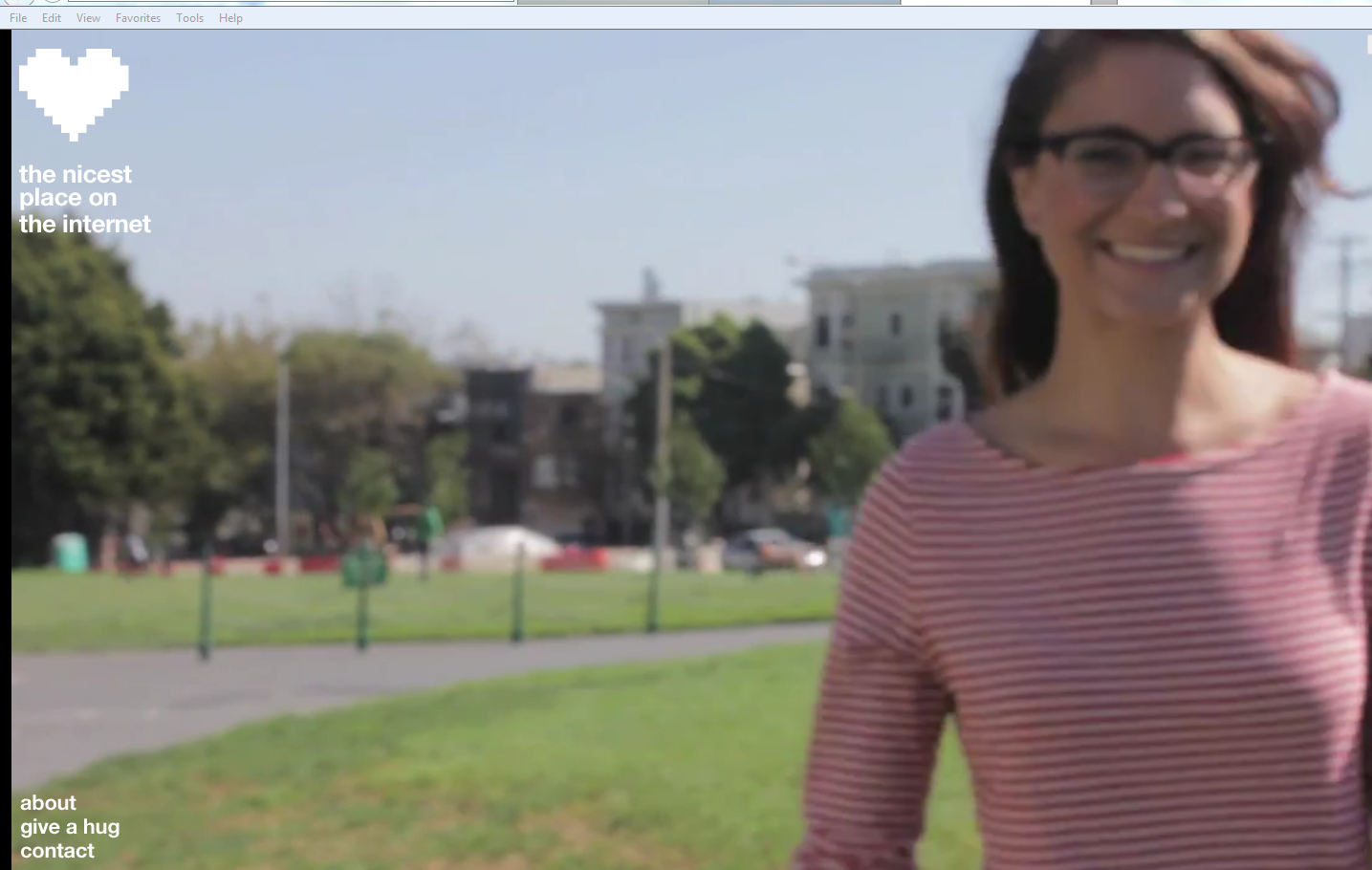
Ever have a day when you just really need a hug, like, right now? Well now you’re in luck:

"Jeff Lam and Lauren Perlow created The Nicest Place on the Internet, a place where you can feel warm and fuzzy with virtual hugs, because they were having an off day. It’s perfect for those chilly winter days."

Check out Creativity Online.

You can also go directly to the site: The Nicest Place on the Internet

You can also contribute your own hug.

I love this idea of virtual kindness; it’s a weird concept in a way, of people donating hugs (so to speak) to complete strangers. But, it’s great because it’s using the World Wide Web to create community and connections with people all over the world. Somehow, by being open to receiving a hug, even a virtual one, we are able to create connections and feel like part of a larger tribe or cohesion.

So often online communities can turn harsh or downright mean; it’s great to see online crowdsourcing being used for positive psychological benefits!