Nature · Social

PARKing Day in Seattle

Speaking of public creativity, yesterday Seattle held its third annual PARK(ing) Day demonstration. Despite the drizzly weather, several groups such as the Trust for Public Land, Piper Creek Nursery, Hazard Factory, and others* came out to raise awareness about open space and promote public space and parks.

From the website:

PARK(ing) Day is an annual, worldwide event that inspires city dwellers everywhere to transform metered parking spots into temporary parks for the public good.

It’s happening already in Australia, Japan, Korea, and for the first time ever, in China! Rebar is up bright and early for the first major PARK(ing) Day installation in Paris. And hundreds of you are preparing to please the public with your own PARKs across Europe, America and beyond.

More at parkingday.org.

Seattle held their event outside the Seattle Art Museum (SAM) downtown. One of the representatives from the Public Land Trust told me how the rotten economy has led people to hold more events outside in public places, from business picnics to yoga classes, raising awareness of all the public space Seattle has to offer and why it’s important to maintain these and add more. Hopefully people won’t forget that once the weather turns bad, or the economy turns good.

Here are some of the pictures I took at the Seattle event:

Park(ing) Day, SAM, Seattle WA 2010
PARKing Day outside the SAM, Seattle WA
Parking Day Seattle 2010 line-up
an arts+crafts table and lounge area were set up for visitors to PARKing Day
Parking Day Seattle 2010 Mark a Park
The Trust for Public Land set up a map for people to mark parks that they liked, could use a little love, or places they wanted parks.
Parking Day Seattle 2010 Bear feet
Bear feet drawn by a little girl visiting the event
PARKing Day activity, Rusty Oliver, Seattle 2010
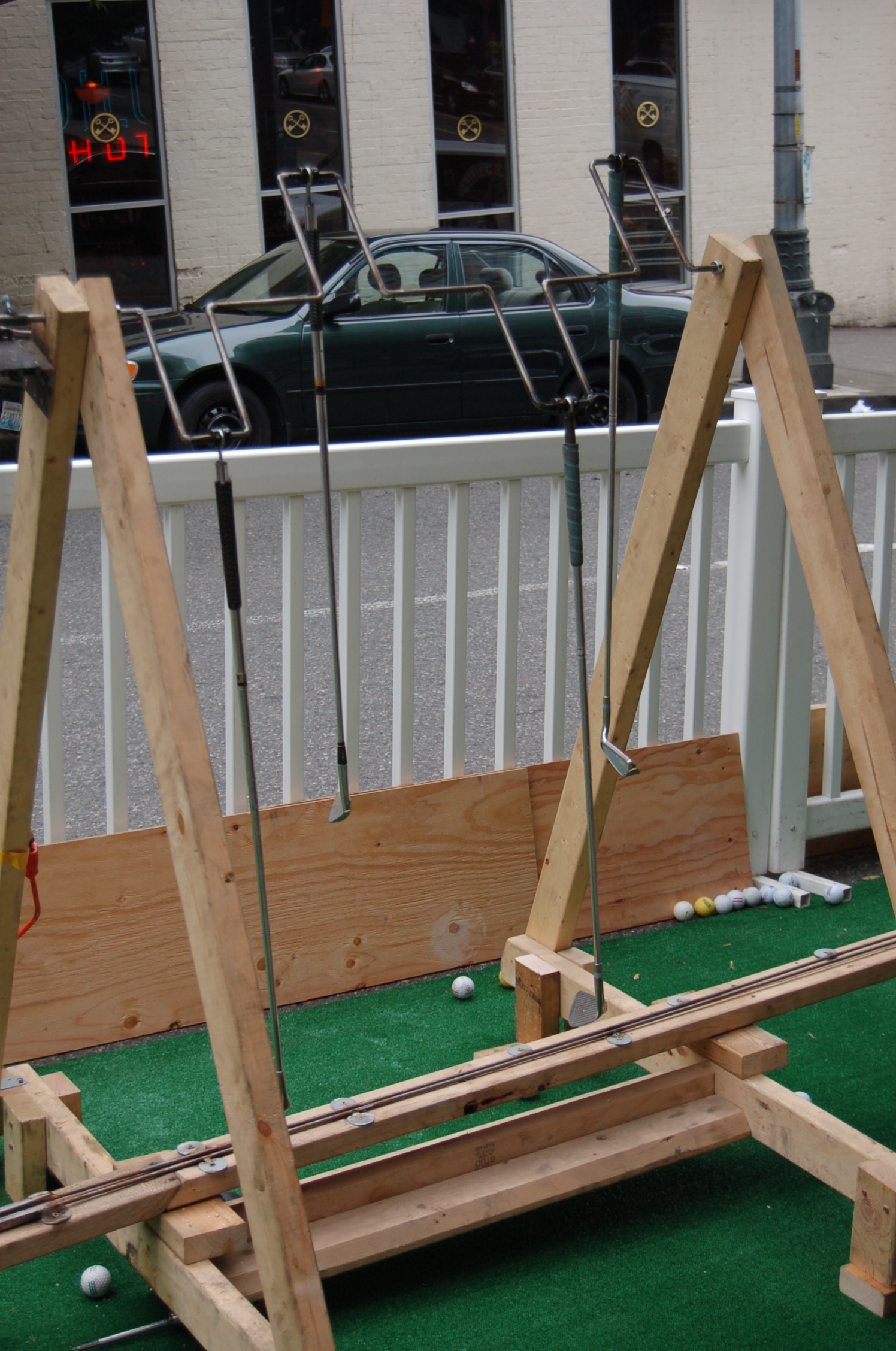
Rusty Oliver, artist behind the Hazard Factory, devoted his PARKing space to this portable mini-golf obstacle he built.

Hopefully the weather next year will be nicer and bring out more participants.

*If I missed any organizers, please leave their names in the comments and I’ll update this post. Thanks!

Nature

10 Easy Steps for Becoming a Radical Homemaker by Shannon Hayes

A small vegetable garden in May outside of Aus...
Image via Wikipedia

So often people want an easy answer about how to make their lives better, and help the environment, and in some ways it is easy, but just having a grocery list of “stuff to do to make the environment better” seems shallow and sort of missing the point. So I’m pleased that Shannon Hayes was reluctant to provide us with an easy out; From 10 Easy Steps for Becoming a Radical Homemaker by Shannon Hayes:

I didn’t see a to-do list as a viable route to a dramatic shift in thinking, beliefs, and behaviors. But since the objective of such a list was smoother discussion and communication of Radical Homemaking ideas with the public, I did it.

I came up with the simplest things I could imagine—like committing to hanging laundry out to dry, dedicating a portion of the lawn to a vegetable garden, making an effort to get to know neighbors to enable greater cooperation and reduce resource consumption.

Thank you, Shannon Hayes, for making such a list. While it may seem shallow, providing a list like this is a way for us easy-answer people to dive in and expand from there.

read the 10 Easy Steps for Becoming a Radical Homemaker by Shannon Hayes.

Mental

Could Living in a Mentally Enriching Environment Change Your Genes?: Scientific American

For me this is one of those “well, duh!” studies, but I suppose people hadn’t previously realized just how strong the effect could be.

From the 2009 article…

“Not only does the environment an animal is reared in have marked effects on its ability to learn and remember, but also that these effects are inherited. The study suggests that we are not the mere sum of our genes: what we do can make a difference.”

read the full article at Could Living in a Mentally Enriching Environment Change Your Genes?: Scientific American.

Mental · technology

Technology Review: Blogs: Mims’s Bits: Babies Take the Wheel of Driving Robots

Who knew technology could be this cute? Actually, lots of people, but I digress…

A team from Ithaca College has developed a way for babies with physical disabilities to get around and learn about their environment. It’s a motorized wheelchair, but instead of using a joystick, which is too complicated for little baby hands, all the baby has to do is rrrreeeaaccchh….. and the chair will move in that direction.

Brilliant!

It uses a Wii fit board. Read more…

via Technology Review: Blogs: Mims’s Bits: Babies Take the Wheel of Driving Robots.

community · environment · psychology

Communities and Brains

This was interesting article about how living in larger households, or in this specific study living as a couple versus living separately after a divorce, consumes less resources overall and is better for the environment. Communes for the environment!

Speaking of groups, I found this an interesting use of group loyalty and playing with America’s usual perceptions of two supposedly polar opposite institutions, or just a cheap way for the military to get some publicity: Miss Utah, who is also an active member of the military, will be competing for the title of Miss America. What’s interesting is the military is actually paying for her training and travel to the competition.

On to brains.

One study has found that a high fever ( > 100.4) reduces symptoms of autism in children. Apparently the fever connects or stimulates nerve cells in the child’s brain. I’m curious why they only studied children (2-18) and not grown-ups. Perhaps because grown-ups don’t go to the hospital when they have a high fever.

And finally, 5-year-old chimps have better short term memories than college students, according to one study series done by researchers at Kyoto University. What was amazing to me was that the chimps were memorizing things in less than 3/10 of a second sometimes. That seems a) impossible for a human brain, and b) an adaptation to living in a setting of constant potential predation (baby chimps are tasty!). However, and even the researchers admit this, the real test would be to see how the young chimps fare against human kids.